
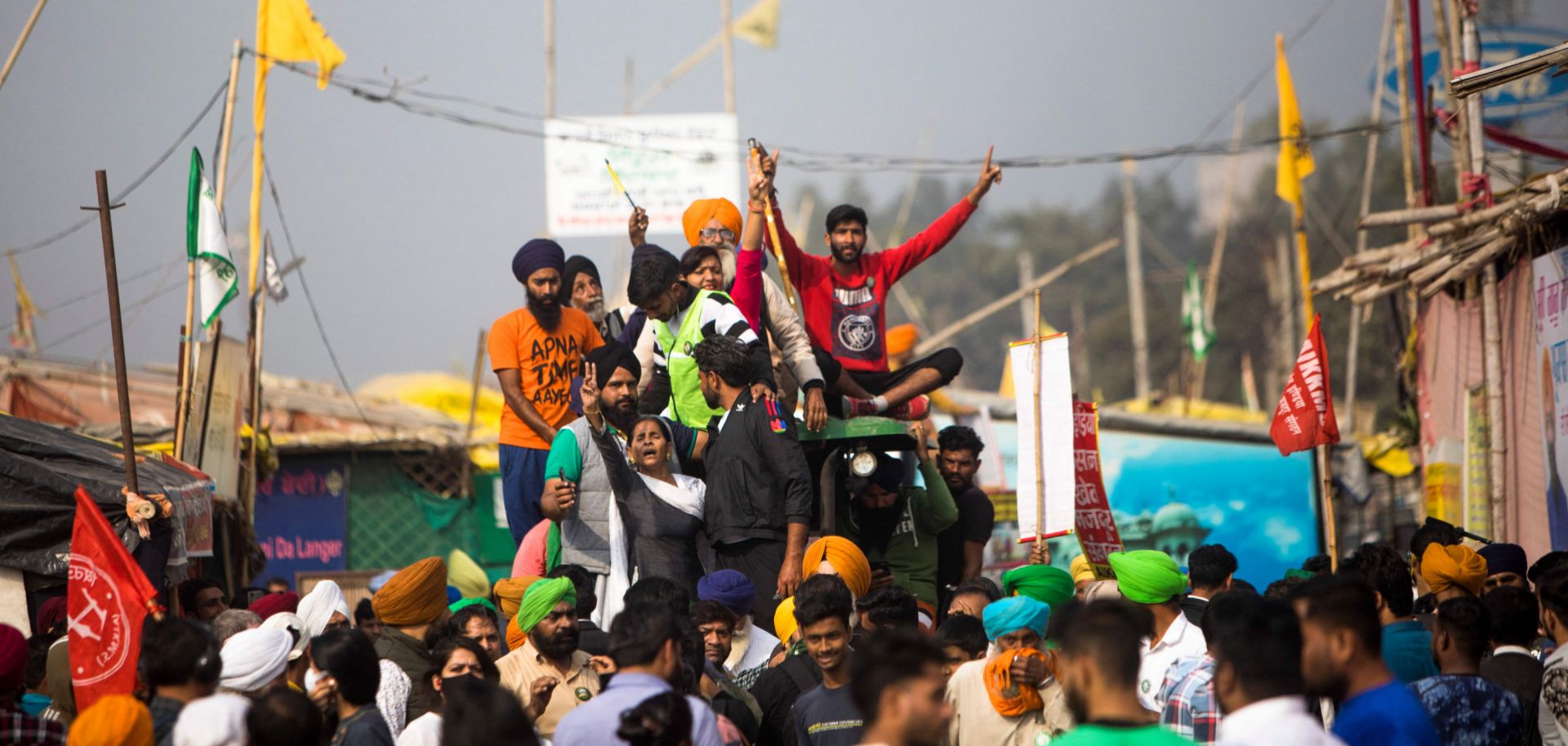
Farmers in India celebrate on Nov. 19, 2021, after the government announced it was repealing the controversial agricultural reforms that sparked nearly a year of protests in the country.
The Indian government’s move to repeal controversial farm laws may help Prime Minister Narendra Modi’s ruling Bharatiya Janata Party (BJP) shore up support ahead of key state elections. But if New Delhi doesn’t propose new reforms to replace those it revoked, India’s agriculture sector will continue to deteriorate and deter foreign investment. On Nov. 19, Modi announced the farm laws that triggered nearly a year of widespread protests would be scrapped at the next parliamentary session, citing his administration’s failure to reach an agreement with farmers. By repealing the laws, the BJP is likely hoping to boost its chances of securing a majority in next year’s legislative state elections in Uttar Pradesh and Punjab, where the farmers' protest movement was concentrated.
- The repeal process will be initiated in the upcoming winter parliament session which starts on Nov. 29.
- The politically important state of Uttar Pradesh and the key agricultural state of Punjab will both hold regional elections in early 2022. The BJP already controls Uttar Pradesh’s state assembly but could gain additional seats to solidify its position ahead of 2024 general elections. In Punjab, the BJP does not hold a majority, but any increase in popularity could help the party gain ground.
With the contentious farm reforms paused, protest activity will likely also pause, or at least significantly slow. The expected increase in the intensity of the protests likely played a part in forcing a repeal of the controversial law. However, farmers will continue to demand a law guaranteeing a federally mandated minimum support price for their crops. If farmers feel their demands on this front are still not being met, it could lead to a resurgence in protests in the coming months.
- Nov. 29 will mark one-year anniversary of when the massive farmers’ protests began in India. According to various media reports published on Nov. 9, one of the main organizers behind the protest movement pledged to stage massive demonstrations on Nov. 29 in honor of the anniversary, which also coincides with the start of the winter parliamentary session.
- The Indian government often sets minimum prices for more than 20 agricultural goods for the government to purchase crops. But there is no law that protects or ensures this minimum support price.
In the long term, the revoking of the reforms risks severely hindering the Modi administration’s efforts to modernize India’s agricultural sector and attract foreign investment. Without modernization, consolidation and direct investment, India’s agricultural production will struggle in the coming decades against increasingly severe and unpredictable shifts in weather. These long-term needs and the threat of further dampening investor confidence will likely compel the Indian government to introduce a modified version of the revoked farm laws after the state assembly elections in early 2022. The new version of reforms may be watered down to make them more palatable. If the Modi administration passes legislation that protects minimum support prices for crops (thus meeting farmers’ key demand), it would give New Delhi more breathing room to reinstate the repealed farm reforms.
