
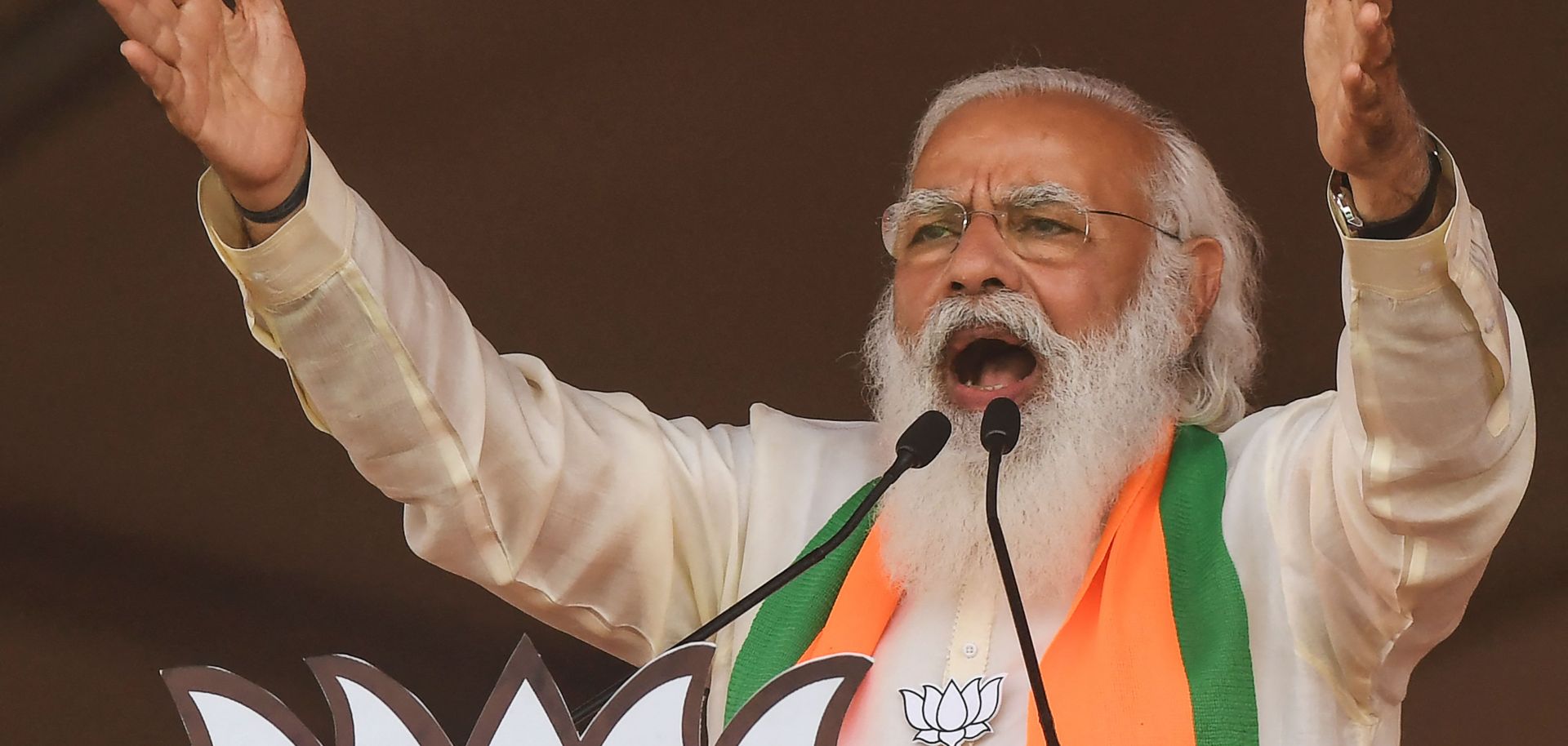
Indian Prime Minister Narendra Modi speaks at a campaign rally for his Bharatiya Janata Party in Kolkata, West Bengal, on March 7, 2021.
Upcoming state elections will test Indian Prime Minister Narendra Modi’s Bharatiya Janata Party (BJP)’s ability to expand beyond its traditional heartland, particularly in northeastern India. Electoral victories would improve Modi’s ability to effectively implement his economic and political reform policies at the local level. Five states or union territories — Assam, Kerala, Puducherry, Tamil Nadu and West Bengal — will hold legislative elections starting March 27. The east Indian state of Bihar held an election late last year. But this wave of upcoming ballots marks India’s first major state election season since the onset of both the COVID-19 pandemic and protests against India’s agricultural reforms. All of the states holding elections are outside of the Hindi heartland, the BJP’s stronghold, and are known for their powerful regional parties.
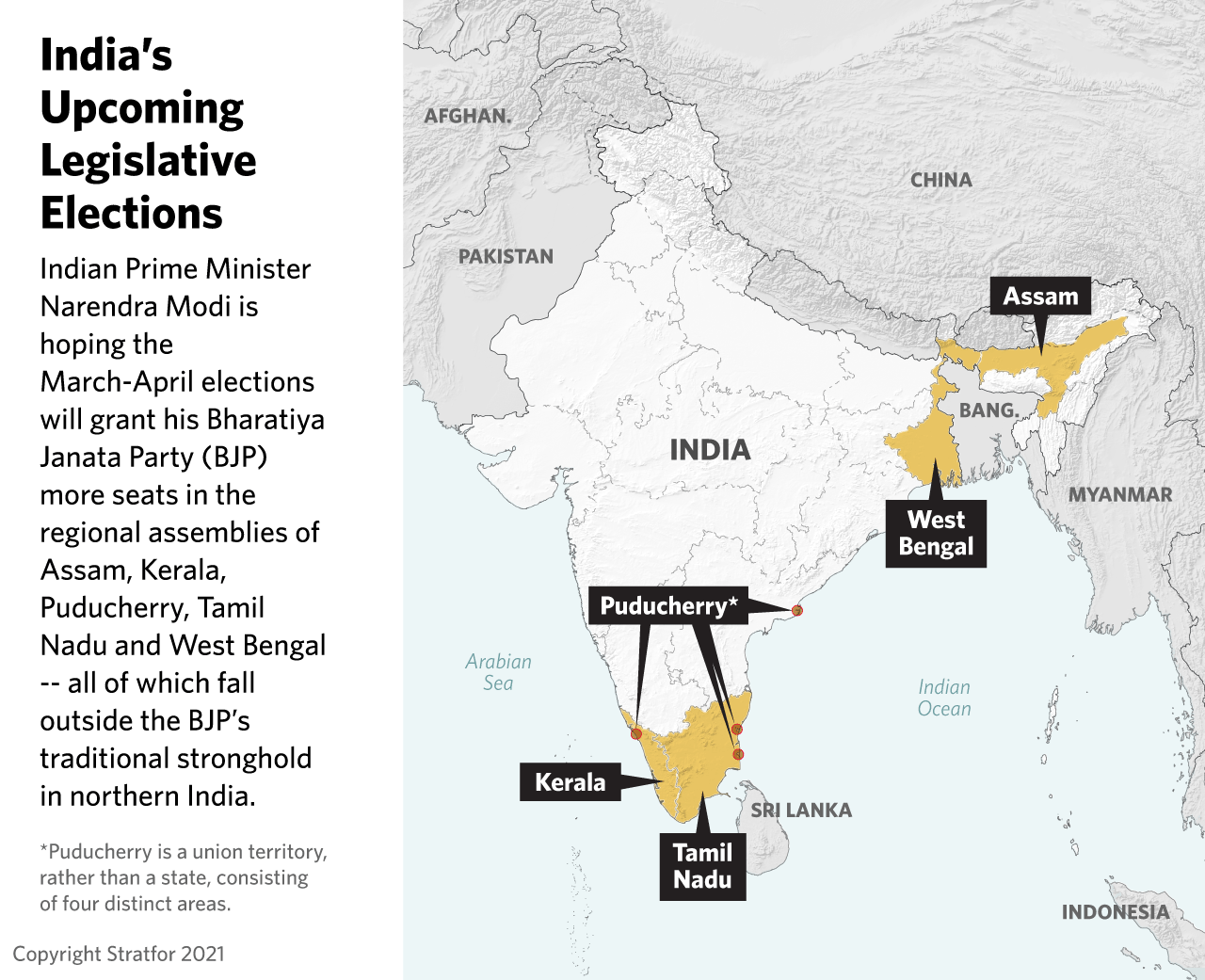
The two most important elections are the ones in Assam and West Bengal, given that the BJP is heavily focused on expanding its reach into India’s northeast. The region continues to be a growth opportunity for the ruling party as it tries to increase its national presence. Modi and the BJP are focusing intensely on the two elections and the BJP very well could end up controlling both states after the election.
- West Bengal: West Bengal, which is India’s fourth most populous state, hasn’t historically been a BJP stronghold. The regional All India Trinamool Congress (AITC) has also recently had a strong grip on the state. But in the 2019 national elections, the BJP performed well in West Bengal. A string of high-profile defections from AITC to the BJP in recent months has also opened up the possibility of the BJP taking control of the state. The AITC has attempted to undermine Modi’s party by using the BJP’s Hindutva Hindu nationalist message to paint it as an outsider challenging “Bengali pride.” The upcoming state election will thus also be, in effect, of whether the BJP has successfully branded itself as a national party despite its Hindutva principles.
- Assam: Of the five states holding elections, Assam is the only one where the BJP is already in the regional government, albeit in a coalition. In December 2019, the BJP passed its controversial Citizenship Amendment Act (CAA), which grants citizenship to non-Muslims (specifically Hindus, Sikhs, Buddhists, Jains, Parsis and Christians) who migrated to India from Pakistan, Bangladesh or Afghanistan prior to 2015. But the slow implementation of the act has since undermined the BJP’s Hindu nationalist strategy that enabled it to win Assam in 2016 state elections, breaking its rival Indian National Congress’s long-standing stranglehold on the state. The BJP’s largest hurdle in Assam will be convincing the populace that it will follow through on its promises of addressing the illegal migrant issue. The state’s proximity to bordering countries like Bhutan and Bangladesh also poses a challenge to the adequate tracking of immigrants, particularly those of Muslim origin.
The BJP has traditionally struggled to break into southern India, including in Kerala, Puducherry and Tamil Nadu. The Tamil Nadu election, in particular, will be worth watching, as the BJP has gained influence in the state through partnering with a powerful local party that is now facing a difficult re-election. The BJP has traditionally struggled to break into southern India, as its Hindutva policies do not gain as much traction as they do in the north. But the BJP has been able to make inroads in Tamil Nadu by leveraging political leaders from the neighboring state of Karnataka. The BJP has built a relationship with the state’s ruling All India Anna Dravida Munnetra Kazhagam (AIADMK), which joined Modi’s national coalition in 2019. However, Modi’s recent decision to abstain from voting on the U.N. Human Rights Council resolution against Sri Lanka for war crimes will complicate the BJP’s ability to establish a foothold in India’s southern tip, as the move falls short of the AIADMK and other Dravidian parties’ nationalist desires to protect all ethnic Tamils, regardless of their country of residence.
- On March 23, the U.N. Human Rights Council passed a resolution against Sri Lanka for war crimes committed against the Tamil ethnic group during the country’s long and violent civil war. India chose to abstain from the vote just weeks ahead of what’s expected to be a close Tamil Nadu state election, despite AIADMK calling on Modi to support the U.N. resolution.
A strong electoral performance — especially in Assam and West Bengal — would provide a clear indicator that the BJP continues to gain momentum outside of its traditional heartland, easing the implementation of national policies at the local level. On the contrary, a poor performance could weaken the BJP ahead of crucial state elections in 2022, where the party will need to defend several states. Although Modi has had some success in carrying out legislative reforms, such as the 2020 agricultural reforms. But the need to coordinate with local governments has stymied the implementation of several BJP policies, like the CAA. For Modi, building regional support is essential in building support in the upper house of India’s federal parliament, as state assemblies also nominate members to the house. The BJP’s national coalition currently lacks a majority in the upper house, which proved problematic in Modi’s attempt to pass his agricultural reforms in 2021 by forcing the BJP to ram through its approval with a controversial voice vote.
- Strong performances in state elections outside of the Hindi heartland will also give the BJP breathing room ahead of next year’s string of state elections in Punjab, Goa, Uttarakhand, Uttar Pradesh, Manipur, Himachal Pradesh and Gujarat. The BJP either directly controls or is part of a coalition government in six of those seven states holding elections. The national assembly elections in Uttar Pradesh — India’s most populous state and a cornerstone of the Hindi heartland — will be particularly important to the BJP.
- A bad electoral performance in the March-April state elections will probably not derail Modi’s current economic strategy, as the BJP’s dominance nationally remains unchallenged and a good performance in the elections would only play further into his ongoing reform strategy.
- Success in Assam would also give the BJP more confidence in pushing through some Hindu nationalist policies in northern and northeastern India, including the CAA. The citizenship amendment bill, which has been criticized as being discriminatory against Muslims, still has yet to be implemented as momentum behind it stalled out last year amid riots in the aftermath of its passage and the COVID-19 crisis. The Indian government is currently developing rules on how to actually implement the act.
