
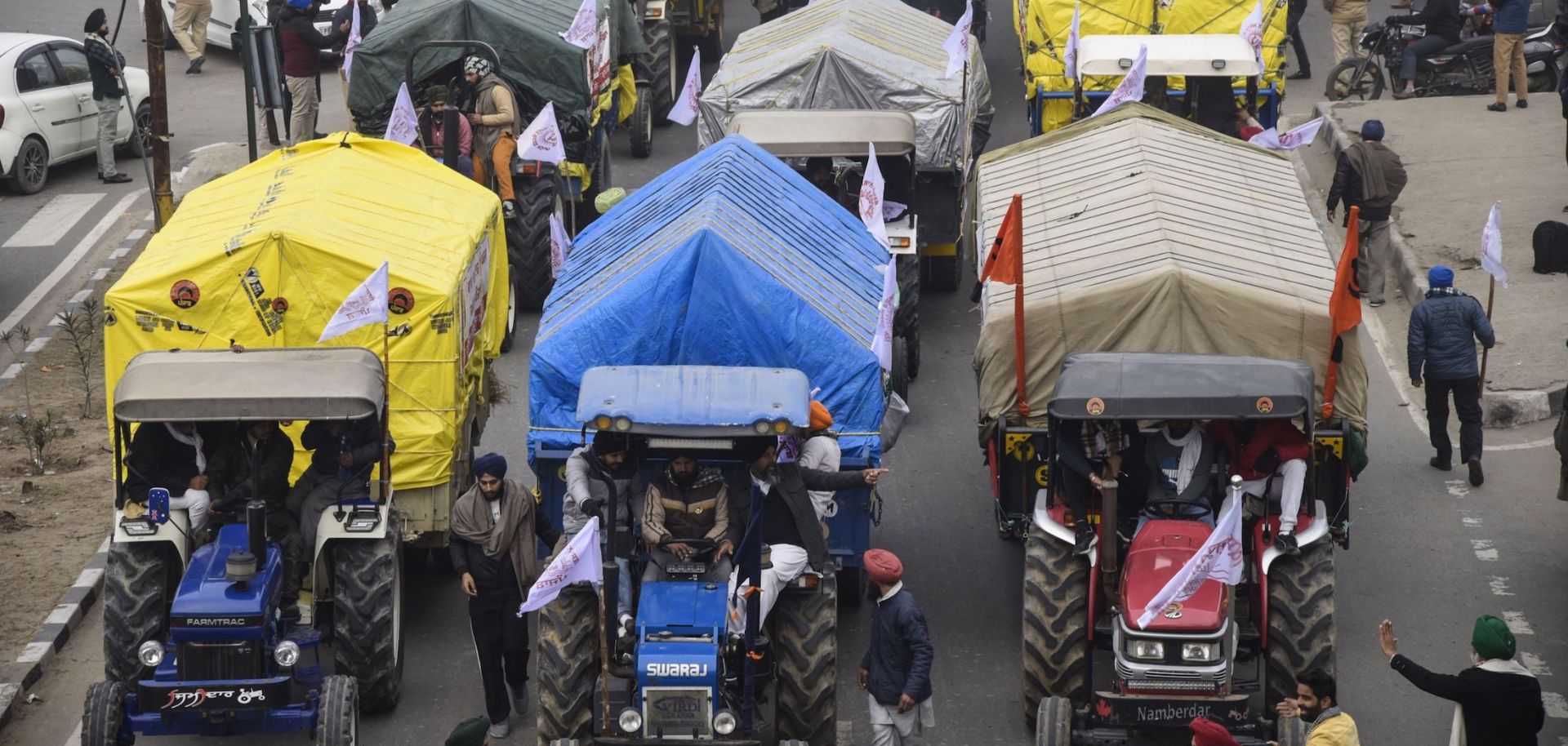
Farmers depart on their tractors to New Delhi to participate in ongoing protests against the Indian government's new agricultural reforms in Amritsar, India, on Jan. 12, 2021.
The suspension of India’s controversial new farming laws to hear protesters’ grievances will delay, but not derail, the implementation of the much-needed agricultural reforms. On Jan. 12, India’s Supreme Court indefinitely suspended the implementation of three key agricultural reforms and ordered the formation of a four-man committee to mediate the government’s disagreements with the farmers engaged in ongoing protests. Per the court order, the reforms will remain suspended until the committee is able to find a new way forward. In the meantime, however, farmers’ demands will remain unresolved, which will likely lead to continued protests and demonstrations against Prime Minister Narendra Modi and one of the key pillars of his broader reform push.
- The new committee will report back to the Supreme Court with its recommendations two months after its initial meeting, which is planned to be held within the next nine days.
- The landmark reforms, rushed through India’s parliament in September, restructure India’s agricultural sector by breaking down state-run regional markets, removing middlemen and allowing farmers to sell their products across state lines. The reforms, however, could also potentially lead to the end of the minimum support price farmers receive at state-run markets, which will become increasingly at risk of shutting down amid increased competition.
- Farmers, particularly in states surrounding the capital of New Delhi, have been protesting since September 2020, arguing that the removal of the minimum price opens them up to the risk of lower prices and forces them to rely on middlemen for their financing needs, as well as for the procurement of supplies and equipment.
The new panel is unlikely to recommend sweeping changes to the farm laws, given several members’ support for the reforms as-is and New Delhi’s need to address long-term concerns about the agricultural sector’s inefficiency and low productivity. Three of the four committee members — Ashok Gulati, Pramod Joshi and Anil Ghanwat — have all publicly backed the reforms. The fourth, Bhupinder Singh Mann, is the president of one of the unions backing the farmer protests, and has stressed the need for more measured reforms, including maintaining the minimum support price. The leaders of the protests, however, have opposed the panel’s formation, seeing it as just another government attempt to assuage their concerns without fundamentally stripping away the reforms’ key tenets. It is thus entirely possible that many of the protesters ultimately reject or boycott any resolution recommended by the panel and future negotiations.
- Ghanwat is the president of a farmers’ union that has backed the reforms. In a recent interview with The Hindu, he said there was “no need” to repeal the new agricultural laws, which he believes have “opened up opportunities for farmers.”
- Joshi is a former director for South Asia at the International Food Policy Research Institute. He co-wrote an opinion piece published by the Financial Express in December that argued “any dilution in the farm laws will constrain Indian agriculture to harness emerging global opportunities.”
- Gulati serves as the agriculture chair at the Indian Council for Research on International Economic Relations. Shortly after the agricultural reforms were passed, he wrote an opinion piece criticizing the opposition Indian National Congress party’s rejection of the new legislation.
- Mann has been one of the prominent leaders of the protests in Punjab, and has said that the new committee was “not dependable,” given that that the three other members have all extensively written about how “the [laws were] pro-farmer,” and that the protest movement thereby needed to “continue [its] agitation.”
The suspension and mediation process means the reforms are unlikely to take effect until at least after the current winter crop season and, potentially, the 2021 monsoon crop season. If proposed modifications to the legislation are limited in scope, and if the suspension is limited in duration, the delayed implementation will not have a major impact on India’s long-term agricultural competitiveness or food security. Otherwise, farmers would view the protests as a success and likely try to block future reforms, potentially resulting in India’s agricultural sector becoming less competitive and unable to meet domestic demand in the second half of the 2020s.
- The continued existence of state-run markets and price guarantees in the short-term and suspended reforms will alleviate some of the concerns that farmers have about their livelihoods being battered by both the COVID-19 crisis and the farm reforms.
- But if there is a significant rollback in the reforms or the suspension is lengthy, the farmers would view the protests as a success and likely try to block future reforms, potentially resulting in India’s agricultural sector becoming less competitive and unable to meet domestic demand in the second half of the 2020s. Such a setback in India’s agricultural sector would also impede Modi’s ability to fulfill his greater goal of shifting the country toward a more urban-based manufacturing economy.
Given that many leaders of the farmer protests are opposed to New Delhi’s mediation efforts, more demonstrations are still likely in the weeks before, and likely after, the committee makes its recommendations. If the recommendations are narrow, as expected, an elevated period of protests surrounding the announcement in places like Punjab and Delhi is likely. The protests — which have so far been concentrated in New Delhi and nearby states — could also expand in scope, as farmers from southern India begin to also take to the streets in solidarity.
