
India has not expressly targeted Malaysia with restrictions on palm oil imports it put into place in January, but the action came after Malaysia's prime minister criticized Indian policies as detrimental to Indian Muslims.
A burgeoning dispute between the world's biggest importer of edible oils and one of the world's biggest suppliers of them is heating up in Southeast Asia. On Jan. 8, India restricted imports of refined palm oil and palm olein. While the trade cuts didn't call out any specific countries, they were intended to hit Malaysia after its leader condemned the Indian government's controversial new policies as being discriminatory against Muslims. As the ruling Bharatiya Janata Party (BJP) struggles to revive India's sluggish economic growth, it will have all the more incentive to advance the religious and identity-based issues underpinning its Hindu nationalist platform. And as evidenced by its palm oil rift with Malaysia, New Delhi won’t be afraid to leverage its trade market to coerce smaller countries into silence.
The Political Motive: Protecting Modi's Message
India's palm oil rift with Malaysia hinges on Prime Minister Mahathir Mohamad's critiques of two policies enacted last year by Indian Prime Minister Narendra Modi's BJP-led government. In August, the ruling party revoked the constitutional autonomy of Indian-administered Jammu and Kashmir, India's only Muslim majority state. The 94-year old Malaysian leader sharply criticized the move during a speech to the U.N. General Assembly, saying India had unjustly "invaded and occupied" Muslim-majority territory. Mahathir's remarks triggered a monthlong import ban under the direction of the industry trade body, Solvent Extractors' Association of India. Then in December, the BJP passed the Citizenship Amendment Act, which grants citizenship to non-Muslim refugees from Afghanistan, Pakistan and India. Just days later at the Kuala Lumpur Summit in Malaysia, Mahathir condemned that action for discriminating against Muslims, saying that "people [were] dying because of this law." Shortly thereafter, the Indian government restricted imports of palm oil.
The measures that Mahathir criticized are both key pillars of the BJP's greater electoral strategy to strengthen India's territorial unity and consolidate the Hindu vote. The BJP undoubtedly knows its nationalist policies are controversial both domestically and abroad. But having increased its parliamentary majority in a landslide win during last year's elections, that's a price it is willing to pay to broaden its political influence in New Delhi. More international criticism is thus all but guaranteed as Modi's party uses its majority mandate to move more decisively on its Hindu nationalist platform.
The Economic Motive: Protecting India's Palm Oil
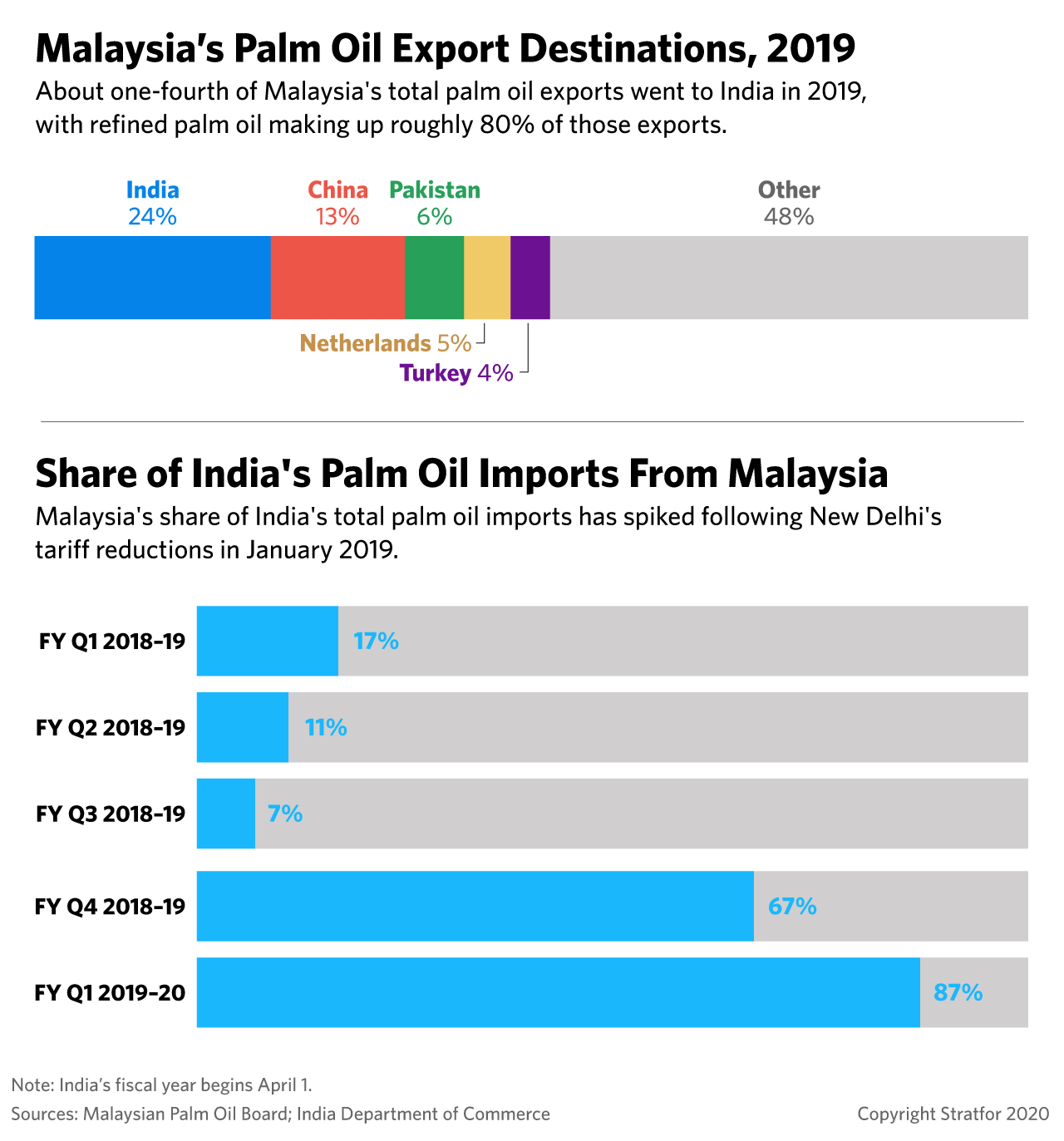
By curbing its imports of Malaysian palm oil, New Delhi is using trade as a punitive measure to silence criticism by an international partner. But the concerns of India's edible oil refiners have played an equally strong role in shaping India's decision, especially as New Delhi struggles to revive faltering growth in its $2.6 trillion economy. At suppliers' request, the Commerce Ministry reduced tariffs on Malaysian crude palm oil from 44 percent to 40 percent and on refined palm oil from 54 percent to 45 percent, at the beginning of 2019. Because the spread between the two varieties of palm oil had shrunk, Indian importers began buying more of the refined variety. The result was dramatic: Malaysia's share of India's palm oil imports skyrocketed from just 17 percent in the quarter ending in June 2018 to 87 percent during the period in 2019.
In August, a Commerce Ministry probe undertaken at the behest of the industry group found that the surge of Malaysian palm olein imports had caused "serious injury" to the industry's profits, refining operations and sales. The ministry's report cited the prolonged preferential tariff policy under India's 2011 free trade agreement with Malaysia as a factor. Convinced that the preferential tariff had harmed the domestic industry, the Indian government raised tariffs. But New Delhi's changing posture in the time since suggests it lacks a coherent strategy on the issue, which could prevent a unified response moving forward. After raising the tariff on Malaysian refined palm oil by 5 percent for six months in September, it reversed course on Jan. 1 by lowering the same tariff by the same amount — two months ahead of schedule, before announcing its wholesale restriction of the import on Jan. 8.
A Southeast Asian Trade War?
Indian Commerce Minister Piyush Goyal has since stressed that India had no plans to broaden its restrictions to other Malay imports, though that hasn't stopped fears of a looming trade war between the neighbors. In 2019, India was the top importer of Malaysian palm oil, accounting for 23 percent of Malaysia's 18 million tons of exports. In response to the recent import reduction, Teresa Kok — Malaysia's primary industries minister in charge of palm oil — said the Malaysian government would seek other markets. But Kok also acknowledged a difficult year ahead and said talks with India were ongoing.
But a rapprochement with Malaysia is unlikely to result in the removal of India's new palm oil restrictions since they aim to protect a domestic industry struggling to compete. India's domestic palm oil supply, however, still won't be enough to meet demand for the foreseeable future, meaning it will continue to rely heavily on imports (India is expected to import 10 million tons of palm oil in 2020). In lieu of Malaysia, the Indian government will likely source more crude palm oil imports from Indonesia, the world's other top palm oil supplier, in the hopes of boosting refining activity in idling factories.
Picking Fights With Smaller States
Ultimately, India's palm oil rift with Malaysia points to New Delhi's growing willingness to use its trade market as a lever to deter foreign partners from challenging its politically effective but increasingly controversial nationalist platform — and as a means of protecting Indian industries from external competition. But Malaysia isn't the only nation that has voiced concerns over India's nationalist policies, which highlights how India will only weaponize its trade market against critics when the balance of power is in its favor. For instance, members of the U.S. Congress have also criticized Modi's Kashmir policy, with President Donald Trump even offering to mediate between India and Pakistan. China, meanwhile, has twice initiated meetings at the United Nations on Kashmir as well. But India has not taken any trade actions against either country tied to their Kashmir criticisms.
In addition to being home to the world's biggest economies, the United States and China are among India's top trading partners. Malaysia, by contrast, is India's 17th biggest goods importer with a $315 billion economy that's eight times smaller than India's, making the cost of lobbing a politically incentivized trade salvo against it relatively low. Likewise, India has considered restricting steel imports from Turkey — whose gross domestic product is less than a third of India's — after its president also criticized stripping Kashmir of its autonomy during the U.N. General Assembly. India's use of trade to deflect political criticism will thus depend on which is the more powerful country in the relationship, opening the potential for similar actions against economically weaker countries that denounce New Delhi's Hindu-nationalist platform.
