
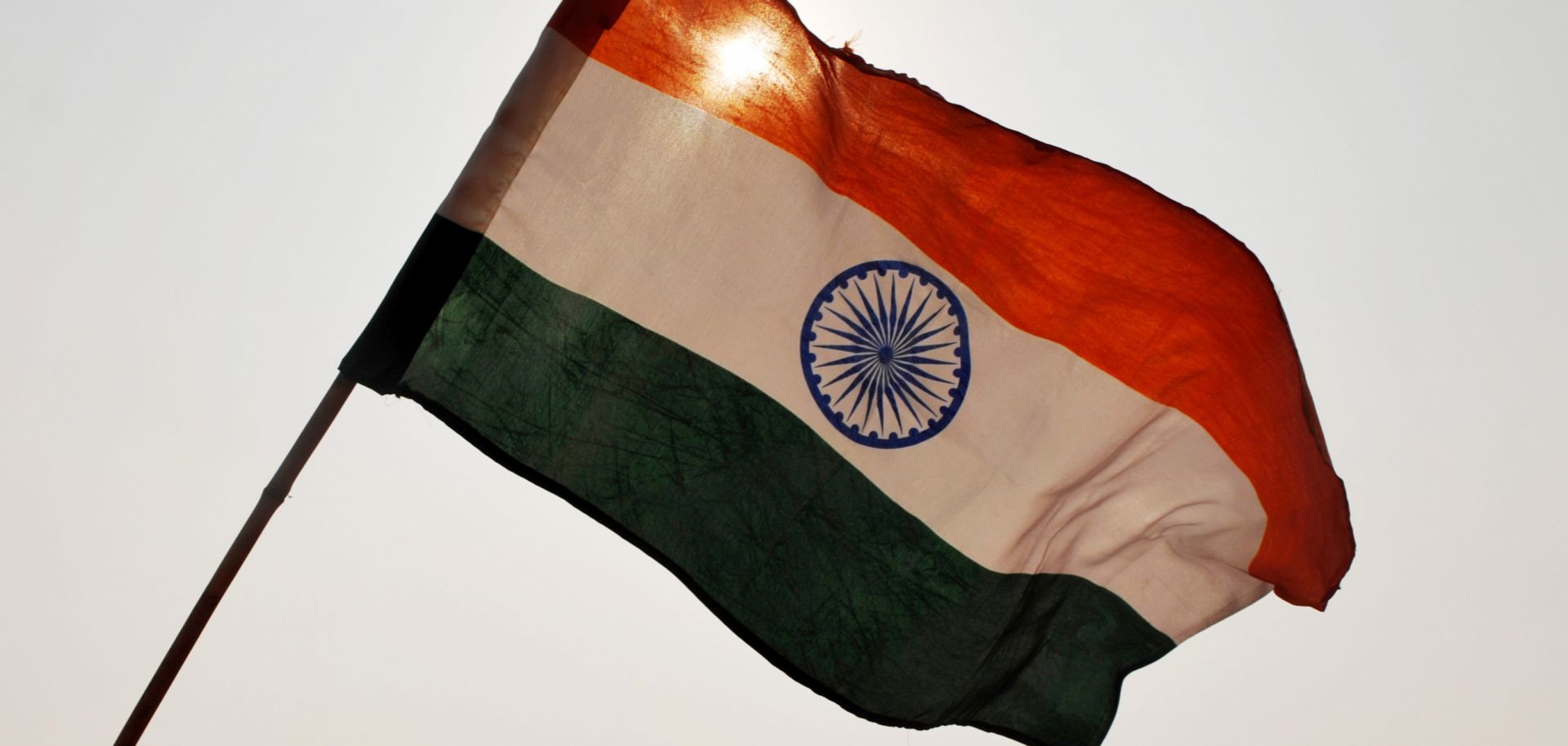
India’s national flag waves above a rally in New Delhi.
Upcoming state elections in India will be key in gauging whether opposition parties can form a united front to challenge Prime Minister Narendra Modi’s ruling Bharatiya Janata Party (BJP) on a national scale. Seven Indian states are scheduled to hold assembly elections in 2022. The northern state of Uttar Pradesh, where 80 lower house seats will be up for grabs, will be especially instrumental for any party looking to increase their presence in the lower house of India’s national parliament in the 2024 Lok Sabha elections. A landslide BJP victory in Uttar Pradesh would also increase the likelihood of the ruling party winning next year’s presidential election, which will likely be held in the summer or fall, in addition to maintaining its parliamentary majority in 2024 — further cementing the BJP’s position in India’s political sphere. But India’s 2022 elections coincide with the public perception of the Modi administration’s mismanagement of India’s second wave of COVID-19 earlier this year, which threatens his BJP’s Hindu nationalist strategy. The elections further coincide with ongoing farmers’ protests against the controversial agricultural reforms the Modi administration passed last year. Maintaining political cohesion among the Hindu population will be crucial to the BJP’s maintenance of power in 2024.
- Elections in the Indian states of Uttar Pradesh, Punjab, Goa, Manipur and Uttarakhand are scheduled for February-March 2022. The states of Himachal Pradesh and Gujarat will then hold elections between November-December 2022.
- Punjab’s government is controlled by the Indian National Congress (INC), India’s main opposition party. All other states holding elections next year have BJP-controlled governments.
- Uttar Pradesh is India’s most populous state. The state also carries the most weight in presidential elections, which are determined by state assemblies.
- With the exception of Punjab and Manipur, all states holding regional elections next year are Hindu majority states. Hindus make up roughly 95% of Himachal Pradesh’s population, followed by Gujarat (89%), Uttarakhand (83%), Uttar Pradesh (80%) and Goa (66%).
Despite momentum from the farmers’ protests and the BJP’s perceived COVID-19 mismanagement, opposition parties will find it difficult to unseat the ruling party. The BJP is expected to win the elections in Uttar Pradesh, though opposition parties — especially the Indian National Congress, India’s largest opposition party — will continue to exploit the farmers’ movement to decrease the BJP’s margin of victory. In light of this social dissatisfaction, the BJP has already started preparing for the Uttar Pradesh elections by announcing several developmental projects and inducting new ministers in the state cabinet. These actions will feed into religious and caste politics and try to appease various farmers’ groups. The INC, which is weak in Uttar Pradesh, is trying to gain influence by supporting the farmers’ protests, but it is unclear whether the movement endorses any party in the state. Additionally, past assembly election results show that no party is guaranteed consecutive wins in Uttar Pradesh. If the BJP is able to win Uttar Pradesh by a huge margin despite its obstacles, the party’s victory would further consolidate its rule in other Indian states and push fringe parties or candidates toward the BJP.
- In Uttar Pradesh’s last assembly elections in 2017, the BJP won 40% of seats, the Samajwadi Party and Bahujan Samaj Party each won 22%, and the INC won 6%.
- In July, the BJP secured a landslide victory in the Uttar Pradesh Zila (district) panchayat chairperson elections, winning 67 out of 75 seats.
- The ongoing farmers’ protests, which initially gained momentum in the states of Punjab and Haryana, are also now gaining popularity in Uttar Pradesh. In recent weeks, prominent farmers’ leader Rakesh Tikait, backed by more than 40 farmers’ unions, has helped organize a series of demonstrations in Uttar Pradesh, with participating farmers pledging to campaign against the BJP in the state.
- On Oct. 2, four protesting farmers died after a car from a BJP leader’s convoy ran over them in the Uttar Pradesh town of Lakhimpur Kheri. In the wake of the violence, leaders from the INC and various other opposition parties tried to meet the victims’ families. But they were ultimately stopped, and some were even detained without lawful justification.
Political infighting in the INC could also enable the BJP to make gains in the key agricultural state of Punjab. The internal upheaval within the INC also risks further eroding the opposition party’s ability to secure meaningful alliances with regional parties in states ahead of the 2024 national elections. The state of Punjab, where the INC is in power, will hold assembly elections in early 2022. The INC was initially projected to easily maintain its majority in the predominantly agricultural state, where the farmers’ protests are strongest. But following a series of recent political crises within the opposition party, the Punjab election is now expected to be a much closer race. On Sept. 18, Punjab’s chief minister resigned — both from his post and from INC — amid internal disputes within the party. A new chief minister was inaugurated following discussions with the state’s INC chief, Navjot Singh Sidhu. But the peace did not last long, with Sidhu announcing his resignation shortly thereafter over disagreements on appointments in the new government. The Aam Aadmi Party, which holds power in Punjab’s neighboring Delhi union territory, stands to gain the most from the INC’s weakening hold on the state. This lack of consistent INC leadership has been a major issue for India’s main opposition party, which is facing similar issues in the state of Chattisgarh. The INC’s disorganization has also led it to focus on turning states like Uttar Pradesh, Chhattisgarh and Punjab away from the BJP, instead of strengthening the INC’s alliances in states with regional opposition parties. Without internal cohesion, the INC will not be able to attract enough cooperation from these smaller opposition parties to challenge the BJP on a national level.
