
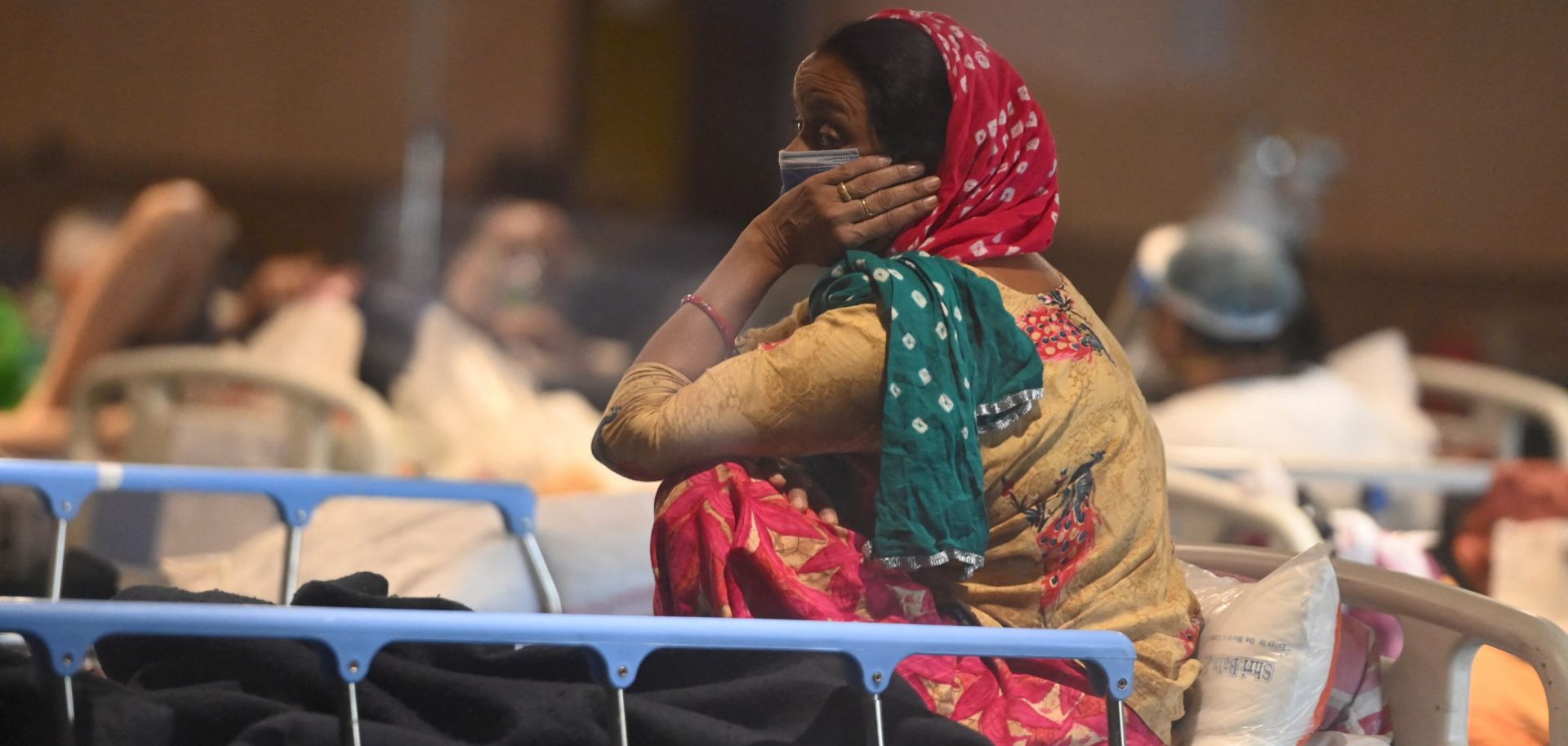
A patient rests at a banquet hall that’s been converted into a COVID-19 ward in New Delhi, India, on April 27, 2021.
India’s emergence as the world’s largest COVID-19 hotspot more than a year into the pandemic threatens to derail its recovery from last year’s deep recession, setting back development and poverty reduction efforts for years to come. The government’s desire to avoid nationwide lockdowns and severe economic effects has forced Indian Prime Minister Narendra Modi to rely instead on the problematic strategy of using vaccinations to overcome the pandemic. Growth will be positive, but downside risks to robust forecasts are materializing and an incomplete or delayed government response threatens the outlook and will affect the Modi government’s ability to pursue needed reforms and avoid political unrest.
- New COVID-19 cases are rising rapidly in India, from only about 13,000 a day at the beginning of March to an average of nearly 350,000 per day since April 22 — the highest daily figure for any country during the pandemic. This is likely an underestimate given the low level of testing outside of India’s urban areas.
- The latest wave of infections is currently confined to 10 Indian states that account for 80% of cases, but those states provide nearly two-thirds of the country’s total economic output. The virus could also spread even further amid reports of a large-scale exodus of migrant workers from many cities, including New Delhi and Mumbai, as people try to avoid possible income losses should the country re-enter a widespread lockdown.
- Only 140 million vaccine doses have been administered to India’s 1.4 billion people as of April 23, according to data from Johns Hopkins University. At the current rate of distributing less than 3 million doses per day, it will take two years to vaccinate 70-75% of the population, which is necessary to reach so-called “herd immunity” and slow the spread of the virus.
India is losing the race between vaccinations and the virus, but it was suffering a structural slowdown prior to the pandemic, which the escalating health crisis has only exacerbated. Estimates of the macroeconomic impact of the pandemic vary widely, with the depth of the recession in 2020 affecting the base from which growth is projected in 2021. High-frequency data on consumer sentiment and retail sales already point to a delayed economic rebound. In its World Economic Outlook released earlier this month, the International Monetary Fund estimated only an 8% GDP decline in 2020 and projected 12.5% growth in 2021. In contrast, the Organization for Economic Cooperation and Development (OECD) in February estimated that India’s economy shrank by 9.9% in 2020 and projected less than 8% growth this year with most of that due to base effects. Regardless of the base from which new growth is calculated, the large output and income losses of 2020 were a setback that cost India progress on growth and poverty reduction. And even with optimistic forecasts, India’s economic activity in 2021 will be barely even with 2019 levels.
Impediments India must address moving forward to regain sustainable growth include:
- A dense population with inadequate health care and spending on public health. According to the OECD, India ranks the lowest among Group of 20 (G-20) countries for health care spending as a percentage of its GDP.
- A weak financial sector with problems in the banking sector, and in particular, state-owned banks that account for 60% of bank lending. The Reserve Bank of India — the central bank — last year projected a doubling of bad loans to nearly 15% by March 2021, a projection that may now seem low given the latest virus outbreak.
- Chronically insufficient infrastructure that stunts manufacturing competitiveness and profitability to provide employment for a young, fast-growing population. Gross fixed capital formation was down by a combined 25% in 2019-2020, despite the government prioritizing public infrastructure investment in its 2021 fiscal stimulus.
- Shaky public finances that assume large increases in revenue based solely on economic growth, rather than expenditure control, in the fiscal year 2021/2022. The government’s expected revenue increases follow a fiscal deficit of 9.5% of GDP in the 2020/2021 fiscal year (ending March), with a high borrowing requirement to service a public debt to GDP ratio of about 90%.
- A large “informal” labor market with a lack of employment opportunities and declining labor force participation. The informal labor sector is estimated to make up between 80-90% of India’s workforce.
- A still burdensome regulatory and business environment. India ranks 63 out of 190 countries in the World Bank’s Ease of Doing Business Index.
- Difficulties implementing needed land and labor reforms to advance its agricultural sector. This includes the significant resistance from farmers engaged in ongoing protests against the agricultural reforms announced in September 2020.
Moving forward, India will be hard-pressed to avoid more severe economic disruptions, which will worsen both short- and long-term economic, social and political instability. Continued development and progress in reducing poverty in India depend on a high level of growth. In 2018, the World Bank projected that meeting India’s goal of having half of its population in the middle class by 2047 required annual average growth of 8% for nearly 30 years. But the last time growth exceeded that level was in 2016 and it’s been on a declining trend since 2017. In a densely populated, rapidly urbanizing country, high growth is a necessary (albeit not sufficient) condition for poverty reduction and mitigation of social unrest. The loss of the prospect of high growth amid India’s escalating COVID-19 crisis, even temporarily, will thus make it even more difficult to overcome its long litany of constraints to move up the global economic ladder.
