
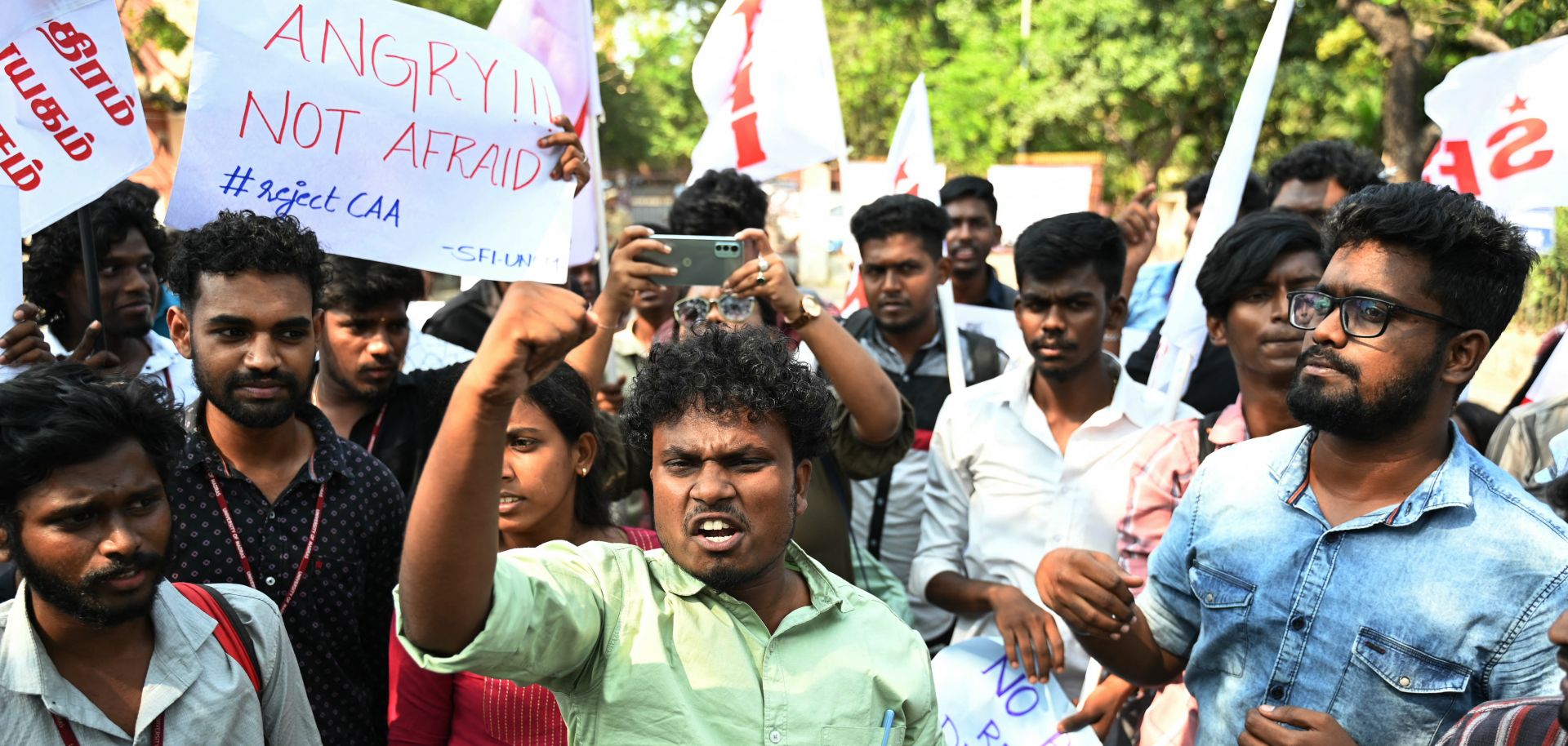
India's enactment of a controversial citizenship law will likely heighten political polarization ahead of the April-May general elections, raise concerns over religious discrimination, and trigger protests and high risks of violent clashes. Sporadic protests have broken out in various parts of India after the government on March 11 issued the rules for implementing its controversial Citizenship Amendment Act, which will streamline the process of granting citizenship to some undocumented non-Muslim migrants from Pakistan, Bangladesh and Afghanistan. The main protests took place in the southern state of Tamil Nadu, the northeastern state of Assam, and parts of the capital New Delhi. Protesters in Tamil Nadu's capital of Chennai marched and shouted their opposition to the bill, which has been criticized as being discriminatory against Muslims. Protesters in Assam also burnt copies of the law, while protests and tensions at New Delhi's Jamia Millia Islamia University triggered the deployment of security forces to the school. In addition, political parties in Assam and the southern state of Kerala, as well as various local and student groups in the northeastern states of Meghalaya and Tripura, also organized strikes and protests on March 12. Meanwhile, security forces have been bolstered and are on high alert in India's capital.
- On March 11, India's Ministry of Home Affairs issued the rules for the Citizenship Amendment Act, paving the way for the nationwide implementation of the bill. The legislation establishes an expedited route to Indian citizenship for persecuted religious minorities — namely, Hindus, Sikhs, Buddhists, Jains, Parsis and Christians who fled Afghanistan, Bangladesh, and Pakistan and entered India before 2015. Notably, the legislation excludes Muslims from these nations from eligibility for expedited citizenship, marking the first instance of religion explicitly being employed as a criterion for citizenship in Indian law.
The implementation of the contentious law comes days before the dates for India's April-May general elections are expected to be announced, and fulfills a key election promise by the governing party. The Indian Parliament first enacted the Citizenship Amendment Act (CAA) in December 2019. However, Prime Minister Narendra Modi's government did not immediately finalize the implementation guidelines for the law due to extensive protests triggered by the CAA's initial passage, coupled with delays caused by the COVID-19 pandemic. Modi's decision to enact the CAA now, ahead of general elections in April and May, thus highlights his efforts to fulfill a crucial campaign promise and garner support from his largely Hindu voter base. Modi's Bharatiya Janata Party (BJP) claims the law is intended as a humanitarian act and has refuted allegations of discrimination, arguing that its sole purpose is to grant citizenship to religious minorities fleeing persecution. However, opponents fear the CAA may be used in conjunction with a proposed National Register of Citizens (NRC) — whose data would be drawn from a national population register — which would require residents in India to prove their citizenship; critics say doing so would render Indian Muslims more vulnerable to losing their rights than groups with the protections afforded by the CAA. The law's opponents have also criticized the CAA's introduction of religion as a basis for citizenship, and claimed it is contradictory to the secular principles enshrined in the constitution.
- The passing of the CAA in 2019 sparked widespread protests across India. In Assam and other northeastern states, violent demonstrations erupted due to concerns that the citizenship law would legitimize the residency status of thousands of undocumented migrants from the predominantly Muslim nation of Bangladesh and other neighboring states. Meanwhile, protests in other parts of India centered on allegations that the CAA was discriminatory against Muslims, with demonstrators demanding equal citizenship rights for Muslim refugees and immigrants. Universities such as Aligarh Muslim University and Jamia Millia Islamia became focal points of major protests, where students accused the police of repression. The anti-CAA protests in 2019-2020 where at least dozens were killed and hundreds injured, including both protesters and law enforcement. The unrest also resulted in damage to public and private property, mass detentions, and disruptions to local internet and mobile phone services in certain areas.
- The National Register of Citizens is officially intended to document all lawful citizens of India and aid in the identification of illegal immigrants. Initially introduced in the state of Assam, the Indian government announced plans to extend its implementation nationwide, though this expansion has not yet been implemented. The possibility of its expansion has prompted concern amid statements from BJP officials, particularly Minister of Home Affairs Amit Shah, who in a May 2019 post on Twitter stated ''[F]irst we [the government] will pass the Citizenship Amendment bill and ensure that all the refugees from the neighboring nations get the [sic] Indian citizenship. After that NRC will be made and we will detect and deport every infiltrator from our motherland.'' Thus, the implementation of CAA has fueled fears about the potential implementation of the NRC, further exacerbating concerns surrounding citizenship.
The CAA's implementation will likely exacerbate political divisions and inter-communal tensions in India, fueled by accusations that Modi's government is advancing its Hindu nationalist agenda and discriminating against Muslim citizens. Critics of the CAA argue that it exemplifies Modi's promotion of a Hindu nationalist agenda, which in their opinion undermines the nation's secular principles, curtails the rights of religious minorities (particularly Muslims), and steers the country toward a Hindu-dominated statehood. Critics and Muslim advocacy groups caution that while the new citizenship law may safeguard non-Muslims excluded from the NRC, it could potentially render Muslims stateless and consequently vulnerable to deportation. Despite the support for the CAA, particularly among BJP-led states, several state leaders — notably in Tamil Nadu, Kerala and West Bengal, which hold large Muslim populations — have claimed to abstain from implementing the legislation, citing its potential to exacerbate societal divisions and deepen political polarization. However, the capacity of these states to abstain from enacting the law will encounter legal constraints emphasized in Article 246 of India's constitution, which delineates the allocation of legislative powers between the Parliament and the state legislatures, with citizenship falling within the purview of the former. While opposing states will face constraints in their resistance to the CAA, they can file petitions with the Supreme Court highlighting related grievances and alleged rights violations. This is likely to prolong disputes over the CAA, as differences between opposing parties and the BJP are expected to continue, further underscored by other contentious policies like the NRC and the Uniform Civil Code. In the short term, these political disputes along with potential social unrest may not challenge India's investment attractiveness. In the medium-to-long term, however, persistent violence and protests combined with disruptions to businesses and supply chains could lead to reputational risks and concerns related to environmental, social and governance (ESG) factors.
- Opposition parties have expressed concern that the law's enforcement could escalate political polarization in India, exacerbating existing religious and inter-communal tensions as elections approach. These concerns are magnified by the heightened anxieties among Muslims regarding potential marginalization stemming from the law, particularly alongside the proposed national register of citizens.
- Further fueling inter-communal tensions in the run-up to India's elections, the northern state of Uttarakhand in February adopted the Uniform Civil Code (UCC), legislation aimed at replacing religious personal laws with unified, secular laws governing marriage, relationships and inheritance. While some applaud the code for addressing discrimination and injustices against women, certain religious minorities and tribal communities view it as a ''Hindu Code'' that encroaches upon religious freedoms. Despite not being adopted by all states, its implementation fulfills a significant promise made by the ruling BJP and could see other BJP-led states — such as Gujarat, Rajasthan, Madhya Pradesh and Assam — follow suit.
The CAA's implementation will likely drive protests and high risks of violent clashes nationwide in the coming weeks and potentially months. Prior CAA protests from 2019-2020 in states like Assam, West Bengal, Karnataka, Uttar Pradesh and Maharashtra, as well as the National Capital Territory of Delhi, saw especially high turnout and risks of violence, indicating these areas will be at greater risk for unrest. The initial reactions to the government's March 11 announcement suggest heightened risks of protests and violence at certain universities, including New Delhi's Jamia Millia Islamia and Jawaharlal Nehru University, as well as Uttar Pradesh's Aligarh Muslim University. Besides the grievances fueled by the implementation of the contentious law, potential advancements in the creation of a National Register of Citizens — the register critics fear may be used in conjunction with the CAA to disenfranchise Indian Muslims — would likely increase protest turnout and risks of violence. Ongoing farmers' protests in northern India may also contribute to further strains on security forces in the region, potentially exacerbating personal safety threats there. Meanwhile, protests and authorities' security precautions risk travel disruptions. To prevent or limit the severity of violent unrest, authorities will likely impose localized curfews, restrictions on large gatherings, as well as internet and potentially mobile service suspensions — all of which would challenge business continuity. Such measures may not immediately limit violent and disruptive risks as well, as aggrieved protesters in India have previously defied authorities' curfews and other restrictive orders.
- Neighboring Muslim-majority countries like Bangladesh and Pakistan will likely criticize the Indian government's actions and condemn them as anti-Muslim. But India's cordial relations with Bangladesh suggest backlash from the country will be limited. Meanwhile, though India's relations with neighboring Pakistan are far more tense, Pakistan's economic, security, and domestic political challenges may limit its interest in intensifying tensions with India in the near term over the CAA.
