
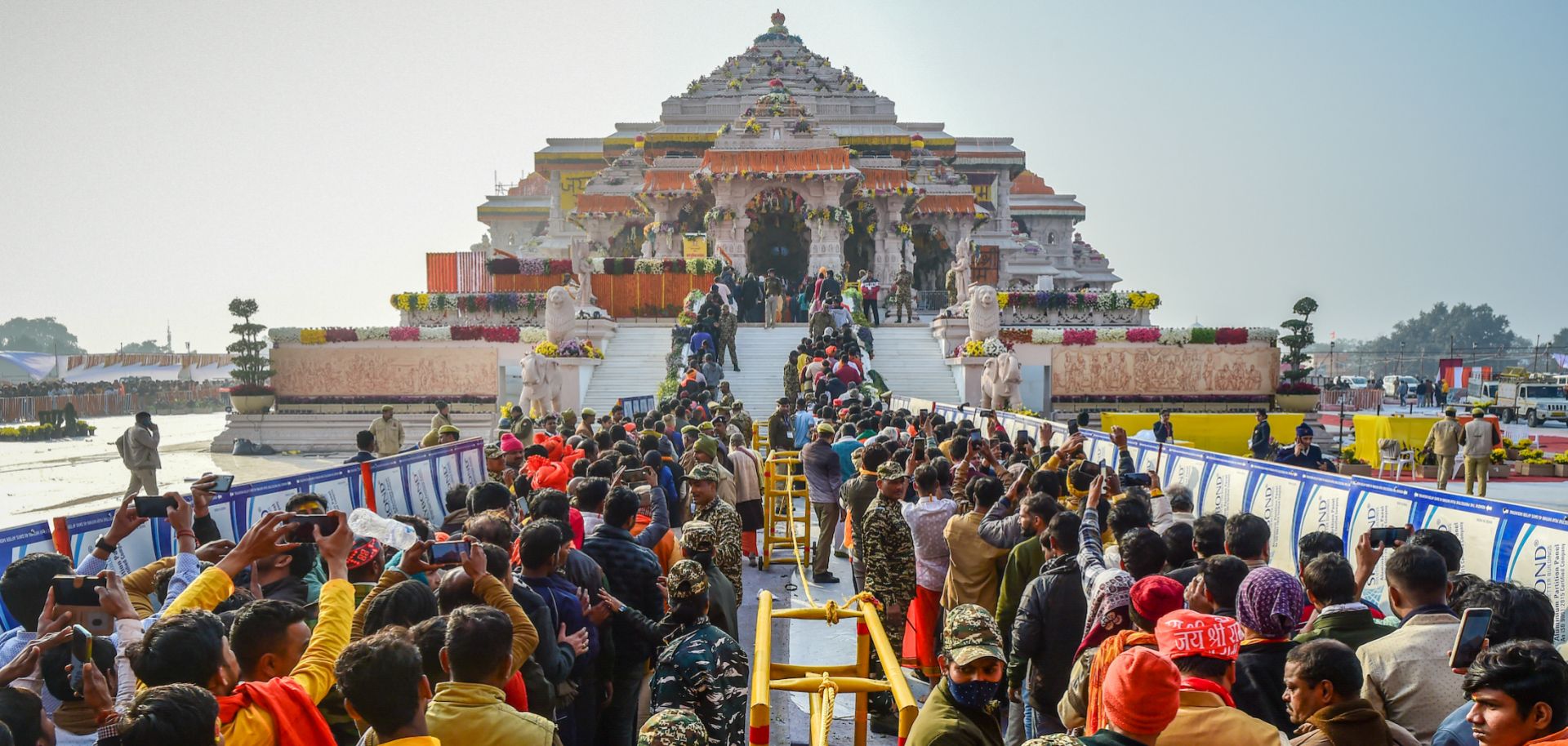
The consecration of the Ram Temple in India's holy city of Ayodhya offers Prime Minister Narendra Modi a strong start to his 2024 re-election campaign by delivering on the issue that first propelled his party to the front stage of Indian politics. On Jan. 22, Modi led the consecration of the Ram Temple in the city of Ayodhya, located in India's northern Uttar Pradesh state. The new temple is situated at a site that many Hindus believe to be the birthplace of Rama, a major Hindu deity, and was built over a demolished 16th-century mosque. Modi conducted religious rituals and unveiled the idol of Ram Lalla during the inauguration ceremony, which was attended by over 7,000 guests, including elite industrialists, politicians and movie stars. The event saw major religious celebrations across the country and within Hindu communities abroad, with numerous state governments in India declaring Jan. 22 as a day off for businesses and educational institutions. However, the opposition Indian National Congress party boycotted the ceremony and accused Modi of exploiting it to secure gains for his ruling Bharatiya Janata Party (BJP) ahead of India's April-May general elections. The BJP, in turn, has labeled the Congress an ''anti-Hindu'' party in a bid to capitalize on the controversy.
- The government orchestrated screenings of the ceremony nationwide, with numerous cities featuring the event in movie theaters. Members of the BJP distributed religious flags door-to-door, and Modi urged people to partake in the celebrations by lighting lamps in their homes and local shrines.
The consecration of the Ram Temple is a major political victory for the BJP, which had defended the cause for decades. While many Hindus consider the Ram Temple to be located at the birthplace of Ram, the site was previously occupied by the Babri Masjid, a mosque built in the 16th century. The site has thus been a source of Hindu-Muslim tensions and controversy since precolonial times, as Hindu activists claimed that the Babri Masjid was built on a Hindu temple demolished by India's then-Muslim rulers. The movement to build the Ram Temple saw fresh momentum during the 1980s, and its endorsement by the BJP propelled the previously fringe party to the front stage of Indian politics. The movement ultimately resulted in a Hindu nationalist mob destroying the Babri Masjid in December 1992, a watershed moment in Indian politics that triggered months-long intercommunal violence between Hindus and Muslims across the country. After years of legal battles between Hindu and Muslim groups, India's Supreme Court awarded full ownership of the land to a Hindu trust in 2019, while granting five acres of land at another site to build a mosque in replacement of the Babri Masjid. The ruling was a major victory for the BJP as it enabled the party to deliver on the pledges that first propelled it to the front stage of Indian politics. The Supreme Court's decision also reinforced Modi's credentials in the eyes of his voter base, given his personal involvement in the Ram Temple movement since the 1980s.
- During India's colonial era, the British administration divided the site of the Babri Masjid, allowing Muslims to pray inside the mosque and Hindus to worship outside. However, in 1949, Hindu activists placed an idol of Ram inside the mosque, leading to the permanent closure of Babri Masjid as a preemptive measure to avoid violence. The Ram Temple movement was emboldened following a 1986 ruling from Ayodhya's district court that overturned the status quo on the site. This ruling is largely perceived to have been a result of pressures from the then-ruling Congress party in a bid to shore up its appeal among Hindus following the government's passing of a controversial bill that many Indians perceived as placating conservative Muslims.
- Further reinforcing the Ram Temple movement was the BJP's Ram Rath Yatra march in 1990, which Modi played a key role in organizing. The march culminated in a failed attempt by Hindu nationalists to demolish the Babri Masjid mosque, which saw local security forces kill at least 17 Ram Temple supporters.
- Ayodhya's Muslim residents have expressed concerns about potential violence by Hindu nationalists; many have also voiced a sense of neglect stemming from the lack of progress on the court-mandated mosque in the city. The proposed Muhammed bin Abdullah mosque of Ayodhya has encountered persistent delays attributed to challenges in fundraising and initiating construction. Nevertheless, after the Ram Temple's inauguration on Jan. 22, the Indo-Islamic Cultural Foundation announced progress in the mosque project, indicating that construction would commence following the Islamic month of Ramadan in May and take three to four years to build.
The temple's inauguration signals the unofficial start of the electoral campaign for India's April-May 2024 general elections and will provide strong momentum for Modi's re-election bid. The controversy surrounding the Congress' boycott of the consecration ceremony and the country-wide religious fervor surrounding the event suggests that the opposition party's decision to skip the ceremony risks damaging its electoral prospects. While the consecration of the temple was set to enable Modi to mobilize his voter base, the Congress' boycott will strengthen narratives that the opposition party is placating minorities and enable the BJP to appeal to Hindu voters at large. In addition to capitalizing on religious sentiment, Modi's inauguration of the Ram Temple comes as part of his government's broader push to boost religious tourism within India. The temple's construction was accompanied by a significant development of infrastructure in and around Ayodhya, with estimates suggesting that the temple will ultimately attract up to 100 million tourists a year, significantly contributing to the city's economic growth. With public funding now supporting the development of dozens of Hindu pilgrimage sites across the country, the inauguration of the Ram Temple is a means for Modi to showcase his party's commitment to both Hindu nationalism and economic development, which formed the basis of the BJP's successful electoral campaigns in 2014 and 2019. The temple's consecration is thus a key element of Modi's 2024 re-election campaign, which is set to center on identity, security and the economy. While this campaign strategy will likely secure Modi another term, the BJP's focus on religious and identity issues risks heightening inter-communal tensions — and potentially violence.
- The construction of the Ram Temple was accompanied by the construction of a new airport and railway station in and near Ayodhya, as well as connecting highways, and water and power projects.
