
Editor's Note: With many significant elections occurring in 2024, RANE is publishing a series of scenario analyses focused on different outcomes of major elections occurring this year, describing how an election outcome might unfold with implications for each potential outcome. The first installment covers India's general elections. The following is a scenario analysis for European parliamentary elections, which will be held on June 9, and the third installment covers South Africa's general election, which will be held on May 29.
Opinion polls suggest the June 9 European Parliament election will see right-wing and far-right parties make significant gains across several EU countries at the expense of center-left and green parties, with potentially significant policy implications for the bloc.
In our baseline scenario, despite gains from far-right parties, center-right and center-left forces retain their majority in the European Parliament and largely reelect the current European Commission, keeping the European Union on a largely pro-European integration and environmentally ambitious pathway. With the centrist alliance likely holding only a narrow majority, the lack of cohesion typical of European Parliament alliances means this scenario could involve more uncertain outcomes for commission proposals, often requiring modification to gain opposition party support for their passage. Given a broader shift from left to right in the overall representation in parliament as well as within the majority itself, right-wing groups could play a more influential role on contentious issues in areas such as climate change, migration and the economy.
In another, somewhat less likely scenario, a right-wing coalition of liberal, conservative and nationalist members of the European Parliament (aka MEPs) emerges with a majority after the election. Still dominated by moderate forces, the coalition remains largely pro-European integration, supportive of Ukraine and critical of rule of law violations. But while it excludes overtly eurosceptic and illiberal parties from its ranks, the alliance is significantly more conservative and protectionist than the previous majority, considerably less enthusiastic about EU enlargement, and generally less supportive of climate action, especially when the last comes at the expense of economic growth, business interests or energy security.
Finally, a less likely scenario sees the balance of power in the European Parliament dramatically shift rightward, with far-right and openly eurosceptic parties entering the majority, fundamentally transforming the institution's traditionally progressive stance into one highly critical of Brussels interfering with the economic, fiscal and social affairs of member states. This also produces a significantly more conservative European Commission uninterested in picking fights with member states over democratic backsliding or in pursuing ambitious net-zero targets. Still, the unique and complex workings of the European Parliament and the European Union as a whole would somewhat mitigate the actual policy impact of a right-wing surge. In fact, the European Parliament has very limited powers compared to most national parliaments, and must divide legislative power with the European Commission and EU member states.
A Centrist Parliament and Commission
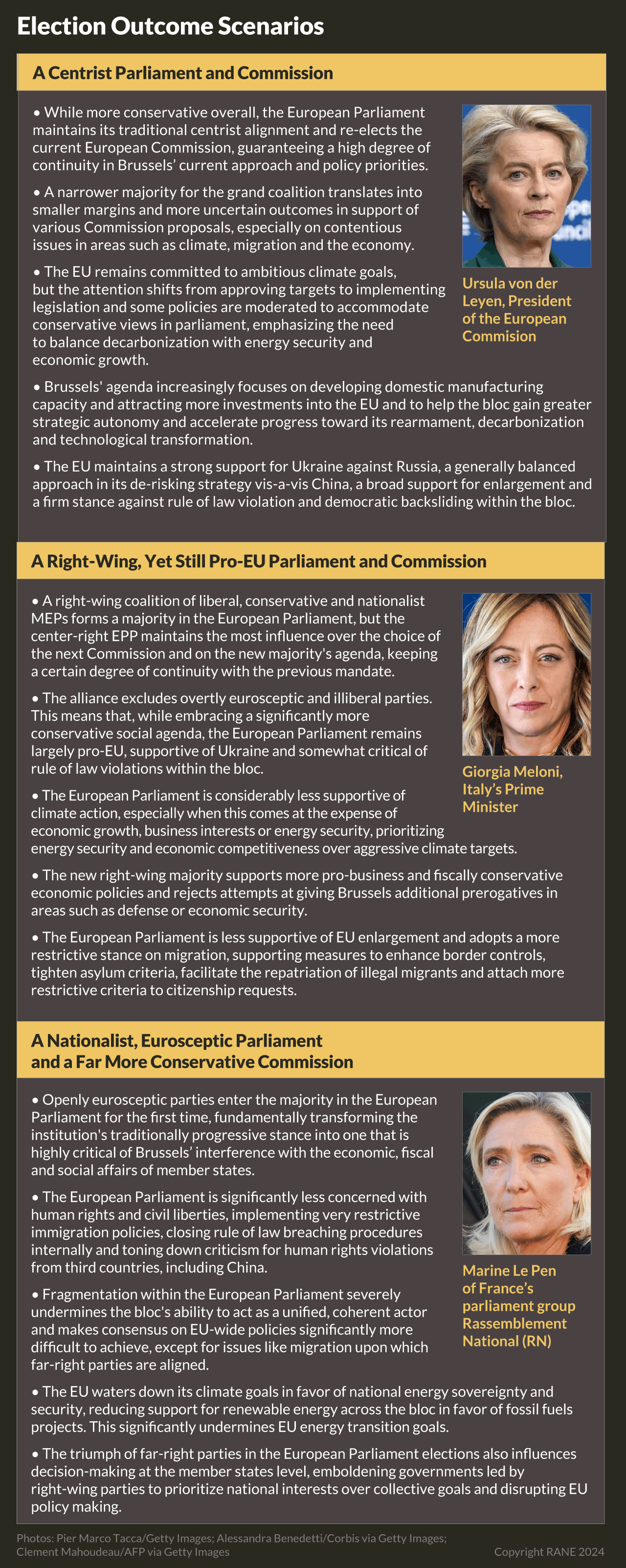
Center-right and center-left parties retain their majority in the European Parliament and largely reelect the current European Commission, keeping the European Union on a largely pro-European integration and environmentally ambitious pathway despite a more conservative parliament overall. Members of the current so-called grand coalition formed by the Liberals, Socialists and Conservatives manage to cobble together enough seats to repeat the same majority backing the present European Commission, though with an even narrower margin than in 2019. The coalition does not hold a majority on its own, but as in the current European legislature, it is backed by the Greens. This gives it just enough seats to propel European Commission President Ursula von der Leyen to reelection and pass legislation. But given the peculiarity of voting cohesion within groups in the European Parliament — where not all lawmakers follow their group's voting instructions — such a narrow majority translates into more uncertain outcomes for various commission proposals. Against this backdrop, proposed packages from Brussels see a higher chance of undergoing modification in parliament to secure the support of opposition parties. Given a broader shift from left to right in the overall representation in parliament as well as within the grand coalition itself, with the center-right European People's Party, or EPP, gaining a more prominent role in the majority, conservative MEPs could more frequently rely on the votes of right-wing groups on contentious areas like climate change, migration and the economy. While the European Commission will not differ substantially in terms of approach and policy priorities from the previous one, it will have to work with a more conservative and less cohesive majority in the European Parliament.
Implications
- The reelection of von der Leyen, supported by the same groups in the European Parliament, means continuity in the commission's approach and policy priorities. But a narrower, less cohesive majority that requires parliamentary groups to actively seek support from other parties to support various legislative proposals increases policy uncertainty. As opposition right-wing lawmakers will likely seek to obstruct the legislative process, this may disrupt and slow policy implementation, particularly on issues related to climate, the energy transition, migration and agriculture.
- Calls for greater European economic, fiscal and financial integration increase after the election, driven by the need to coordinate action and pool resources to invest in key common EU policy objectives such as rearmament, the digital and energy transition and bolstering the bloc's industrial base.
- The EU commitment to ambitious climate goals remains, but policies are moderated to accommodate conservative views in parliament, emphasizing the need to focus more on technological solutions, market-based mechanisms and ensuring energy security alongside decarbonization efforts. Still, renewables continue to attract the most regulatory and financial support from Brussels compared to other technologies, such as nuclear or carbon capture, utilization and storage.
- The European Parliament remains committed to the Green Deal, but attention shifts from approving emissions reduction targets to implementing legislation. Brussels' green agenda also increasingly focuses on attracting more green investment and supporting industry decarbonization efforts and green manufacturing with regulatory and financial support.
- A narrower majority for pro-environmental forces in parliament translates into small margins when supporting further Green Deal legislation. This leads to some specific measures being adjusted to balance environmental ambitions with economic growth and competitiveness concerns, particularly when affecting traditional industries such as agriculture, automotive and manufacturing.
- The European Parliament continues to support strong trans-Atlantic ties and increased cooperation with the United States in areas such as climate change, security, trade and tech. A potential reelection of Donald Trump would significantly disrupt this and accelerate EU efforts to seek greater self-sufficiency and diversification on defense and trade.
- Brussels continues to promote positive post-Brexit relations with the United Kingdom, navigating eventual tensions arising from trade and regulatory divergence as well as greater bilateral cooperation in areas of mutual interest such as energy, the green transition, defense and migration.
- Brussels maintains a generally balanced approach in its derisking strategy vis-a-vis China, advocating for cooperation on global challenges like climate change and health while addressing concerns about trade practices, human rights and security implications of economic dependencies. An overall more protectionist European Parliament advocates for policies directly targeting Chinese competition, such as anti-dumping or anti-subsidy import duties on goods such as electric vehicles or wind turbines. Brussels continues, however, to refrain from imposing extensive export controls and investment restrictions.
- The European Parliament remains strongly in support of Ukraine's sovereignty and territorial integrity and maintains a firm stance against Russian aggression, supporting continued financial and military support for Kyiv (as well as progress on Ukraine's future EU membership) as well as sanctions against Moscow and its allies.
- The European Union does not seek to introduce further major EU-level overhauls on migration, focusing instead on implementing new asylum and migration rules agreed upon under the Migration Pact and on bolstering EU resources, forces and tools to manage irregular entries across the bloc's common external borders.
- The European Parliament and Commission elaborate concrete industrial policies to meet the goals of the European Defense Industrial Strategy unveiled in March 2024 in co-decision with member states, seeking to increase investment in defense capabilities and strengthen the European defense industry. Common EU spending on defense procurement increases, while the European Commission centralizes some aspects of defense procurement.
- Support for EU enlargement toward the Western Balkans, Ukraine and Moldova continues under the new European Parliament, with an emphasis on adherence to the bloc's democratic principles, rule of law and economic reforms as prerequisites for accession, but no new full member is accepted within the bloc by the end of the legislature in 2029.
- The European Parliament continues to support EU sanctions (including freezing EU funds) and infringement procedures against member states found in breach of the rule of law, democratic principles and civil liberties.
- The EU remains a vocal advocate of an open, fair and rule-based international trading system as well as of multilateral trade dispute settlement within the World Trade Organization, actively engaged in multilateral discussions to reform the organization.
- Brussels maintains signing new free trade deals as one of the key priorities for the European Union, but underlying protectionist tendencies within the bloc coupled with stringent ESG standards in negotiations continue to complicate the commission efforts to sign new deals, especially with countries with large agricultural sectors such as Mercosur members. Still, some agreements are eventually achieved, like the ones with Australia and India.
- The European Union implements a comprehensive industrial strategy to accompany the bloc's Green Deal that involves direct EU disbursement of subsidies and other business incentives across member states to meet specific industrial goals and spur EU and foreign investment in strategic sectors in the bloc.
- The European Union pursues a balanced approach to protecting critical technologies and infrastructure with measures to screen foreign investment and ensure supply chain resilience while gradually developing tools aimed at curbing technology transfers to adversarial countries such as outbound investment screening mechanisms and export controls. The European Union creates an Economic Security Council that alongside member states supervises economic security matters. While the commission acquires a more central role in assessing risks and proposing restrictions, member states retain the power to eventually restrict exports or investment.
- The European Parliament supports progress on the long-delayed Capital Markets Union, an initiative to create a single market for capital across the bloc; reduce the bloc's reliance on third-country financial institutions and infrastructure; and provide a greater, easier and cheaper choice of funding for companies in the European Union. The view for a centralized model devolving national supervision of capital markets to the EU prevails, with MEPs ultimately supporting deeper integration of member states' capital markets.
- The European Parliament supports measures to balance fiscal consolidation efforts across the bloc with the need to boost investment in strategic sectors and social cohesion, backing proposals to create new common financing instruments to fund important public policy objectives such as rearmament and the green and digital transitions.
- Support for developing sustainable agricultural practices across the bloc continues, but measures to align environmental and climate objectives with agricultural policies are accompanied by substantial subsidies for farmers and carve-outs for the sector.
A Right-Wing, Yet Still Pro-EU Parliament and Commission
A right-wing majority in the European Parliament remains largely pro-European Union, supportive of Ukraine and critical of rule of law violations, but also considerably less ambitious on climate and increasingly protectionist. A right-wing coalition of liberal, conservative and nationalist MEPs emerges with a majority after the election in the European Parliament. The EPP remains the largest group, thus maintaining the most influence over the choice of the next European Commission president as well as on steering the new majority's agenda. Von der Leyen, the EPP candidate, would likely be reelected to lead the commission for a second time, though this commission would be more conservative. Besides the EPP, the new conservative majority consists of the liberal Renew Europe group and a significant number of lawmakers from the right-wing European Conservatives and Reformists group, which either join the EPP or support the coalition on a case-to-case basis. The alliance excludes overtly eurosceptic and illiberal parties, such as Poland's Law and Justice and Hungary's Fidesz. While significantly more conservative than the previous majority (which included the Greens and the Socialists), the alliance remains largely pro-European Union, supportive of Ukraine and somewhat critical of rule of law violations. Yet the new coalition in the European Parliament is also considerably less supportive of climate action, especially when such action comes at the expense of economic growth, business interests or energy security, as well as of EU enlargement. The new right-wing majority also embraces more pro-business and fiscally conservative economic policies as well as a conservative social agenda.
Implications
- The center-right coalition in the European Parliament results in a further slowing of European integration, with libertarian and fiscally conservative parties rejecting proposals to issue further joint debt in pursuit of common policy objectives and nationalist parties reluctant to cede Brussels additional prerogatives in areas like capital markets and banking unions or economic security.
- The European Parliament embraces a radically different approach to the energy transition, prioritizing energy security and economic growth over aggressive climate targets. Investment in green technologies continues to receive regulatory and financial support, but they are balanced with continued exploitation of traditional energy sources to ensure energy independence and affordability. Technologies such as carbon capture, utilization and storage and nuclear power play an increasingly large role in the bloc's energy transition strategy.
- The Green Deal and related sustainability initiatives face some scaling back and an overall slower implementation, with the European Parliament supporting measures watering down environmental mandates to favor economic competitiveness and energy security. This puts significant doubt over the EU capacity to meet its ambitious net-zero targets, with a particularly negative impact on all nature-, agriculture- and biodiversity-related initiatives.
- The European Parliament will likely vote for a suspension of the 2035 EU ban on new cars with internal combustion engines, forcing Brussels and member states to renegotiate a new approach and timeline.
- EU relations with allies such as the United Kingdom and United States remain positive overall, emphasizing the need to increase cooperation on trade, security and defense, although the potential return of Trump to the White House would further push MEPs to seek greater EU spending on defense and industry.
- There is largely continuity in the EU derisking strategy vis-a-vis China, with Brussels pursuing a cautious China policy balancing economic interests with concerns over security, human rights and trade dependencies. But while EU member states and the European Parliament remain supportive of measures to shield EU companies from Chinese competition and tighten control over Chinese investments and acquisitions in critical infrastructure and sectors of the economy considered of strategic importance, both oppose attempts by Brussels to implement export and outbound investment restrictions to China.
- Support for Ukraine as well as for maintaining sanctions against Russia remains strong, as the largest, mainstream parties in the coalition remain highly supportive of Kyiv. The new center-right majority is less inclined, however, to support Ukraine's EU membership bid as well as particularly ambitious and expensive post-conflict reconstruction efforts.
- EU relations with Africa continue to improve, but the focus increasingly shifts away from development to strategic partnerships centered on energy investment, migration control and security.
- The European Parliament embraces a more restrictive stance on migration, supporting measures to enhance border controls, tighten asylum criteria and facilitate the repatriation of illegal migrants. Legal migration is increasingly tied to labor market needs, with integration policies taking a conservative tone and more restrictive criteria tied to citizenship requests.
- The European Parliament remains generally supportive of measures to increase EU strategic autonomy on defense and foster a more resilient military-industrial base in the bloc, yet objections to increasing common spending and centralizing responsibilities mean many of the proposals and goals of the European Defense Industrial Strategy unveiled by the commission in March 2024 end up substantially watered down. Brussels remains focused on the initial stages of development instead of expanding its influence into procurement, while most spending on common EU defense projects and procurement continues to come from national budgets and the private sector.
- Support for EU enlargement continues somewhat, but with more stringent conditions related to reform, rule of law and alignment with EU policies, reflecting a generally more cautious approach. No substantial progress occurs for any of the current EU candidates through the end of the legislature in 2029.
- The European Parliament continues to somewhat support EU sanctions (including freezing EU funds) and infringement procedures against member states found in breach of rule of law and democratic principles, yet the focus on civil liberties and minority rights for taking such actions is drastically diminished.
- The European Parliament increasingly focuses on supporting innovation and reducing bureaucratic hurdles to enhance EU competitiveness. There is little support for increasing common EU financing to fund investment in digital and green technologies, while calls for increased defensive trade measures aimed at sheltering EU industries from unfair foreign competition increase.
- The larger role of the Liberals within the majority compared to the previous grand coalition that included the socialists and the greens translates into a European Parliament closer to the stance of fiscally conservative governments across the bloc calling for less emphasis on industrial policies and more efforts to improve the business and investment environment through deregulation and market-oriented reforms.
- EU member states and the European Parliament support adopting new inbound investment screening regulations and/or strengthening existing ones. But both remain very skeptical of ceding prerogatives to Brussels on grounds of economic security, strictly confining EU competencies (e.g., Brussels' prerogatives, as opposed to member states prerogatives) to trade and monetary policy and opposing any commission attempt to increase its powers on assessing risks associated with member states' export and investment policies.
- The European Parliament supports progress on the long-delayed Capital Markets Union, even though national authorities maintain a central role in the supervision of capital markets. The initiative is meant to help provide greater, easier, and cheaper funding choices for companies in the European Union, especially amid the lack of new common financing to fund investments in line with important public policy objectives such as rearmament and the green and digital transitions, which the European Parliament does not support.
- Rising protectionism hinders Brussels' ability to conclude trade agreements with countries with large agricultural sectors, such as India, Australia and the Latin American bloc of Mercosur countries.
- There is little support in parliament for increasing common EU financing to fund investment in digital, green and defense technologies, but lawmakers are open to greater fiscal liberties for member states in pursuing common industrial policy objectives.
- The European Parliament embraces a more socially conservative agenda, with right-wing groups promoting the defense of so-called traditional values and the idea of a decentralized European Union also in terms of social policies, advocating for greater national autonomy in this area.
- The European Parliament advocates for the agricultural sector to be exempt from environmental and sustainability measures, emphasizing instead the need to improve food security and calling for a significant increase in agricultural subsidies under the Common Agricultural Policy.
A Nationalist, Eurosceptic Parliament and a Far More Conservative Commission
The balance of power in the European Parliament dramatically shifts to the right, with far-right and openly eurosceptic parties entering the majority. This fundamentally transforms the institution's traditionally progressive nature into one highly critical of alleged interference by Brussels with the economic, fiscal and social affairs of member states. The election sees a major shift to the right across several EU countries, with a populist right-wing coalition made up of the center-right EPP and the radical right-wing groups European Conservatives and Reformists and Identity and Democracy, as well as a number of unaffiliated MEPs (most of whom tend to belong to smaller far-right parties). This scenario is the result of a larger than expected collapse of progressive political forces at the election, perhaps in response to exogenous shocks such as a major terrorist attack in Europe or a new migration crisis in the run-up to the vote that boosts far-right parties. The more moderate EPP maintains its role as a major partner in the alliance, but the presence of far-right, eurosceptic parties within the coalition does not allow it to propel von der Leyen to reelection. This means the new European Commission is a significantly more conservative one uninterested in picking fights with member states over democratic backsliding or in pursuing ambitious net-zero targets. The European Parliament becomes considerably less interested in human rights and civil liberties, implementing very restrictive immigration policies while closing rule of law breaching procedures internally and toning down criticism of human rights violations from third countries. The inclusion of openly eurosceptic parties within the majority challenges the very idea of a European integration process, with far-right parties pushing for policies emphasizing national sovereignty over collective European decisions and calling for a rollback of EU institutions' supranational powers.
Implications
- The triumph of far-right parties in the European elections also influences decision-making at the council level, emboldening member state governments led by right-wing parties to prioritize national interests over collective goals and block decisions at the EU level.
- The European Parliament is significantly more fragmented, which severely undermines the bloc's ability to act as a unified, coherent actor and makes consensus on EU-wide policies significantly more difficult to achieve, except for issues like migration upon which far-right parties are aligned.
- On migration, by contrast, far-right parties manage to cooperate quite effectively. The European Parliament calls for the implementation of significantly more restrictive immigration policies, including tighter border controls, easier repatriation and stringent asylum procedures, and push for a reform of EU asylum policy framework to allow member states greater discretion on the matter and scrap requirements to share refugee allocations.
- Far-right parties integrate nationalist rhetoric into the European Parliament's economic agenda, complicating efforts to implement economic policies and share EU industrial projects that benefit the bloc as a whole rather than individual member states.
- The European Parliament pushes for greater fiscal sovereignty, challenging EU-wide fiscal rules and contributing to tensions over budgetary contributions and allocations. This disrupts EU efforts to allocate resources to important common policy objectives such as developing industrial, defense and energy infrastructure projects and encourages member states to increase national spending, ignoring EU deficit and debt thresholds.
- Divisions among different EU countries' far-right parties within the European Parliament over fiscal policy preferences hinder the EU's ability to adopt common, expansionary fiscal measures. This leaves only national governments and the European Central Bank with the capacity to support economic activity across the bloc, negatively impacting economic growth overall in Europe.
- The European Parliament pushes for a marked deprioritization of climate goals in favor of national energy sovereignty and security. Renewable energy and climate initiatives see reduced funding and support, while fossil fuels projects see a resurgence across the bloc. This significantly undermines EU energy transition goals and leads to the bloc missing its renewable energy and emissions reduction targets by a wide margin.
- While the European Union does not abolish the Green Deal as advocated by many far-right parties ahead of the vote, it adopts significantly less ambitious climate and sustainability targets and slows or even actively scales back the implementation of some legislation agreed under the previous legislature. The radical policy shift creates significant uncertainty for investment in the bloc.
- While the European Parliament (and the European Union as a whole) has very limited foreign policy powers, the increased influence of far-right parties on EU institutions leads the bloc to lose all influence over Europe's foreign policy and alliances.
- On China, a more nationalist European Parliament prioritizes economic interests over human rights concerns, thus significantly limiting criticism of Beijing's governance and human rights records. Rising protectionism, however, leads to increased support for measures to shield EU companies from Chinese competition.
- The presence of pro-Russian parties in the coalition weakens the European Parliament's support for Ukraine and firm opposition to the country ever joining the European Union. This also leads to a pragmatic shift in relations with Russia, with parliamentary groups questioning sanctions' effectiveness and arguing the bloc needs to reengage with Moscow to ensure peace and economic and energy stability.
- A focus on securing borders and controlling migration could dominate EU-Africa relations, with development aid and energy investments directly tied to migration management agreements.
- The European Parliament advocates stronger national military capabilities at the expense of collective European defense initiatives, leading to an overall increase in defense spending and undermining cooperation under the European Defence Fund and Permanent Structured Cooperation. Eurosceptic forces in parliament also oppose any further EU integration on defense matters, as proposed under the European Defense Industrial Strategy.
- EU enlargement embracing the Western Balkans, Ukraine and Moldova stalls, pushing these countries closer to Russia and further destabilizing the security situation in the immediate EU neighborhood.
- The European Parliament abandons any support for rule-of-law infringement procedures against member states. This means countries led by populist euroskeptic governments such as Slovakia and Hungary can more freely implement policies curbing institutional and individual freedoms as well as minority protections, potentially encouraging other countries to follow suit.
- Policies to enhance EU competitiveness favor protectionist measures to safeguard EU industries and an overall relaxation of regulations to stimulate economic growth and job creation, potentially at the expense of environmental and social standards.
- Any initiative to increase the European Commission's prerogatives in terms of economic security is abandoned, with measures aimed at protecting critical industries and technologies from foreign access or influence left to the discretion of national authorities within single member states.
- The European Parliament embraces a significantly more socially conservative agenda, rolling back initiatives infringing on national cultural values or sovereignty and potentially refocusing social welfare programs to prioritize specific demographics, which would increase social inequality across the bloc.
- The European Union takes a more assertive posture in trade disputes, prioritizing the protection of domestic industries and markets over multilateral commitments. Far-right parties promote national sovereignty, even on intra-EU trade, challenging the cohesion of the eurozone and the EU internal market.
- Against the backdrop of greater EU fragmentation and policy paralysis, the governments of France and Germany seek greater bilateral cooperation to advance shared strategic goals such as increasing defense integration and spending, maintain support for Ukraine against Russia and coordinate stances vis a vis China and the United States. National elections in both countries in 2027 and 2025, respectively, could also lead to right-wing governments taking over in Paris and Berlin, complicating these efforts.
- Eastern and Northern European countries that feel more directly threatened by Russia look for even greater defense cooperation with NATO, the United States and other non-EU countries amid scarce progress in pursuing further EU defense integration.
