
Editor's Note: With many significant elections occurring in 2024, RANE is publishing a series of scenario analyses focused on different outcomes of major elections occurring this year, describing how an election outcome might unfold with implications for each potential outcome. The first installment covers India's general election, and the second covers European parliamentary elections. The following is a scenario analysis for South Africa's general election, which will be held on May 29.
South Africa's May election will be the country's most competitive vote in 30 years, testing the dominance of the ruling African National Congress party, or ANC. In one of the most likely scenarios, the ANC loses its outright parliamentary majority and forms a coalition with smaller, mostly centrist parties in exchange for policy concessions such as cuts to public spending and reduced social services. These concessions heighten tensions between President Cyril Ramaphosa and the ANC's populist Radical Economic Transformation faction, or RET, leading to a scattered legislative agenda as Ramaphosa jockeys between coalition partners and the RET to avoid an implosion of his parliamentary majority. Government policies aimed at reining in public spending result in failed wage negotiations with unions, causing strikes and interruptions to health care, education and transportation services.
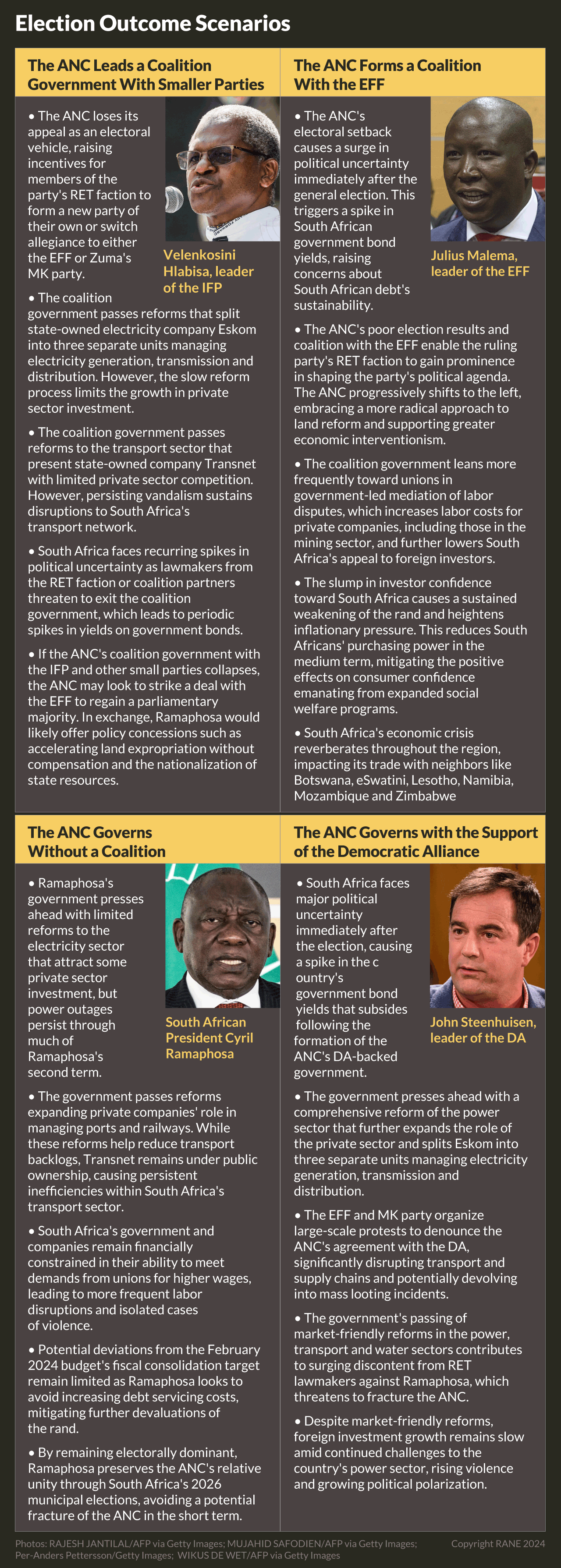
In an alternate election outcome, the ANC faces a significant electoral setback and gathers only around 40% of votes, forcing it to enter into a coalition with the Economic Freedom Fighters, or EFF. As part of the coalition agreement, government policy departs from Ramaphosa's pro-business tendencies as the EFF insists on advancing Black economic empowerment, or BEE, policies, like land expropriation without compensation and the nationalization of state resources. While Ramaphosa resists the EFF's most controversial policy measures, the government's interventionist economic policies and expansion of redistributive programs cause a further slump in investor confidence. This, in turn, increases concerns over the sustainability of South Africa's debt and threatens to prompt a severe economic crisis in the medium term.
In a less likely scenario, the ANC continues to govern South Africa by securing close to 50% of the vote in the May 2024 election, enabling it to form a minority government without relying on any major political party or by retaining an outright parliamentary majority. However, persisting internal rivalries within the ANC mean the government continues struggling to pass economic reforms, forcing Ramaphosa to strike case-by-case alliances with other small parties and independent lawmakers to pass legislation. As a result, Ramaphosa's government struggles to pass meaningful economic reform, which fuels the country's economic malaise and unemployment crisis.
In a low-likelihood, high-impact scenario, the ANC faces a significant political defeat and wins fewer seats than the Multi-Party Charter for South Africa, which is led by the main opposition Democratic Alliance party, or DA. Having lost his parliamentary majority by a substantial margin, Ramaphosa convenes talks to form a government of national unity. The DA ultimately accepts this offer in exchange for economic reforms to South Africa’s electricity, transport and water sectors. However, this acceptance prompts the EFF and former President Jacob Zuma’s uMkhonto weSizwe, or MK, party to refuse to participate in the national unity government and stage large-scale protests that substantially disrupt supply chains and threaten to devolve into mass-looting incidents. While pressure from the DA compels the ANC to press ahead with a comprehensive reform to the power sector and expand the role of private companies in the water and transport sectors, the reform process is slow amid large-scale protests from unions that threaten to compel the government to backtrack on specific bills or policy proposals. While investor sentiment toward South Africa broadly improves, the growth in foreign investments is slow amid continued challenges to the country's power sector, rising violence and growing political polarization.
The ANC Leads a Coalition Government With Small Parties
The ANC gains around 45% of the vote and strikes a coalition agreement with one or several small opposition parties to secure a parliamentary majority. While opposition parties including the DA and the Inkatha Freedom Party, or IFP, promised not to enter into a coalition agreement with the ANC when they signed the Multi-Party Charter for South Africa, the deal falls apart when the ANC offers the IFP and other small parties influence over policymaking in exchange for their partnership. However, Ramaphosa must make several policy concessions, such as cuts to public spending and reduced social services. These concessions increase tensions within the ANC between Ramaphosa and the RET faction, which pushes back against the coalition government's market-friendly reforms. Ramaphosa jockeys between coalition partners and the RET to avoid an implosion of his parliamentary majority, resulting in a scattered legislative agenda and heightened political uncertainty over a potential collapse of the coalition government. Efforts to rein in public spending result in more contentious wage negotiations with public sector worker unions, causing strikes and interruptions to health care, education and transportation services. The coalition government could eventually collapse, which could lead the ANC to form a new coalition with the EFF or MK party or hold an early general election.
Implications
- The ANC's coalition with more fiscally conservative parties enables the government broadly to keep its fiscal consolidation targets outlined in the February 2024 budget, mitigating potential increases in debt servicing costs in the short term.
- Ramaphosa's ability to secure a parliamentary majority without the EFF results in only minor advancements to BEE policies, which heightens the RET faction's discontent toward the coalition government.
- With the ANC falling well below the 50% threshold, the party loses its appeal as an electoral vehicle, raising incentives for members and lawmakers of the party's RET faction to form a new party or switch allegiance to either the EFF or MK party.
- The coalition government passes reforms that split state-owned electricity company Eskom into three separate units managing electricity generation, transmission and distribution. While this attracts some private sector investment in South Africa's power sector, inflows remain limited due to the slow reform process.
- Electricity sector reforms help progressively reduce the extent and duration of power outages, but South Africa's power crisis persists in the medium term, keeping energy costs high for businesses amid a continued (yet declining) reliance on power generators.
- The coalition government passes reforms to the transport sector that progressively present state-owned company Transnet with limited private-sector competition. While these reforms reduce inefficiencies and attract private sector investment to the transport sector, persisting vandalism and insecurity sustain disruptions to South Africa's transport network.
- The EFF and MK party push back against the Ramaphosa government's further turn toward a market-friendly agenda. The two parties will organize regular protests against the government that risk turning violent and resulting in transport disruptions.
- South Africa faces recurring spikes in political uncertainty as lawmakers from the ANC's RET faction or coalition partners threaten to exit the coalition government, which leads to periodic spikes in yields on South African government bonds. Political uncertainty also adds downward pressure on the rand, raising the comparative cost of imports and fueling inflationary pressure.
- The South African Reserve Bank keeps interest rates higher for longer amid persisting inflationary pressure, dampening consumer sentiment and mitigating improvements to the country's macroeconomic outlook.
- Labor negotiations in South Africa's public sector grow increasingly contentious due to political and financial constraints that prevent the government from proposing wage increases that keep up with inflation. This leads to more systemic strikes in key sectors like transportation and public services that disrupt business continuity for local and foreign companies.
- Flare-ups of unrest due to labor disputes and anger over inequality lead to intermittent instances of violence and looting, but not on a scale similar to that seen in the summer of 2021. The unrest leads to periodic and potentially severe disruptions to supply chains and business continuity.
- The risk of a significant departure of RET lawmakers from the ANC or steep disagreements between the ANC and its coalition partner(s) persists throughout the duration of the coalition government. The government's loss of a parliamentary majority would pause progress on reforms, potentially for months, as Ramaphosa enters talks to form a new coalition government.
- If the coalition government collapses, the ANC may look to strike a deal with the EFF to regain a parliamentary majority. In exchange, Ramaphosa would likely offer policy concessions on the advancement of BEE policies, such as an acceleration of land expropriation without compensation and the nationalization of state resources.
- Labor negotiations in South Africa's mining sector become highly contentious, resulting in recurrent bouts of violence that chronically disrupt the country's mineral exports, curbing the government's income stream.
- Tensions grow between the ANC and the MK party, with Zuma organizing frequent demonstrations in Gauteng province and his home province of KwaZulu-Natal. These demonstrations threaten to turn violent and disrupt transport and supply chains, including the port of Durban.
The ANC Forms a Coalition With the EFF
The ANC faces a significant electoral setback and only gathers around 40% of votes after a successful campaign from former President Jacob Zuma and his MK party that splits the ruling party's electoral base. Even though the ANC secures the presidency owing to South Africa's presidential voting mechanism, the party cannot govern by solely relying on smaller parties. Faced with the choice of either striking a deal with the DA or the EFF, the ANC ultimately enters into an agreement with the EFF following a period of severe political uncertainty in a bid to preserve its internal cohesion. While smaller parties such as the IFP may join the coalition, government policy departs from Ramaphosa's pro-business tendencies as the EFF insists on advancing BEE policies like land expropriation without compensation and the nationalization of state resources. This empowers the RET faction within the ANC, progressively obstructing economic reforms. While Ramaphosa resists the EFF's most controversial policies, the coalition government expands South Africa's social programs and its intervention in the economy, causing a further slump in investor confidence that threatens to cause a severe economic crisis in the medium term.
Implications
- The ANC's electoral setback causes a spike in political uncertainty immediately after the general election. This triggers a spike in South African government bond yields, raising concerns about South African debt's sustainability.
- The ANC's poor election results and coalition with the EFF enable the ruling party's RET faction to gain prominence in shaping the ANC's political agenda. The ANC progressively shifts to the left, embracing a more radical approach to land reform and supporting greater economic interventionism.
- The coalition government more frequently favors unions in government-led mediation of labor disputes, which increases labor costs for private companies, including those in the mining sector, and further lowers South Africa's appeal to foreign investors.
- The government implements new social welfare and other redistributive policies, contributing to short-term improvements in inequality. In the months following the election, these policies decrease the frequency of socioeconomically motivated protests, mitigating supply chain disruptions.
- In order to finance its social policies, the coalition government waters down the February 2024 budget's fiscal consolidation targets, causing international credit rating agencies to downgrade South Africa's credit rating from BB to B or below.
- South Africa's credit rating downgrade(s) trigger a sustained increase in borrowing costs, making it harder for the government to maintain social programs without increasing the country's public deficit.
- South Africa's labor market becomes more rigid as the government passes legislation making it harder to hire foreign nationals, further degrading investor sentiment toward the country.
- Despite sustained inflationary pressure, the government covertly pressures the South African Reserve Bank to lower interest rates to fuel domestic consumption, but this pressure erodes the bank's independence.
- Electricity sector reforms initiated during Ramaphosa's first term in office stall. While independent power producers' current contracts remain in place, new contracts are primarily delivered to Black-owned companies. The government increases funding to Eskom, which remains a single, state-owned company.
- South Africa's power sector remains mired in inefficiencies, causing the country's electricity blackouts to persist. Energy costs remain high for the foreseeable future, discouraging foreign investment in the country.
- The government pauses reforms to state-owned enterprises, or SOEs, which leads SOE-dominated sectors such as transport to face sustained — if not rising — inefficiencies. These inefficiencies crowd out investment opportunities for the private sector and increase SOEs' dependence on cash transfers from the central government to remain solvent.
- Amid surging electricity, labor and transportation costs, South Africa's mining sector becomes less cost-competitive. Although South Africa's platinum industry remains internationally competitive due to few alternative suppliers, the competitiveness of the country's coal and iron ore mining sectors significantly declines compared with other exporters.
- The slump in investor confidence in South Africa causes a sustained weakening of the rand and heightens inflationary pressure. This reduces South Africans' purchasing power in the medium term, mitigating the positive effects on consumer confidence emanating from expanded social welfare programs.
- In a bid to shore up support amid a deteriorating economic outlook, the government pursues policy proposals to redistribute land from the white minority to the Black majority at an accelerated pace, which increases violence between Black farmers and white landowners.
- As South Africa's economic crisis worsens, layoffs from the private sector rise, resulting in a resurgence of socioeconomically motivated protests in the medium term. However, protesters levy these demonstrations at companies announcing job cuts rather than the government, risking damage to the targeted companies' premises.
- South Africa's economic crisis reverberates throughout the region, impacting its trade with neighbors like Botswana, eSwatini, Lesotho, Namibia, Mozambique and Zimbabwe.
- South Africa begins a progressive drawdown of its troops in eastern Democratic Republic of the Congo at the demand of the EFF, weakening Congolese President Felix Tshisekedi in his fight against M23 rebels.
The ANC Governs Without a Coalition
Following a strong performance in the final weeks of the ANC's electoral campaign, the party secures close to 50% of votes. This enables the ANC to remain in power without relying on any other single political group, whether by forming a minority government or, in a less likely scenario, retaining an outright parliamentary majority. In turn, Ramaphosa is smoothly reelected as president, thereafter pressing ahead with plans for pro-business reforms, including in the electricity and transport sectors. But even if the ANC retains an outright parliamentary majority, persisting internal rivalries within the party between Ramaphosa's pro-business faction and the RET faction mean the government will continue struggling to pass structural economic reforms. These challenges would increase should Ramaphosa lead a minority government, as this would compel him to strike case-by-case alliances with smaller, mostly centrist parties in exchange for policy concessions. This scenario thus results in Ramaphosa passing only limited electricity reforms in his second term. South Africa's economic malaise continues amid persisting, albeit less intense, electricity blackouts that dampen economic growth. South Africans' economic grievances steadily grow, fuelling strike action from unions, protests and heightened insecurity. As the end of Ramaphosa's second term draws closer, the ANC's RET faction grows increasingly rebellious, disrupting the passing of legislation and potentially looking to remove Ramaphosa from his position as ANC head and, by extension, South Africa's president.
Implications
- By remaining electorally dominant, Ramaphosa preserves the ANC's relative unity through South Africa's 2026 municipal elections, avoiding a potential fracture of the ANC in the short term.
- Ramaphosa's government presses ahead with limited reforms to the electricity sector that encourage private sector investment in energy generation and transmission infrastructure. This results in a progressive decline in power outages, although those persist through Ramaphosa's second term, causing energy costs to remain high for businesses.
- Tensions between the ANC's pro-business and RET factions progressively increase in the first half of Ramaphosa's second term. If the ANC performs poorly in South Africa's 2026 municipal elections, tensions between the two sides will rapidly surge, and the RET faction could look to take over the party leadership. If the RET faction succeeds, Ramaphosa would not complete his second term.
- The government passes limited reforms to the transport sector that expand private companies' role in managing ports and railways. While these reforms attract some private investment that progressively helps reduce transport backlogs, Transnet remains under public ownership, causing persistent inefficiencies within South Africa's transport sector.
- South Africa's government and companies remain financially constrained in their ability to meet demands from unions for higher wages, causing labor negotiations in the mining and public sectors to remain contentious and potentially lead to more frequent labor disruptions and isolated violence.
- Flare-ups of unrest due to labor disputes and anger over inequality lead to intermittent violence and looting, but not on the scale seen in the summer of 2021. This unrest disrupts supply chains, leading to persisting interruptions to business continuity.
- The government's inability to pass major structural reforms results in a continued erosion of investor confidence, resulting in a persisting unemployment crisis and socioeconomic inequality. This causes South Africa's crime levels to remain high, especially in low-income urban neighborhoods.
- Left-wing parties such as the EFF back unions and organize frequent demonstrations calling for an expansion of welfare programs, which catalyze rising social discontent and threaten to turn violent.
- The government presses ahead with limited advancements to BEE policies in fields such as land reform to appease the RET faction, but it refrains from nationalizing state resources.
- If the ANC rules as a minority government, political uncertainty will heighten yields on South African debt, threatening to raise borrowing costs and potentially compelling the government to deviate from its fiscal consolidation targets presented in the February 2024 budget.
- Potential deviations from the February 2024 budget's fiscal consolidation targets remain limited as Ramaphosa looks to avoid increasing debt servicing costs, mitigating further devaluations of the rand and subsequent inflationary pressure.
- South Africa continues to lead southern Africa's regional integration and development initiatives and maintains its troop deployment to the Democratic Republic of the Congo with other Southern African Development Community countries through December. South Africa remains a regional military and political power, but the country's domestic challenges turn the government's focus inward.
- The MK party organizes regular protests in Zuma's home province of Kwazulu-Natal, which could lead to transport and supply chain disruptions, including to the port of Durban.
The ANC Governs With the Support of the Democratic Alliance
While the ANC remains the single largest party by vote count, it faces a major electoral setback and secures fewer lawmakers than the DA-led Multi-Party Charter for South Africa, losing its parliamentary majority by a substantial margin. Ramaphosa convenes talks to form a government of national unity following the election, which the DA agrees to support in exchange for economic reforms. The EFF and MK party subsequently refuse to participate in the government, instead calling for large-scale protests over the ANC's perceived collusion with the economic interests of South Africa's white minority. Protests become recurrent, threatening to devolve into mass-looting incidents on a scale similar to that seen in summer 2021. With the ANC having lost its appeal as an electoral vehicle, members of the RET faction exit the party over policy disagreements, raising the prospect of a fracture of the ANC. While the formation of a government of national unity shores up investor confidence in South Africa, electricity and transport sector reforms are slow amid large-scale protests from unions, which cause major disruptions to supply chains and business continuity that could compel the government to water down its reform agenda.
Implications
- South Africa faces major political uncertainty immediately after the election, heightening yields on South African government bonds. Bond yields then significantly decline following the formation of the ANC's DA-backed government.
- The EFF and MK party organize large-scale protests to denounce the ANC's agreement with the DA, and the demonstrations cause large-scale disruptions to transport and supply chains and risk devolving into mass looting incidents. The Gauteng and KwaZulu-Natal provinces face the highest risks.
- High-income residential areas face an increase in crime in the months following the election as more economically disadvantaged South Africans feel legitimized in engaging in criminal activity against the support base of a government perceived as unjust.
- The government presses ahead with a comprehensive reform of the power sector that further expands the role of the private sector and splits Eskom into three separate units managing electricity generation, transmission and distribution.
- South Africa's power sector crisis persists for the foreseeable future due to the slow-moving nature of the government's reforms, resulting in persisting, albeit less extensive, power outages that keep energy costs high for businesses due to their continued reliance on power generators.
- South Africa's water sector remains state-owned, but the government expands its use of private companies to fix the country's water infrastructure, which helps mitigate further restrictions on water consumption.
- Labor negotiations between the government and South Africa's public sector become highly contentious as the government looks to cut back on spending and rejects wage increases that keep up with inflation. This results in systemic strikes in sectors such as transportation and public services that disrupt business continuity for foreign companies.
- The government's overtly market-friendly economic agenda triggers bouts of public unrest initiated by unions and left-wing parties that risk devolving into violent protests. Demonstrations occasionally compel the government to water down or backtrack on specific bills of its reform agenda that prove particularly controversial.
- The EFF and MK party adopt a highly antagonistic rhetoric against Ramaphosa's DA-backed government that heightens South Africa's political polarization and further deteriorates intercommunal relations.
- The government's passing of market-friendly reforms in the power, transport and water sectors contributes to surging discontent from RET lawmakers against Ramaphosa, which threatens to fracture the ANC.
- The government passes reforms that progressively shift the management of South Africa's transport sector into a public-private partnership format. Despite these reforms, South Africa's transport network continues to face regular disruptions amid persisting insecurity and vandalism.
- Despite improved investor sentiment toward South Africa following the government's formation, the growth in foreign investments is slow amid continued challenges to the country's power sector, rising violence and growing political polarization.
- South Africa's internal challenges compel the government to become less internationally active and more internally focused. South Africa begins a progressive drawdown of its troops in eastern Democratic Republic of the Congo at the demand of the DA, helping the M23 rebel group gain momentum against the Congolese government.
- With Ramaphosa retaining the presidency, South Africa maintains a neutral approach to the Russia-Ukraine war, but Russian disinformation targeting Western interests in the country steadily grows.
