
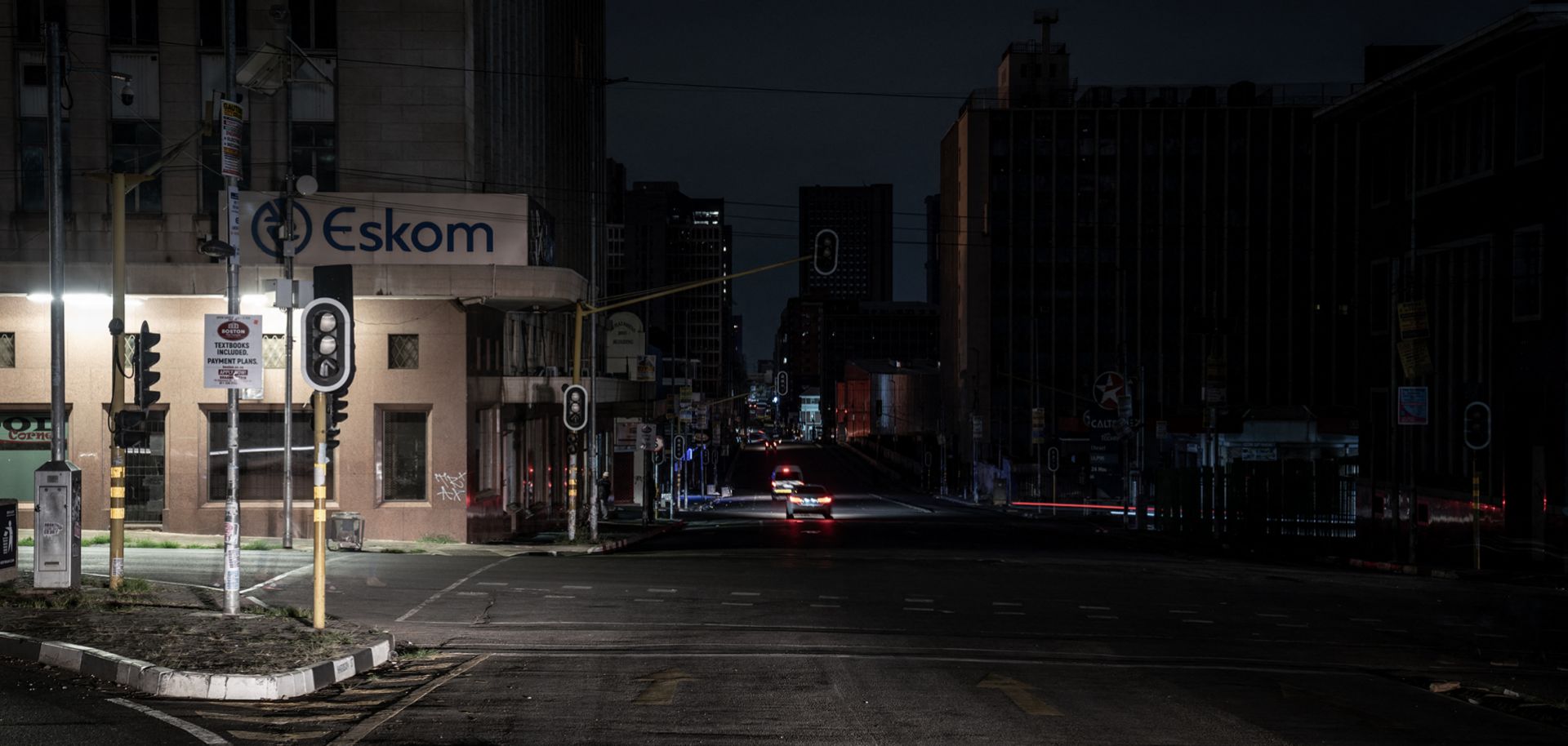
An illuminated Eskom sign is seen outside the power utility's regional office in Johannesburg, South Africa, during load shedding (i.e. a rolling blackout) on Jan. 31, 2023.
Eskom's bailout will likely save the electricity utility from a debt default, but South Africa's blackouts will persist through the next year, sustaining business disruptions and economic losses. During his 2023 budget speech on Feb. 22, South African Finance Minister Enoch Godongwana announced that the country's state-owned power utility Eskom will receive a 254 billion rand ($13.9 billion) government bailout over the next three years, contingent on performance improvements and partial privatization of South Africa's electricity transmission network and coal-fired plants. The bailout will be granted in installments and will draw on 66 billion rand (about $3.6 billion) of funding provisions made during the October 2022 midterm budget and require an additional 188 billion rand (about $10 billion) in borrowing by the government. According to Godongwana, an international panel of energy experts will determine which of Eskom's failing coal-fired electricity plants can be rehabilitated by mid-2023, after which Eskom will hand over operations and plant maintenance to private operators. For Eskom, the conditions of the bailout include restricting expenditure to transmission and distribution, using proceeds from the sale of non-core assets to service the debt relief arrangement, and abstaining from new borrowing from April 1 until the end of the debt relief period. If the grid operator fails to meet these conditions under this agreement, it will be required to repay loans at market rates to South Africa's National Revenue Fund.
- Eskom supplies over 90% of South Africa's electricity; the utility's total debt is about 400 billion rand (approximately $22 billion).
- The government will grant Eskom advances of 78 billion rand (about $4.2 billion) in 2024, 66 billion rand (about $3.6 billion) in 2025 and 40 billion rand (about $2.2 billion) in 2026. Additionally, the government will take over 70 billion rand (about $3.8 billion) of Eskom's debt portfolio in 2026, financed through issuing short- and long-term bonds in the domestic market.
- On Feb. 9, South African President Cyril Ramaphosa announced an indefinite state of disaster over the country's electricity crisis during his State of the Nation address, which will empower the government to accelerate project development, free up financial resources and reduce regulatory requirements.
Eskom's long-standing financial mismanagement is partially to blame for South Africa's chronic blackouts, which have caused widespread economic losses and social unrest in recent years. South Africa's government has been forced to bail out Eskom several times since the utility began planned blackouts in 2008. But the country's electricity crisis has recently hit a new low, with Eksom imposing an unprecedented level of planned outages called ''load shedding'' to stave off the collapse of specific power plants due to high demand. In late February, Eskom increased the intensity of its load shedding to ''stage 7,'' removing 7,045 megawatts from the grid at a time to avoid overwhelming the country's entire electricity system. In theory, stage 7 would result in 7-hour-long blackouts, but some South Africans have reported outages lasting between 10 and 14 hours at a time. South Africa's unreliable electricity supply stymies business activity and costs the country millions of dollars a day, and was one of the primary reasons why the country's National Treasury downgraded its 2023 economic growth forecast to 0.9% on February 22 (down from its 1.4% forecast in October 2022). Labor unions, business interest groups, activists and citizens are up in arms over the crisis, resulting in high protest activity across the country. While protests against growing load shedding have so far largely remained peaceful, political demonstrations carry a latent risk of devolving into unrest, looting and vandalism — especially given South Africa's poor economic conditions.
- The South African Reserve Bank estimates that power outages cost the country as much as 899 million rand ($49 million) per day.
The bailout and planned performance improvements will likely prevent Eskom's collapse due to debt default and offer the best chance yet for stabilizing South Africa's long-term electricity supply, but won't immediately alleviate the ongoing crisis. Contrary to political statements by some members of the ruling African National Congress (ANC) party, Eskom's bailout and other recent emergency measures are highly unlikely to solve the electricity crisis within the year, which would be tantamount to adding 4,000 to 6,000 megawatts of power generation capacity to the grid (what Eskom says it needs to provide a secure electricity supply). The proposals are unlikely to have an immediate effect because it will time to create additional power generation capacity, whether it's through rehabilitating old plants (which could take months) or constructing new ones (which would likely take several years). Further, the corruption and mismanagement that degraded Eskom's efficiency for over a decade remain pervasive throughout the South African government. South African President Cyril Ramaphosa has repeatedly attempted to clamp down on corruption, but state capture and siphoning of state resources will likely continue to erode effective service delivery. Additionally, implementation challenges will very likely stall and/or stop some of the performance improvements required by the bailout (some of which the government has attempted before). Ramaphosa has long advocated for privatizing Eskom and a broader liberalization of the country's energy sector. The 2023 budget unveiled by Godongwana on Feb. 22 also included ''unbundling'' policies that partially privatize the country's electricity transmission network and coal-fired plants in the planned improvements, which may help address South Africa's power plant maintenance challenges. However, the country's immensely powerful labor unions will probably oppose any reforms that could result in job losses or wage cuts, likely leading to demonstrations numbering in the thousands. This means that in the short (and likely medium) term, insufficient electricity supply will continue to plague every aspect of South Africa's economy, including its business environment, agricultural production, and education and health services. In the long term, the reliability of the country's power grid will largely depend on whether the government can implement structural reforms (such as the above-mentioned privatization reforms) despite the long list of constraints.
- The addition of approximately $14 billion to South Africa's domestic debt burden will increase debt servicing costs to about 20% of main-budget revenue, averaging 366.8 billion rand (about $20 billion) annually over the medium term and reaching 397.1 billion rand (about $22 billion) in the 2025/26 fiscal year. While South African domestic debt is currently sustainable, the country's financial risk will grow over the long term without substantial improvements to electricity delivery.
