
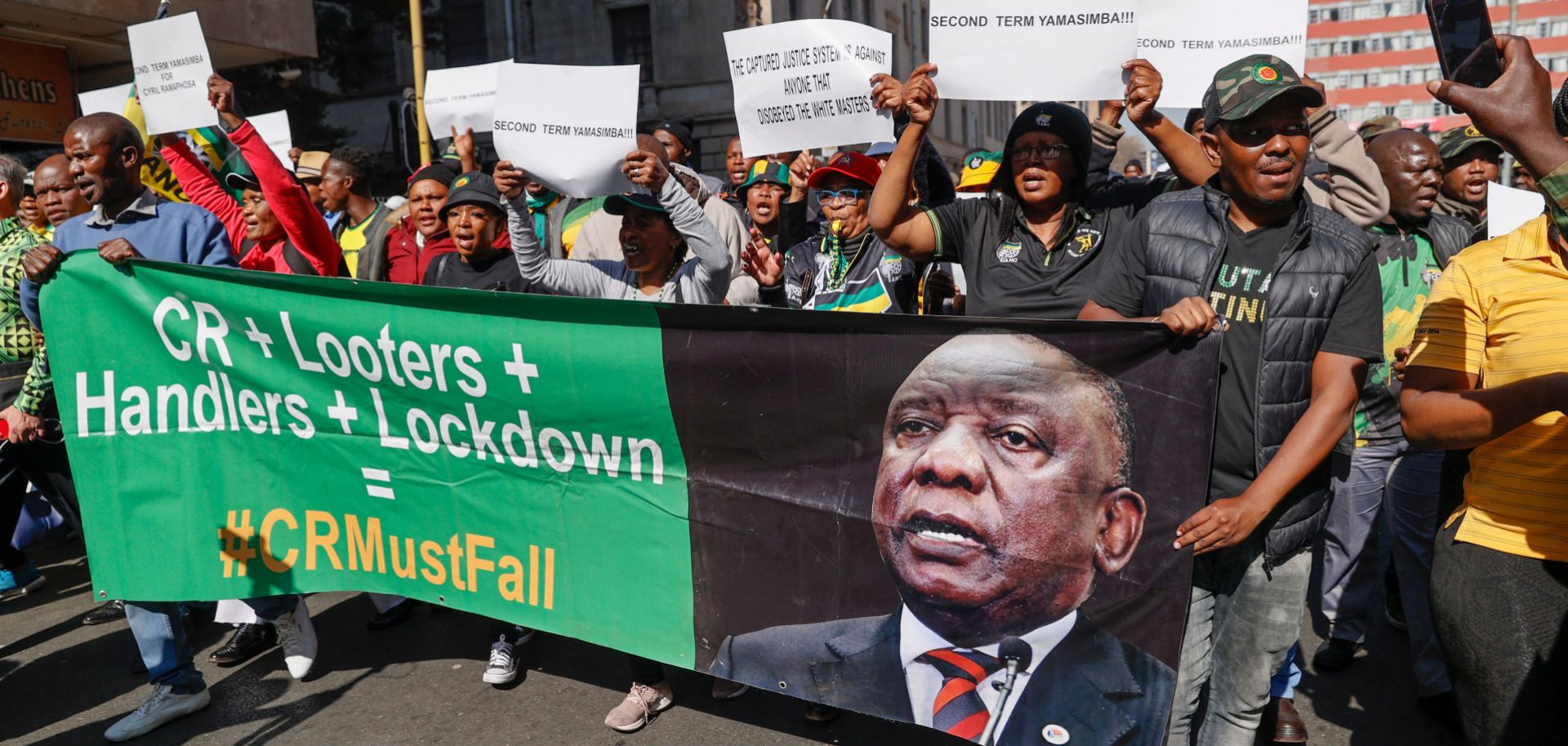
Disgruntled members of the African National Congress (ANC) march to the party’s headquarters in Johannesburg, holding a poster reflecting the face of South African President Cyril Ramaphosa, on July 15, 2022.
The findings of a large investigation into corruption in South Africa will likely deepen factionalism within the ruling African National Congress (ANC) party, which will risk further delaying the crucial reforms needed to repair the country's economy and its government's image. On June 22, Chief Justice Raymond Zondo delivered the grand finale of his commission’s four-year inquiry into the alleged looting of billions of dollars of government finances during former President Jacob Zuma’s tenure (2009-2018). The findings of the fifth and final installment of the investigation into “state capture” — a type of systemic corruption in which businesses and politicians conspire to rig government decisions in their favor — detail a vast network of corruption that extended from state-owned companies like Eskom and Transnet, to political elites and the private sector. The nearly 5,000-page report chiefly implicates Zuma, but current President Cyril Ramaphosa is also accused of mishandling allegations of misconduct.
- Based on his commission’s findings, Chief Justice Zondo has recommended prosecuting numerous officials (including Zuma himself), as well as overhauling appointment processes and managerial controls. In response, the Ramaphosa administration has promised to pursue the proposed legislative and structural changes, but has yet to provide details on how and when it will do so.
- On July 17, the policy chief of the ruling ANC party — of which both Zuma and Ramaphosa are members — also pledged to identify internal weaknesses and force members implicated in the report to stand before the party’s integrity commission in two months.
- Before he became president in 2018, Ramaphosa served a four-year term as deputy president under the Zuma administration. While it remains unclear how much Ramaphosa knew of the shady goings-on during that time, the Zondo commission’s final findings do indicate Ramaphosa was aware of the widespread graft and corruption that continued under his own administration, making him complicit in some instances of state capture.
The Zondo commission report found widespread evidence of corruption, fraud, bribery and illegal activity in South Africa's railway, electricity and aviation sectors, as well as in state security services and high political offices. The commission’s final findings center largely on the former Zuma administration’s ties with the Guptas, a wealthy Indian family whose business executives and their associates amassed a fortune during Zuma’s presidency. The commission discovered that the Guptas wielded immense influence over political appointments and elections, which connected the family to millions of rand in irregularities at the South African Revenue Service. The state-owned power utility, Eskom, also entered into irregular contracts worth R14.7 billion ($941.4 million) with associates of the Gupta family and President Zuma, in which former Eskom CEOs Brian Molefe and Matshela Koko were complicit. In addition, collusion between employees at the state-run transportation firm Transnet and external individuals also ensured preferential treatment for the Gupta enterprise, as well as cover for money laundering initiatives, widespread graft, pilfering of state funds and illicit locomotive deals. According to the Zondo commission’s report, Eskom and Transnet together accounted for 97% of the recorded losses of government funds tied to the Guptas during Zuma’s term (2009-2018). The report's other main findings include:
- Transnet — the state-owned rail, ports and pipelines company — was also involved in a systematic process of appointing corrupt actors and allies to governance and staff positions in order to influence large procurements and capital expenditures.
- Bosasa, a government services company that is now called African Global Operations and provides prison services and housing contracts, used business fronts to receive kickbacks in exchange for profitable government contracts. The company bribed ANC officials, including Zuma, in order to secure lucrative contracts for government buildings, prisons and housing projects.
- Deeply rooted corruption within the State Security Agency led to the bribery of law enforcement, initiatives aimed at influencing the media and judiciary, illegal payouts and personal use of the agency's funds.
- The quality and effectiveness of state-owned South African Airways' governance steadily declined during Zuma's administration, which enabled acts of corruption and fraud.
The report will likely deepen disputes within the ANC, which will exacerbate South Africans’ anger at their government and impede the passage of key economic reforms. The commission’s recommendation to prosecute Zuma and his allies in the left-leaning Radical Economic Transformation (RET) faction of the ANC is likely to worsen animosity with Ramaphosa’s pro-business faction of the party. This will likely intensify the resolve of Zuma’s political opponents and members of the judiciary to follow through on the ongoing corruption case against the former president. But the escalating tensions will also likely fuel allegations by Zuma’s supporters that the trial is a political witch hunt, thereby increasing the risk of violent clashes between the two groups. Deepening factionalism will also impede the government’s ability to address accusations of corruption within South Africa’s embattled state-run utility firm Eskom. This will, in turn, impede improvements to the country’s power grid, despite Ramaphosa’s recent efforts to reform the electricity sector by buying some of Eskom’s debt and making other regulatory changes. Internal strife within the ANC will also likely further inhibit Ramaphosa’s ability to scale back government spending and pass pro-business economic reforms, including those involving South Africa’s labor market. Moreover, the report will only heighten South Africans’ anger over government corruption and mismanagement. Much of this frustration will likely be directed at the Ramaphosa administration, with citizens seeing their president as complicit in state capture and/or unable to address corruption pervasive in key sectors. In the medium term, declining popularity will likely hurt Ramaphosa’s chances of securing another term as the leader of the ANC at the party’s December convention, as well as his odds of securing a second term as South Africa’s president in 2024.
- Despite multiple delays, Zuma’s ongoing corruption case for his role in a weapons deal in the 1990s is expected to resume on Aug. 1, which could provoke demonstrations and potential unrest among the former president’s supporters.
- On July 25, Ramaphosa announced a raft of measures to boost the country’s power generation capacity and keep Eskom afloat, despite his administration’s apparent inability to address corruption within the company. Ramaphosa said the government plans to double an upcoming power tender for the renewable sector, as well as scrap requirements for private power companies that have a generation capacity of over 100 megawatts, thereby allowing them to install power capacity (such as solar or wind) of any size without needing a license. Ramaphosa also said homes will now be able to sell power generated from rooftop panels. While significant, these regulatory changes are unlikely to immediately impact South Africa’s power generation capacity, portending more electricity outages and supply disruptions through at least next year.
- In the wake of the third part of the state capture report, the opposition Democratic Alliance called the ANC “an organized crime syndicate.” While opposition groups have previously used similar rhetoric, it appears to be growing in frequency and popularity, indicating declining support for the ruling ANC nationwide.
