
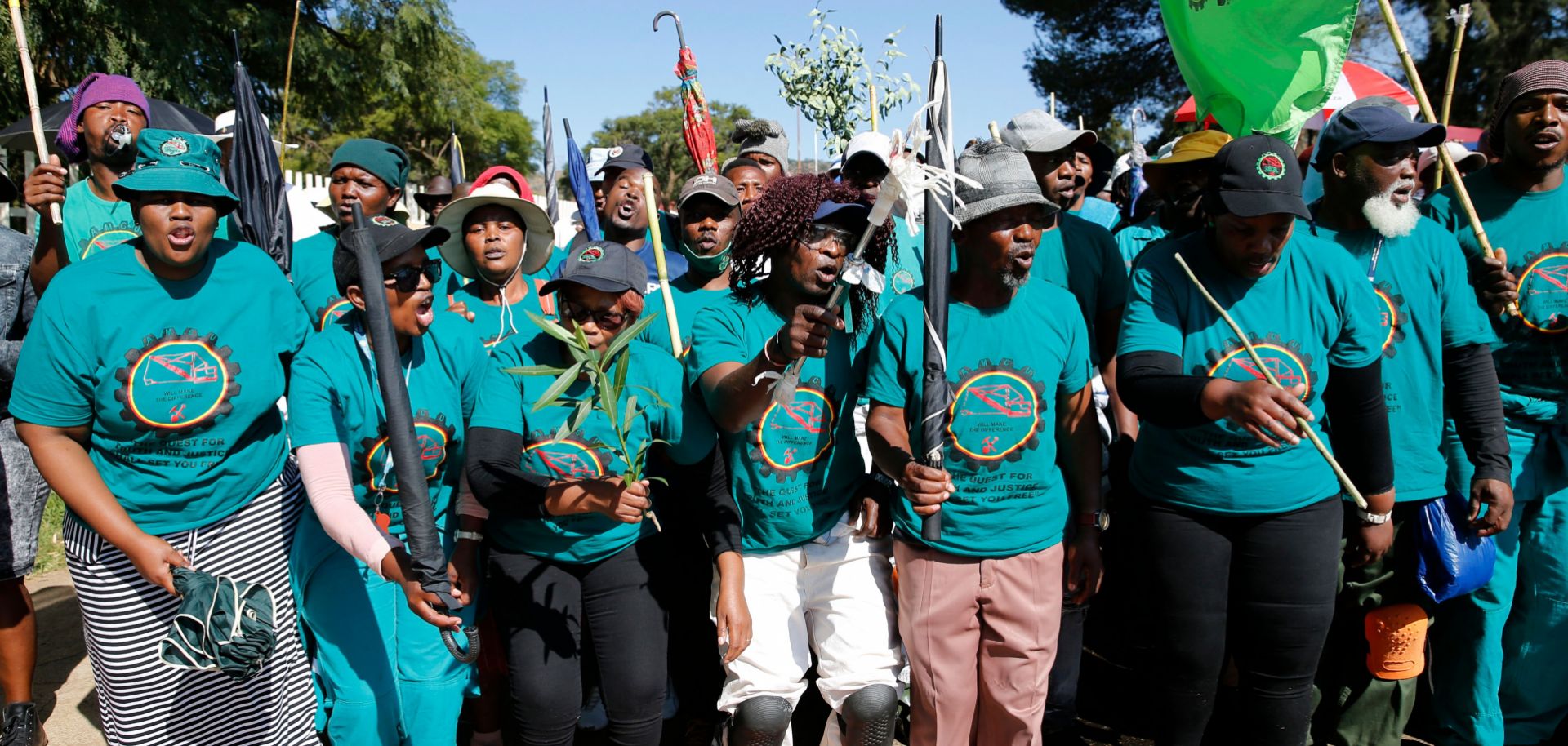
Striking workers affiliated with the Association of Mineworkers and Construction Union (AMCU) sing outside of Sibanye-Stillwater's Driefontein gold mine near Carletonville, South Africa, on May 6, 2022.
Contentious public and mining sector wage negotiations in South Africa could lead to more strikes that disrupt business operations and public services, with the potential to spur limited bouts of unrest. The Congress of South African Trade Unions demanded a 10% wage increase for public sector workers for the 2022-23 fiscal year in talks at the Public Service Coordinating Bargaining Council (PSCBC) on May 4, in addition to housing stipends, a bursary fund for children, relief funds for natural disasters and measures for early access to pension funds. Separately in the mining sector, the National Union of Metalworkers of South Africa (NUMSA) said it would launch a strike on May 11 at ArcelorMittal South Africa, the country's largest steel producer, after the firm rejected the union's demands for a 10% wage increase, a housing allowance and an 80% medical aid contribution from the employer. Workers from the Sibanye-Stillwater gold mines, along with members of the Association of Mineworkers and Construction Union (AMCU) and the National Union of Mineworkers (NUM), are also demanding wage increases and have been on strike for about three months. NUMSA, AMCU and NUM are all competing with one another for membership, leading each to demand more concessions from mining companies, particularly for new workers.
- During a May Day event in Rustenburg, striking miners forced President Cyril Ramaphosa to leave the stage in the middle of his speech.
- Wage negotiations between workers at the Sibanye-Stillwater gold mines and a coalition of three mining unions — the AMCU, NUM and the Solidarity and United Association of South Africa (UASA) — began nearly a year ago. While the UASA agreed to a proposed wage increase in February, AMCU and NUM have been on strike since March 9. Sibanye has said that AMCU and NUM's wage demands are unsustainable for its gold operations as they would inflate the wage bill to roughly $508 million by July 2023.
While unions have historically held strong negotiating power in South Africa, high inflation, growing inequality, increasing commodity prices and stalled COVID-19 recovery are emboldening them to make particularly ambitious demands for wage increases. The strength and size of unions across South Africa means that failed negotiations resulting in strikes can lead to significant business and supply chain disruptions. This — combined with the fact that the governing African National Congress (ANC) party has ruled the country in the so-called ''Tripartite Alliance'' that includes the COSATU, a confederation of most of South Africa's unions — has granted unions strong bargaining power in the country. Even so, difficult economic conditions are spurring unions to stake high demands. In recent years, the consumer inflation rate has been built into the structure of wage adjustments as the ''cost of living'' increases. But the 10% wage increase demanded by unions is far above consumer inflation, which reached 5.9% in March. Workers are insisting that employers take the national economic climate into account, citing the global fallout from the ongoing COVID-19 pandemic and, more recently, the Russian invasion of Ukraine, which — in addition to relatively insignificant wage increases in recent years — has eroded South Africans' purchasing power.
- Of the 25.3% of workers in South Africa's formal economy that are unionized, the vast majority hail from the country's mining and public service sectors.
- According to the World Bank, the global economy is currently experiencing the largest commodity shock since the 1970s, brought on by Russia's Ukraine invasion and the West's expanding sanctions campaign, which have caused energy, food and fertilizer prices to skyrocket worldwide. While high mineral prices benefit the South African Treasury's revenue collection, many consumers are unable to afford their regular supply of household goods.
- On May 4, Moody's Investors Service said that inflation in South Africa is set to top 8% in 2022, crushing the South African Reserve Bank's 3-6% target range.
- On May 1, a spokesperson with the NUMSA said the COVID-19 pandemic has forced South African companies to restructure their operations to remain profitable, which has led to worsening working conditions and exacerbated an already volatile job market.
Negotiations between the government, private employers and union members are highly likely to be combative, and could lead to more strikes and flare-ups of unrest. Talks between unions and private employers are separate from those between unions and the government. Both sets of dialogue, however, are likely to run into roadblocks. Earlier this year, the South African government pledged to reduce public-sector wages as a way to curb spending, meaning the government is highly unlikely to easily acquiesce to demands for higher-than-normal wage increases for government workers. The two sides will probably end up somewhere in the middle, but it may take months of additional negotiations and/or strikes to get there. In the meantime, strikes staged by public sector employees like teachers, doctors, nurses and sanitation workers could see continued disruptions to key government services like healthcare and education. Such disruptions would likely increase discontent for the Ramaphosa administration, raising the risk of protests that could escalate into limited spates of unrest. South Africa's crucial mining sector, meanwhile, will likely also see continued labor disruptions. While the talks between the Sibanye-Stillwater gold mine workers and the mine's owners have made some progress since March, the two sides appear to be at an impasse. As its ''final settlement offer,'' Sibanye-Stillwater said on April 22 that it would increase entry-level employees' monthly wages by $53 between 2022 and 2024, including a $3 increase in living-out allowance. But workers rejected the offer and have since continued to demand a $65 monthly wage increase, along with a $7 increase in living-out allowance. This portends continued strikes that could further disrupt the production capacity of Sibanye-Stillwater's gold mines, which accounted for approximately 13% of South Africa's total gold exports in 2020, according to data from the Observatory of Economic Complexity.
- In 2022, the government is projected to spend $139 billion on wages for South Africa's 1.2 million public workers, including nurses, doctors, teachers and police officers. Public wages are the largest component of government spending, which Pretoria is attempting to reduce in order to allocate more funds to other sectors like education and healthcare.
- Unions and the South African government are negotiating single-year wage contracts after a court ruling in February 2022 dictated that the South African government did not have to back pay an 8% wage increase that was supposed to occur in 2020. Single-year contracts will increase the frequency of negotiations, as well as increase government uncertainty.
- According to Sibanye-Stillwater's annual report, the company produced 0.98 million ounces of gold in 2020, which amounts to approximately $1.7 billion in exports based on the average closing price of gold for that year. South Africa exported $13 billion worth of gold in 2020.
