
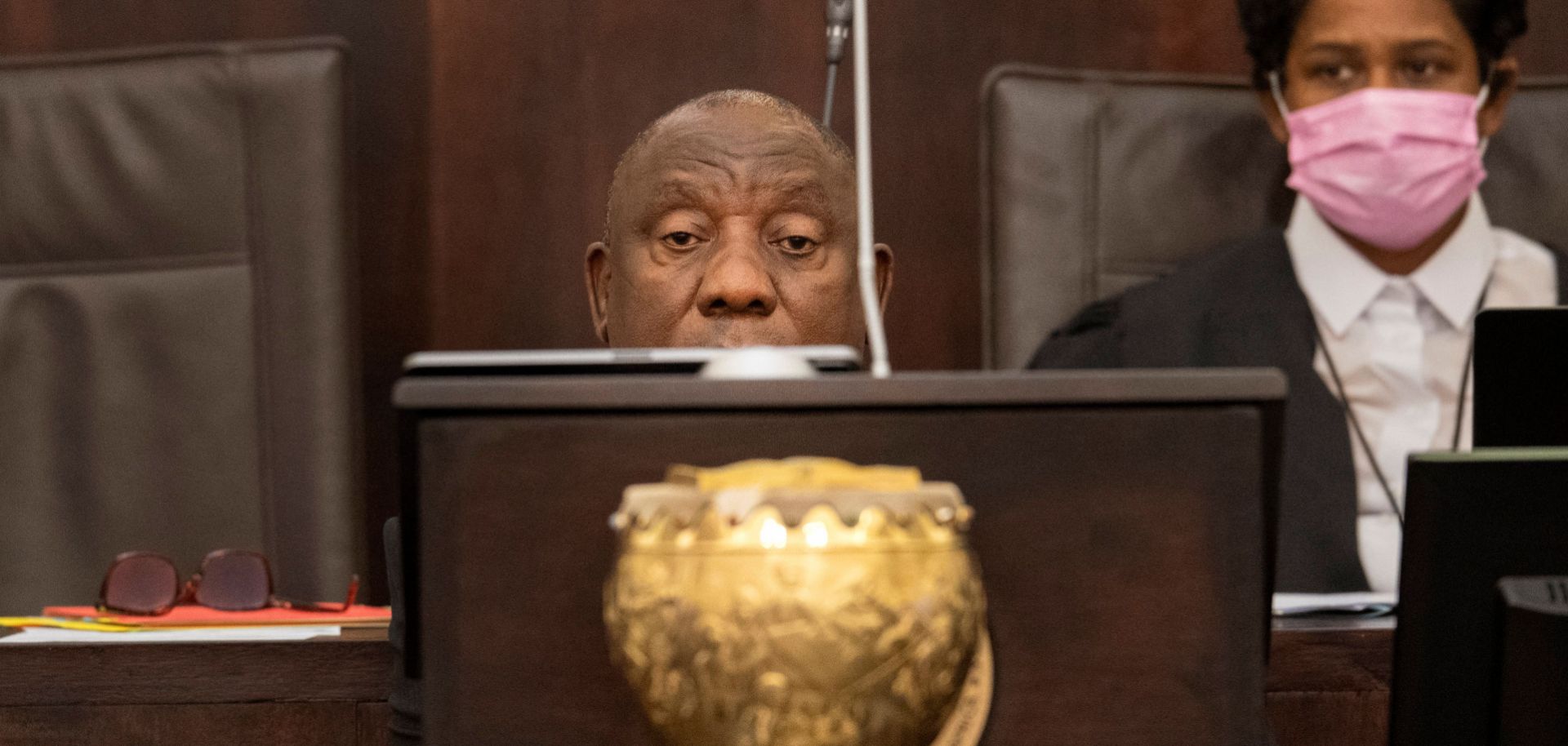
South African President Cyril Ramaphosa waits for heckling to die down as he makes a speech in parliament on June 9, 2022. Ramaphosa claimed he was the victim of "dirty tricks" in a damaging burglary scandal.
Allegations that South African President Cyril Ramaphosa concealed and stole millions of dollars at his Limpopo wildlife farm risk harming his reelection chances, impeding economic reforms and potentially triggering unrest across the country. On June 8, Ramaphosa said he would voluntarily appear before the governing African National Congress’ (ANC) party’s integrity commission to answer questions involving accusations that he illegally took matters into his own hands after $4 million was mysteriously stolen from his Phala Phala Farm in 2020. On June 1, the country’s former spy chief Arthur Fraser filed a criminal complaint accusing Ramaphosa of concealing the alleged theft, and subsequently kidnapping and illegally interrogating the suspects. In the 12-page sworn statement, Fraser — who served as the head of the South African State Security Agency from 2016 to 2018 during the administration of former President Jacob Zuma — also alleged the assailants were paid to keep quiet, implying Ramaphosa covered up the crime because he acquired the $4 million through illicit means. Ramaphosa has denied the claims, saying that the money came from the sales of animals and that he never engaged in any corrupt activities. But the scandal nonetheless caused a political uproar, with opposition parties — as well as members of Ramaphosa’s own ANC party — calling for the president to step down.
- Security forces forcibly removed opposition lawmakers during parliamentary sessions on June 9 and 10 after they disrupted proceedings by accusing Ramaphosa of breaching his oath of office.
For Ramaphosa, whose political career has focused heavily on tackling corruption in South Africa, the scandal could prove particularly damning. Anti-graft measures remain a cornerstone of Ramaphosa’s agenda despite the high frequency of corruption charges that have been lodged against members of his ruling ANC party. Until now, Ramaphosa has largely managed to remain above the fray in South Africa’s highly corrupt political environment. This has, in part, enabled him to lead an anti-graft agenda and juxtapose himself with former President Zuma, whose corruption and contempt of court cases are ongoing. But several key members of the ANC have faced corruption charges during Ramaphosa’s tenure, casting doubt on the efficacy of the president’s initiatives. And with Ramaphosa now in the hot seat himself, the farm theft scandal risks further eroding his credibility on anti-graft efforts.
- Early in his tenure, Ramaphosa introduced the “step aside” rule, which requires criminally charged politicians to leave office but crucially does not ban them from returning. This loophole has enabled politicians to quickly return to power; former Durban Mayor Zandile Gumede, for example, briefly left his post before seeking reelection as the ANC’s regional chairperson, despite Gumede facing over 200 corruption charges.
Opposition leaders will use this to further tarnish Ramaphosa’s reputation, potentially harming his odds of winning the ANC leadership election in December. Some of the largest opposition parties, including the Democratic Alliance (DA) and the Economic Freedom Fighters (EFF) have called for Ramaphosa’s resignation in the wake of the accusations involving the farm theft. Members of a rival faction within Ramaphosa’s own ANC party, the Radical Economic Transformation (RET) group, have also demanded that Ramphosa go on leave while the integrity commission investigates the charges laid out in Fraser’s statement. Even if the claims against Ramaphosa prove empty, members of the RET will still attempt to use the scandal to sideline the president ahead of the December ANC convention, which will see members select the head of the party (a position that Ramaphosa currently holds). If Ramaphosa does not win the top ANC seat, his odds of presidential reelection in 2024 will be greatly reduced. Opposition parties will attempt to deplete public support for the ANC in key local constituencies, like Gauteng and KwaZulu Natal provinces (home to Johannesburg and Durban, respectively), ahead of the 2024 general elections, which are already slated to pose a challenge to the ANC’s deep-rooted grasp on power.
- The leader of the Democratic Alliance (DA), John Stumaigher, called for an investigation into possible graft in relation to the $4 million stolen from the farm. EFF party leader Julius Malema has also called on Ramaphosa to abide by his own “step aside” rule by taking a leave while the inquiry is underway.
The scandal also risks delaying and/or preventing Ramaphosa’s proposed economic reforms and injecting greater volatility into South Africa’s political environment. Reduced support for Ramaphosa amid the corruption allegations will complicate and potentially stall his efforts to pass badly needed economic reforms, like privatization of the power sector, reduction of the public wage bill and overall reduced public spending. In the immediate term, as the inquiry into the scandal progresses, demonstrations and potential unrest at government buildings during hearing dates are likely, particularly among EFF supporters. This means that unless Ramaphosa steps aside (which he has so far given no indication of doing), disruptions to transportation and businesses can be expected across the country, but particularly in Pretoria, Durban, Johannesburg, Limpopo and Mpumalanga.
- EFF party leader Julius Malema said that if Ramaphosa refuses to step aside while the investigation proceeds, the EFF will “mobilize many sectors” to “stop recognizing him as the president…and prevent him from performing presidential functions.”
