
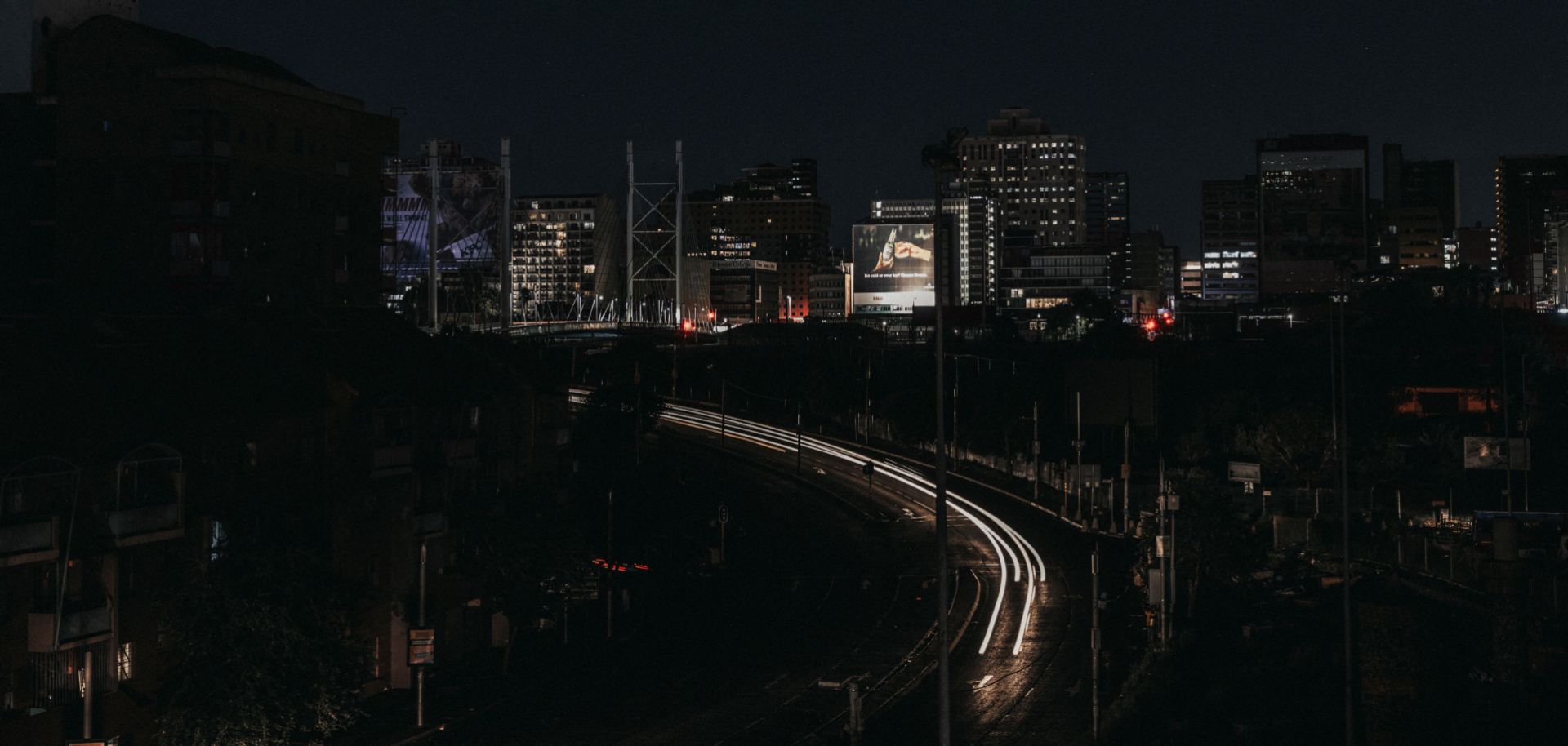
A general view shows the darkened Braamfontein district of Johannesburg, South Africa, on Jan. 15, 2023, after a ''load-shedding'' blackout was implemented.
The government's emergency declaration will unlock extra financing and fast-track regulatory processes, but it's unlikely to address the underlying drivers forcing the country's grid operator to impose ongoing power cuts, portending more blackouts that will further damage South Africa's development and business environment. On Feb. 9, South African President Cyril Ramaphosa announced an indefinite state of disaster over the country's electricity crisis during his State of the Nation address at Cape Town City Hall. South Africa's electricity crisis has markedly worsened over the past two years, culminating in a record number of consecutive blackout days in 2023, widespread discontent and mounting political pressure over the administration's response, prompting emergency measures. The state of disaster will empower the government to accelerate project development, free up financial resources and cut down on regulatory requirements, which Ramaphosa said his administration will use to provide generators, solar panels and uninterrupted power supply to businesses in food production, storage and retail supply chains. According to Ramaphosa, the state of disaster will also enable the government, when possible, to exempt hospitals and water treatment plants from planned outages known as ''load shedding'' to stave off the collapse of specific power plants due to overwhelming demand.
- In 2022, South Africa's state-owned power utility Eskom imposed 205 days of load shedding. As of Feb. 10, these planned outages have occurred for a record 103 consecutive days.
- Eskom has implemented various levels of load shedding over the past decade. But a lack of investment in South Africa's aging electricity infrastructure, pervasive corruption within the energy sector, vandalism of power lines, disruptive labor action, heavy reliance on coal, and general inefficiency have led to growing concerns over complete electricity collapse. While a total collapse of the country's power grid likely remains an extreme scenario, insufficient electricity supply will still limit South Africa's long-term development prospects by obstructing business activity, economic growth, food production, health services, and access to education.
- Eskom's official position is that load shedding is limited to ''stage 8'' (planned blackouts for eight hours at a time), but South African industry experts say that the limit is an arbitrary ceiling, and that households and businesses may experience blackout periods of 10 to 14 hours.
The state of disaster will free up state financing and cut down on regulatory delays for infrastructure development, but structural interventions will likely take 12-18 months to alleviate load shedding, which means blackouts are likely to continue in the medium term. The state of disaster will likely expedite infrastructure development and cover the cost of diesel for Eskom's diesel-powered plants through the end of the year. South Africans could thus see some relief from blackouts in the next few months ahead of winter. However, the government's proposals are the same ones that have been in play for years that have failed to alleviate the country's electricity crisis. This is in part because the government's solutions do not address widespread corruption and mismanagement that inhibit the authentic implementation of its plans. As such, load shedding is likely to continue for at least the next 12-to-18 months and probably longer.
- The government's plans include fixing Eskom's coal-fired power stations and improving the availability of existing supply; enabling accelerated private investment in generation capacity; accelerating procurement of new capacity from renewables, gas and battery storage; and providing tax incentives for businesses and households to invest in solar.
Continued load shedding will further erode South Africa's political stability, economic growth and social development. The ruling African National Congress (ANC) has never been less popular, and widespread discontent over the party's mismanagement of the electricity crisis (among other grievances) will likely trigger unrest that could further undermine the ANC's chances to form a government on its own after 2024 general elections. This is a hazard to broader political stability as it remains unclear whether South Africa's political institutions would endure under coalition governance. Evidence suggests that international companies are not yet leaving South Africa due to the electricity crisis (many businesses rely on back-up diesel-powered generators). However, the ongoing operational disruptions are forcing many small- and medium-sized businesses to shutter their doors, worsening South Africa's already high unemployment rate. If unaddressed, the electricity crisis will also further degrade South Africa's health care and education systems, worsening the population's general well-being and the country's investment appeal.
- The ANC suffered historic losses during legislative elections in November 2021, when support for the party that led South Africa out of the apartheid era dipped below 50% for the first time since 1994.
- South African opposition parties, civil society organizations and labor unions have said that they will stage protests in the coming months to demand relief from blackouts and a reduction to a planned hike in electricity tariffs scheduled to take effect on April 1.
- The state of disaster will also likely give opportunistic and corrupt politicians an avenue for misusing public funds, given the reduced regulatory barriers to public spending. Ramaphosa previously imposed a state of disaster to address the COVID-19 pandemic, during which the government improperly granted 2,803 contracts worth about $800 million to suppliers, according to a 2022 inquiry by the South African Special Investigation Unit.
- In January, the South African Reserve Bank projected that rolling blackouts would cost the country 2% of its gross domestic product in 2023, setting economic growth at just 0.3%.
- In early February, Agri SA, the biggest agricultural organization in South Africa, called on the Ramaphosa administration to address the impact of the power outages on the country's farmers, which the group says will cause crop failures, higher food prices, shortages of certain food products and job losses in the near future.
