
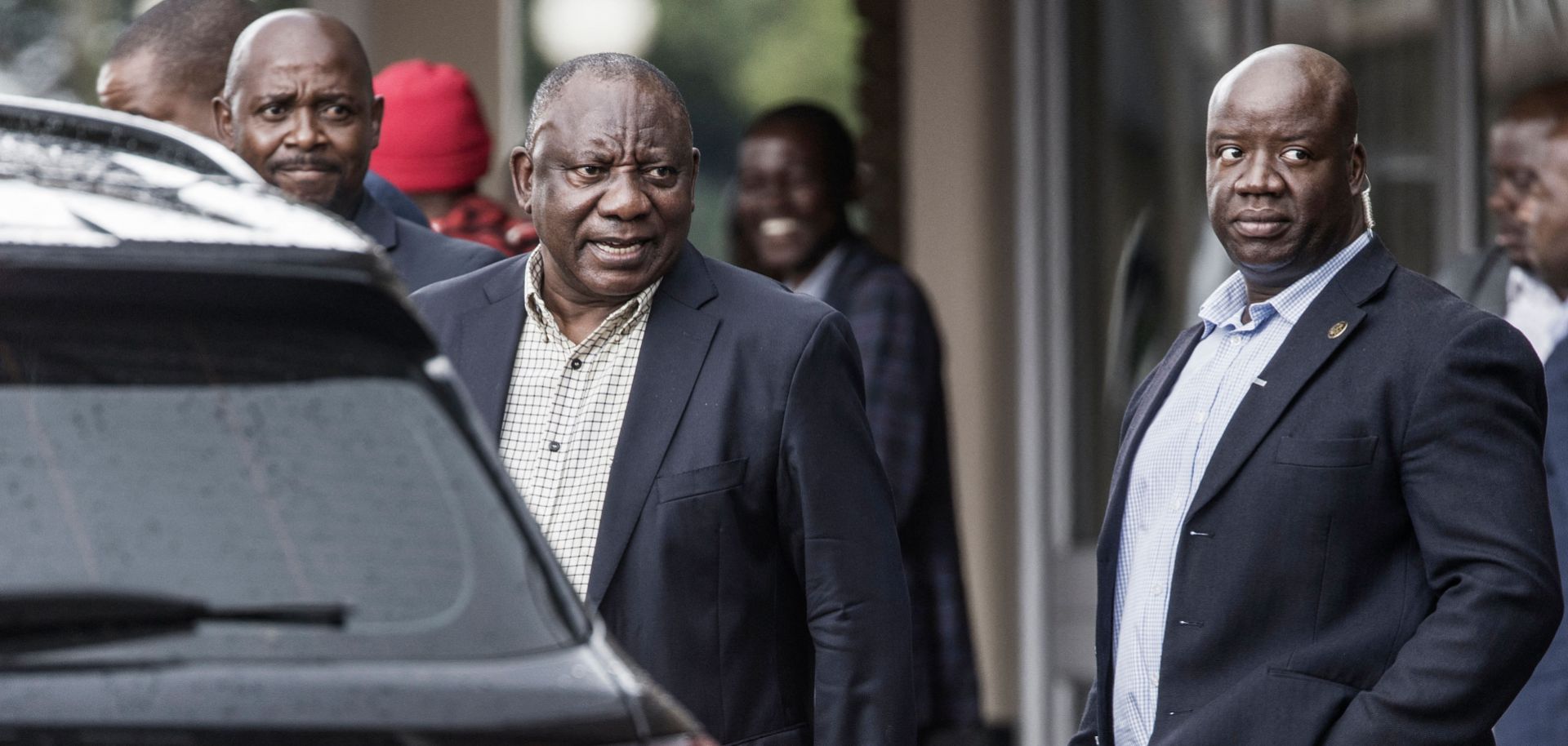
South African President Cyril Ramaphosa (center) leaves an ANC national executive committee meeting in Johannesburg on Dec. 5, 2022.
South African President Cyril Ramaphosa will likely survive a possible impeachment inquiry, but increased political infighting and a weakened ruling party mean that the government is even less likely to pass reforms to address the country's electricity, banking and labor crises. On Dec. 5, the executive committee of the governing African National Congress (ANC) told party members to reject a South African advisory panel's findings that President Ramaphosa — once lauded as the ''anti-corruption president — may have violated the constitution at an upcoming parliamentary vote. The ANC postponed the vote (which was originally scheduled for Dec. 6) until Dec. 13, just three days before the party is set to begin its national conference where members will elect the next ANC president — a position also held by Ramaphosa. The ANC executive committee's decision comes on the heels of widespread speculation that Ramaphosa would resign as president after a parliamentary advisory panel released findings on Dec. 1 that Ramaphosa may have violated the constitution during a 2020 robbery at his Limpopo game farm.
- In June 2022, former South African spy chief Arthur Fraser alleged that a close aide of Ramaphosa brought large sums of U.S. dollars from across Africa and the Middle East to the president's Johannesburg residence before taking it to his game farm in South Africa's Limpopo province. Fraser claimed that robbers then stole between $4 and $8 million from the farm, which Ramaphosa never reported, but had political allies investigate. While Ramaphosa denies any wrongdoing, he admitted that $580,000 was stolen from his farm in February 2020, which he says was the result of the sale of 20 buffaloes to a Sudanese businessman.
- The advisory panel began its investigation into the alleged robbery and subsequent cover-up in August 2022, when the speaker of South Africa's National Assembly appointed a panel of two retired judges and a lawyer to determine whether there was evidence to support a case for Ramaphosa's impeachment.
- On Dec. 5, Ramaphosa's lawyers petitioned the constitutional court to reject the report, arguing that the parliamentary panel had exceeded its power and mandate, misjudged information and based its findings on hearsay. A court date hasn't been set, but legal experts at the University of Cape Town say that the president has a legitimate chance to win the legal challenge.
The ANC will likely reject the advisory panel's recommendation to open an impeachment inquiry, which means Ramaphosa could still stand for election at the party's Dec. 16 national conference. Ramaphosa has faced staunch resistance from the Radical Economic Transformation (RET) faction of the ANC, which supports former President Jacob Zuma and Zuma's more populist policies. But Ramaphosa's base, which is also the majority of the party, is rallying behind him. As such, his opponents in the RET and opposition parties are unlikely to have sufficient votes to open an impeachment inquiry into the president on Dec. 13 during the parliamentary vote on Dec. 13. Leaks from the ANC's executive committee meetings have been limited, but one likely explanation for the committee's support of Ramaphosa is the absence of viable alternatives. Despite the harm done to his reputation by corruption allegations, Ramaphosa himself remains more popular than the ANC, which means that the president still offers the ruling party the best chance at reelection in the 2024 general elections.
- In pre-convention delegate counts held last month, Ramaphosa secured the most nominations for ANC president from the party's nationwide branches. Zweli Mkhize — who previously served as health minister under the president but is now supported by the RET — trailed Ramaphosa in delegate counts, securing only 1,121 nominations from the ANC's 3,543 branches. The field could also expand to include new candidates, although this would require 25% or more of the delegates' support at the convention.
Even if Ramaphosa holds onto the presidency, corruption allegations will weaken the ANC and its pro-business faction in particular, as well as stall structural reforms in the electricity, banking and labor sectors. Amid declining national support for the ANC, opposition parties like the Economic Freedom Fighters (EFF) and the Democratic Alliance (DA) will likely rally around calls for the president to step down, push for additional legal proceedings, and/or hold public demonstrations — all of which could raise the potential for isolated instances of unrest. But the ANC is still likely to remain in power through 2024, as even with repeated internal crises, South African opposition parties do not have the necessary support to overtake the ruling party. If the pro-business faction of the ANC (which Ramaphosa represents) is able to remain at the helm of the ANC (and therefore also likely the South African presidency), deep party divisions will likely hinder the passage of structural reforms that would liberalize the country's banking sector, limit increased spending on public sector wages, and reform the state-owned power utility company Eskom. This would also likely deepen the ANC's internal political crisis, increasing the likelihood of party fractures in the medium term. If the more populist RET faction wins the ANC top spot and the presidency (an unlikely albeit disruptive scenario), it will likely seek to increase social spending and strengthen labor unions, as well as enact land redistribution policies — potentially aligning with leftist parties like the Economic Freedom Fighters to pass such legislation. Pro-business members of the ANC will likely oppose such policies, leading to political stalemates. In the medium-to-long term, the political stalemate will likely worsen South Africa's economic crisis and increase its debt burden, with the potential to usher in a turning point in South African politics as the party that has ruled since independence from the apartheid regime continues to fracture.
- The ANC came to power in 1994 with the election of South African anti-apartheid leader Nelson Mandela. The party has since remained the country's dominant political force,
- although popular support for the ANC has greatly diminished in recent years amid the erosion of labor conditions and public services (including water and electricity) in the country, as well as growing inequality levels, among other crises.
