
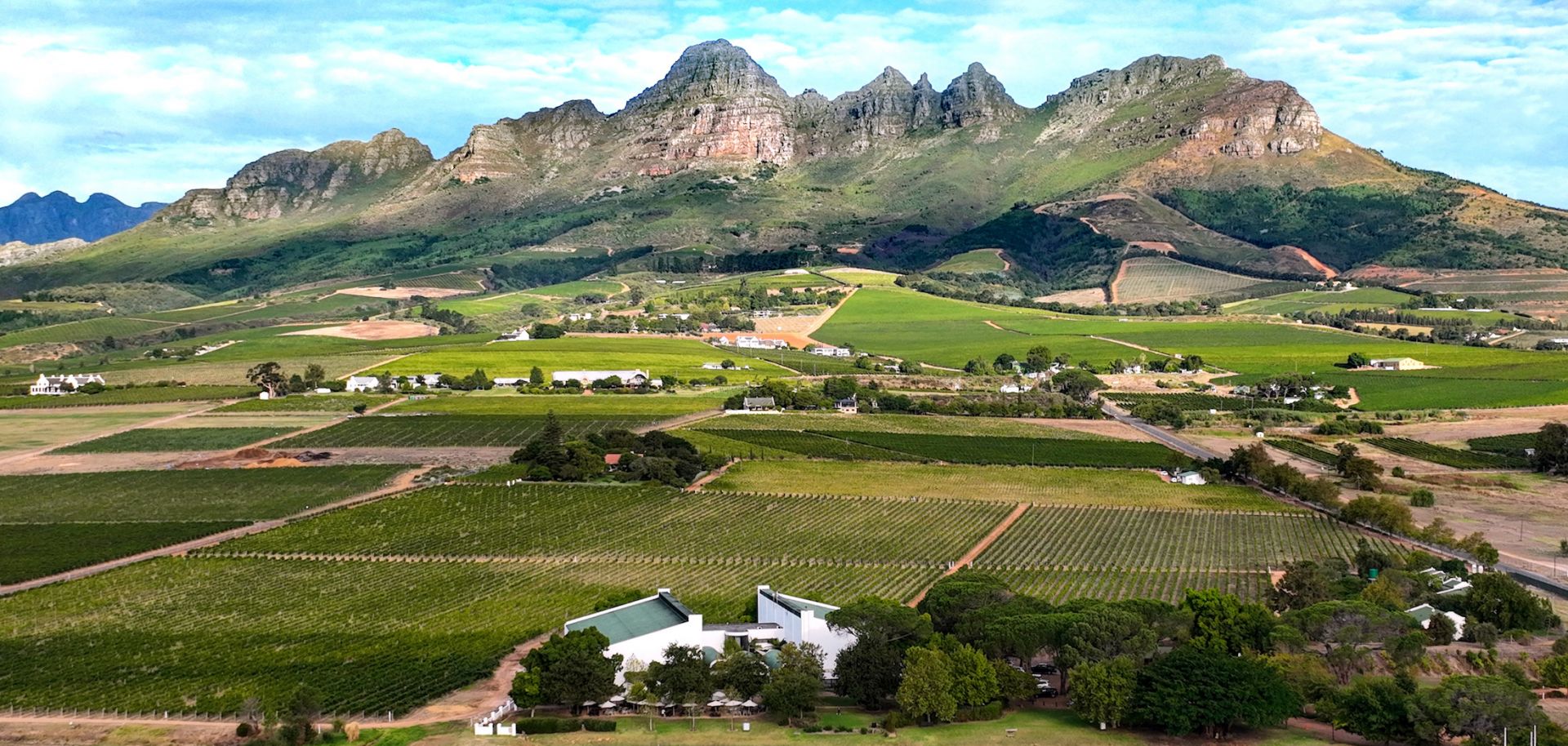
An evening aerial view of the Eikendal Vineyards winery estate on the slopes of the Helderberg Mountain during harvest season on March 15 in Western Cape province's wine-producing town of Stellenbosch, South Africa.
South Africa's land expropriation bill illuminates simmering racial and socioeconomic tensions sustaining the country's long-standing debate over land rights, but the bill is unlikely to usher in a renewed period of land expropriation. The South African National Assembly adopted a land expropriation bill on Sept. 28, despite objections from opposition parties. If South African President Cyril Ramaphosa enacts the bill, which he is likely to do, the bill will enable the government to purchase privately owned land against an owner's will for "public purpose" and in the "public interest," as stipulated in Section 25 of South Africa's Constitution. The bill also includes a "nil compensation" clause, which would amend the existing constitutional mandate on land reform by enabling the government to expropriate land without offering compensation in specific circumstances.
- The South African Constitution's "property clause" stipulates that a person or community dispossessed of property after June 19, 1913, as a result of past racially discriminatory laws or practices is entitled to restitution or equitable compensation.
- The bill's nil compensation clause may be used when land is abandoned, owned by the state or held for speculative purposes (purchased in the hopes that the value will increase without building or development).
Deeply rooted divisions over land redistribution and expropriation have long plagued South African politics. During periods of colonial and apartheid rule, black South Africans underwent mass dispossessions of land that carry through to the current era. As such, land redistribution, including state seizure of privately-owned land, has remained a divisive point of policy contention for decades. Representatives of the ruling African National Congress party (ANC) say the expropriation bill brings legislation in line with the constitution and provides the government with a framework for addressing forced land dispossession by enabling expropriation without compensation — a rallying cry for several South African populist parties — in specific and limited circumstances. Different variations of the expropriation bill have been in progress for 14 years, and the ANC is touting the bill's recent passage as both a social justice and regulatory victory by allowing for nil compensation in specific cases and greater clarity on the specifics of those cases. Officials from the Economic Freedom Fighters, perhaps the most popular populist party in the country, have said the bill does not go far enough, calling it proof that the ANC is a "staunch defender of white land owners." By contrast, the Democratic Alliance (DA), a pro-landowner party particularly popular in Western Cape province, has said the bill is a mechanism for unduly punishing white landowners and that the party will contest the legislation in the constitutional court.
- The 1913 Natives Land Act restricted black people from buying or occupying land and facilitated the mass relocation of black people to "homelands" and townships. While such laws prohibiting black land ownership are no longer in place, 72% of privately owned land belongs to white South Africans, despite white citizens only constituting 9.6% of the country's total population.
The expropriation bill is unlikely to facilitate a government policy shift toward widespread land redistribution, which will provide investors with greater certainty about land reform. Despite the fact that the bill (if enacted) will enshrine the concept of expropriation without compensation into South African law, the nil compensation clause's specificity and limited scope mean the government will still have to pay market prices in most situations — an expenditure that is not included in South Africa's already overstretched budget. For this reason, the bill would need to be extensively amended before it could enable the government to carry out widespread expropriation of privately-owned property, which has been one of the primary fears of investors and farmers. Ramaphosa's administration is unlikely to attempt such reforms because such mass expropriation would discourage investment in South African land and real estate, which would undermine the president's pro-business policies. South Africa's next president (elected either in 2024 if Ramaphosa does not win reelection or 2028 if he does) could attempt to reform the bill-turned-law, but long-standing challenges to land redistribution regarding funding and infrastructure will continue to inhibit existing land reform projects. The combination of these factors means the long-awaited enactment of the expropriation bill will likely put to rest widespread investor uncertainty over property rights for the remainder of Ramaphosa's tenure, and perhaps longer.
- South Africa has long struggled to implement land reform projects due to the underutilization of agricultural land because of a lack of money for input and operational costs, inadequate infrastructure, a lack of market access for agricultural products, and the inability to pay rent and for basic services like water and electricity.
Even so, the expropriation bill will likely inflame racial and socioeconomic divides, laying the groundwork for more extreme demands and proposals from opposition groups. The historical nature of politics surrounding land rights means that the expropriation bill will likely drive opposition parties' rhetoric and policy positions for months — if not years — to come. For instance, the EFF may use the bill's limited scope to demand that the ANC deliver on other leftist policies, including the renewal of the COVID-19-era cash transfer program that is set to expire in March 2023. On the other end of the spectrum, the DA could challenge each of the ANC's future attempts to expropriate and redistribute land — with or without compensation — in court, potentially slowing the government's already glacially slow land reform programs. There will also likely be an uptick in instances of unrest among white farmers and low-income, black South Africans, particularly in rural areas. Such unrest is especially likely if opposition groups attempt to incite violence, which the EFF has done many times in the past.
