
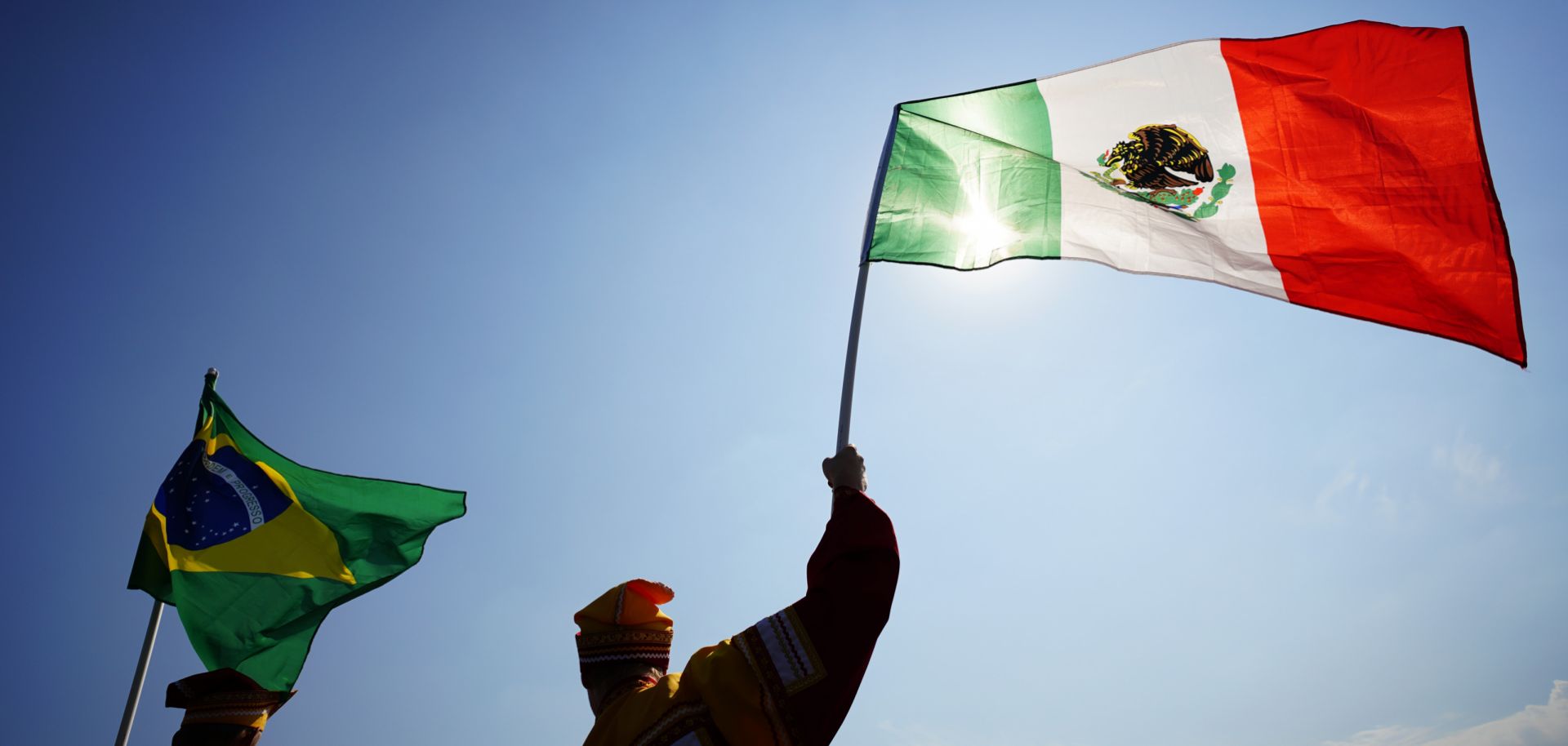
While Brazil and Mexico have proven financially resilient in the face of tighter global financial conditions, insufficient structural reforms in both countries and global economic fragmentation will stymy their economic growth in the coming years. However, compared with Brazil, Mexico is poised to fare better for the remainder of the decade thanks to its stronger economic fundamentals and closer trade ties with the United States. Mexico has been able to avoid a major financial crisis for nearly 30 years, while Brazil hasn't experienced a major crisis since 2002. This is owed to the fact that both countries benefit from solid external debt positions and manageable external financing requirements, while limited foreign-currency mismatches enable them to adjust to external financing through currency depreciation rather than precipitous and often financially damaging currency devaluations. Indeed, while the Mexican and Brazilian economies experienced downturns in the wake of the 2008-09 global financial crisis, as well as during the COVID-19 pandemic in 2020-21, the countries avoided broader financial instability. Both economies will again prove resilient in the current context of China's ongoing economic weakness, high U.S. and EU interest rates, and the global economy's increasing fragmentation. But while the countries may avoid financial destabilization in the years ahead, Brazil and Mexico's economic growth will remain low due to external headwinds and a lack of domestic reforms.
- Brazil and Mexico are the world's 8th and 13th largest economies, respectively. Brazil's $4 trillion economy is roughly the same size as France's economy, while Mexico's $3.1 trillion economy is roughly the same size as Italy's economy.
- In terms of sovereign creditworthiness, Brazil's average rating is a sub-investment BB-, while Mexico's is BBB. While Brazil's external financial position is solid, a combination of high government debt and large fiscal deficits account for its sub-investment grade rating. This constrains public investment and Brasilia's ability to pursue anti-cyclical fiscal policies. Mexico's external and government debt is comparatively more manageable, and its government has also repeatedly demonstrated its willingness to control inflation and exercise fiscal restraint to maintain economic and financial stability.
- Sovereign default risk is currently very low in both countries. Brazilian and Mexican five-year credit default swaps are trading at around 190 and 110 basis points, respectively, implying a very low probability of default on external debt over the next half-decade. Typically, market-based default measures are a better reflection of default risk, as they incorporate all the available information, while credit rating agencies only review their ratings once every 6-12 months and are therefore slower to reflect (more cyclical) changes in risk.
Although both the Brazilian and Mexican economies have managed to avoid financial instability over the past two decades, their growth performance has been dismal. Mexico enacted significant economic reforms after experiencing a major financial crisis in 1994-95, and has since maintained a strong commitment to sound macroeconomic policies. But despite this, Mexico's economy has only grown an average of 2% per year for the past 25 years. Another round of reforms, mostly focused on the energy sector, under Mexican President Enrique Pena Nieto (2012-18) also failed to spur economic growth as intended. Brazil similarly implemented significant structural reforms in the late 90s, shortly after overcoming hyperinflation. During his first two terms (2003-10), Brazilian President Luiz Inacio Lula da Silva oversaw a period of accelerated increased economic growth, thanks in part to a favorable international economic environment. But over the past decade, the country's annual economic growth has averaged a mere 1% due to the weakening of both the external economic climate and Brazil's internal macroeconomic discipline under former president Dilma Rousseff (2011-16), along with increased domestic political instability (including a massive corruption scandal erupting in 2014 that weighed on economic confidence and investment). As a result of this slowed growth, the Brazilian and Mexican economies have underperformed relative to their emerging market peers since the early 2000s. They've also barely grown faster than advanced economies, which is an anomaly given that emerging markets usually grow much more quickly than mature economies due to higher marginal capital productivity and more favorable demographics, among other things.
- Brazil's real GDP growth averaged a mere 0.6% and 2.2% over the past 10 and 20 years, respectively, while Mexico's GDP growth averaged 1.4% and 1.8%. By comparison, the world's emerging and developing economies as a whole averaged 4% growth between 2013 and 2022, with individual countries like India, Indonesia and the Philippines registering an average of 5.7%, 4.3% and 5% growth, respectively, during that period.
- GDP per capita is $18,700 in Brazil and $23,800 in Mexico (by comparison, Canada's GDP per capita is $60,000 and the United States' is $80,000). Both Brazil and Mexico have failed to narrow the per capita income gap with advanced economies over the past few decades, unlike many of its Asian emerging economy peers.
Economic growth in Brazil and Mexico is unlikely to accelerate significantly over the next few years due to a lack of productivity-enhancing economic reform. While financial vulnerabilities will remain manageable, a lack of market-oriented and productivity-enhancing reform will make it unlikely that either economy will grow faster than 2% per year over the next 10 years. Mexican President Andres Manuel Lopez Obrador will leave office next year, but this is unlikely to portend significant policy changes as the current frontrunner to take his position, Mexico City mayor Claudia Scheinbaum, hails from Lopez Obrador's left-wing Morena coalition. If elected president, Scheinbaum would be highly unlikely to pursue liberalization measures and productivity-enhancing reforms needed to boost Mexico's economic growth, given her left-leaning, ''anti-neoliberal'' political base. In Brazil, structural economic reforms will similarly remain limited under left-wing President Lula, whose term ends in January 2027. But even if a reform-minded candidate succeeds Lula, he or she would still find it difficult to push through far-reaching policy changes, as Brazilian presidents have historically relied on diverse and heterogeneous congressional coalitions that typically limit their ability to enact wide-ranging policy reform. Aside from a less than encouraging reform outlook, the demographic outlook in both Mexico and Brazil will also turn from less favorable to adverse in the years ahead. These trends mean that both governments will have a limited capacity to support economic growth through fiscal policy and public investment. But compared with Mexico, Brazil's challenges will be more daunting due to its already higher levels of social security spending and government debt, as well as its greater fiscal imbalances.
- Brazil's gross general government debt amounts to 85% of GDP, while Mexico's stands at 56% of GDP.
- Brazil's projected structural deficit will reach 9% of GDP in 2023, while Mexico's is projected to reach 4% of GDP, leaving little room to support public investment on a larger scale.
- Both Mexico and Brazil's implicit pension and health-care spending-related liabilities amount to 70% of GDP until 2050 — a notably high level by emerging economy standards.
External headwinds brought on by international economic fragmentation will also weigh on Mexico's and especially Brazil's economic outlooks. U.S.-Chinese economic decoupling is bad news for both Brazil and Mexico because it will translate into lower global economic growth due to concomitant trade- and investment-related efficiency losses that arise from protectionism. In view of the potential fragmentation of the global economic system, however, Mexico is less vulnerable than Brazil. The Mexican economy is closely integrated with North America-centered supply chains, which will enable it to attract increased investment in its manufacturing sector. More generally, Mexico benefits from geographic proximity to the United States’ massive economy, as well as its larger number of free-trade agreements with other countries, which should somewhat provide a buffer in case of increased global protectionism. Brazil, by contrast, may be more vulnerable to future external shocks due to its greater reliance on Chinese trade. China's shift toward less commodity-intensive and lower economic growth could weigh on the South American country's economic outlook by limiting demand for its imports. That said, Brazil may still be able to remain a strategic commodity exporter to China. It may also be able to attract increased Chinese foreign investment in its agricultural and energy sectors. But such investments have previously proved more politically contentious than manufacturing investments. Moreover, investment in agriculture is generally less efficiency- and productivity-enhancing than investment in the manufacturing sector.
- Mexico's major exports are cars, computers and auto parts; its main trade partners are the United States and Canada, which purchased 83% and 3% of Mexico's total exports in 2021, respectively. Brazil's major exports are iron ore, soybeans, crude oil, raw sugar and poultry; its main trade partners are China (which purchased $88 billion worth of Brazilian exports in 2021), followed by the United States (which purchased $30 billion) and Argentina (which purchased $12 billion),
- Mexico has been a member of the NAFTA/USMCA trade bloc with the United States and Canada since the mid-90s; it is also a member of the Comprehensive and Progressive Agreement for Trans-Pacific Partnership (which includes Japan and 10 other transpacific countries) and the Pacific Alliance (which includes Chile, Columbia and Peru). Brazil is a member of the South American trade bloc Mercosur (which includes Argentina, Paraguay and Uruguay), but unlike Mexico, it does not have free trade agreements with any of the world's major economies.
