
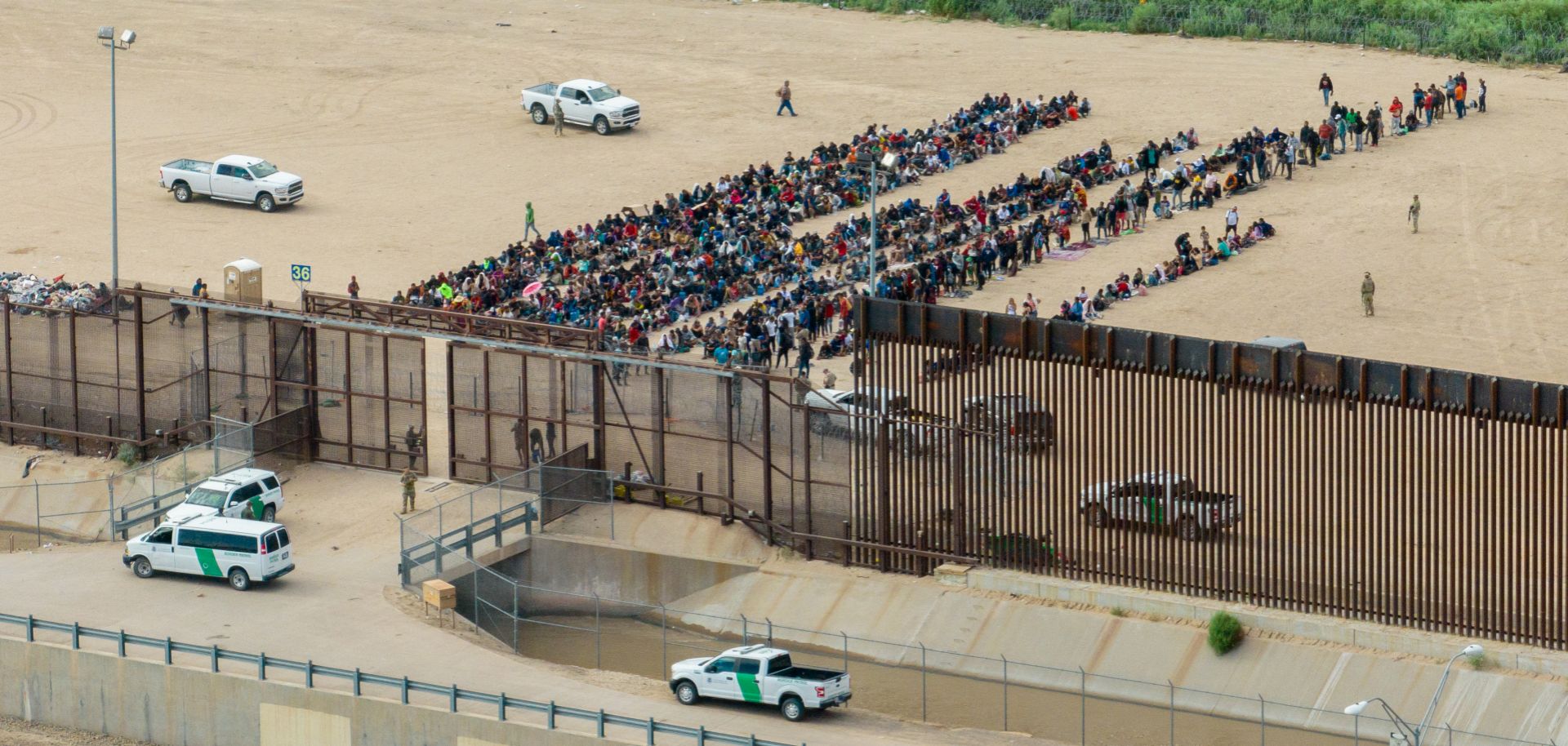
The recent influx of crossings at the U.S.-Mexico border and the consequent supply chain disruptions will make migration a central point of debate in both countries' 2024 general elections, and could also eventually damage Mexico's attractiveness for nearshoring among some companies if the situation does not improve. The number of illegal border crossings from Mexico to the United States has surged in recent weeks, growing from 144,570 crossings in June to 232,972 in August, according to U.S. Customs and Border Protection (CBP) data. While data is not yet available for the full month of September, reports indicate that the month is on track to surpass the record 252,000 border crossings recorded in December 2022. The influx of migrants reaching the southern U.S. border has strained CBP resources, leading to the closure of some official crossings to divert personnel to support migrant processing efforts. Closures and increased inspections have led to massive delays for cargo vehicles waiting to cross into the United States, with thousands of trucks stranded due to wait times lasting multiple days in some areas. Migrants are continuing to arrive en masse at the border, with Mexican President Andres Manuel Lopez Obrador saying on Oct. 2 that 10,000 migrants are reaching the border each day.
- The increase in regional migration follows years of economic challenges across the Caribbean and Latin American regions, which — combined with rising insecurity, political instability and repression in Venezuela, Haiti, Cuba, Nicaragua and Ecuador — has prompted hundreds of thousands of people to depart their home countries and travel north in search of better opportunities.
- The Bridge of the Americas that connects the Mexican city of Juarez to the U.S. city of El Paso, Texas, has been closed for cargo processing since Sept. 18. Earlier this week, the Mexican Employers' Association (COPARMEX) issued a statement indicating the closure has stranded 1,500 cargo trucks.
- Texas Governor Greg Abbott has ordered Department of Public Safety troopers to re-inspect trucks already cleared by CBP, further increasing delays at Texas border crossings. Both the U.S. federal government and Mexico have called on Texas to stop the inspections. Traffic has surged at the Santa Teresa Port of Entry in New Mexico as cargo vehicles take alternative routes outside of Mexico to avoid the inspections.
In both Mexico and the United States, the supply chain bottlenecks are causing economic damage and production disruptions, and are also straining local government resources. On Oct. 3, the government of Mexico's Chihuahua state released a statement indicating that its economy — which is highly dependent on trade through the state — lost more than $947 million between Sept. 18 and Oct. 2 due to supply chain delays at the U.S. border. The United States has also seen delayed deliveries of goods, creating a backlog of shipments that has reportedly caused some Mexican manufacturers to suspend production due to a lack of available storage space. In the United States, the surge of migrants reaching its southern border is straining government resources as well. In September, the Texan border town of Eagle Pass declared a state of emergency last month to provide authorities additional financial resources after an estimated 4,000 people crossed into Eagle Pass from Mexico in two days, overwhelming the local police and fire departments and the town's only shelter. In September, the mayor of El Paso also said the border crisis had pushed the city to ''a breaking point,'' citing that the number of migrants crossing into El Paso each day had increased from about 350 people to 2,000 within weeks — resulting in a surge of new arrivals that has far exceeded the city's shelter capacity.
- The Mexican Employers' Association estimated that the slowdown in trade with the United States is creating daily losses of $35 million for Mexican businesses. Mexico's freight trucker union, CANACAR, has additionally reported a slowdown of up to 10,000 cargo trucks and $1.2 billion in export losses as truckers are forced to use alternative routes or wait in long lines, increasing transportation and logistics costs.
- Railcar manufacturer Trinity Industries, Inc. reported railcars delivered to the United States were 13% below projections for the third quarter due to border disruptions in September.
Most immediately, elevated migration and worsening border disruptions will fuel domestic political tensions ahead of elections in both countries next year. Migration has long been an inflammatory political issue in the United States, and recent comments made by former President Donald Trump and other Republican Party candidates criticizing the current administration's handling of the situation show that this will continue to be the case ahead of the November 2024 election. Texas Governor Abbott, for example, could impose additional border restrictions (one of the drivers of current border delays), spurring protests both opposing and in support of migrants' presence in the United States. Meanwhile, in Mexico, disruptions to business activities in states governed by opposition parties may make the issue more prominent ahead of the country's June 2024 election. While Mexico's federal government has deployed additional security forces to the border, states with particularly severe economic disruptions from border delays could decrease support for the ruling Morena party ahead of the polls, including in the border states of Baja California, Sonora and Tamaulipas, all of which are currently governed by MORENA. Finally, as political figures in Mexico increase references to disruptions from migration, residents or migrants may protest in border states, which could cause further border disruptions, at least temporarily.
- During the second Republican presidential debate on Sept. 27, candidates made migration a primary issue and expressed support for building a wall along the U.S.-Mexico border, with Florida Governor Ron DeSantis saying he would declare migration a national emergency if elected president.
- The United States has seen recent protests both in favor and against migration. In June, people in Florida, Texas, California and other states took part in a protest dubbed ''A Day Without Immigrants'' to oppose a Florida law imposing penalties for those who transport undocumented migrants and for employers that don't verify workers' immigration status. By contrast, in September, hundreds of demonstrators took to the streets of Staten Island in New York City — which has seen the arrival of 110,000 migrants over the past year — to protest the sheltering of some migrants in a local school.
- In Mexico, Chihuahua state officials from the opposition National Action Party criticized the federal government for not taking sufficient action to prevent the disruptions at the U.S. border. Anti-migrant protests are relatively rare in Mexico, but in 2018, hundreds of residents of Tijuana protested against a migrant caravan, blocking roads in the city center.
While the current supply chain disruptions are still limited in scope, a failure by Mexican and U.S. authorities to address the rising number of migrants moving northward could, over time, lead some companies to reevaluate plans to move their operations to Mexico. The United States and China's economic decoupling in recent years has seen a growing number of companies move their operations to Mexico, as businesses calculate that overall they can decrease costs and limit their exposure to potential disruptions related to escalating U.S.-China tensions by shifting supply chains closer to the massive U.S. market — a practice commonly known as ''nearshoring.'' Given the still comparatively small dollar figures, the economic costs of the current supply chain disruptions caused by the migrant crisis at the U.S.-Mexico border are unlikely to significantly challenge this wider nearshoring trend, which saw Mexico surpass China in exports to the United States for the first time in decades this year. However, if the United States and Mexico fail to successfully adjust border operations to account for elevated migration, disruptions could continue at current or increased levels over the long term (a possibility given current record-breaking migration through Central America). If supply chain costs rise significantly as a result, some companies may reconsider plans to shift supply chains to Mexico and other Latin American countries. Such a scenario would be much more likely to impact the calculations of companies still evaluating where to move supply chains compared with those that have already established operations and made investments in the region.
- Even before the current bottleneck challenges, the Association for Supply Chain Management warned that ongoing supply chain shifts to Mexico would strain labor and border infrastructure and create delays, necessitating improvements to border processing measures.
- Redwood Logistics Mexico reported in September that a technology company expressed hesitance to move all of its production to Mexico due to the current delays.
