
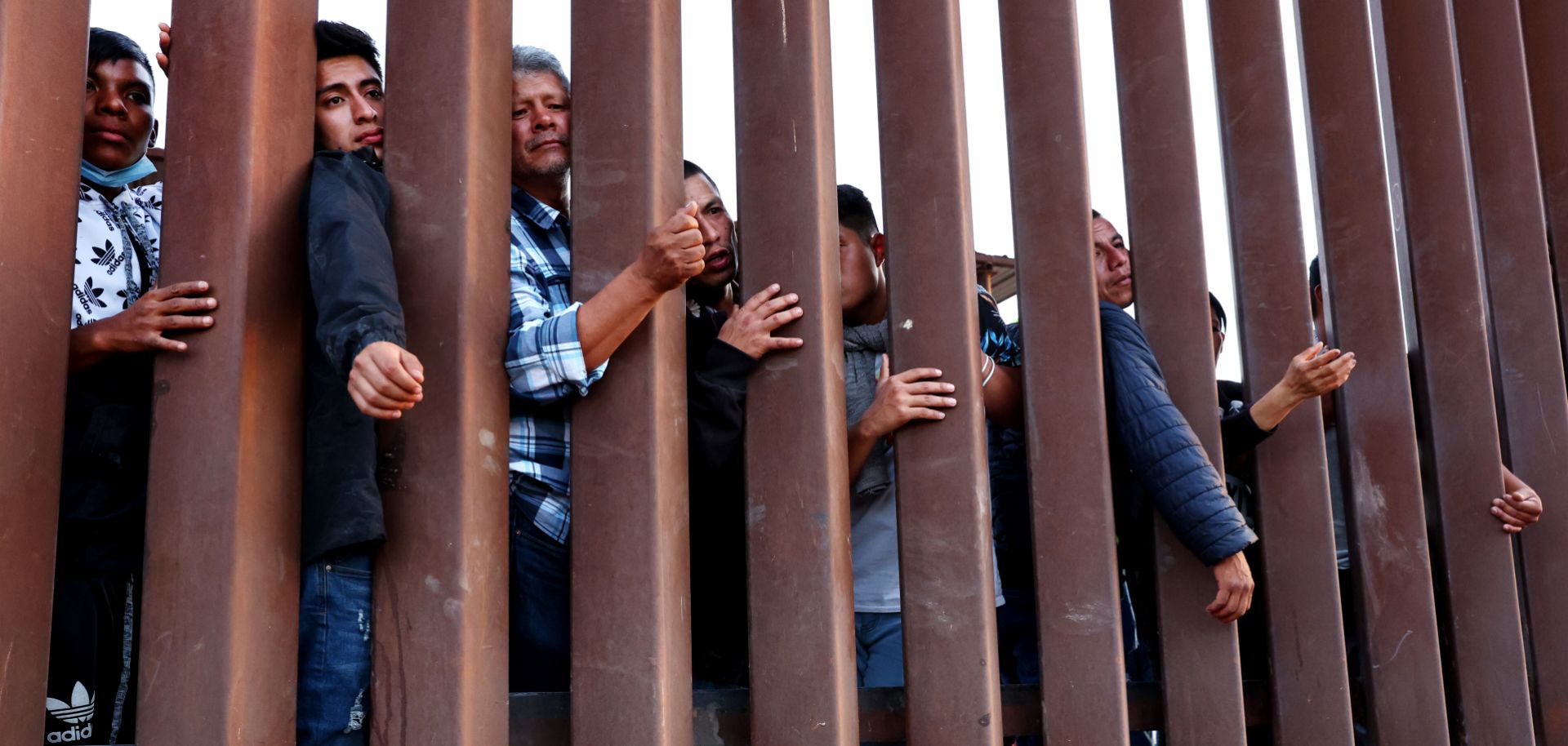
People wait for soup donated by the Yuma County Abolition group after crossing the border from Mexico into San Luis, Arizona, on May 23, 2022.
The administration of U.S. President Joe Biden’s new push to curb northward migration flows in Latin America will likely prove largely unsuccessful — portending more disruptions at the U.S.-Mexico border that could further impede regional cooperation by prompting local lawmakers in the United States to increase their anti-immigration rhetoric and policies ahead of contentious midterm elections. At the end of the Summit of the Americas in Los Angeles on June 10, 20 countries signed a joint declaration to create a region-wide approach to curbing high rates of migration, with an emphasis on curbing migration flows to the United States specifically. The initiative is focused on four main pillars: stability and assistance for communities in migrants' countries of origin, expansion of legal pathways for migration, more humane management of migration, and coordinated emergency response in the case of sudden hikes in migration.
- The signatories of the agreement include Argentina, Barbados, Belize, Brazil, Canada, Chile, Colombia, Costa Rica, Ecuador, El Salvador, Guatemala, Haiti, Honduras, Jamaica, Mexico, Panama, Paraguay, Peru, the United States and Uruguay.
- Latin America has experienced high levels of migration in recent years, as acute economic and political crises in Haiti and Venezuela have driven more people to join traditional flows from Cuba, El Salvador, Guatemala and Honduras to the United States. Subsequently, a record number of over 2 million migrants were encountered attempting to cross the U.S.-Mexico border in 2021 alone. This increase led to anti-migrant measures in the United States, more migrant camps at points of crossing, and increased instances of migrants rushing border crossings, which resulted in several disruptions to cross-border trade.
The initiative is unlikely to effectively curb high rates of migration in the short-to-medium term due to the lack of participation from key transit countries and limited commitments from Mexico and Canada, as well as the United States itself. Mexico and Canada are planning to issue a limited number of temporary worker visas to agricultural workers who would otherwise likely seek to migrate to the United States. But these visas will be available only to a very small portion of the total number of migrants seeking to reach the United States. As a result, the declaration will divert only a small number of U.S.-bound migrants from Haiti and Central America seeking better economic conditions. In addition, the declaration is non-binding, which may lead some countries to bow out of their commitments should governments receive domestic pushback against migration as more populations begin to feel resource scarcity amid high food and fuel prices. South American countries like Brazil and Chile (which have both seen an uptick in immigration in recent years) also notably did not commit to any actions; this will further hinder the declaration’s effectiveness by placing the primary burden of curbing migration on North American and Central American governments.
- The United States has announced $314 million in new funding for humanitarian and development assistance to migrants across the Americas. Canada, Mexico and the United States have also announced independent commitments to expanding temporary foreign worker visas (with an emphasis on the agricultural sector) for a total of 86,500 people spanning 2022 to 2024.
- Many Haitian, Cuban and Venezuelans who immigrated to Brazil and Chile because of the two countries’ recent economic growth are now seeking to resettle elsewhere after facing discrimination, as well as a lack of economic opportunities, in both South American nations.
In lieu of a more substantial regional approach to migration management, high rates of migration will likely provide fodder for politically-motivated stunts ahead of the U.S. November midterm elections, which may strain relations with Mexico and lead to increased disruptions to cross-border traffic. Countries across Latin America and the Caribbean are experiencing high inflation driven largely by rising food and fuel prices. As the economic situation at home worsens, more people from these countries will be incentivized to enter the United States during the fall and summer months, which traditionally see higher rates of migration. The resulting strain on U.S. border infrastructure would, in turn, likely serve as fodder for U.S. politicians ahead of upcoming legislative elections — especially those running for positions in states along the Mexico border like Texas and Arizona, which are both holding concurrent gubernatorial races in November. This could lead local U.S. governments to call for anti-migration demonstrations or increased inspections on cross-border cargo trucks, as Texan Governor Greg Abbott did for six days in April. Such actions would not only put pressure on the U.S. federal government to intervene in state policies — creating a political crisis in the United States — but also likely strain relations with Mexico, which could impede cooperation on security measures and information sharing. A lack of U.S.-Mexico coordination could result in more migrant groups rushing border crossings, as well as increased cartel violence at or near points of crossing. Both of these possibilities would almost certainly slow trade along the U.S.-Mexico border, adding to the mounting global trade and supply chain disruptions related to the ongoing war in Ukraine.
- The United States offers Temporary Protected Status for Haitian migrants, enabling them to access public services and work legally. This makes the United States an attractive destination for Haitian migrants, who currently make up a large portion of those seeking asylum at the U.S. southern border.
