
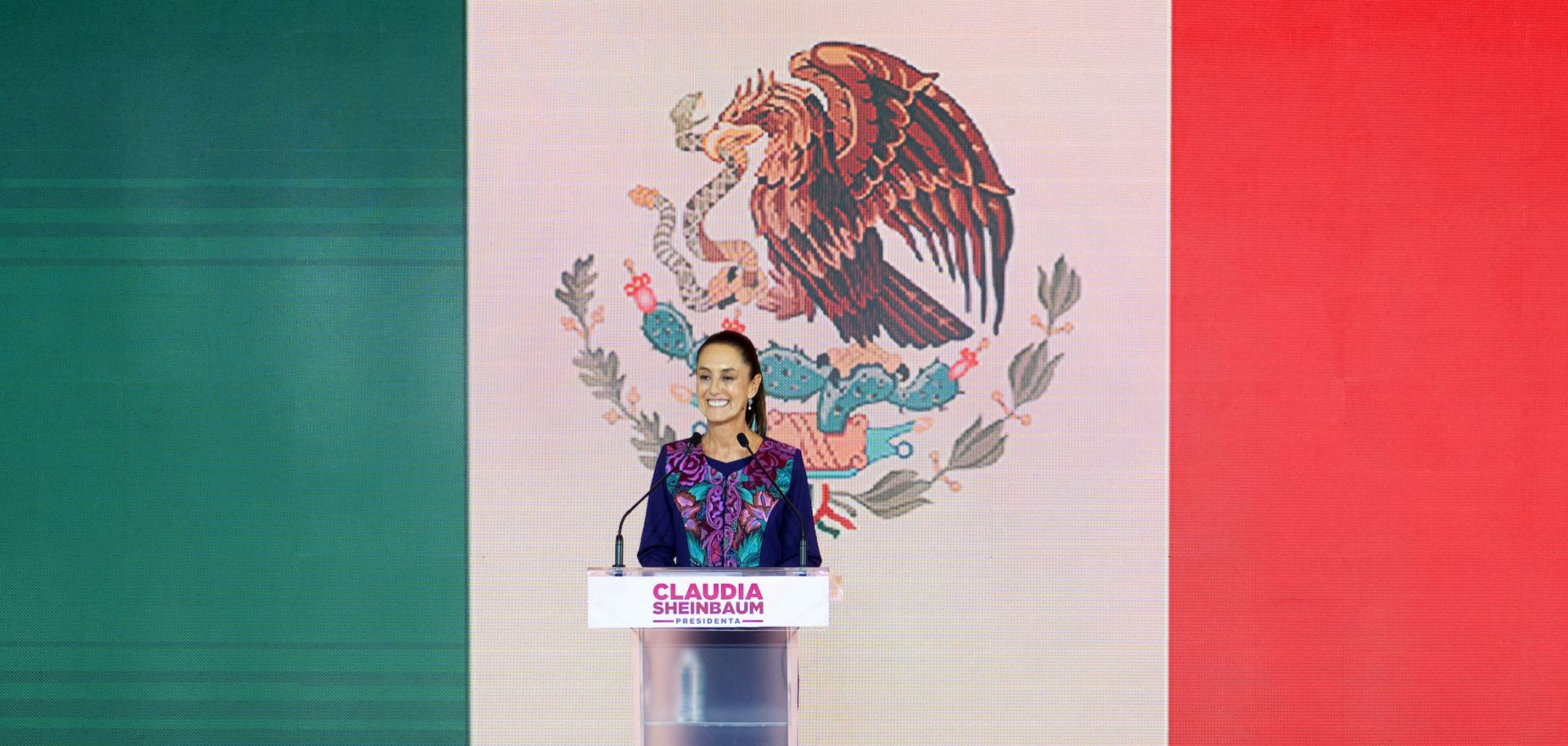
Mexican President-elect Claudia Sheinbaum's pledge to pursue a constitutional reform that would overhaul the country's judicial and institutional systems could diminish Mexico's attractiveness as a destination for foreign investment at a time when the country stands to benefit from global supply chain restructuring. In recent weeks, president-elect Sheinbaun has promised to pass a wide-ranging constitutional reform that would affect labor rights, environmental issues, and independent government regulatory bodies, including the National Electoral Institute, among other agencies. Most importantly, the reform seeks to alter the federal judicial branch, including reform of Mexico's Supreme Court and the election of certain types of judges by popular vote. Some of these proposals have heightened domestic and foreign investor concerns about Mexico's institutional stability and predictability. For example, radical judicial reform would deter portfolio and especially foreign direct investors by making the legal environment less predictable at a time when geopolitically driven economic fragmentation, de-risking and friend-shoring were making Mexico an increasingly attractive investment destination.
- On June 2, Sheinbaum of the left-wing Morena party was elected president to succeed Andres Manuel Lopez Obrador (2018-24), who is also a member of the Morena party. Sheinbaum will begin her single six-year term on Oct. 1.
- In concurrent legislative elections held on June 2, Sheinbaum's Morena-led ruling coalition also won a supermajority in the Chamber of Deputies and fell just two seats short of securing a constitutional majority in the Senate. This might enable the outgoing Lopez Obrador government to pass constitutional reforms once the new legislative session starts on Sept. 1, before he passes the torch to Sheinbaum in October.
- On Feb. 5, Lopez Obrador submitted a package of 18 constitutional amendments and two legal reform initiatives that would primarily affect the judiciary but indirectly affect labor rights, electoral dynamics and the role of the state in the economy, and the electoral system. The proposed changes would also eliminate various regulatory agencies and autonomous constitutional bodies, among other things. The government plans to approve the reforms in September, once the new, more Morena-controlled Congress takes office.
Mexico's economy has underperformed in the past few decades, but it has proved financially resilient to repeated external shocks. In the 2000s, the International Monetary Fund (IMF) classified Mexico as a high-growth emerging economy. But Mexico never succeeded in growing more than 2.5% on a sustained basis since its default in 1982. The reasons for this include labor market informality, limited human capital and insufficient investment. Moreover, Mexico's economic growth is sensitive to the U.S. economic cycle and, in particular, U.S. industrial production given Mexico's extensive integration into U.S. manufacturing supply chains and the large share (85%) of Mexican exports to the United States. Economic shocks — like the 2001 dotcom bubble in the United States, the U.S.-centered global financial crisis of 2008, and the COVID-19 pandemic in 2020-21 led to sharp economic downturns in Mexico, but these shocks were not financially destabilizing thanks to the country's robust macroeconomic framework, including sustainable debt levels, inflationary targeting by an independent central bank, and a floating exchange rate. The energy-focused reforms under President Enrique Pena Nieto (2012-18) were supposed to unleash Mexico's growth potential by opening up and liberalizing the Mexican energy sector to foreign investors. However, economic growth failed to accelerate, largely because the reforms did not provide for significantly greater competition, despite liberalizing parts of the energy sector. Structural reform, particularly in a sector characterized by large and long-term capital expenditure, also requires more time for it to impact economic growth. And under Lopez Obrador, the government began again to play a more important role in the economy, and liberalization and market competition were rolled back. Such a change will likely be intensified under Sheinbaum over her six-year term.
- Between 2000 and 2023, Mexico's real GDP growth averaged a mere 1.7%. Under Lopez Obrador, the country's real GDP grew an average of 1% per year, compared with 2% under Pena Nieto. This compares poorly to upper middle-income economies in Eastern Europe and Asia. The IMF projects Mexico's real GDP growth to average 2% between 2024 and 2029, which is roughly in line with the Mexican economy's historical performance.
Mexico's macroeconomic fundamentals are stable, but the government is running a large deficit and will find it difficult to narrow it to pre-election levels, which means that public debt will continue to increase in the near-to-medium term. During the early years of his term, which began in 2018, President Lopez Obrador stuck to a disciplined fiscal policy, leading to a broadly stable government debt-to-GDP ratio. However, the emergence of the COVID-19 pandemic in early 2020 led to a sharp increase in Mexico's debt-to-GDP, as the government increased public spending to mitigate the social and economic fallout from the crisis, and as the consequent economic downturn eroded government revenues. In addition, in its pre-election 2024 budget, the Mexican government increased social expenditure and investment, leading to a sharp increase in the deficit, which is now expected to reach almost 6% of GDP. Meanwhile, state-owned oil company Petroleos Mexicanos, or Pemex, required (and will continue to require) government financial support amid the government's ongoing tangible reliance on oil-related revenues. This means that Pemex's performance will remain an important factor affecting the Mexican government's financial position.
- The IMF projects Mexico's net public sector debt to increase, even if very slowly, in the next few years, even if the overall fiscal balance stabilizes at less than 3% of GDP. But the IMF also forecasts Mexico's fiscal deficit to reach almost 6% of GDP in 2024, a level that exceeds the deficit of 4.3% of GDP during COVID-19 when economic growth collapsed. Additionally, the IMF predicts a change in the primary balance worth more than 2% of GDP, implying a substantial fiscal adjustment in 2025. It is unlikely that Mexico's government will succeed in implementing such a large adjustment within a 12-month timeframe. Adjustment will be more drawn out if the Mexican government fails to lower the deficit substantially next year — in which case, government debt would also continue to increase, even if only gradually. So the risk of an insufficient fiscal adjustment will remain manageable and the risk of broader financial instability will remain low as long as Sheinbaum remains credibly committed to adjusting fiscal policy in 2025-27.
- Mexico's oil revenues amount to around 15% of budgetary revenue or a little more than 3% of GDP. This continues to make revenues sensitive to fluctuations in global oil prices, despite the government's policy of hedging oil revenues. But the government hedges its oil revenue, making the situation manageable. Stagnant-to-declining oil production does represent a challenge, but much more so over the medium term. Moreover, Pemex has significant liabilities, which are contingent liabilities from the government's point of view (meaning the government would very likely assume and back Pemex's liabilities using its own balance sheet). As of 2023, Pemex's total liabilities stood at $106 billion, almost half of which are set to mature in the next three years or so. The government has already allocated $10 billion to help Pemex repay its maturities.
- Mexico's net international investment position has been stable at roughly 30% of GDP. Its current account deficit is less than 2% of GDP and fully financed, generally over-financed by net foreign direct investment inflows in the form of reinvested earnings (rather than greenfield investment and intercompany loans). Mexico also has access to the IMF's Flexible Credit Line worth $35 billion, providing the country with a seal of approval for its overall economic policies and financial position. The three major international rating agencies assign an investment grade rating of BBB or BBB- (or its equivalent) to Mexico.
Sheinbaum's support for her predecessor's sweeping reforms and her ruling alliance's commanding control of Congress have rattled markets by fueling concerns about Mexico's future institutional quality and stability. A stable, predictable and professional judicial system is important in terms of a country's ability to attract long-term foreign (direct) investment. While Sheinbaum was widely anticipated to win Mexico's June 2 presidential election, financial markets reacted negatively to the unexpectedly strong performance of her electoral alliance in the concurrent congressional elections. With a two-thirds majority in the lower house (the Chamber of Deputies) and a nearly two-thirds majority in the upper house (the Senate), the likelihood of Lopez Obrador's wide-ranging institutional reforms being approved has increased. Sheinbaum has lent her support to the outgoing president's proposed reforms, which, among other things, could lead to an overhaul of the judiciary, including the firing of 1,600 judges and their replacement through popular elections. In principle, the reforms could be enacted as soon as September (when the next Congress takes office), but Sheinbaum has promised broad consultations, possibly as a way to justify watering down the reforms. Her cabinet appointments point toward a more collegial, less top-down approach to policy-making, which also suggests she may be less keen to push through sweeping institutional reforms compared with her predecessor, particularly if they weigh on investment and economic confidence. However, Lopez Obrador and his supporters in Congress are acting to approve some major changes before Sheinbaum takes office in October. Indeed, the Chamber of Deputies' constitutional commission has laid out plans for the judicial reform proposal to be presented to the lower house on Aug. 15 — a development that financial markets reacted poorly to, and will continue to fuel market volatility in the coming weeks.
- Sheinaum's left-wing ruling alliance controls 373 out of the 500 seats in the Chamber of Deputies and 83 out of the 128 seats in the Senate.
- The day after Mexico's general election, the peso lost 10% of its value and Mexican stock markets dropped 6%, reflecting investor concerns about the risks associated with the proposed judicial reform.
- Historically, ex-presidents have held little sway over Mexican politics, in part because they can only serve one six-year term, and in part because lawmakers in the Chamber of Deputies in the Senate cannot be elected for back-to-back terms. Ousting a sitting president requires a two-thirds majority in both houses of Congress, which should limit Lopez Obrador's ability to pressure Sheinbaum to do things she does not want to do. At the same time, Sheinbaum is facing pressure from her congressional allies to push forward with the reform.
In the context of reshoring and friend-shoring, Mexico faces a unique opportunity to attract foreign investment and integrate itself further into the North American economy, but radical institutional reform might undermine its attractiveness as an investment destination. In the 1990s and 2000s, Mexico faced significant competition from low-cost China in terms of U.S. market share. But with international companies pursuing supply chain diversification in the context of increasing geopolitical risks, including Chinese and American ones, seeking to diversify their supply chains, Mexico is again becoming a very attractive destination for foreign direct investment. Mexico's membership in the United States-Mexico-Canada Agreement (or USMCA, formerly NAFTA) provides companies with relatively easy access to the U.S. markets in terms of geography and tariffs. In this context, Lopez Obrador's proposed institutional and judiciary reforms would make it more difficult to take advantage of these structural trends. But foregone economic upside will be much less of an impediment to approving the reform package than a more immediate, negative market reaction, such as higher interest rates, a weaker peso and declining capital investment.
- The IMF has shown that capital flows between geopolitical allies have increased, driven mostly by expanding foreign direct investment. To the extent that investment and trade flows are redirected, Mexico stands to benefit.
- In 2023, Mexico replaced China as the United States' largest import partner for the first time in 20 years. This has not yet resulted in a significant increase in foreign direct investment (FDI) into Mexico, according to the country's annual FDI inflow data. But in the first quarter of 2024, the United States accounted for half of Mexico's FDI inflows.
