
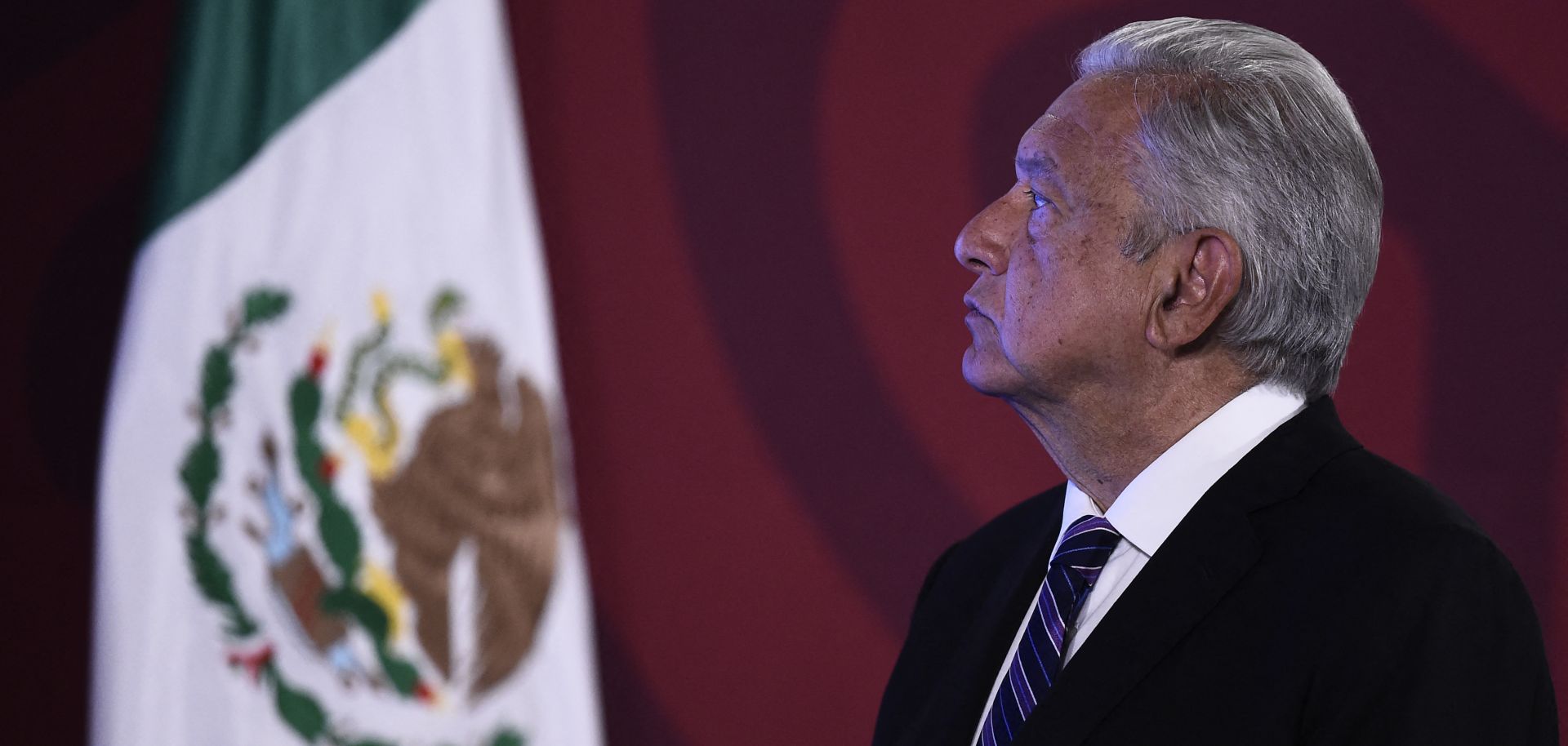
Mexican President Andres Manuel Lopez Obrador looks at a graph during his daily press conference in Mexico City on April 11, 2022.
Mexican President Andres Manuel Lopez Obrador's symbolic victory in the recall referendum he initiated, along with a temporary period of increased collaboration with the opposition, could help cement his government's political agenda. According to a rapid count, Lopez Obrador won an April 10 recall referendum with 90.3 to 91.9% of the vote. While voter turnout was between 17 and 18.2% and failed to meet the 40% threshold to make it legally binding, it was a political victory for Lopez Obrador, who organized the recall referendum as a public litmus check a little over halfway through his six-year term.
- Lopez Obrador first proposed the idea of holding a presidential recall referendum on the campaign trail in 2018 as part of his criticisms of previous governments that remained in power despite low approval ratings.
The referendum comes before Mexico enters a brief break between election cycles, which could see increased collaboration between the government and the opposition on constitutional amendments. While the Mexican government will likely use the referendum as evidence of public support for its policy platform, its political constraints will remain. Lopez Obrador's governing Morena party and its coalition partners have a simple majority in Congress, which enables them to pass legislation. However, the ruling coalition still needs support from opposition parties to reach the two-thirds majority needed to pass the constitutional reforms that Lopez Obrador has proposed. After the June 5 gubernatorial elections, some members of the ''Va por Mexico'' opposition coalition will be more likely to collaborate with the government in an effort to pass aspects of constitutional reforms that are favorable to them, giving the Lopez Obrador administration a window of opportunity to cement its policy platform in the constitution. This window will close when the unofficial campaign season for 2024 general elections begins in late 2023 and once again limits room for cooperation between the government and opposition.
- Lopez Obrador's Morena party needs support from at least 55 of the opposition's 221 lawmakers in the lower house of Congress to pass constitutional amendments. Because it only needs support from a fraction of the opposition, the government does not need to appeal to the more conservative lawmakers to pass amendments, but can instead appeal to those in the center like the Institutional Revolutionary Party.
The Lopez Obrador administration will likely reach deals with some opposition members to introduce reforms that increase the state's control over Mexico's energy sector and potentially other industries. In the coming weeks, the Mexican government is likely to focus its efforts on passing a constitutional amendment that would bolster the role of the state in the country's power and lithium mining sectors. The government will probably also propose similar reforms in the oil and gas industry aimed at further limiting private-sector investment in the country's budding offshore exploration. Some opposition lawmakers will be willing to collaborate with the government on these reforms in exchange for support on policies they favor, as well as increased collaboration on the budget and other items that Lopez Obrador's ruling Morena party has the ability to pass unilaterally. Even if some of the government-proposed constitutional amendments are watered down because of negotiations with opposition members, they will likely still be economically damaging to companies operating in the country's extractive industries and may deter new investment opportunities. Lopez Obrador has also indicated that he would seek electoral reforms to replace Mexico's National Electoral Institute (which he's accused of being biased against him) with a new electoral authority. Such a reform would likely undermine the autonomy of Mexico's electoral institutions, increasing political risk by potentially making the country's election process less transparent. While the opposition has so far refused to collaborate on the controversial electoral reform, a scandal or allegations of corruption involving the National Electoral Institute — verified or not — could increase support for such an amendment.
- Mexico's opposition coalition has proposed 12 additions to Lopez Obrador's proposed constitutional amendment that would further bolster the country's state-owned electricity company against private competitors. The Morena party has accepted nine of these additions, including provisions to reduce electricity costs for households and companies operating in Mexico's agricultural sector. This is a win for the opposition Institutional Revolutionary Party, which has sought to decrease the financial burden on farmers and other agricultural workers in the country — indicating that the opposition will likely work with the government to approve constitutional reforms if it means advancing their own policy platforms.
- Lopez Obrador blames his failed presidential bids in 2006 and 2012 on electoral fraud. In March, he announced plans to send a constitutional amendment to Congress that would dismantle the National Electoral Institute and make key roles, like the electoral councilor and electoral judge, democratically elected positions.
- After the April 10 referendum, Lopez Obrador's Morena party wrote a letter criticizing the National Electoral Institute for holding the vote on Palm Sunday ahead of the Christian Easter holiday when fewer people are likely to participate. The letter also claimed that the electoral commission failed to adequately inform citizens on where to vote and installed an insufficient number of voting booths.
