
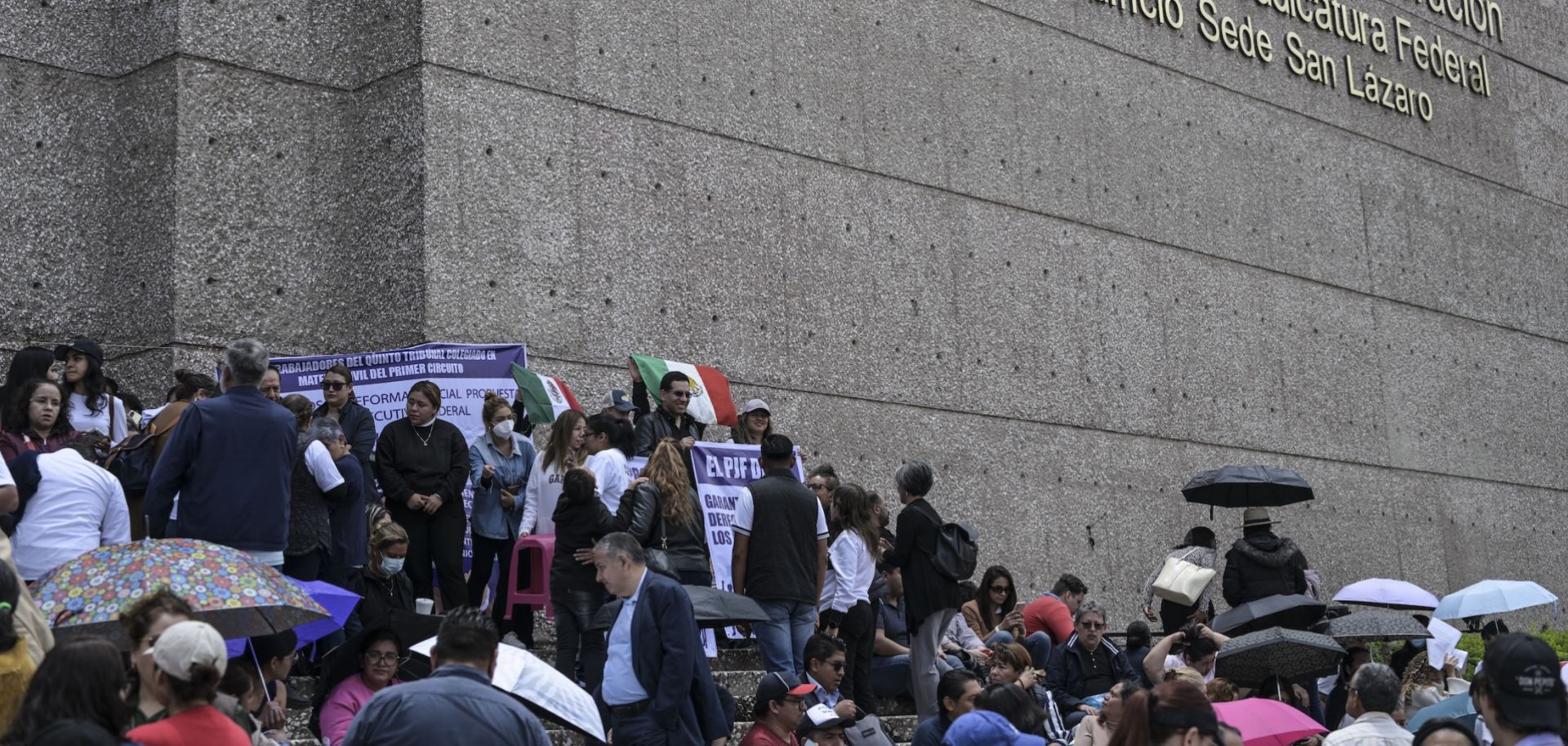
Mexico's government is likely to pass several constitutional reforms by September that will likely reduce judicial independence, increase government control over the economy and harm the business environment in the long term. Throughout August, the Commission for Constitutional Topics of Mexico's Chamber of Deputies will continue voting on 18 constitutional reform proposals President Andres Manuel Lopez Obrador presented in February along with two regular bills that would enact additional reforms. These initiatives range from regulation of mining, energy and agriculture to structural changes to how the country's three branches of government and military forces work. Dubbed "Plan C," the reform package also aims to solidify several government programs Obrador implemented over the past six years by enshrining them in the Mexican Constitution in a bid to make his legacy much harder to reverse before his successor and ally, Claudia Sheinbaum, takes office Oct. 1. With enough votes on the constitutional commission, the ruling National Regeneration Movement, known as Morena, is clearing bureaucratic hurdles so these bills can be put to a vote once the country's new legislature convenes Sept. 1.
- The judicial reform proposal aims to reduce the number of Supreme Court justices and the length of their terms and replace the current appointment process of 1,688 trial, appellate and high court judges with popular elections. The proposal leverages Mexicans' widespread dissatisfaction with their court system, which large numbers deem inefficient, time-consuming, costly and corrupt, according to polls, with almost 50% of citizens saying they have little or very little confidence in judicial authorities. Still, this has been the most controversial recent reform proposal given concerns that it will undermine the country's democratic checks and balances and increase the judiciary's exposure to the interests of political, economic and criminal groups and limit its independence given changes in how judges will be appointed.
- Mexico ranked 116th out of 142 countries on the Global Rule of Law Index in 2023, and has just four judges per 100,000 inhabitants, four times below the global average, according to the National Institute of Statistics and Geography.
- Obrador's Plan C also includes changes to the executive and legislative branches and the electoral system. These include the reorganization of several agencies, institutes and commissions and the centralization of power under the presidency. They would also reduce the number of deputies and senators at federal, state and local levels. They would also eliminate several autonomous regulatory bodies and otherwise simplify the process by which administrative agencies operate.
Lopez Obrador wants to leverage the comfortable parliamentary control his coalition obtained in the June 2 elections to pass sweeping reforms during his last month in office just as Mexico becomes increasingly integrated into global supply chains amid broad geopolitical realignments. Morena and its allies obtained a two-thirds majority in the Chamber of Deputies and lack just two seats for a supermajority in the Senate, positioning them to approve constitutional changes. These reforms will be introduced just as Mexico is becoming an increasingly attractive investment destination on the back of the realignment of supply chains amid geopolitical shifts that have led to near- and friend-shoring. The Council of Global Companies, which represents more than 60 multinationals operating in Mexico, has expressed concerns that the judicial reform will interfere with the judiciary's impartiality. Worries that weaker oversight bodies may enable the government to introduce interventionist sector-specific regulation have spooked financial markets. Private sector concerns focus on the possibility that the executive branch will have unchecked power to unpredictably change or significantly restrict rules on companies' operational conditions, favoring state-owned enterprises amid fewer mechanisms for enforcing contracts and resolving commercial disputes. Proposed reforms would also likely violate commitments regarding market access; investment; independent and autonomous sector regulatory agencies; and antitrust requirements and trade rules under USMCA, complicating the deal's renegotiation scheduled for July 2026, especially if former President Donald Trump wins the U.S. presidential election in November.
- Morena's coalition, which includes the Green Party and the Labor Party, will have 372 out of the 500 seats of the lower house of Congress, 38 more than required to pass constitutional reforms. In the Senate, government allies will control 83 seats compared with the 85-seat supermajority threshold. More than half of the country's 32 state legislatures must also approve constitutional changes, and the ruling coalition controls most seats in 25 of them.
- In 2023, Mexico surpassed China as the leading source of goods imported to the United States for the first time since 2002 amid growing tensions between Washington and Beijing. The value of goods imported from Mexico to the United States rose nearly 5% to more than $475 billion between 2022 and 2023, according to U.S. Commerce Department data.
- Mexico's stock market dropped 6.1% on June 3 as election results showed the ruling coalition had obtained a supermajority in the chamber while the result in the Senate remained unclear. The stock market has partially recovered, but has not returned to preelection levels since. In contrast, the U.S. dollar appreciated 4% against the Mexican peso the day after the vote and has risen 9.7% in total since election day.
Given Morena's strength in Congress, Obrador's political capital and the weakened opposition, legislators will likely pass several constitutional changes in September; Sheinbaum will likely pursue approval of the remaining ones once in office. The presidential election in June was in many aspects a referendum on Obrador's policies, and Sheinbaum promised continuity. Morena's landslide victory in the executive and legislative branches and their strong performance across Mexico's states coupled with opposition internal struggles suggest pushback against the reform package will likely be limited. Although judicial reform proposals have proved controversial and judicial workers launched a strike on Aug. 19, opposition leaders are unlikely to mobilize large crowds or force Morena to significantly water down its proposals, including controversial ones such as the judicial reform. Morena leaders have meanwhile specified parts of the judicial reform on which they will not negotiate, namely the popular election of members of the judiciary, and noted they are willing to adapt only a few parts of the proposal. This is unlikely to ease domestic and foreign concerns about the reform's impact on the country's institutions and business environments. The ruling coalition will be able to pass other potential sweeping constitutional changes unilaterally at least until the midterm elections in 2027.
- Sheinbaum won the June 2 presidential election in a landslide victory, with a 32-percentage-point lead over the second-most popular candidate, Xochitl Galvez, who represented a coalition of all the country's major parties that have taken turns in the country's leadership in the past century. At the state level, Morena went from governing four to 25 out of Mexico's 32 states between 2018 and 2024.
- Morena leaders indicated they are considering adding to the judicial reform proposal a provision to create a technical selection committee to vet candidates so voters would only choose from a list of lawyers of established ability. The ruling party is also considering staggering the judicial elections in two separate votes (one in June 2025 and another coinciding with the 2027 midterm vote), claiming these would reduce the risks of politicization of the judiciary branch critics have flagged.
If passed, the reforms would likely expose Mexico's judicial and regulatory oversight bodies to more influence from various lobbies, enabling interventionist economic policies and weakening the rule of law, likely making the country less attractive to the private sector in the long term. Although the proposal prohibits private donations to judges' campaigns, the popular election of judges will significantly expose Mexico's judicial system to greater influence from political, economic and criminal groups likely to fund campaigns in exchange for increased influence over court decisions. In turn, judges may also prefer sentences they deem popular, rather than fair, to secure reelection. Also, fewer and less autonomous oversight bodies suggest Mexico will have limited checks and balances on the executive branch, especially as the current ruling coalition already controls the legislature at the federal level and in most states. This combination will likely enable further interventionist measures, such as regulatory restrictions on the agricultural, mining, energy and other regulated sectors, limiting the Mexican economy's competitiveness and attractiveness as a destination for foreign investment. That will be especially the case at least over the next six years, as Sheinbaum is likely to maintain Obrador's resource nationalist view while also backing a more prominent role of state-owned enterprises over private sector players. Against this backdrop, courts are likely to disproportionately favor the government, state-owned enterprises and local communities in disputes with private companies operating in the country. This scenario will likely undermine business confidence, as it will fuel regulatory and legal unpredictability and increase the risks of corruption.
- While countries like Japan, the United States and Switzerland elect some judges, Bolivia is the only country where all national judges are chosen by popular vote, a system introduced in 2009. Intended to reduce judicial inefficiency, corruption and political interference, some critics argue that this approach has largely failed. High rates of blank and void ballots indicate voter disinterest, and many judges appointed through this system have political ties but lack experience. The judiciary's legitimacy is further undermined by delays in elections amid political gridlock. In a January 2024 report, the Inter-American Commission on Human Rights noted the heightened politicization of candidates and noted that the judiciary may be subordinated to the "interests of the ruling political power."
