
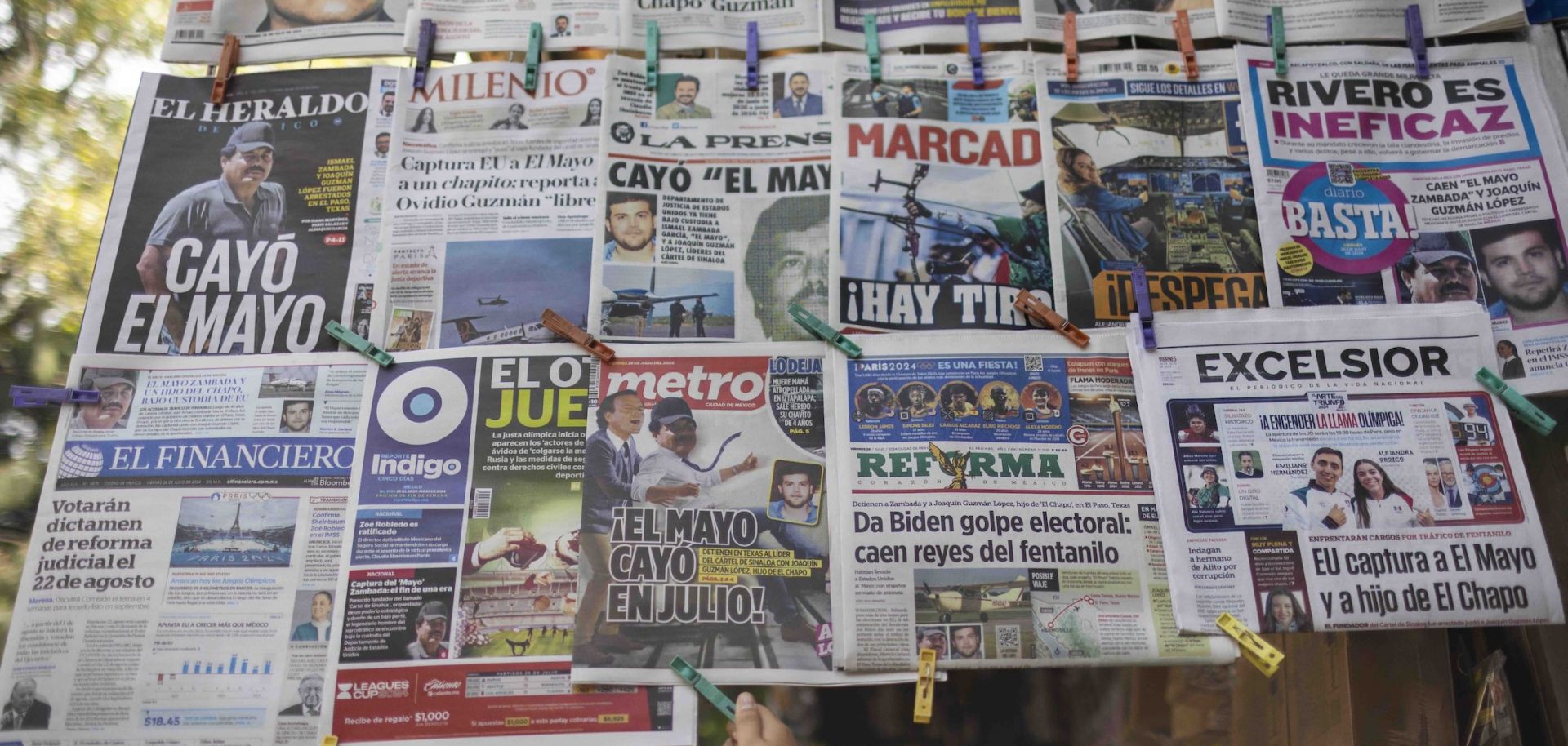
In Mexico, the arrest of two major Sinaloa Cartel leaders will almost certainly trigger retaliatory violence nationwide against local civilians and authorities, as well as potentially U.S. targets, in the coming weeks, while the group's potential consequent fragmentation would shift the country's criminal landscape. U.S. authorities arrested Sinaloa Cartel co-founder and leader Ismael Zambada Garcia, also known as El Mayo, in El Paso, Texas, on July 25 in the culmination of a months-long joint operation between the U.S. Department of Homeland Security and Federal Bureau of Investigation. The operation tricked El Mayo into boarding a plane that he thought would bring him to clandestine airfields in Mexico to inspect for use in drug trafficking operations, but the plane instead landed in Texas, where U.S. agents immediately arrested him. During the operation, U.S. agents also arrested Joaquin Guzman Lopez, one of the sons of Sinaloa Cartel co-founder Joaquin ''El Chapo'' Guzman, who was extradited to the United States in 2017. A U.S. law enforcement official reported that Guzman Lopez was working with U.S. officials to lure El Mayo onto the plane, though this has not been officially confirmed. A day after the operation, on July 26, U.S. President Joe Biden issued a statement commending the work of the law enforcement officials, adding his administration would continue to do ''everything [it could] to hold deadly drug traffickers to account and to save American lives.'' During a press conference held on the same day, the head of Mexico's Secretariat of Security and Citizen Protection Rosa Icela Rodríguez reported that Mexican authorities were informed of the U.S. operation after it occurred, and stated that the Mexican government did not participate in the arrests.
- Lopez is one of ''Los Chapitos,'' a group of El Chapo's sons who have been major players in their father's Sinaloa Cartel in recent years. Another member of the group, Ovidio Guzman, was arrested and extradited to the United States in 2023.
- The United States has been trying to arrest El Mayo for decades. In 2021, the U.S. government increased the reward for information leading to his capture from $5 million to $15 million amid a surge in U.S. overdoses linked to fentanyl trafficked into the country by Mexican cartels.
The arrests come as the Sinaloa Cartel has faced increased challenges in recent years due to the arrest of multiple leaders and increased competition from the rival Jalisco New Generation Cartel (CJNG). The Sinaloa Cartel has dominated Mexico's criminal landscape for decades, after El Chapo and El Mayo formed the cartel in the 1980s in Sinaloa state. The group was the only major cartel that remained largely intact after the government of then-Mexican President Felipe Calderon cracked down on cartels from 2006-2012, which led to the collapse and/or fragmentation of previously powerful groups like Los Zetas. However, in the last decade, the Sinaloa Cartel has faced numerous challenges to its operations. Mexican authorities arrested El Chapo multiple times from 2001 to 2015, with him escaping and continuing to govern the Sinaloa Cartel even while detained. But in 2017, following his third arrest, Mexican authorities extradited El Chapo to the United States, which has since prevented him from governing the Sinaloa Cartel, thus eliminating lower cartel leaders' access to the group's most high-profile leader. Following El Chapo's extradition, his four ''Los Chapitos'' sons and El Mayo took over as the group's main leaders. But the Sinaloa Cartel took another hit in January 2023, when Mexican authorities arrested Los Chapitos member Ovidio Guzman Lopez in Culiacan, Sinaloa, and later extradited him to the United States. In addition to internal leadership challenges, the group has also faced increased competition from CJNG, which has quickly expanded over the last decade, encroaching on the Sinaloa Cartel's dominance over Mexico's criminal landscape. Conflict with CJNG in multiple states, including Michoacan, Chiapas and Zacatecas, has further strained the Sinaloa Cartel's capabilities. In the face of these mounting challenges, reports have indicated increased infighting within the Sinaloa Cartel in recent years, which could worsen following the arrest of El Mayo, who had historically been central in unifying the group due to his status as its founder. There are also reports that Guzman Lopez was involved in the U.S. operation to arrest El Mayo, which may indicate a power struggle, with Los Chapitos potentially attempting to seize full control of the cartel by eliminating El Mayo.
- The Sinaloa Cartel is one of the largest traffickers of cocaine and fentanyl in the world. Within Mexico, the group also engages in human trafficking, fuel theft, extortion and kidnappings for ransom. While the group's operations are based in Sinaloa, it maintains heavy control of the nearby Durango and Sonora states, with a less extensive presence in other Mexican states.
- The Sinaloa Cartel has a decentralized structure to make the group more resilient to counter-crime operations and clashes with rival cartels. Individual cells operate across Mexico but report to a few cartel leaders, who ensure the cartel's trafficking operations run smoothly, collect the bulk of revenue, and dictate operational shifts and geographic expansions. But this decentralized structure, which is common among larger Mexican criminal groups, also makes the group prone to internal fracturing and power struggles.
The arrests are almost certain to trigger retaliatory violence against government and civilian targets in the coming weeks, increasing safety risks for locals and travelers in Mexico, while creating logistical challenges for supply chains. Members of the Sinaloa Cartel are all but guaranteed to conduct retaliatory attacks over the coming days and weeks, as previously seen following arrests of major leaders of the Sinaloa Cartel and other Mexican criminal groups. The violence may include arson attacks, shootings in public areas, bombings, kidnappings, and the implementation of narco-blockades on major roads. Likely targets include security forces, government buildings and businesses, including retail locations. This violence will most likely be concentrated in Sinaloa Cartel centers of operation, namely in the states of Sinaloa (particularly the city of Culiacan), Durango, Sonora and Chihuahua. Chihuahua, in particular, may face an elevated risk of retaliatory attacks given that Ciudad Juarez sits on the border with the U.S. city of El Paso, where El Mayo was arrested; however, the rival Juarez Cartel's control over Ciudad Juarez will likely limit the Sinaloa Cartel's ability to wreak havoc in the city. The U.S. government's seemingly unilateral operation to arrest El Mayo may also trigger rare violence specifically targeting U.S. entities, including well-known U.S. businesses, American travelers, and even U.S. government facilities in Mexico, such as consulates in Juarez, Hermosillo and Tijuana. However, fears of immediately triggering significant retaliation by both the Mexican and U.S. governments will likely limit the cartel's willingness to conduct such attacks against U.S. targets. Increased violence will raise safety risks for local personnel, corporate travelers and tourists, both as bystanders caught in the crossfire and, to a lesser degree, as direct targets for violence, with the additional risk of collateral damage to businesses from arson, bombings or shootings. Narcoblockades, increased government security presence, and the potential short-term cancellation of public transportation due to safety concerns could also delay travel and supply chain shipments through affected areas.
- The 2023 arrest of Ovidio triggered immediate retaliatory violence across Culiacan, which included at least 12 armed clashes between Sinaloa Cartel members and Mexican authorities, as well as narco-blockades throughout Sinaloa state. Sinaloa Cartel members also conducted an armed attack on the Culiacan International Airport that included gunfire against two planes, a passenger plane and a military plane.
In the coming years, the arrests risk shifting Mexico's criminal landscape by fragmenting the Sinaloa Cartel, which would enable the CJNG to achieve territorial dominance across Mexico and create disruptions to criminal groups elsewhere in Latin America, though drug trafficking will likely persist. The arrests will change the Sinaloa Cartel's leadership structure, which — combined with potential efforts by Los Chapitos to seize full control of the cartel amid reports that Guzman Lopez worked with U.S. authorities on El Mayo's arrest — will likely trigger infighting among the group's various factions, particularly the one previously led by El Mayo. Such internal disputes would almost certainly escalate to violence, fueling bloody clashes between rival Sinaloa Cartel groups in the coming months. This would likely result in the cartel's partial fragmentation, in which small factions split away to form their own criminal groups. But over the years, the clashes could eventually lead to the group's near-total dissolution if most of its factions splinter off. Such fragmentation would significantly worsen security conditions in Sinaloa Cartel's areas of operation for an extended period, as intra-cartel violence is typically the driver of the worst criminal violence in Mexico. Murders and public violence would surge in both urban and rural areas of states like Sinaloa and Durango, which have typically experienced lower homicide rates due to the Sinaloa Cartel's total dominance. Though this would likely drive the Mexican government to increase counter-crime actions in the area, previous efforts to stem violence during cartel fragmentation periods have demonstrated the challenges of doing so, as combatting multiple small rival groups simultaneously often strains security forces' capabilities, meaning elevated violence would likely persist for years. Furthermore, partial or total Sinaloa Cartel fragmentation would likely weaken the group, enabling its main rival, CJNG, to seize control of territories in Mexico the two sides have competed over — such as Baja California (including the U.S.-Mexico border city of Tijuana), Chiapas, Michoacan and Zacatecas. CJNG typically uses more extreme tactics than Sinaloa Cartel so severe violence would occur during this process, though levels of violence could ultimately decrease in such areas if and when CJNG eventually achieves dominance. Outside Mexico, the fracturing or dissolution of the Sinaloa Cartel would create ripple effects across Latin America that disrupt the balance between rival criminal groups and escalate violent competition in areas where the cartel holds strong influence, including Ecuador, Guatemala and Colombia. However, despite these far-ranging impacts, the strong market for illegal drugs in the United States and other Western countries will continue to drive drug trafficking and other related crimes in Latin America in the long term, meaning that the arrest of El Mayo and even the weakening of the Sinaloa Cartel would likely not significantly shift the availability of dangerous illegal drugs in Western countries.
- In June 2024, Sinaloa state reported an official homicide rate of 17.4 per 100,000 people and Durango reported a homicide rate of 6.3 per 100,000 people, both far below the nationwide average of 24.9 per 100,000 people (though Mexican homicide rates are likely significantly undercounted). Meanwhile, the high-violence state of Guerrero reported a homicide rate of 56.9 per 100,000 due to competition between rival cartels.
