
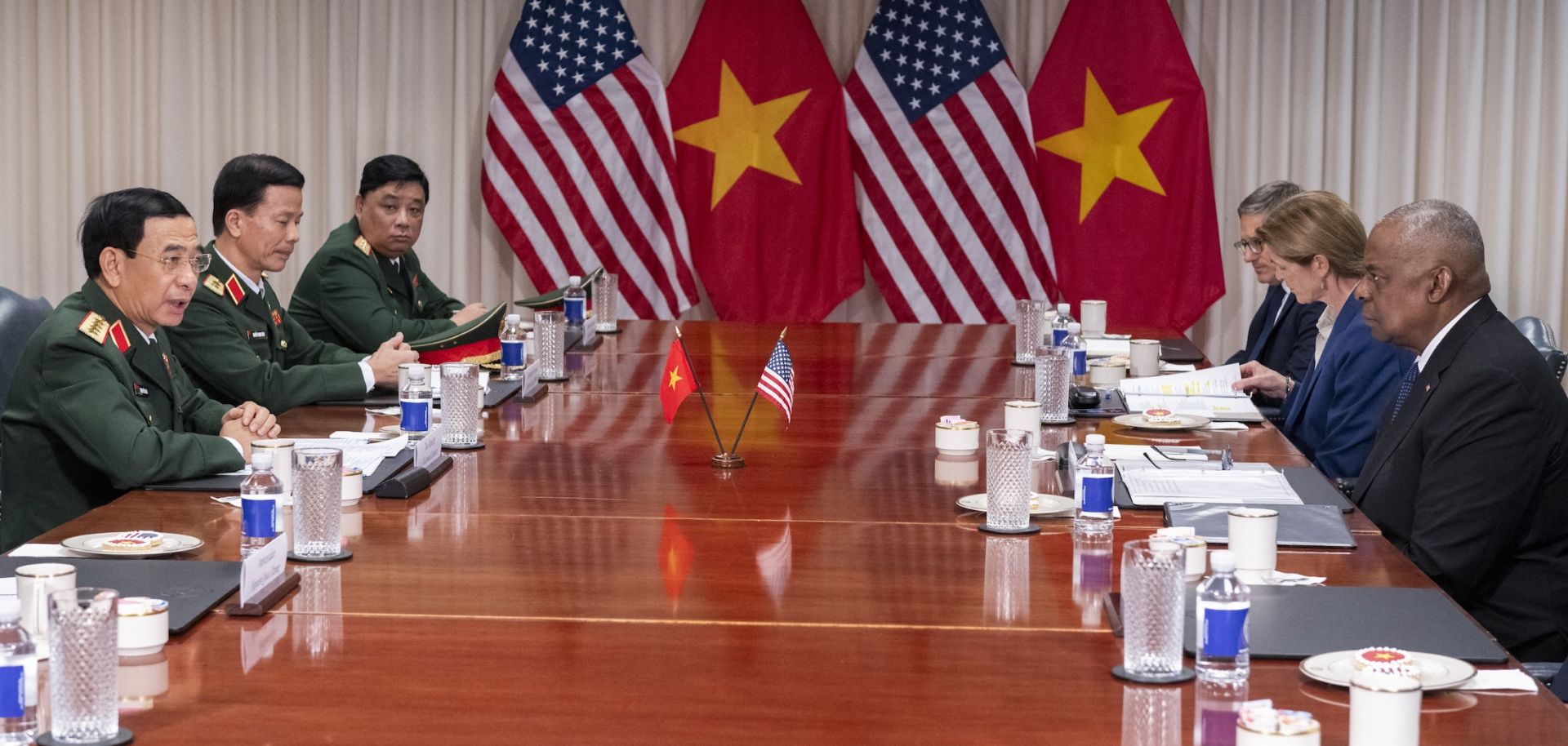
Risks to the U.S.-Vietnam relationship would differ depending on who wins the U.S. presidential election, with Trump likely to prioritize reducing the two countries' growing trade imbalance and Harris likely to balance the strategic partnership with more targeted trade measures. U.S.-Vietnam relations are currently at an all-time high. But the trajectory of the increasingly strategic bilateral relationship will differ considerably depending on the outcome of the U.S. presidential election on Nov. 5. On the campaign trail, Republican candidate Donald Trump and Democratic candidate Kamala Harris have both maintained a tough stance on China, which indicates they would each seek to continue deepening the United States' partnership with Vietnam. However, Trump and Harris' approaches to relations with Hanoi would diverge significantly, particularly on trade.
Under the administration of U.S. President Joe Biden, U.S.-Vietnam relations have advanced significantly, highlighted by the two countries' move to upgrade ties last year. In September 2023, Vietnam and the United States upgraded bilateral ties to a ''comprehensive strategic partnership,'' Vietnam's top-level diplomatic designation short of an alliance. The upgrade signaled a new era of more robust bilateral engagement on both economic and security fronts, setting a foundation for long-term cooperation amid regional challenges that will continue into the next U.S. administration. It also underscored Vietnam's growing importance to the United States as a strategic counterbalance to China in the Southeast Asia region. Deepening economic ties have been the cornerstone of the partnership, with the United States emerging as Vietnam's largest export market and a key investor in the country's evolving technology sector. The Biden administration has emphasized supply chain diversification, supporting Vietnam's emergence as a manufacturing hub to reduce U.S. trade dependence on China. However, the trade relationship has also been marked by challenges, including the two countries' large and widening trade deficit in Vietnam's favor, which the Biden administration has not taken any measures to substantively address. Though Biden's overall approach to Vietnam ties has been less tariff-focused than his predecessor, his administration has imposed more targeted tariffs, specifically on solar panels manufactured in Vietnam.
- The U.S. trade deficit with Vietnam has surged from $39.5 billion in 2018 (when the then-Trump administration imposed new tariffs on China) to $116 billion in 2022 and $104.5 billion in 2023. The trade deficit stood at $69.7 billion when Trump left office in 2020, meaning it has substantially widened under Biden.
- The United States and Vietnam have bolstered defense cooperation through military training, maritime capacity-building and limited intelligence-sharing initiatives, particularly in the South China Sea, where Vietnam's interests align with those of the United States in maintaining a ''free and open Indo-Pacific'' amid China's vast territorial maritime claims and militarization.
- Additionally, the Biden administration has actively engaged Vietnam in technology collaboration, especially in areas like semiconductor production and cybersecurity, underscoring Vietnam's growing role in global supply chain resilience from Washington's perspective.
- In May, the Biden administration levied a 14.25% tariff on imported double-sided solar panels made in Vietnam (as well as those made in nearby Cambodia, Malaysia and Thailand). In October, the White House also issued a 30% tariff on specific solar modules made in Vietnam using Chinese components.
A second Trump administration would prioritize minimizing the trade imbalance over the evolving strategic partnership, potentially limiting broader strategic cooperation between Washington and Hanoi. During Trump's first term (2017-2021), U.S.-Vietnam relations advanced on both economic and security fronts. The administration supported a stronger partnership with Vietnam, recognizing the country's increasing strategic importance in Southeast Asia, especially in the face of China's growing influence. But tensions nonetheless persisted due to the two countries' trade imbalance and Vietnam's currency practices, with the Trump administration in 2020 designating Vietnam a currency manipulator in its last weeks in office. If he reenters the White House, Trump would likely take a hard-line approach to trade, which for Vietnam, would translate to a prioritization of tariffs over the strategic partnership. Particularly as Vietnam continues to gain traction as a significant manufacturing hub for Chinese companies, its expanding trade surplus with the United States would likely lead to higher U.S. tariffs on top of the 10-20% tariffs Trump has pledged to impose on all foreign imports if he wins in November. This would very likely strain relations, limiting cooperation with Vietnam on security and technology issues that counter China's influence. To mitigate potential fallout, the Trump administration could pursue targeted bilateral trade deals, like reduced tariffs for Vietnamese seafood and agricultural products, though such exceptions would need to be negotiated.
- The Trump administration sold coastal patrol boats and cutters to Vietnam in 2017 and 2019, respectively, in the first transactions since former President Barack Obama lifted a U.S. ban on selling military hardware to Vietnam in 2016. Trump also actively sought to sell more arms to Vietnam during his term but did not generate any more substantial deals. Nonetheless, a Vietnamese willingness to purchase U.S. arms in his second term could incentivize Trump to ease tariffs.
- The U.S. imposition of high tariffs on China, beginning in 2018, has allowed Vietnam to thrive as a low-cost production destination, attracting a plethora of Chinese businesses seeking to sidestep these levies. Consequently, Vietnam's trade surplus with the United States has skyrocketed, placing it third among all U.S. trading partners, trailing only China and Mexico.
- The Biden administration removed Vietnam's status as a currency manipulator in April 2021, but still cited concerns over Vietnam's currency practices and large trade surplus with the United States.
A Harris administration, on the other hand, would likely prioritize the strategic partnership with Vietnam over trade issues, though potential U.S. demands to decouple from Chinese technology would also risk straining ties with Hanoi. If elected U.S. president, Harris would likely broadly maintain the Biden administration's approach to Vietnam, which has focused on strengthening the country's role as a counterweight to China's influence in Southeast Asia. This means, like Biden, she would probably take a more cautious approach to trade disputes in an effort to preserve and enhance Washington's strategic relationship with Hanoi. This means, like Biden, she would probably hold firm on targeted issues (like refusing to designate Vietnam as a market economy), while avoiding blanket punitive measures that could severely strain ties. To protect U.S. industries while keeping trade measures narrow, her administration would likely concentrate on specific trade enforcement against Chinese entities that use Vietnam and other regional countries to bypass U.S. tariffs, which would probably involve examining products made from Chinese-sourced intermediate goods exported to the United States as finished goods. Although Harris might address Vietnam's alleged currency manipulation (particularly if a weaker U.S. dollar raises Vietnamese export prices and prompts Vietnam to manipulate its currency), these concerns would likely be handled through diplomatic channels rather than punitive actions. However, Chinese components in Vietnamese products will remain a major concern, which could see the Harris administration demand Vietnamese collaboration on phasing out Chinese technology from critical supply chains. While the White House would likely frame such an arrangement from the perspective of strengthening security alignment between the two nations, significant demands to decouple from Chinese technology would provoke a backlash from Vietnam, who would likely view such asks as overreach given China is its largest trade partner. Indeed, like all other Southeast Asian countries aside from the Philippines, Vietnam has indicated a desire to avoid openly choosing sides in the U.S.-China rivalry. If Harris pressures Hanoi too aggressively, it could thus jeopardize the strategic partnership, as Vietnam's economic ties to China remain deeply entrenched.
- In August, the Biden administration refused to redesignate Vietnam as a market economy (as opposed to a non-market economy), despite Hanoi warning that doing so would have consequences for the bilateral relationship — a threat Vietnam has yet to follow through on. As a Harris administration would likely represent strong continuity with the Biden administration, this — along with Biden's targeted tariffs on technologies like solar panels that include Chinese components — exemplifies how Harris would likely not sideline trade issues while still prioritizing the strategic partnership.
