
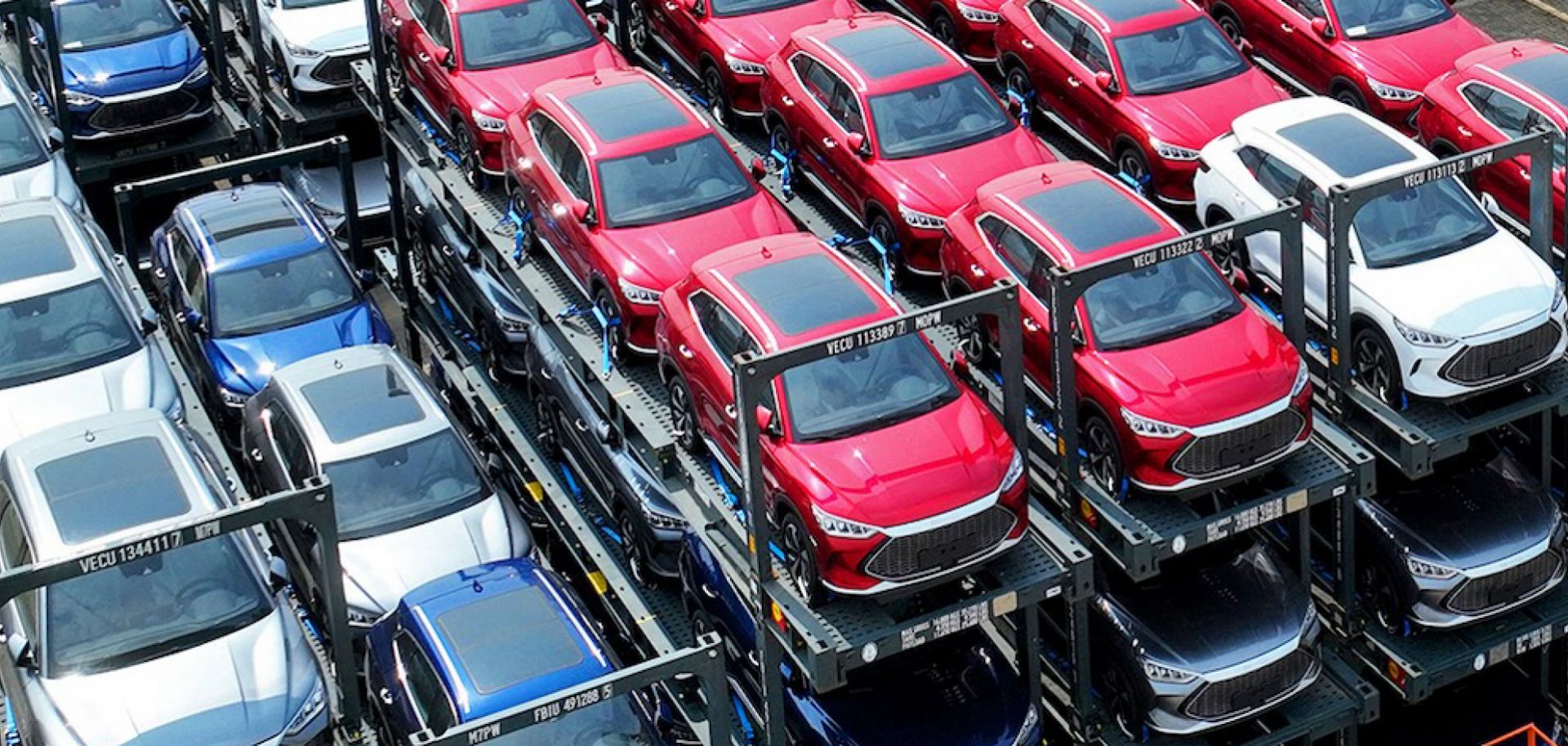
The United States, the European Union and other Western countries will likely restrict the sale of Chinese cars and auto supplies in their domestic markets to reduce national security and economic risks. Over the last six months, the automotive industry — particularly electric and connected vehicles — has become the latest front between China and the West over strategic competition as Western governments look to restrict China's role in the sector. U.S. Treasury Secretary Janet Yellen arrived in China on April 3 for five days of face-to-face discussions with Chinese officials over several issues, including U.S. concerns about Chinese subsidies contributing to growing EV production capacity that could flood global markets. Yellen's visit comes after the Commerce Department on Feb. 29 began formulating new rules that aim to safeguard the information and communications technology and services supply chain for connected vehicles; the rules would broadly define connected vehicles and squarely focus on restricting Chinese technology. The Biden administration is also considering increasing tariffs on Chinese EVs and the automotive industry while reducing tariffs on less strategic goods.
- Beyond the United States, the European Union launched a 13-month probe in October 2023 into Chinese subsidies for EV automakers, which could eventually lead the bloc to place large tariffs on Chinese EVs. Politico also reported on Feb. 27 that the United Kingdom was considering a similar probe.
- On the campaign trail, U.S. Republican presidential candidate Donald Trump threatened on March 18 to place a 100% tariff on Chinese vehicles exported to the United States from Mexico, upping his threat of a 50% tariff made earlier in the month.
Chinese EVs are proving to be cheap and competitive in some Western markets, underscoring that if left unchecked, Chinese EVs could flood developed markets. Chinese automotive manufacturers represent an economic and political threat to automotive industrial bases in Western countries like the United States, France and Germany. This gives Western political leaders an incentive to implement more protectionist measures to shield their workers and domestic base from Chinese competition, particularly after seeing the impact of unrestricted Chinese EVs on Australia's domestic market. Australia's free trade agreement with China, which went into effect in 2015, ensures that most non-luxury Chinese electric vehicles sold in Australia are exempt from tariffs. As a result, China's EV automaker BYD secured 14% of Australia's nascent EV market in 2023, just one year after entering the Australian market, and every EV model currently sold in Australia for less than $50,000 is made in China. As Australia's demand for EVs increases amid Canberra's broader push for decarbonization, Chinese EVs' cheap cost well positions them to take advantage of the non-luxury EV market. China's access to the Australian market is unique, as EV imports to the United States and the European Union are subject to much higher 27.5% and 10% tariffs, respectively. However, this may not be enough to prevent Chinese EVs from being cost-competitive in these markets given China's much lower production costs, government subsidies and the higher cost of labor in the West.
- In 2023, EVs produced in China accounted for 19.5% of EVs sold in Europe, according to the European Federation for Transport and Environment (T&E), and that figure is expected to reach 25% in 2024. While the majority of those vehicles are Western brands like BMW and Tesla, T&E projects that Chinese brands will reach 11% of the European EV market in 2024 and 20% by 2027, with BYD alone targeting 5% of the market by 2026.
- While higher tariffs in Europe and the United States protect their markets to a small degree from Chinese exports, BYD and other competitive Chinese EV companies will avoid some of these tariffs by increasing production outside of China. For example, BYD will open an assembly plant in Hungary in 2026 and in Brazil by the end of 2024, and the company also plans to open one in Mexico. While higher production costs in these countries may ease some risks of Chinese EVs flooding various markets, Chinese companies that manufacture EVs outside of China will still benefit from Chinese subsidies for imported parts and components.
China's role in the EV industry — and the automotive industry more broadly — is also increasingly becoming a national security concern due to data collection. The U.S. information and communications technology and services supply chain review for connected vehicles illustrates growing concern about China's role in the automotive industry beyond just finished vehicles. The review will examine how non-Chinese automakers use Chinese-made connected parts such as GPS systems, infotainment systems, backup cameras and other sensors. Vehicles are becoming increasingly dependent on electronics, and the industry is in the midst of an advanced driver-assistance systems (ADAS) boom; more than 60% of cars in 2030 are expected to use so-called Level 2 or higher ADAS systems, which enable the vehicle to perform some amount of steering by itself, up from just 10% in 2019. Those more advanced systems — particularly Level 3 and beyond — that are beginning to penetrate the market have many sensors like lidars, ultrasonic sensors, cameras and radars. From the perspective of countries like the United States, connected vehicles that use a significant amount of Chinese equipment — regardless of whether or not the entire vehicle sports a Chinese brand — are effectively moving data collection devices that Chinese threat actors could exploit. Given Western concerns about Huawei and other Chinese telecommunication companies penetrating Western telecom networks and creating a national security threat, it is only a matter of time before Western governments implement more stringent requirements on China's role in the automotive industry and access to information collected by cars. While all types of vehicles create these national security risks, EVs are of high concern because most of them are currently in the luxury market, which tends to have more automation technologies.
The United States is likely to take the heaviest-handed approach among Western nations in placing restrictions on Chinese EVs and connected electronics in vehicles. Regardless of the outcome of the U.S. presidential election in November, the United States is likely to eventually increase tariffs on Chinese cars beyond the current 27.5%. Washington will also likely implement supply chain and other restrictions that prevent Chinese automakers from exporting vehicles and vehicle components — including EV batteries, connected equipment and finished vehicles — to the country in large volumes. Ultimately, this will hobble U.S. efforts to decarbonize its transportation sector, particularly for lower-class Americans who may be priced out of buying more expensive EVs. The United States is also likely to eventually expand its export controls and place technology restrictions on some of the most national security-relevant technologies in vehicles that have military applications. lidar, ultrasonic sensors and autonomous driving systems are all technologies that have clear military applications, and Washington will likely eventually target Chinese entities operating in these areas with export controls the same way that it has Chinese drone manufacturers and camera makers. U.S. efforts to restrict China's automotive industry will likely provoke Chinese retaliation, including on U.S. automakers' operations in China and potentially via export controls on crucial technologies. For instance, Beijing could restrict exports of Chinese battery maker Contemporary Amperex Technology Co.'s lithium iron phosphate battery technology, which would limit U.S. automakers' ability to license the technology to build EV batteries in the United States.
The European Union will likely be more targeted in its approach to restrictions on Chinese EVs, but a significant level of restrictions is likely nonetheless, which will likely draw Chinese retaliation. The European Commission said in March that it found "sufficient evidence" that China had provided illegal financial support for battery-powered electric vehicles and that Brussels could impose provisional tariffs as early as July. The commission has also started instructing EU customs officials to register the import of EVs so Brussels can subject them to any countervailing duties at the end of the aforementioned investigation into Chinese subsidies for EV automakers. It is unclear how high tariffs could go, though they will vary by automaker, with Chinese brands like BYD likely to face the stiffest penalties. Although they have not been a focus thus far, Chinese components and technology used in EU vehicles, regardless of where they are assembled, will likely emerge as concerns for the European Union and EU member states. While many European countries are unlikely to restrict Chinese technology in the auto sector as broadly as the United States due to concerns about Chinese retaliation, they will likely eventually implement at least some restrictions, even if they are narrowly focused on the riskiest aspects of technology, like sensors on highly automated vehicles. Despite the European Union's attempt to avoid a broader trade war with China, some level of retaliation is likely, as the bloc accounts for about a third of Chinese EV exports. While China has launched an investigation into brandy imported from the European Union in what is widely believed to be retaliation for France's support of the EV probe, EU brandy exports to China totaled less than 15% of the value of China's exports of EVs to Europe in 2023. Should the EU tariffs be more expansive than Beijing anticipates, China may widen the scope of its investigations into European goods or consider carrying out investigations or placing restrictions on European automakers that have a large presence in China, like BMW.
- European parliamentary elections in June are unlikely to significantly change EU policy on the matter, as European Commission President Ursula von der Leyen would likely return with many of the same priorities under even a slightly more conservative European Parliament.
- Any EU restrictions on Chinese EVs would likely divert some Chinese EV exports to the United Kingdom, Australia and Canada, as these countries have somewhat similar safety and other standards that EVs produced in China or by Chinese manufacturers may find easier to meet. This likely means that the United Kingdom will also implement safeguard tariffs or countervailing duties.
- The European Union would probably be unable to meet its ambitious car fleet electrification targets exclusively through domestic manufacturing, but the bloc likely will not have to, as tariffs are mostly designed to persuade Chinese companies to relocate some of their production facilities from China to Europe rather than completely block their access to the EU market. Additionally, Chinese EV makers already sell their products in China at a fraction of European prices, suggesting they can absorb higher tariffs in the European Union and remain profitable. While there might be short-term fluctuations, the number of Chinese EVs in the European Union will likely continue to grow thanks to the overall competitive pricing.
