
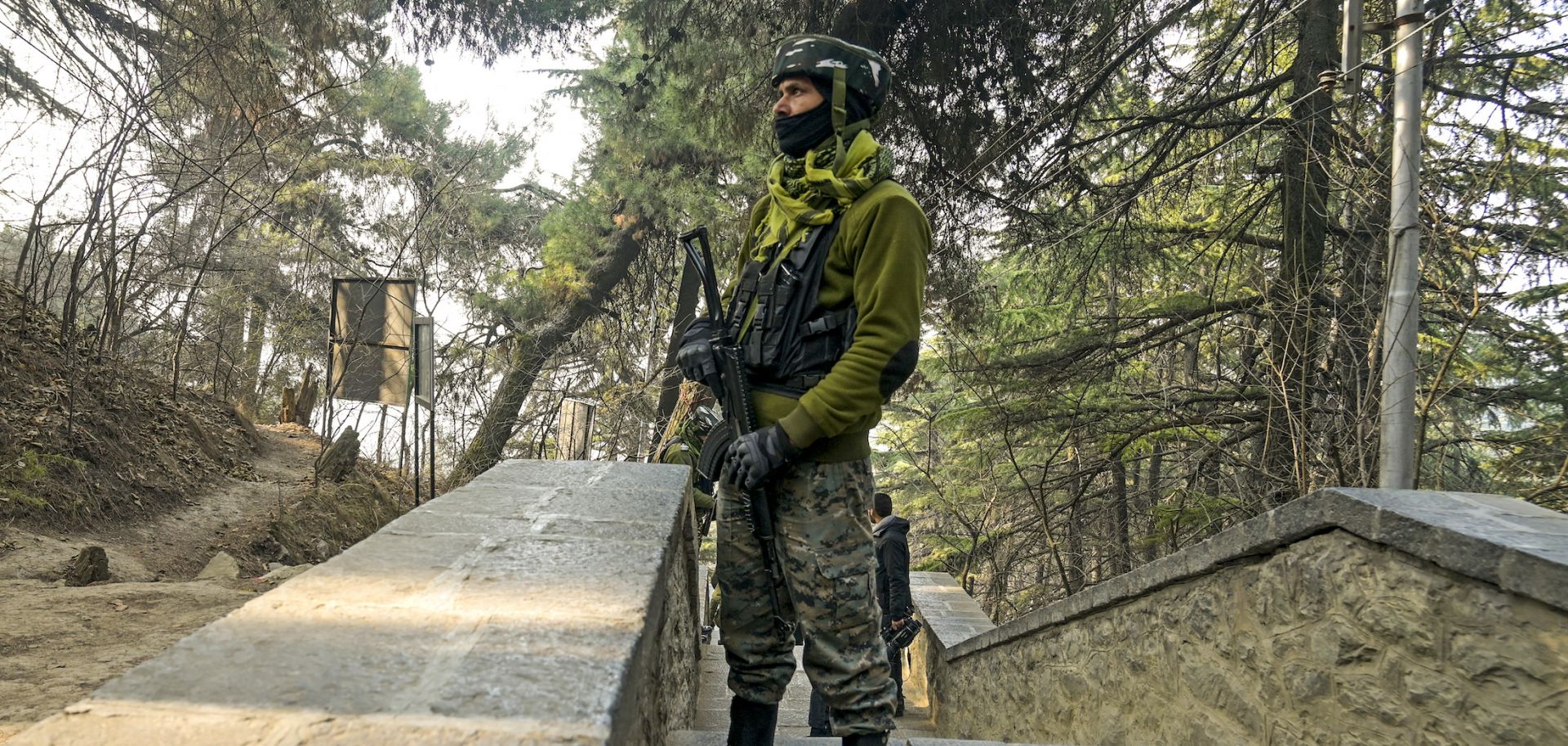
The risk of protest and terrorist attacks in Jammu and Kashmir will increase in the run-up to regional elections, and an eventual mass-casualty attack would risk triggering a military escalation between India and Pakistan. On Dec. 11, 2023, India's Supreme Court upheld Indian Prime Minister Narendra Modi's August 2019 presidential orders that abrogated Articles 370 and 35A of the Indian constitution — which, respectively, had formerly granted constitutional autonomy to Jammu and Kashmir and special rights to its permanent residents. While the ruling was seen as a victory for the ruling Bharatiya Janata Party (BJP), the Supreme Court also instructed India's Electoral Commission to convene fresh assembly elections in Jammu and Kashmir by Sept. 30, 2024, which will be the province's first since the abrogation of Article 370. These elections are thus set to be historically significant, and the Indian government's ability to ensure they run smoothly would significantly strengthen New Delhi's claim over the region. Social unrest has remained limited across the province since 2019 when the central government heavily cracked down on protestors denouncing the abrogation of Articles 370 and 35A through a series of mass arrests and internet blackouts.
- Jammu and Kashmir last held assembly elections in 2014, with residents being without elected representatives and under direct rule from New Delhi since late 2018. The Indian government claims the latter steps were taken due to local parties' failure to form a coalition following the collapse of a regional government in June 2018, but this has been rejected by several Kashmiri parties, who argue the move was a power-grab by the BJP to prevent the formation of a coalition of parties beyond the ruling party's reach.
- Article 370 granted Jammu and Kashmir its own constitution, a separate flag and autonomy on all matters, with the exception of foreign affairs, defense and communications. However, a series of presidential orders over past decades had already significantly eroded the province's autonomy by the time of Article 370's abrogation.
- Article 35A attributed special rights and privileges to Jammu and Kashmir's ''permanent residents'' that did not apply to the state's non-permanent residents, such as the right to vote and purchase property as well as access to government employment, in order to preserve the state's demographic profile. While its removal has triggered fears of demographic replacement among many native Kashmiris, it was prior to its removal a source of frustration for a considerable part of the Indian public, with India's Chief Justice D. Y. Chandrachud noting that it ''took away fundamental rights'' from non-permanent residents.
- While India's Supreme Court instructed the country's Electoral Commission to hold assembly elections by Sept. 30, 2024, these elections could be held at the same time as India's 2024 general elections, which will be held in April and May.
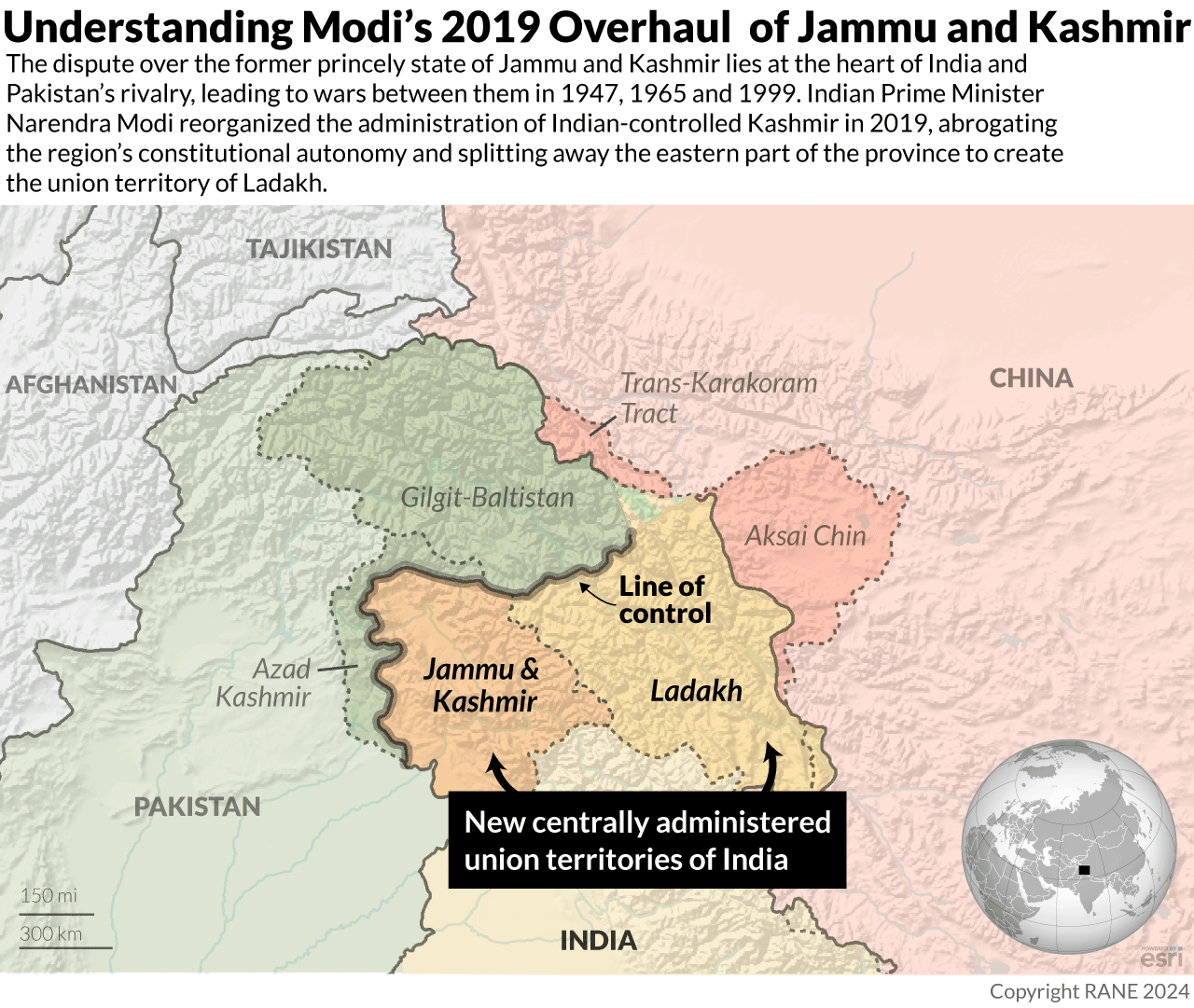
While India's central government has retained firm control over Jammu and Kashmir's security apparatus since 2019, the resumption of political activity will heighten the risk of protest amid fears of interference from the Indian government. In addition to abrogating Articles 370 and 35A of the Indian constitution, Modi's government also redefined Jammu and Kashmir as a union territory, changing it from its former status as a state, which thereby granted the Indian government direct control over policing and security forces in the region, thus enabling it to intensify its crackdown on protestors and militant groups. While protest activity in the Kashmir Valley has died down in recent years, it could see a resurgence amid the resumption of political campaigning in the state in the runup to the upcoming assembly elections — with concerns that these historically important elections may not be free and fair due to interference from the central government. Another factor heightening the risk of protest is fears among many native Kashmiris that the Indian government is seeking to alter Jammu and Kashmir's demographic makeup following the abrogation of Article 35A. The recent redistricting of Jammu and Kashmir's constituencies is adding to these fears, with the Indian government accepting recommendations from the country's Delimitation Commission to increase the number of assembly seats for Hindu-majority Jammu from 37 to 43, while the number of seats in the Muslim-majority Kashmir Valley only rose from 46 to 47. Together with the Supreme Court's endorsement of the abrogation of Article 370, these factors will act as powerful drivers of protests in the run-up to the assembly elections — which the Indian Government would likely crack down upon.
- The Indian government's ban of the Tehreek-e-Hurriyat party on Dec. 31, 2023 is likely to heighten the perception of some Kashmiris that the upcoming assembly elections will not be free and fair. Indian Home Minister Amit Shah stated that the party was banned for ''spreading anti-India propaganda and continuing terror activities to fuel secessionism.''
While the Kashmir Valley has seen a decline in terrorist activity since the abrogation of Article 370, an uptick in attacks is possible in the run-up to the assembly elections amid sustained militant activity in the region. Since the abrogation of Article 370, the number of security incidents in Jammu and Kashmir has declined amid New Delhi's security crackdown on local jihadist groups. Nonetheless, the region faces sustained militant activity — with the number of civilian casualties only dropping slightly despite the heavy presence of Indian security forces. In recent years, most attacks have been led by The Resistance Front (TRF) and the Peoples' Anti-Fascist Front (PAFF) and have primarily targeted migrant workers and religious minorities, especially Hindus. Meanwhile, the electoral campaign for Jammu and Kashmir's 2024 assembly elections will represent an opportunity for these groups to broaden the scale and targets of attacks in an attempt to foil Modi's ambitions of showcasing that normalcy has returned to the region. This could materialize through larger-scale operations, as well as more frequent attacks against Indian security forces. In doing so, militant groups will hope to force New Delhi into pressing ahead with a 2019-like crackdown in the region, hoping that it will act as a catalyst for protests and contribute to isolating India internationally.
- Militant activity in Kashmir has historically been led by Lashkar-e-Taiba (LeT), Jaish-e-Mohammed (JeM) and Hizbul Mujahideen, whose activities continue to be coordinated from Pakistan-controlled Kashmir through the United Jihad Council. According to the Indian government, TRF is a front for LeT, while the PAFF is a front for JeM.
- According to India's Ministry of Home Affairs, the number of ''terrorist-initiated incidents'' in Jammu and Kashmir declined from 153 to 125 between 2019 and 2022 — an 18% decrease. Data from the Ministry also shows that while the number of Indian security forces killed declined by 45% between the 2017-2019 and 2020-2022 periods, civilian deaths were only down by 7% over the same period.
- On Jan. 11, 2024, India's Chief of Army Staff Manoj Pande stated infiltration attempts from Pakistan-controlled Kashmir into Jammu and Kashmir continued, stressing that the areas of Poonch and Rajouri had seen ''increased terrorist activity'' in the last six months.
A mass-casualty attack by militant groups in Jammu and Kashmir would risk triggering a military escalation between India and Pakistan, the likelihood and severity of which would be heightened in the event of a significant increase in support from Pakistan to local militants. As jihadist groups will look to increase their activity ahead of Jammu and Kashmir's assembly elections, the risk of a mass-casualty attack in the province is set to rise in the coming months — albeit from a low baseline. Such an attack would risk prompting India to launch air and artillery strikes into nuclear-armed Pakistan, given Pakistan's military and Inter-Intelligence Services (ISI) decades-long support for these groups. Nonetheless, the absence of a sustained buildup in militant activity ahead of such an attack would indicate Pakistan has not meaningfully increased support for militants in the region, thus reducing India's urge to retaliate heavily against Pakistan and the risk of a major military escalation. The fact that attacks have continued at a frequent pace in the Kashmir Valley in spite of Indian security forces' heavy presence suggests that parts of Pakistan's security apparatus continue to provide support to local militant groups. Nonetheless, the country's military leadership likely exercises some restraint in doing so to avoid a major escalation with India, given Pakistan's own economic, political and security challenges. Given these constraints, Islamabad's support for these groups is unlikely to increase significantly in the immediate term, complicating efforts by local militants to sustain a months-long buildup in attacks ahead of the upcoming assembly elections. However, the latter's importance increases the incentives for Pakistan's military to up its support to militant groups, as India's ability to hold smooth-running elections would be a setback for Islamabad's claim on the region. Should Pakistan increase its support to militant groups, this would likely result in a heightened scale and frequency of attacks in Jammu and Kashmir, which would make a mass-casualty attack more likely while also heightening the risk of a severe military escalation between New Delhi and Islamabad should such an attack take place.
- On Nov. 24, 2023, India's Northern Army commander, Lieutenant General Upendra Dwivedi, accused Pakistan of ''making attempts to push foreign terrorists'' into Jammu and Kashmir, highlighting sustained tensions between the two countries.
- On Feb. 14, 2019, JeM militants drove a vehicle-borne improvised explosive device into a paramilitary convoy near the town of Pulwama, killing 40 Indian security personnel. In response, India launched airstrikes on the town of Balakot, located in Pakistan's Khyber Pakhtunkhwa region, which in turn prompted Pakistan to close its airspace and launch airstrikes into Jammu and Kashmir. Then-U.S. Secretary of State Mike Pompeo later stated that India and Pakistan came ''close'' to a ''nuclear conflagration.''
