
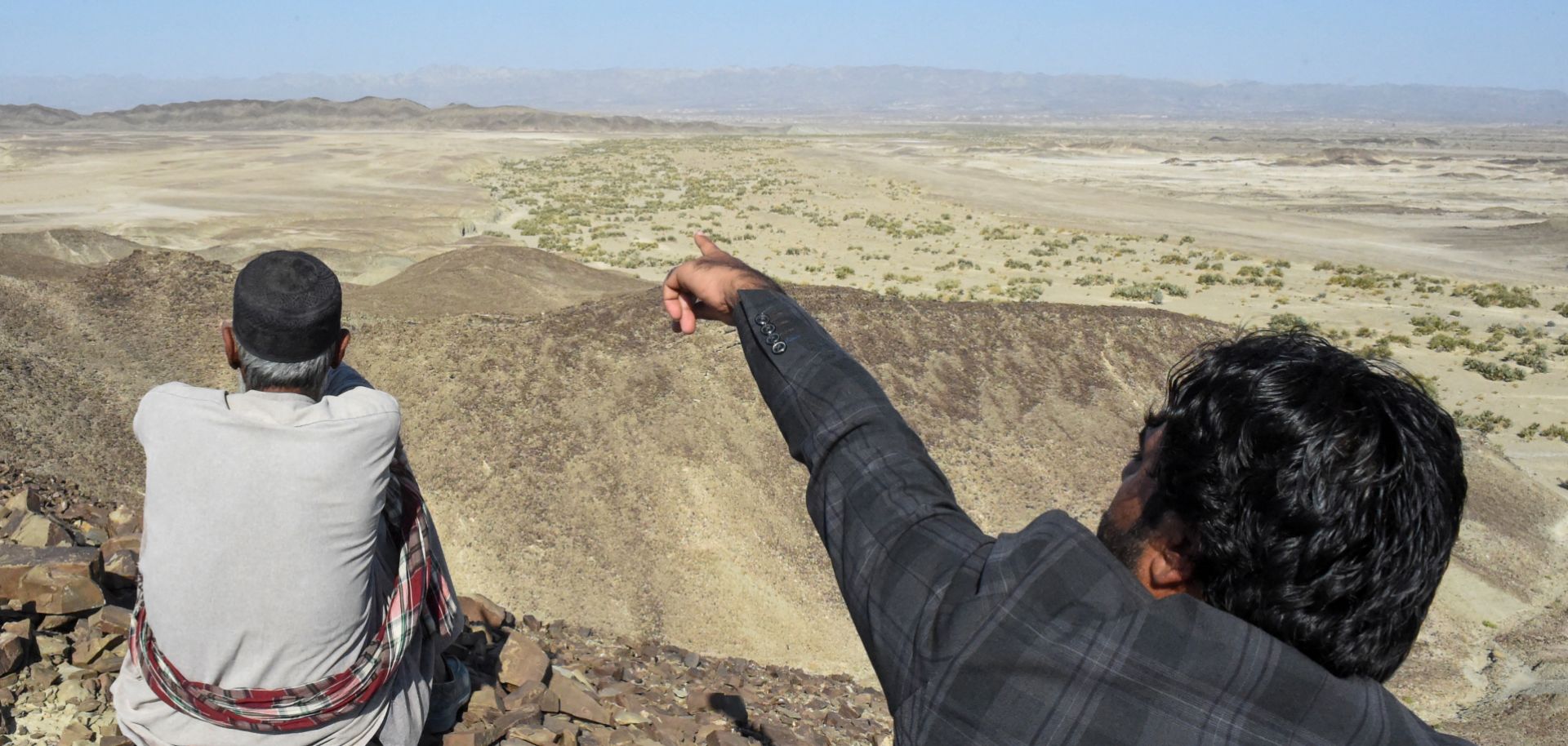
Recent strikes between Iran and Pakistan will heighten risks of border clashes, militant retaliation and protests in Pakistan, while also opening the door to a tit-for-tat escalation that likely neither country wants. On Jan. 18, Pakistan's military said it launched ''precision strikes'' as part of an ''intelligence-based operation'' against alleged positions of the militant Balochistan Liberation Army and Balochistan Liberation Front, which Iranian media says killed at least nine foreign nationals at a village in Iran's Sistan-Baluchistan province. In a statement condemning the attack, Iran's foreign ministry simultaneously underscored Iran's ''policy of good neighborliness and brotherhood'' with Pakistan, and said Iran ''does not allow enemies to strain the amicable and brotherly relations'' between the two countries. While a Pakistani foreign ministry statement cited Iran's alleged inaction against ''terrorists'' and ''credible intelligence of impending large scale'' attacks as triggers for the strike, Pakistan's attack on Iran came just two days after Iran launched a strike on Pakistan targeting alleged bases of the Jaish al-Adl militant group. Pakistan's foreign ministry further stated that Pakistan's strike was a ''manifestation of Pakistan's unflinching resolve to protect and defend its national security,'' and that the country would ''continue to take all necessary steps to preserve the safety and security of its people''; however, the ministry also labeled Iran a ''brotherly country,'' stressed ''dialogue and cooperation in confronting common challenges,'' and committed to ''continu[ing] to endeavor to find joint solutions.'' Multiple countries have urged Tehran and Islamabad to practice restraint, while China has offered to serve as a mediator.
- A day after Iran's Jan. 16 strike, Pakistan's foreign ministry condemned the attacks as an ''unprovoked violation of [Pakistan's] airspace'' and claimed the attacks killed two children and injured three others. That same day, Pakistan also recalled its ambassador from Iran and requested the Iranian ambassador to Pakistan, who was in Tehran at the time, not return to Pakistan.
The strikes mark a major escalation of the two countries' years-long dispute over cross-border militancy, but were likely driven by more immediate domestic political pressures. For years, Iran and Pakistan have accused the other of harboring or failing to sufficiently counter militant groups that conduct cross-border attacks. While this dispute has regularly inflamed tensions between the two countries, Islamabad and Tehran also maintain formal avenues for communication and cooperation on such contentious issues. In 2023, both sides also undertook efforts to strengthen cross-border trade and economic ties, as well as better address security issues along their shared border. Nonetheless, recent events likely incentivized Iran and Pakistan to act now. Iran's decision to strike Pakistan was likely driven by pressure from the ruling elite and hard-line factions within the security services to retaliate and demonstrate strength following the deadly Jan. 3 twin bombings in Kerman, which were later claimed by Islamic State. Iran has since claimed the Islamic State militants who conducted the Jan. 3 attacks crossed into Iran through Pakistan, and while Jaish al-Adl does not appear linked to the Jan. 3 attacks, the group had previously conducted a deadly attack in mid-December targeting a police station in southeastern Iran. Iran's desire to show resolve is particularly strong given the upcoming March 1 vote for the Assembly of Experts (which will pick the successor to Supreme Leader Ayatollah Khamenei) and the parliament. Meanwhile, Pakistan's decision to retaliate was likely driven by a desire for its military to restore deterrence in the immediate wake of Iran's Jan. 16 attack. More broadly, however, Islamabad has other reasons to demonstrate strength and try to regain popular support due to its failure to stem worsening militancy in the country, and amid authorities' stand-off against former Prime Minister Imran Khan over the past year, which has increased popular anti-military sentiment and has led to repeated bouts of social unrest.
- On the same day of the Iranian strike, Iran's foreign minister met with Pakistan's caretaker prime minister at the World Economic Forum in Davos, Switzerland. The two sides had also reportedly met to discuss cross-border security issues in recent months.
- On Jan. 15, Iran also fired missiles into Syria and Iraq, targeting what it claimed to be a spy base for Israel's intelligence agency Mossad in northern Iraq, as well as anti-Iran terrorist groups in Syria. The airstrikes occurred amid heightened tensions in the Middle East due to the ongoing conflict between Israel and Iran-backed Palestinian militant group Hamas in Gaza, now spanning over 100 days.
- In May 2023, Iranian and Pakistani leaders inaugurated a marketplace and a power transmission line along their shared border, in what both sides framed as a notable step toward enhancing regional trade and energy cooperation. Emphasizing the significance of the project, Iranian President Ebrahim Raisi highlighted that both countries now view the border as an opportunity rather than a threat. Then-Prime Minister Shehbaz Sharif added that they exchanged proposals to strengthen and streamline joint border security mechanisms.
Recent strikes increase the risks of border clashes and militant attacks in various parts of Pakistan, and could potentially trigger protests in Pakistan's Balochistan province in the event of disruptions to bilateral trade. Most immediately, the strikes will heighten the risks of clashes between both countries' troops along their border and challenge near-term cooperation on cross-border militancy. The risk of attacks from militant groups on both sides of the border will also increase. Indeed, some groups have already threatened or conducted attacks following recent strikes: Jaish al-Adl has claimed responsibility for killing an Iranian colonel in a border region in Iran following Tehran's Jan. 16 strikes on the group in Pakistan, and the Balochistan Liberation Army has announced ''war on the state of Pakistan'' in the aftermath of Pakistan's Jan. 18 strikes on the group. In Pakistan, the threat of Baloch separatist attacks will be highest in Balochistan province, but will also be elevated in other places including the cities of Karachi and Lahore, where separatists have previously conducted attacks. Such attacks would likely primarily target security forces and potentially Chinese nationals, as separatists accuse China alongside Pakistan of exploiting Baloch resources and land. Other militant groups, namely Tehreek-e-Taliban Pakistan and the Islamic State, may seek to exploit tensions and instability by attempting attacks as well; while these would likely center in Pakistan's Khyber Pakhtunkhwa province, where the groups are most active, both have also conducted attacks in recent years elsewhere in Pakistan. Meanwhile, diplomatic fallout and risks of violence may also disrupt bilateral trade or Iranian supplies of commodities like electricity and fuel. This would threaten shortages, particularly in Balochistan province, parts of which are heavily reliant on such supplies; if prolonged, such shortages in Balochistan would increase risks of protests and unrest there.
While both sides appear intent on avoiding further escalation, additional Iranian strikes into Pakistan would likely be met with a proportionate response from Islamabad, which would heighten the risk of protracted skirmishes along the Iran-Pakistan border. While both Pakistan and Iran have condemned each other's recent strikes, both sides have also made statements underlining their cooperation and the more amicable aspects of their relationship, which suggests neither is intent on extended confrontation. Pakistan, in particular, continues to face severe domestic challenges, namely continuing economic challenges and regular militant attacks, as well as political instability and tensions ahead of general elections scheduled for Feb. 8. Given these challenges, the Pakistani military — which plays a leading role in determining the country's foreign and defense policy — likely wants to avoid entering into a major armed conflict with Iran. Nevertheless, the Pakistani military also likely cannot afford to show weakness, particularly amid many Pakistani citizens' growing frustration with their military and its failure to counter heightened militancy in the country. As such, the extent of the current crisis between Iran and Pakistan is set to be defined by the next steps taken by Tehran. Given Islamabad's desire to avoid heightening bilateral tensions, Iran's decision to refrain from further strikes would likely set the stage for de-escalation between the two sides. But additional Iranian strikes into Pakistan would likely still prompt the Pakistani military to launch proportionate retaliation within Iranian territory. This would in turn risk resulting in the two parties entering a tit-for-tat cycle, which would heighten the likelihood of protracted skirmishes on the Iran-Pakistan border and result in sustained tensions between Tehran and Islamabad. While both sides face strong pressures to avoid escalating to a larger confrontation, their border will remain a flashpoint amid persistent frictions and unresolved grievances, thus sustaining the risk of similar cross-border strikes in the future.
- In theory, China is well-suited to serve as a mediator between Iran and Pakistan, given its strong relations with both countries and its regional interest in counterterrorism security cooperation. Nonetheless, domestic drivers in Tehran and Islamabad will remain the primary indicators for the trajectory of tensions, as China will not militarily intervene directly to stop a conflict (i.e. with a troop presence).
- Severe and protracted tensions with Iran could also see at least some Pakistani Shiites take to the streets in protest, potentially aided by Iranian efforts to stoke grievances or unrest among the minority group that comprises around 10-15% of Pakistan's population.
