
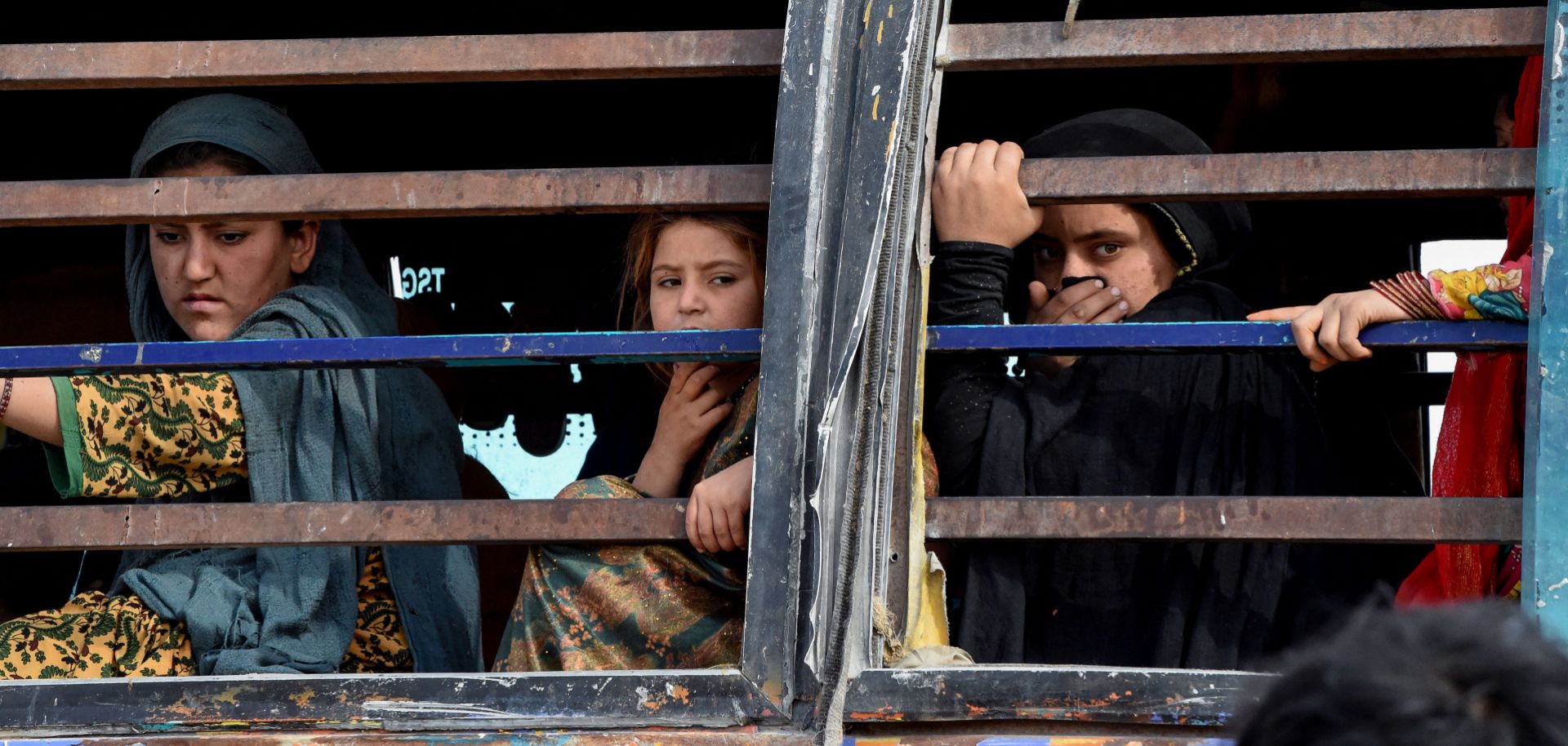
Pakistan's deportation drive and new cross-border travel policy will likely worsen security threats in the country and challenge stability in Afghanistan and potentially the broader region. Security forces have been conducting raids across Pakistan over the past week as part of a nationwide deportation drive that commenced after the government's deadline for undocumented migrants to leave the country expired on Nov. 1. Afghan nationals make up the majority of migrants in Pakistan, and the government estimates that some 150,000-200,000 of the 1.7 million undocumented Afghans in Pakistan have either left voluntarily or been repatriated since the deadline was first announced by Caretaker Interior Minister Sarfraz Bugti on Oct. 3. Local reports claim Pakistani security forces have also arrested and deported some Afghan nationals who were residing in Pakistan legally. Migrants are being held at so-called holding centers established nationwide to process those to be imminently deported, and Pakistan has opened more such centers since the Nov. 1 deadline expired to alleviate hours-long processing times. A new ''one document regime'' also took effect on Nov. 1 requiring travelers of the various tribes along the Afghanistan-Pakistan border to have a valid passport and visa; this supersedes a decades-long policy of providing such travelers with special travel permits that granted greater ease of movement, as many families and tribes were divided by Britain's establishment of the Afghanistan-Pakistan border, or Durand Line, during the colonial era.
Pakistan's tougher approach to migrants comes after militant attacks, rising crime and severe economic challenges over the past year that officials have often blamed on Afghans. While Pakistani officials have claimed security forces are not targeting any specific group in their deportation efforts, they have also repeatedly accused Afghans of largely driving the country's security and economic challenges. Pakistan has faced continued militant attacks since the Taliban took over Afghanistan in August 2021, which the Pakistani government has often blamed on cross-border militancy and accused the Afghan Taliban of failing to counter. In recent months, the Afghan Taliban claim to have arrested some 200 suspected anti-Pakistan militants in border areas, and that the group's supreme leader ordered Taliban fighters not to conduct attacks in Pakistan. But militant attacks in Pakistan have nonetheless continued, sustaining distrust between the two sides. Pakistani officials have also blamed Afghan nationals for driving rising crime in Pakistan's cities, which in combination with militant attacks, officials say is exacerbating the country's economic challenges and straining its recovery. Pakistan was on the verge of default before the International Monetary Fund approved a $3 billion Stand-By Arrangement for it in July; an IMF team just arrived in Pakistan on Nov. 2 to conduct a first review of the country's adherence to the fund's bailout conditions.
- In announcing the expulsion deadline on Oct. 3, Caretaker Interior Minister Sarfraz Bugti claimed that more than half of the 24 suicide bombings the country had faced since January were conducted by Afghans, and that Afghans also made up a majority of militants who have raided Pakistani military bases in recent months. Additionally, Bugti underlined persistent frustrations with the Afghan Taliban's alleged failure to address Pakistan's security concerns, saying Afghans' continuing involvement in militant attacks against Pakistan demonstrated ''they are not honoring the edict'' of the Afghan Taliban's supreme leader, and that Pakistan ''respect[s] him greatly and expect[s] his edict to be enforced in letter and spirit.''
- An Oct. 2 report by the state-run Associated Press of Pakistan appears to contradict officials' public statements that Pakistan is not targeting any particular group and is only focusing on those without legal documentation. The report outlines the three phases in which deportations will purportedly be carried out, with the second phase focusing on ''those with Afghan citizenship'' and the third phase targeting ''those with proof of residence cards.'' In a statement issued on Oct. 31, the non-profit Human Rights Commission of Pakistan underlined these concerns, saying Bugti had ''made it clear'' that the current phase of deportations would be ''followed by the deportation of foreigners with legitimate documents.''
- Pakistan's army chief Asim Munir has similarly alluded to security concerns driving the deportation drive, saying the safety and security of every Pakistani was of ''paramount importance which cannot be allowed to be compromised at any cost.''
The new policies are unlikely to alleviate Pakistan's challenges and will probably only worsen security threats by stretching authorities' resources and intensifying anti-government grievances, heightening risks of protests and violence. Deportation operations will likely burden Pakistan's security forces, which are already tasked with countering heightened militancy, crime and social unrest driven by other political and economic grievances. Should Pakistan remain committed to its current plan, it would likely take at least several months to expel the majority of undocumented Afghan nationals in the country — let alone those from other countries like Iran and Myanmar. Pakistan's caretaker information minister has acknowledged that such mass repatriations will be a ''challenging task,'' which the government has sought to alleviate by breaking up into phases. Nevertheless, even in the early days of the first phase, the new policies have already alienated many Afghan migrants and driven localized protests, some of which have been attended by thousands of people. Risks of protests and potentially violent resistance to such operations may consequently rise as deportations continue. Meanwhile, the Afghan Taliban — which have condemned Pakistan's policies and called for the government to reverse its decisions — have already alluded to a potential retaliatory military response, and the group maintains relations with the anti-Pakistan Tehreek-e-Taliban Pakistan that it may leverage to intensify violence in Pakistan. This suggests Pakistan's security challenges are only poised to worsen in the coming months, a sensitive time given the country's continuing economic challenges and long-delayed elections scheduled for Feb. 8, 2024.
- Pakistan's new cross-border travel policy has also driven continuing and reportedly thousands-strong protests in the border district of Chaman, Balochistan province.
- Pakistani officials' accusations that Afghans are largely driving the country's challenges also risks driving anti-Afghan sentiment among Pakistanis that increasingly devolves into targeted violence and intercommunal clashes. The government has already threatened legal action against Pakistani citizens accused of ''assisting'' undocumented migrants by providing shelter or employment, which is reportedly prompting Afghans to be evicted by landlords or terminated by their employers.
Even if Pakistan fails to expel all Afghans from the country, the influx of migrants returning to Afghanistan will worsen humanitarian and economic conditions there, likely destabilizing Afghanistan and potentially the broader region. Afghanistan has experienced continued dire economic and humanitarian conditions that have challenged the Afghan Taliban and sustained its reliance on international actors to help deliver basic services. These challenges have only worsened after a series of deadly earthquakes and aftershocks — among the most destructive in the country's history — hit the western part of the country in October. While the earthquakes prompted a number of countries to pledge humanitarian aid and support, the United Nations and multiple aid organizations had already reported severe humanitarian funding shortfalls over the past year that had begun disrupting aid operations in the country. The influx of Afghan migrants from Pakistan, in addition to the recent earthquakes and the impending onset of the country's traditionally harsh winters, will significantly worsen Afghanistan's humanitarian and economic challenges at the risk of further destabilizing the country. This may only be exacerbated by the fact that Pakistan's policies appear intended to escalate pressure on the Afghan Taliban to more sincerely address Islamabad's security concerns. If they have the desired effect, Pakistan's recent moves will inflame disagreements within the Afghan Taliban over whether the group should continue supporting its long-standing partner TTP, which is based in eastern Afghanistan and has been primarily responsible for the surge in militant attacks in Pakistan. While the Afghan Taliban have remained unified despite reportedly facing other severe challenges to its cohesion, a heightening of disunity within the group would only risk further worsening instability in Afghanistan. This may result in increased social unrest and violent resistance to the Afghan Taliban as dissatisfaction with authorities worsens, and may heighten the threat of militant attacks in Afghanistan as the Afghan Taliban's resources are further strained.
- Estimated fatalities from Afghanistan's October earthquakes range from nearly 1,400 to 2,400 people, while the United Nations says that after assessing two-thirds of affected areas, more than 21,500 homes have been destroyed and another 17,000 have been severely damaged.
- Iran also made a similar pledge to expel undocumented Afghan migrants in recent months, with its interior minister saying on Sept. 27 that the country was ''close to implementing the plan.'' Refugee flows from Iran would only further strain already limited resources in Afghanistan.
- Most migrants being expelled from Pakistan are reportedly going back to Afghanistan. But given the dearth of economic opportunities and severe humanitarian conditions present there, some will likely try to enter Iran or attempt to travel to other regional countries from Afghanistan.
