
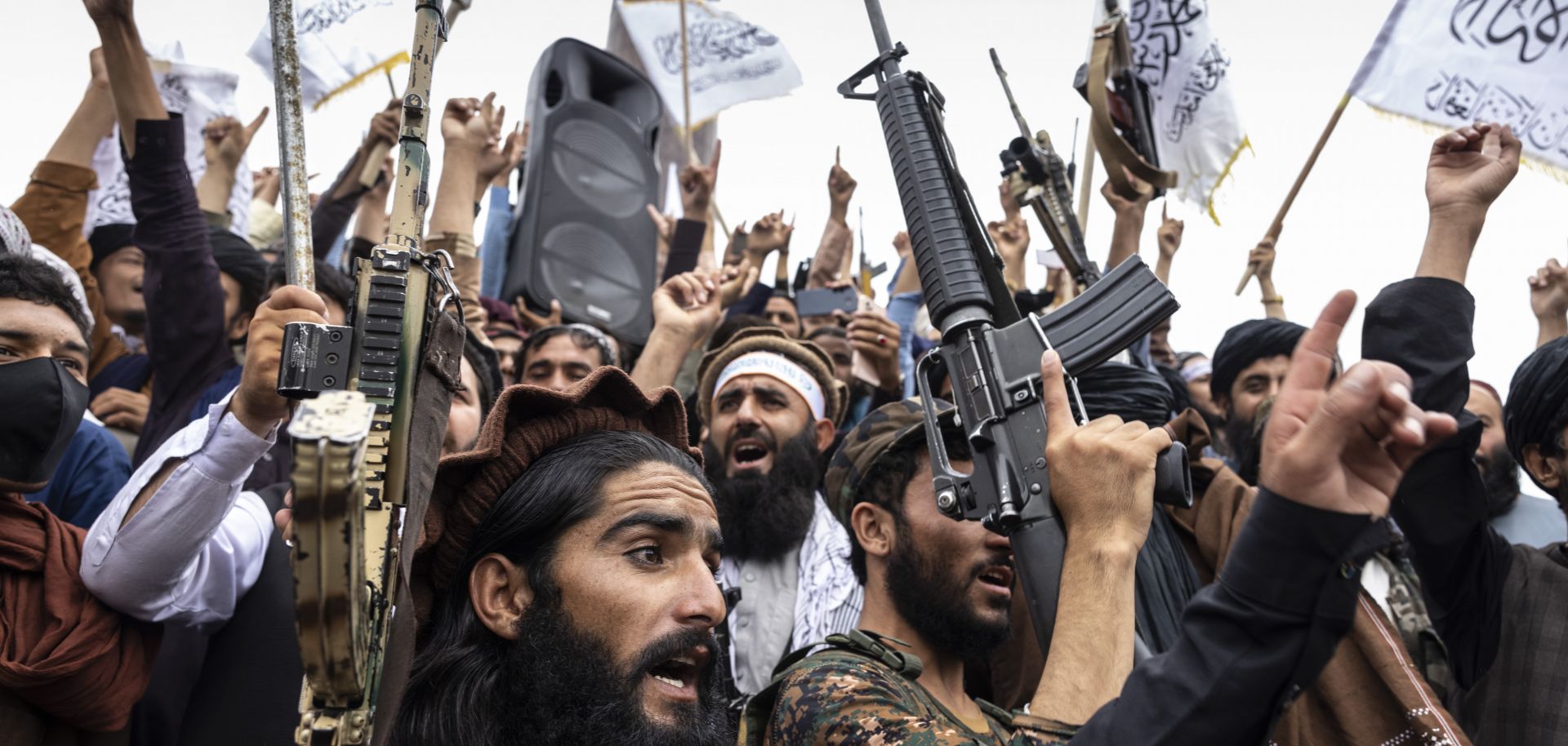
Taliban supporters take to the streets in Kabul, Afghanistan, on Aug. 15, 2022, during a national holiday celebrating the first anniversary of the group’s takeover of the country.
Editor's Note: This column is the first of a two-part series that explores where the Taliban exceed expectations since retaking control of Afghanistan on Aug. 15, 2021, and the many challenges that still lie ahead for the group as it enters the second year of its second reign over the country. The second part, which focuses on the many threats the Taliban will face to their continued rule, can be found here.
Although the Taliban have fared better than initially expected at managing certain aspects of governance since seizing power last August, the group continues to face a diverse array of challenges that it appears poorly equipped to resolve amid persistent disunity and the dominance of hard-liners in the movement. Just over a year ago, the Taliban seized control of Kabul following a rapid offensive across Afghanistan. The ensuing chaos saw the collapse of the former Afghan government and the frantic withdrawal of U.S. and U.S.-allied coalition forces from the country. In the immediate aftermath, many observers raised concerns about whether the Taliban would be able to maintain control over Afghanistan and, if so, if they would form a more inclusive and effective government compared with the prior Taliban regime that ruled over Afghanistan between 1996 and 2001. But while the group has exceeded expectations in managing certain political, diplomatic and economic issues over the past year, the Taliban face multiple constraints that will continue to threaten their hold on power, including persistent disunity and the continued dominance of hard-liners in shaping domestic policy.
The Taliban's Relative Successes
1. Securing overall political control
The Taliban have been able to successfully secure and maintain broad political control over Afghanistan by implementing the strategic lessons learned from their previous rule and by capitalizing on the current lack of strong resistance. As demonstrated in its 2021 military offensive that ended in the seizure of Kabul, the group recognized early on the importance of establishing and maintaining control of rural areas and border checkpoints, which enabled them to besiege (and eventually seize) government-controlled areas and force the surrender of the Afghan government.
The lack of major foreign support to anti-Taliban resistance forces, combined with the low morale among government troops, also helped the Taliban physically consolidate power. The former Afghan government was already exceptionally fragile, corrupt and widely unpopular, which left its military forces unwilling and unmotivated to stand up to the Taliban after foreign forces pulled out. Meanwhile, the resistance fighters who maintained control over pockets of northern Afghanistan during the Taliban's last reign also lacked the coordination and foreign financial support to put up a serious fight — enabling the Taliban to soundly overtake all of the north this time around.
Over the past year, the Taliban have also put loyal commanders and religious scholars in charge of all Afghan provinces. The big show of loyalty or control by the Taliban was during the so-called "loya jirga," or grand council, meeting in June 2022 in which about 3,000 clerics and religious scholars participated. Although the meeting did not yield any big political and social policy decisions, the event highlighted the Taliban's consolidation of power among community leaders in distant areas of the country.
2. Launching a sophisticated diplomatic campaign
Amid regional countries' interest in stabilizing Afghanistan, the Taliban have sought to legitimize their rule internationally by engaging in more sophisticated diplomacy, which has resulted in more meaningful and productive relations — at least with certain key countries. The Taliban's Islamic Emirate of Afghanistan remains unrecognized by the international community, including by their closer partners like Pakistan, the United Arab Emirates and Saudi Arabia (all of whom recognized the Taliban as the leader of Afghanistan during the group's prior reign). But more countries have demonstrated a greater willingness to meaningfully engage with the current Taliban regime.
The Taliban have also more effectively crafted and managed their political messaging, at least with regional countries, including through the use of politically-savvy designated spokespersons. For instance, one of the Taliban's spokespersons, Suhail Shaheen, and Cultural Commission member Muhammad Jalal, have used Twitter for both domestic and external messaging over the past year, publicizing good governance and related social achievements, as well as the Taliban's diplomatic meetings and efforts to provide stability and security. According to an Aug. 15 report issued by the D.C.-based think tank Washington Institute, the Taliban have held about 400 meetings with 35 different countries since retaking control of Afghanistan last year, and have also attended several regional conferences. Over the past year, 16 countries have reopened their embassies in Afghanistan as well, and more countries (including Germany and Malaysia) are considering doing the same. The past year has also seen the Taliban reinstate Afghan embassies in China, Pakistan, Qatar, Saudi Arabia, Turkey, Turkmenistan, the United Arab Emirates and Uzbekistan.
From negotiating more favorable conditions for the withdrawal of Western forces to maintaining relatively cordial relations with many regional countries, including key partners China and Pakistan, the Taliban have been able to generate pragmatic interest among important regional actors to engage with the group politically and economically. While the West remains reluctant to deal with the Taliban due to the group's poor human rights standards and support for militant groups, regional countries have enhanced their cooperation with the Taliban. Pakistan, for example, has relied on the Taliban to mediate cease-fire negotiations between Islamabad and the anti-government militant group Tehreek-e-Taliban Pakistan (TTP, also known as the "Pakistani Taliban"), which is based in Afghanistan. Meanwhile, China has begun economic engagement with the Taliban; private Chinese traders have taken several trips to Afghanistan over the past year to explore opportunities in the South Asian country's mining sector.
At the same time, Uzbekistan and Pakistan are keen on commencing a trans-Afghanistan railway project, while Iran has demonstrated interest in advancing energy cooperation with the Taliban. Finally, the Taliban and the United Arab Emirates are currently in the works of negotiating a contract that would be the Arab Gulf country to operate the Kabul International Airport. These examples suggest that some countries — particularly those with interests either near or in Afghanistan — are willing to strengthen relations with the Taliban. And over time, these countries may eventually be willing to officially recognize the regime.
3. Keeping the economy afloat and maintaining civil services
The Taliban have also been successful in some aspects of economic management (including enhancing revenue collection, continuing mineral exports and preventing a total breakdown of services in the country), despite the withdrawal of budgetary aid from the West that had previously comprised 75%-80% of the Afghan government's budget. The immediate fallout from the Taliban takeover in August 2021 saw Afghanistan's overall GDP contract by a third and pushed many Afghans (further) into poverty and unemployment. But the Taliban have since brought the economy out of total free fall, with the country's GDP stabilizing in recent months (albeit at a lower level than in the pre-Taliban period).
The Taliban claim to have collected an estimated $840 million in revenue from December 2021 to June 2022, with duties on exports accounting for over half (55%) of that revenue. The continuation of mining exports has proven to be particularly valuable, with revenue from Afghanistan's coal shipments to Pakistan having doubled since the Taliban takeover. The Taliban have also selectively enforced the ban on growing and selling opium they imposed shortly after coming to power, allowing opium cultivation to reportedly proceed in some areas as local Taliban officials seek to collect associated taxes and duties. In addition, the Taliban have demonstrated relative success in retaining civil workers and continuing certain government services, as the provision of electricity, water and humanitarian aid have largely continued over the past year.
That said, Afghanistan's economy is still far more fragile and internationally isolated than it was before the fall of Kabul, and it faces a number of significant challenges that will require substantial international assistance to meaningfully counter. Much of the population is experiencing near-extreme poverty and acute hunger, while persistent insecurity, lack of budgetary aid, and recent natural disasters portend a likely further deterioration of the country's economy. This past June, a 5.9 magnitude earthquake struck the central Afghan provinces of Paktika and Khost, killing an estimated 1,000 people and destroying thousands of homes. In recent weeks, flash flooding across the country has also caused widespread property damage, in addition to killing over 100 people.
But even in the face of these challenges (and the continued lack of Western aid), the Taliban have so far staved off a complete economic collapse. And that in and of itself is a success, as many international observers had feared the group's return to power would serve the final blow to Afghanistan's war-torn economy.
4. Creating relative security
The security situation in Afghanistan has generally improved over the past year, largely because the violence that previously plagued the country was driven by the Taliban themselves. But since taking power in August 2021, the Taliban have also effectively countered attempts by the National Resistance Front and several other armed groups to challenge its territorial control. This is partially due to the Taliban's months-long efforts to build out its security forces, which are now likely larger than the previously assessed 75,000 fighters the group reportedly maintained in the summer of 2021. The group has also repaired and utilized some of the aircraft left behind following the withdrawal of U.S. and U.S.-allied troops, which has likely helped the Taliban counter flare-ups of resistance activity by enabling more expedient transportation and deployment of troops and material. As a result, the Taliban have successfully limited the vast majority of resistance activity to northeast Afghanistan, notably the historically anti-Taliban Panjshir province. In the past year, some anti-Taliban resistance forces have occasionally tried to seize control of villages or districts in the northeast, but the Taliban have generally successfully resisted or quickly retaken contested areas.
Meanwhile, attacks by Islamic State Khorasan Province (ISKP), currently the country's biggest security threat, have thus far proven to be more tactical than strategic threats. ISKP fighters have conducted a number of high-profile attacks — primarily against Taliban commanders and minorities in major cities — that have shown that the country is not completely internally secure. However, the group has not demonstrated the near-term intent or capability to challenge and hold large swathes of territory, and it is not a geographically-wider threat compared with the war between Taliban insurgents and foreign forces in the prior two decades. Indeed, a U.N. report published in July said "targeted [ISKP] attacks" accounted for the bulk civilian casualties in Afghanistan between mid-August 2021 and mid-June 2022, but also acknowledged an "overall, significant reduction in armed violence," as the United Nations recorded 2,106 civilian casualties during this period (which is fewer than in previous years).
Finally, the U.N. Security Council has assessed the Taliban will likely continue to constrain al Qaeda, at least in the near term, to reduce potential disruptions to the Taliban's consolidation of power in Afghanistan. Some level of cooperation and communication between al Qaeda and the Taliban is all but certain, as evidenced by the fact that al Qaeda's former leader, Ayman al-Zawahiri, had been living in Kabul before he was killed in a U.S. unmanned aerial vehicle strike earlier this month. But the Taliban have largely sought to reduce the West's perception that their rule will result in an external terrorist threat, and thus curtail the potential for substantial foreign counterterrorism intervention that could threaten the Taliban's control. For now, al Qaeda also likely maintains a similar interest in allowing the Taliban space to govern and consolidate control unhindered, given that al Qaeda's long-term resurgence is significantly helped by having a relative safe haven governed by an ally in Afghanistan.
Next: Reflecting on the Taliban's First Year Back in Power in Afghanistan, Part 2: The Challenges Ahead
