
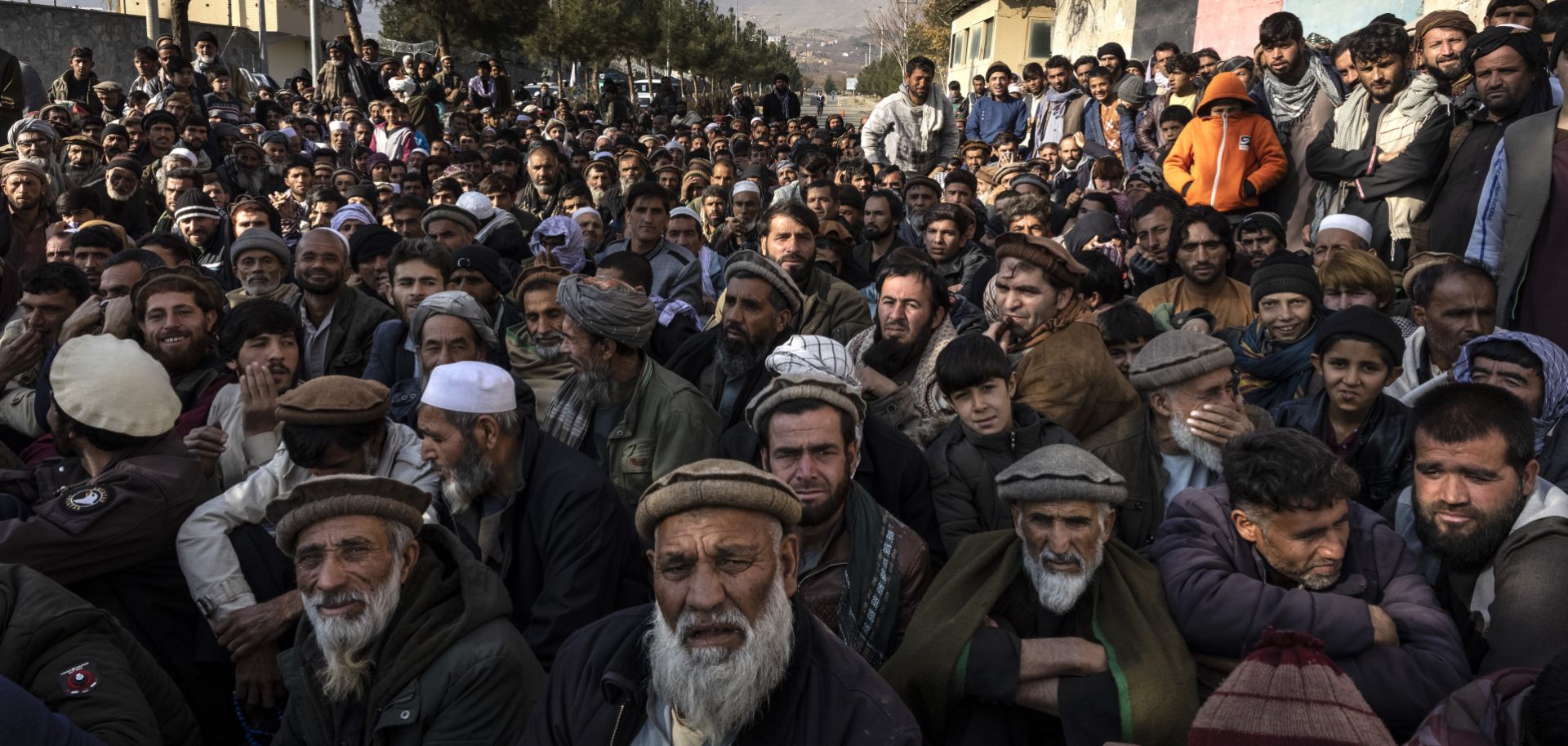
Hundreds of villagers wait outside a government center to register for humanitarian aid on Dec. 6, 2021, in Charikar, Afghanistan.
Editor's Note: This column is the second of a two-part series that explores where the Taliban exceeded expectations since retaking control of Afghanistan on Aug. 15, 2021, and the many challenges that still lie ahead for the group as it enters the second year of its second reign over the country. The first part, which focuses on the group's relative successes over the past year, can be found here.
While the Taliban have effectively established themselves as the de-facto government in Afghanistan, they will face considerable challenges to their continued rule, making effective diplomatic partnerships for economic advancement and preventing security threats, both domestically and to external actors, essential. Notably, most challenges are closely related to the accomplishments discussed in the first part of this series — highlighting that what may have been relative successes in the Taliban's first year in power also present longer-term liabilities.
The Taliban's Top Challenges in Year Two
1. Mitigating economic and humanitarian crises
Despite keeping the economy from completely collapsing, the most critical challenge for the Taliban will be improving the country's still-dire economic and humanitarian crises, which recent natural disasters have only exacerbated. The Taliban's opaque budget and policy priorities make it difficult to decipher the group's current economic focus. But in the absence of foreign budgetary aid that made up about 75% of the country's prior budget, the Taliban will be increasingly desperate for financial help to plug a reported $500 million dollar budgetary gap. Meanwhile, about $9 billion belonging to the Afghan Central Bank remains withheld in Western banks — most of it in the United States. Despite calls to unfreeze the assets, these funds may remain unavailable due to the Taliban's hard-line domestic policies, including controversial limits on women's and girls' rights. The recent discovery that al Qaeda's former slain leader had been hiding out in Kabul also suggests a violation of the 2020 U.S.-Taliban agreement (in which the Taliban pledged to keep Afghanistan from again becoming a safe haven for Islamist extremist groups) — potentially further dimming the likelihood of Washington allowing the Taliban to access these frozen funds. Furthermore, Western sanctions on several Taliban leaders and the group's failure so far to gain international recognition have blocked the Afghan banking system from conducting transactions with other countries.
These more macroeconomic headwinds coincide with others that present immediate challenges to the Afghan populace. For example, thousands of women have lost their jobs due to the Taliban's hard-line restrictions, while overall unemployment has increased due to lack of economic demand, which has caused disruptions in the delivery of essential services like healthcare and education in most areas of the country.
Food insecurity is also worsening in Afghanistan. An estimated 20 million people (50% of the population) are currently food insecure, with women and children being the most severely affected. The risk of crime related to poverty and hunger, as well as people turning to militant groups for monetary safety, thus remains high in the country. The growing humanitarian crisis is deepening Afghanistan's dependence on external aid and raises questions about the Taliban-led government's ability to effectively manage the economy in the long term.
2. Maintaining internal unity
As the Taliban attempt to transition from a violent insurgent movement countering a common enemy to engaging in national governance, internal disunity and hard-line dominance will remain a serious constraint. The Taliban have many internal divisions, including hardliners vs. moderates; local Taliban leaders and commanders vs. Taliban core members who have political power; and ethnic minorities within the Taliban vs. the majority Pashtun Taliban.
The abrupt revocation of the long-expected resumption of older girls' education in March was a particularly prominent example of continued disagreements between more pragmatic members of the Taliban and the group's more hard-line members. The incident highlighted the persistent dominance of hard-liners in shaping domestic policy, despite the subsequent costs to the group's international diplomatic efforts. Though the Taliban's ambitions for official recognition and further international assistance may eventually influence at least limited compromise on certain issues, the group has thus far failed to demonstrate a willingness to do so — even amid the country's deteriorating conditions, suggesting that, overall, hard-line governance and disunity will continue.
Internal discord has also been reportedly triggered by different Taliban elements fighting over control of resources and territory, particularly in high-earning mining regions. Take, for example, the Taliban's recent killing of one of their former commanders. In early July, the group's Kabul-based political leadership started to voice their frustration with Malawi Mahdi, a Taliban intelligence chief in Afghanistan's Bamiyan district. Mahdi, who was ethnic Hazara, had reportedly been locally collecting taxes as opposed to adhering to the Taliban's policy of central, monopolized control of resources. The conflict then took a sectarian turn and escalated into an uprising led by Mahdi, to which the Taliban reacted fiercely — ultimately defeating and reportedly killing the rebel commander in August as he was trying to flee to Iran. This example speaks to Afghanistan's complex geography and demography; the presence of valuable natural resources in ethnic minority-dominated areas could prove a dangerous future threat to the Taliban's power.
Meanwhile, the Taliban have demonstrated increasing distrust of ethnic minorities even within the movement. The group has reportedly replaced Tajik and Uzbek Taliban fighters with Pashtun fighters in certain key areas of Afghanistan. This, along with reported incidents of Taliban violence and discrimination against minority groups, will only likely further reinforce perceived alienation among these minorities, which risks fueling at least localized resistance to Taliban rule that could grow. In a more escalatory scenario, some of these aggrieved Taliban members could even defect to groups like ISKP or other anti-Taliban groups, not only undermining Taliban unity but also creating a security threat as they do so. ISKP has already been observed disseminating propaganda targeting Tajiks and Uzbeks, so there is not merely a notional concern.
One further potential medium-to-long term threat is the newly formed High Council of National Resistance. The anti-Taliban resistance council is comprised of exiled former warlords like Ata Mohammad Noor and Uzbek leader Abdul Rashid Dostum, along with several Hazara leaders, who have demanded ethnic minorities have meaningful influence in governing the country and threatened armed mobilization if their concerns are not heeded. It remains to be seen whether, despite living abroad, these individuals still hold sufficient sway in Afghanistan to influence events on the ground. But they remain well-known figures in the country and still have lots of international contacts, which could one day see some degree of foreign support for their ideas.
Ultimately, these combined challenges — driven by persistent internal disunity and the dominance of hard-liners in the movement — will make it increasingly difficult for the Taliban to effectively govern the diverse country. If the Taliban starts compromising on social and religious hard-line policies, the group would likely alienate many local level commanders, soldiers and others (including key leaders) who believe in the strict implementation of the Taliban's interpretation of Islamic governance. This could lead Taliban members to join groups like ISKP and anti-Taliban resistance movements, thereby fundamentally threatening the Taliban's control over the country.
3. Gaining more international aid and recognition
The continued dominance of hard-liners in the movement will likely continue to limit prospects for greater international assistance and official recognition of the Taliban, particularly by Western countries. Besides limiting women's rights and older girls' ability to access education, the Taliban have continued to limit press freedoms, engage in arbitrary detentions and suppress dissent — sometimes brutally. The Taliban have also failed to credibly demonstrate their intent to form a more inclusive government or draft a new constitution.
The group's hard-line governance has triggered persistent Western criticism of the Taliban and has occasionally driven delays and hesitance on providing more substantive assistance to Afghanistan. For example, after the Taliban banned older girls from returning to school in March, the World Bank temporarily suspended humanitarian aid projects worth $600 million for months that it had initially approved. In recent days, frustrations with the Taliban's hard-line governance (and the restrictions on girls' education, in particular) have reportedly also driven disputes among members of the U.N. Security Council on whether to exempt 13 Taliban officials from a travel ban. If the ban is not lifted, it would further complicate the Taliban's efforts to engage in international diplomacy.
Meanwhile, the Taliban's enduring relationship with al Qaeda may have diplomatic consequences as well. The recent discovery that slain al Qaeda leader Ayman al-Zawahiri was living in Kabul has reminded the world that the Taliban still retain ties with the notorious Islamist extremist group behind the 9/11 attacks against the United States, as well as many other deadly attacks in Europe and elsewhere. This will make it politically difficult for Western leaders to offer more near-term support to the Taliban-led government in Afghanistan — especially when coupled with the controversial hard-line policies it has enacted over the past year. Indeed, the apparent hosting of al-Zawahiri in the Afghan capital reportedly prompted the U.S. government to at least temporarily pause negotiations with the Taliban on unfreezing Afghan central bank funds.
The expected continuation of at least some of the aforementioned issues will sustain challenges to the Taliban's quest for further international assistance and recognition, particularly from Western countries, which in turn will limit the Taliban's ability to counter the country's ongoing economic and humanitarian crises or legitimize their de-facto rule. The continued absence of substantive economic aid that could potentially ease Afghanistan's humanitarian crisis could give space for social unrest or even drive some support for anti-Taliban resistance forces in certain areas of the country. As long as the Taliban remains unrecognized, it will lack the ability to officially represent Afghanistan and pursue the country's interests at the international level, risking the exacerbation of poverty, crime and instability.
4. Managing domestic and regional security threats
Despite consolidating territorial control, the Taliban face a significant legitimacy and security challenge due to domestic and regional threats. In February, the U.N. Security Council assessed that extremist groups generally enjoy significant freedom in Afghanistan following the Taliban's takeover of the country. This indicates the Taliban will likely continue to face challenges in constraining the actions of such groups, both domestically and regionally. Most significantly, ISKP has demonstrated the persistent capability to conduct lethal attacks primarily targeting the Taliban and religious minorities in Afghanistan, despite the Taliban's attempts to counter the group. Though reports about ISKP's recent concern regarding group infiltrations may suggest the Taliban are evolving its counter-ISKP approach from generally ineffective and brutal counterterrorism to a more targeted, espionage-based strategy, the Taliban have thus far failed to limit ISKP's ability to launch attacks. Further persistence of the ISKP threat will allow it to continually undermine confidence in the Taliban's claimed capability and intent to secure the country and protect Afghanistan's religious minorities.
Though the Taliban have demonstrated success in countering anti-Taliban resistance forces, the potential remains for such forces to more effectively coordinate their efforts and potentially gain international support, which could enhance their ability to challenge the Taliban's territorial control. The Taliban's alienation of ethnic and religious minorities may also drive recruitment and support for such groups or even the formation of new ones, which, if substantial enough, could similarly enhance their impact on Afghanistan's security.
In addition, the Taliban will likely continue to occasionally clash with the border forces of neighboring countries given heightened mutual suspicions and the irresolution of certain cross-border disputes — most notably over the legitimacy of the Afghanistan-Pakistan border, known as the ''Durand Line.'' While the tactical impacts of these clashes will likely remain localized, their unpredictability and potential for escalation mean that clashes may drive occasional challenges to relations with neighboring countries. Neighboring countries' desire to maintain stability and prevent spillover violence from Afghanistan will likely constrain potential escalations, meaning consequent challenges to the Taliban's regional relationships will likely remain temporary and limited. But flare-ups in tensions with bordering nations could still create challenges for the Taliban, especially if they require the group to reallocate resources from other areas to strengthen border security.
Finally, despite generally securing the country, the Taliban will continue to face challenges constraining militant groups that threaten foreign countries, which will sustain international concern about threats emanating from Afghanistan. Besides ISKP and al Qaeda, other militants — including Pakistani TTP militants, along with Tajik militants and ethnic Uyghur fighters from China — continue to operate in Afghanistan. The Taliban's limited capability — and at times, intent — to constrain the diversity of threats based in the country will likely sustain risks to its diplomatic and economic efforts, particularly if any of these groups successfully conducts a major attack against a foreign country. Though different countries maintain different tolerances to the risks posed by Afghanistan-based militant groups, regional countries in particular (including Russia, China, India and various Central Asian countries) have all stated that their continued engagement with the Taliban is contingent on the Taliban constraining threats from Afghanistan to their countries.
Threats emanating from Afghanistan may also trigger foreign counterterrorism strikes, which risks undermining perceptions of the Taliban's control over the country. Demonstrating the challenges the Taliban face, ISKP has already claimed rocket attacks against Uzbekistan and Tajikistan, while the TTP has attacked Pakistani security forces primarily in Pakistan's Khyber Pakhtunkhwa province. In response, Uzbekistan and Tajikistan put their military forces on alert, while Pakistan reportedly conducted airstrikes against alleged TTP militants in eastern Afghanistan in April. Propaganda materials released by many of these militant groups have expressed their continued intent to threaten regional countries. Ultimately, the Taliban's failure to meaningfully constrain the activity of Afghanistan-based militant groups will pose a sustained threat to the Taliban's legitimacy and Afghanistan's security.
Going forward, the Taliban will face far more difficult challenges compared to its first year in power as it seeks to maintain control over the crisis-stricken, diverse country. Even given some improvements in stability, Afghanistan remains a cautionary tale.
