
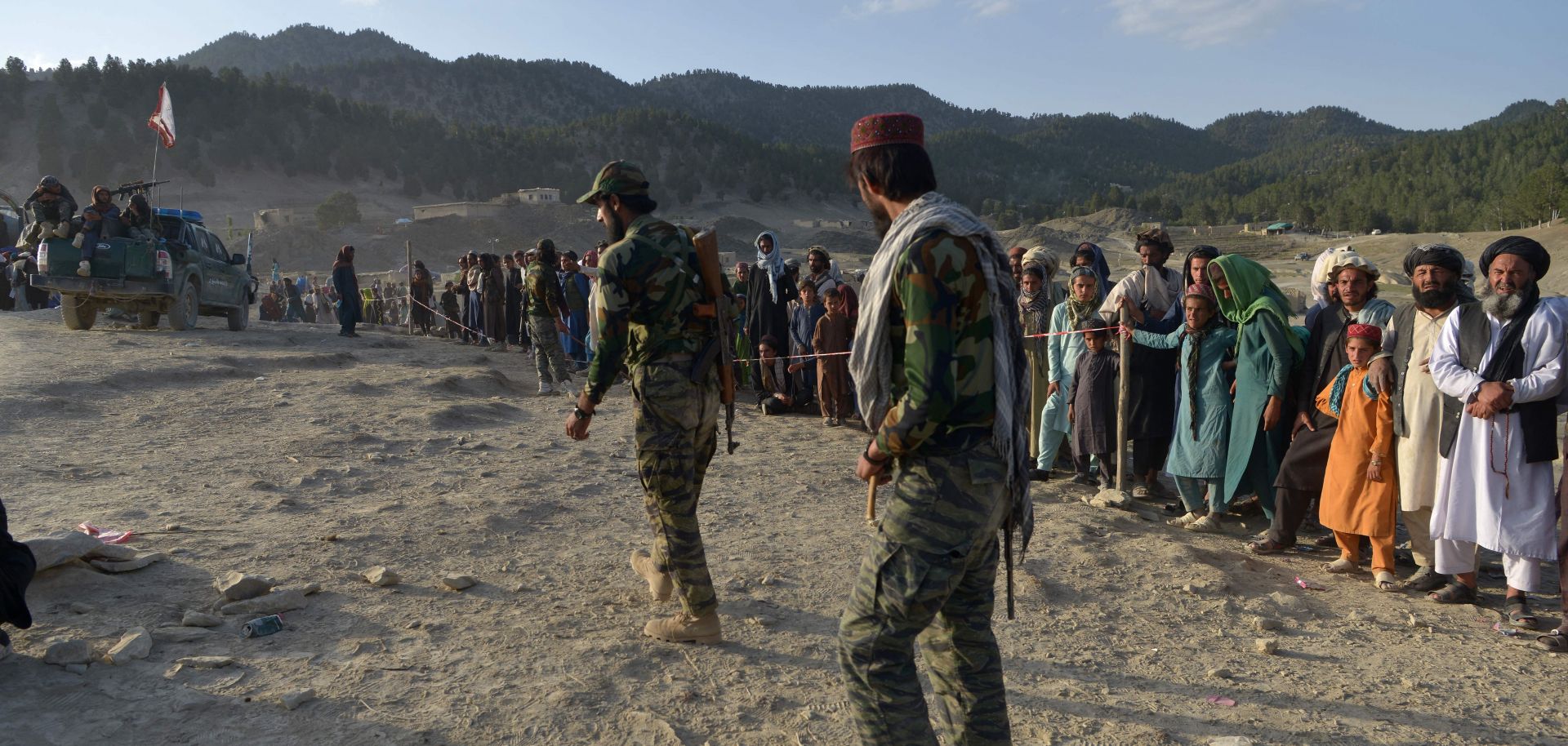
Taliban fighters stand guard on June 26, 2022, as people wait to receive aid in a village in Afghanistan’s Khost province after a recent earthquake.
By improving ties with the Taliban, India is seeking to reduce security risks, counterbalance Pakistan’s influence and improve economic opportunities in Afghanistan. But this strategy is likely to achieve only modest results because of Afghanistan’s fragile economic and security environment, as well as New Delhi’s enduring ideological and cultural differences with the Taliban. Indian officials recently visited Afghanistan for the first time since the Taliban took control of the country last year. A delegation led by J.P. Singh — a secretary overseeing India’s external affairs with Pakistan, Afghanistan and Iran — traveled to Kabul on June 6 to discuss the delivery of humanitarian aid with Taliban leaders. With the exception of sending such aid and indirectly contacting Afghanistan through third countries, New Delhi had not established a formal dialogue with Kabul since the Taliban seized power in August 2021. The diplomatic visit reflects India’s new policy of engagement with the Taliban government in Afghanistan, given the new geopolitical realities of the region now that the Pakistan-backed Islamist group appears poised to retain control of the strategically important landlocked nation for the foreseeable future.
- India has sent 20,000 tons of wheat, 13 tons of medicine and 500,000 COVID-19 vaccines since August 2021 as humanitarian aid to Kabul through a land route via Pakistan.
- In the aftermath of the Kabul earthquake on June 21, India was one of the first countries to send aid. According to recent reports, New Delhi also sent a technical team to Kabul to look into reopening the Indian embassy in the city, which was closed in August 2021.
India’s attempts to re-establish ties with Afghanistan are connected to its strategic and economic interests. With the Taliban takeover in August 2021, India lost the limited political and diplomatic influence it had in Afghanistan because New Delhi never fostered a formal relationship with the Taliban. However, a foothold in Afghanistan is necessary for India to counter Pakistan’s presence and influence in Afghanistan. The close Pakistan-Taliban relationship poses a threat to Indian interests in the region because it gives Pakistan strategic depth and security against India. A continued Indian absence in Afghanistan would allow Pakistan to cement its role at the expense of India in the region. Therefore, India is now interested in increasing its presence in Afghanistan to counterbalance Pakistani influence, which could be a security risk to India in the long term. In addition, India’s decision to exit Afghanistan over security concerns in 2021 opened the door for other regional players like China, Russia and Iran (as well as some Arab Gulf nations) to engage with the Taliban, further weakening New Delhi’s influence in Afghanistan. The Taliban, for their part, are also interested in improving their ties with India as they seek to establish a stable government with meaningful foreign economic partners in their quest for international recognition.
- India has traditionally played a secondary role in Afghanistan. In the early 2000s, it logistically supported the Northern Alliance against the Taliban without getting directly involved in the conflict. India’s presence in Afghanistan under the previous U.S.-backed government mainly took the shape of developmental aid to the country.
- Despite the Taliban’s assurances that Indian personnel would not be harmed, India evacuates staff from its embassy in Kabul in August 2021. India’s consulates in Afghanistan were shut down even before the Taliban takeover. China and Pakistan, by contrast, never closed their embassies in Kabul and continued diplomatic outreach to the Taliban-led government.
- On June 2, Mullah Yaqub — the Afghan government’s acting defense minister and son of the Taliban’s founder — hinted at Kabul’s willingness to work with India and even send Afghan defense troops to India for training.
India will attempt to gain a foothold in Afghanistan through humanitarian aid and developmental financing. As one of the first steps toward working with the Taliban, India will likely reopen its embassy in Kabul with reduced staff and services. In addition, New Delhi will likely continue to send food and medical aid in the coming months following the Kabul earthquake amid Afghanistan’s grim economic situation. In an effort to increase bilateral economic ties, India will likely also authorize imports of Afghani dry fruits, as well as certain agricultural and horticultural products, and resume air transport to and from Afghanistan. To help the Taliban build a sustainable economy, India will likely restart its small infrastructure projects in Afghanistan as well, which include building new roads, healthcare clinics and power distribution networks.
- The Turkmenistan–Afghanistan–Pakistan–India (TAPI) pipeline project could also facilitate diplomatic and economic dialogue between Afghanistan and India in the coming years. Upon completion, the TAPI will supply gas from resource-rich Turkmenistan to Pakistan and India through Afghanistan. The implementation of the pipeline, which was initially scheduled to come online by 2019, still faces significant security and logistical constraints. But the TAPI could eventually help India meet its growing energy needs by granting it direct access to Turkmen gas. It could also offer New Delhi a great opportunity to partner with Kabul and deepen its participation in Afghanistan’s infrastructure development.
- Improved relations with the Taliban-led Afghan government in Kabul could enable India to source minerals like copper, coal and iron ore from Afghanistan via the new International North-South Transport Corridor (INSTC) as well. The trade route — which runs from Russia, through Iran, to India — began operation last month with the first shipment. The Zaranj-Delaram highway built by India in Afghanistan forms an important node for the INSTC by connecting Afghanistan’s Delaram District to the border of Iran.
- Given Iran’s already friendly ties with the Taliban-led government in Afghanistan, Tehran and New Delhi can also offer the use of the Indian-developed port of Chabahar in Iran to facilitate Afghani exports in the long term.
Increased economic and diplomatic cooperation with the Taliban could help India mitigate security threats emanating from Afghanistan. Such threats include terrorist groups like al Qaeda, which is based in Afghanistan, as well as Pakistan-supported militant groups like Jaish-e-Mohammad (JeM) and Lahskar-e-Taiba (LeT), which reportedly also have a presence in Afghanistan. The vast, mountainous and insufficiently controlled border between Afghanistan and Pakistan makes it difficult to monitor the activities of such groups, creating a permanent terrorism threat for India. A working partnership with the Taliban, however, could help New Delhi alleviate some of these concerns by enabling India to leverage diplomatic as well as economic cooperation (such as increased trade, humanitarian aid and infrastructure projects) to pressure the Taliban to rein in militant groups.
- A U.N. report released in May 2022 identified the presence of LeT and JeM training camps inside Afghanistan’s Nangarhar and Kunar provinces.
The Taliban’s radical Islamist ideology, ties with militant groups and close relations with India’s regional rivals will ultimately constrain the effectiveness of New Delhi’s rapprochement strategy. The Taliban’s historically close relationship with India’s neighboring archrival Pakistan, as well as the overall cultural similarities between Afghanistan and Pakistan, will limit the scope of increased Indian-Afghan cooperation. Moreover, the Taliban are likely to tread cautiously in restoring ties with New Delhi, given India’s past anti-Taliban stances and support of the former Afghan government that collapsed in August 2021. China, India’s other strategic rival in the region, is also influential in Afghanistan — creating another factor that could prevent the Taliban from favoring India, particularly in future economic deals. Additionally, Indian Prime Minister Narendra Modi’s Hindu nationalist government and discriminatory policies against Muslims raise the potential for diplomatic rifts with the radical Islamists currently in charge of Afghanistan’s Taliban-led government. And finally, increased militant activity and attacks by JeM and/or LeT, which both have ties to the Taliban, can disrupt security in India and strain New Delhi’s ties with Kabul as well.
