
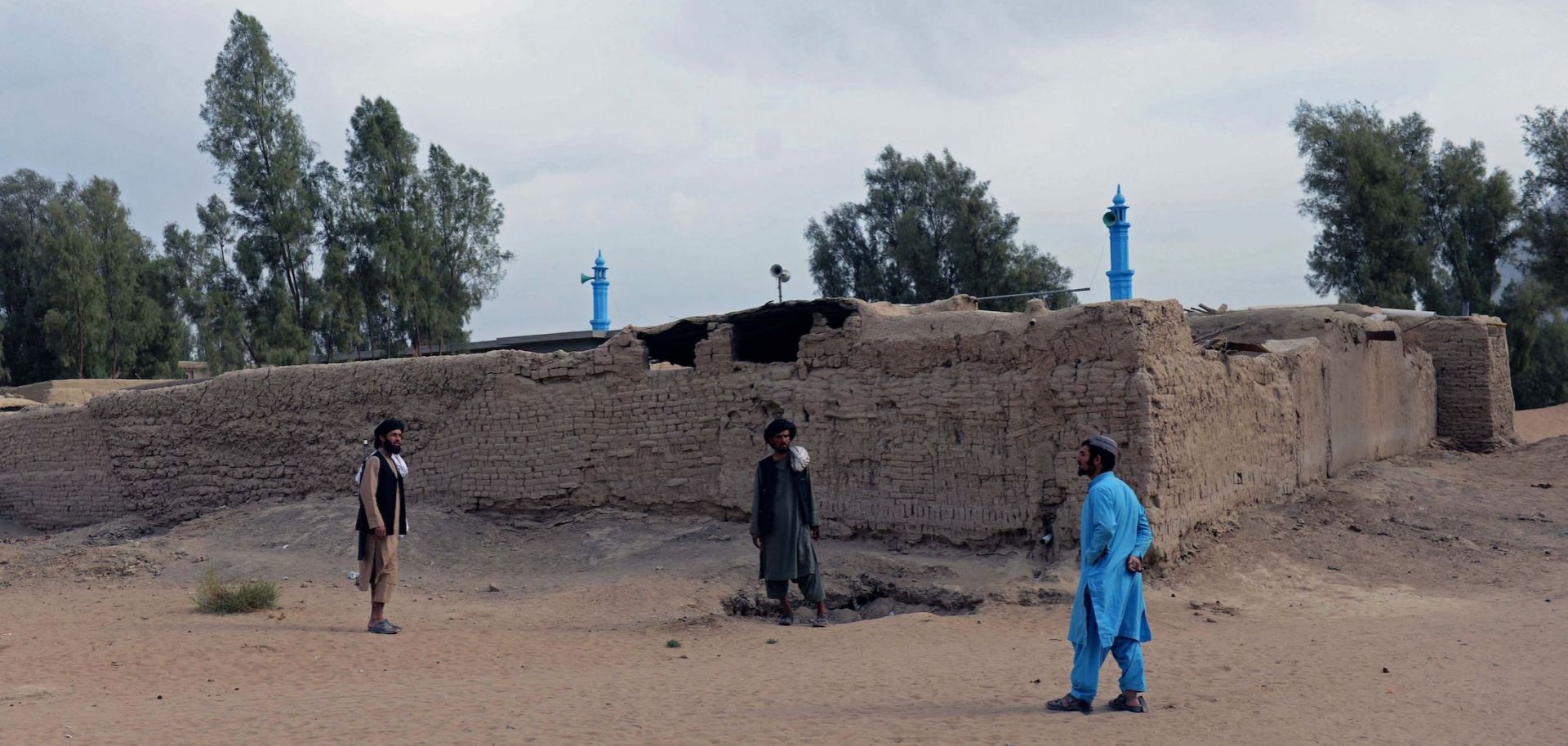
Taliban members stand near the birth house of the group’s supreme leader, Hibatullah Akhunzada, in Kandahar, Afghanistan, Nov. 7, 2021.
Reports of a failed drone strike against a leader of the Tehrik-e Taliban Pakistan (TTP) in Afghanistan highlight the complex challenge of Afghan-Pakistani relations following the Taliban takeover. Maulvi Faqir Mohammad survived an apparent attack against a compound where he was staying on Dec. 16. Conflicting reports say either a drone fired a missile at the compound in Afghanistan’s eastern Kunar province, on the border with Pakistan, or that a ground-based munition, likely a mortar, struck the compound. Mohammad was reportedly uninjured in the attack, amid reports from the TTP that said the missile failed to detonate. The attack came shortly after the TTP ended a month-long cease-fire with Pakistan, blaming Islamabad for failing to uphold its side of the arrangement.
The TTP poses a challenge for Taliban-Islamabad relations as both sides see the group from different perspectives. The Taliban leadership has promised not to allow Afghan territory to be used as a base of militant operations against neighboring countries in return for economic and political assistance. At the same time, the Taliban also needs to maintain good relations with groups like the TTP, which assisted with the Taliban insurgency, and could draw members away from a Taliban seen as too interested in foreign relations over more conservative views among its rural members. For Islamabad, it is important to maintain close ties with the Taliban to promote stability and security along the long border and into the northern Pashtun areas of Pakistan. But the Pakistani government also wants to quell the actions of the militant TTP, which has carried out numerous attacks inside Pakistan. The brief cease-fire between the TTP and Pakistan, brokered by Pakistan’s allies in the Taliban-led government, was an attempt by both sides to manage their respective interests, but it proved short-lived.
If Pakistani security forces were behind the attack against Mohammad, it highlights Islamabad’s willingness to strike inside Afghanistan to hit at its opponents. Such an action, however, will strengthen the elements within the Taliban and their partners who see Pakistan as another imperialist nation, one that wants to impose its own will on Afghanistan. That would, in turn, further weaken Islamabad’s influence in Afghanistan at a critical time, when the Taliban are still trying to cement their control and are preparing to hold a Loya Jirga (or grand council) to shape the new constitution and government of Afghanistan. With factional differences already wracking the Taliban leadership, and only tentative central control over the myriad fighters across the country, an anti-Pakistan turn could heighten the risk of infighting, undermine any push toward stability, and raise the chances of a renewed civil war in Afghanistan.
It is possible that the Taliban are quietly cooperating with Islamabad to allow Pakistani security forces to strike at select members of the TTP as a way to keep relations with Pakistan robust while still appearing to be independent. The Taliban have been struggling to counter the rising activities of the Islamic State Khorasan Province (ISKP) in Afghanistan and have little bandwidth to simultaneously target the TTP, especially as the Afghan Taliban see the TPP as somewhat of an ally. Despite the concern over Pakistani influence, the Taliban know they need Islamabad’s assistance. Pakistan is the primary land corridor into Afghanistan, a critical route for humanitarian supplies, and for any future international trade. Pakistan and China are the most likely source of early infrastructure development in Afghanistan, and both countries are arguing for the international community to release frozen Afghan funds to the Taliban.
The TTP represents the primary test case for the Taliban’s promise to prevent the use of Afghan territory as a base for transnational attacks, making the Dec. 16 attack a key indicator of the future direction of stability and security in Afghanistan. If we are seeing quiet cooperation between Kabul and Islamabad to disrupt the TTP and target key members, this would represent a pragmatic approach by a constrained Taliban to appease their neighbor while recognizing their own inability to reign in the TTP. If it is Pakistan acting on its own, without Kabul’s knowledge or tacit approval, then we could see an erosion of cross-border relations — raising the likelihood of further destabilization in Afghanistan, and potentially pulling Pakistan and even China into more direct intervention in Afghanistan.
