
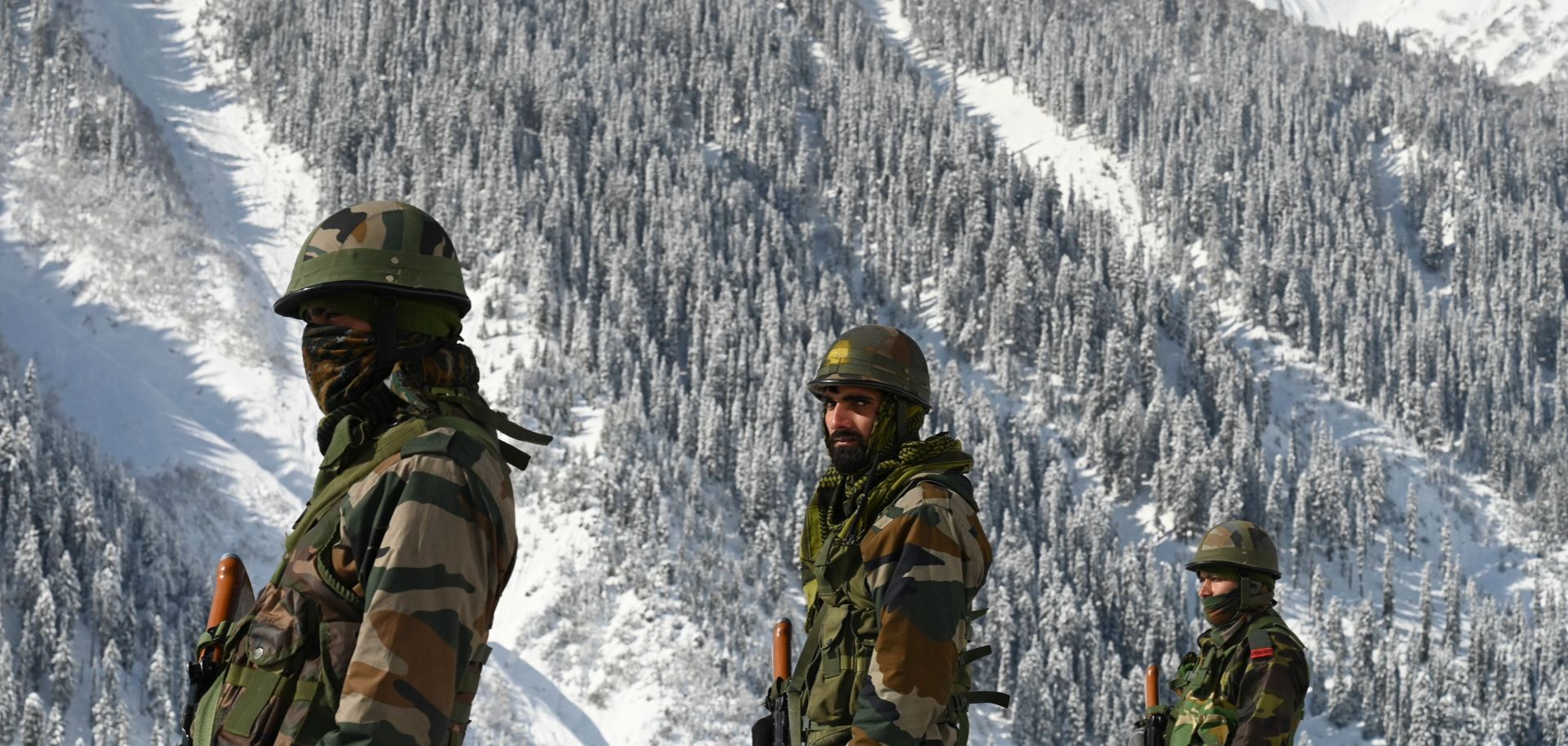
Though India and China's recent efforts to ease bilateral tensions will likely reduce the risk of border clashes in the coming months, long-standing mistrust and the two countries' ongoing strategic competition will likely limit the speed and scope of reconciliation. Media reports on Oct. 31 indicated Indian and Chinese troops had resumed patrolling operations along their disputed border, a day after unnamed Indian defense officials said the two countries had completed withdrawing their troops, vehicles and temporary structures from Depsang and Demchok in eastern Ladakh. The developments come more than a week after India's Foreign Secretary Vikram Misri on Oct. 21 announced the two sides had reached an agreement on patrolling the boundary. The deal marks a breakthrough given China's long-standing reluctance to even consider concessions in Depsang and Demchok, the last two areas of the border where Indian and Chinese troops stood face-to-face. Misri also suggested that reduced tensions along the border could pave the way for broader India-China relations to improve, four years after major border clashes in 2020 strained ties. Though official details on the agreement remain scant, Indian officials cited in recent media reports have said the two sides seek to return to patrolling arrangements maintained before the 2020 border clashes, which disrupted patrolling along parts of the border. The resumed arrangements would include Indian troops patrolling up to the formally designated patrolling points 10 to 13 in the high-altitude plains of Depsang — whose flat surface and location near India's Daulat Beg Oldi military base make them strategically significant — in addition to restarting patrols in Demchok's Charding Nala area. Additionally, both sides will reportedly limit the number of troops on patrol, coordinate the timing of activities, and monitor for violations to further limit the potential for clashes.
- Indian and Chinese troops have sporadically clashed amid their decades-long border dispute, prompting a 1996 agreement that the two sides would not carry firearms or explosives along the border. However, the border clashes that erupted in 2020 represented a severe escalation, resulting in fatalities and reports of gunshots for the first time since 1975.
- The border patrolling deal was announced on the eve of the Oct. 22-24 BRICS summit in Russia, where Indian Prime Minister Narendra Modi and Chinese President Xi Jinping held an in-person meeting for the first time since 2019, further underscoring the recent thaw in the two countries' ties.
Following the 2020 border clashes, bilateral tensions worsened amid India's restrictions on Chinese investments and both sides' development of military and civilian infrastructure along their disputed border. In the wake of the 2020 border clashes, India intensified scrutiny of both Chinese investments and visa applications from Chinese citizens; the Indian government also banned Chinese apps like TikTok and WeChat and halted direct flights to China, further straining New Delhi's ties with Beijing. Relations then further soured as both sides developed civilian and military infrastructure along the border to strengthen and defend their respective claims. Among the most recent flashpoints was India's March inauguration of the Sela Tunnel in the mountains of the country's northeast, which provides India with ''all-weather'' access to the disputed border. China, meanwhile, has built dozens of villages along its western frontier, particularly in the southwest near the most accessible Himalayan passes bordering India, Bhutan and Nepal. The consequent rise in tensions between India and China has driven sporadic border flare-ups, including in the northeastern Indian state of Sikkim and the eastern Indian state of Arunachal Pradesh in January 2021 and December 2022, respectively. Several rounds of bilateral military-level talks and occasional informal meetings between higher-level Indian and Chinese officials have yielded some progress toward resolving border tensions in recent years. This includes limited military disengagements from particularly contentious parts of the border, the most recent of which took place in September 2022 in the Gogra-Hot Springs area of eastern Ladakh. However, the two countries have made little progress in improving their broader relationship.
The two sides likely came to the border patrolling agreement in the interest of stabilizing relations and opening the door to friendlier commercial ties as China faces international and economic pressures, and as India attempts to bolster its domestic manufacturing and broader economy. China's economic growth has recently faced headwinds from slowing domestic consumption and foreign investment, as well as a real-estate downturn. These challenges have been exacerbated by a rise in foreign restrictions on Chinese imports, including U.S. restrictions on Chinese chips and EU restrictions on Chinese electric vehicles. Beijing likely believes cooling tensions with New Delhi will increase the prospects of India easing some of its existing investment and other restrictions against China, while also reducing the likelihood of additional Indian restrictions or measures. Meanwhile, despite bilateral tensions, India's economic ties with China have continued to grow, with Indian imports of Chinese goods increasing from $65.26 billion in fiscal year 2020 to $101.74 billion in fiscal year 2024; this has helped China become India's largest supplier of industrial products in 2023, and a top supplier for India's electronics, machinery, pharmaceutical and textile sectors, among others. Against this backdrop, media reports indicate India's business community has pressured the government to ease its restrictions on China to bolster India's manufacturing sector and economic growth.
- In June, Reuters reported that Chinese officials were pushing India to resume direct passenger flights as Chinese overseas travel remained weak nearly two years after China ended its stringent zero-COVID restrictions.
Though the reported border patrolling agreement and associated de-escalation mechanisms appear likely to reduce tensions and the likelihood of clashes along the border in the coming months, underlying risks of flare-ups will remain until greater trust can be built. India and China are reportedly finalizing the details of patrolling arrangements, and so long as they remain in close contact, monitor and verify troop movements, and utilize de-escalation mechanisms, the risk of border clashes will likely decrease in the coming months. That said, some level of mistrust between the two countries will persist, especially between their troops, who have stood face-to-face and have periodically brawled with each other. Lingering risks of clashes will thus remain until more confidence-building measures are implemented and a long period of time passes with little to no incident. Such clashes would likely primarily threaten personal safety in remote border areas, especially should the two sides quickly employ de-escalation mechanisms to stem further violence. Recurrent skirmishes and/or significant casualties, especially deaths, would set back efforts to build trust and improve relations between China and India. China has also employed cyber threat actors against India surrounding prior flare-ups and tensions along the border, including during and in the years after the 2020 border clashes, which saw China-linked hackers target India's power sector. Though these breaches have so far seemed largely aimed at gathering information (as opposed to disrupting Indian operations), China could use the stolen information to facilitate more disruptive cyber attacks during potential future periods of escalation with India. Unlike physical clashes between Indian and Chinese troops, cyber attacks targeting Indian critical infrastructure would likely cause disruptions in India that extend beyond its remote border regions, with the country's north likely being most affected. In the longer term, China and India's development of civilian and military infrastructure along their disputed border, combined with China's particular resistance to territorial concessions under President Xi, will likely remain sticking points for durable, full-scale disengagement.
- Months after India and China's major border clashes in June 2020, India's financial capital and western city of Mumbai experienced a widespread blackout. In the aftermath of the outage, some speculated that China may have been responsible, especially given reports that China-linked cyber threat actors were targeting India's power sector around that time. But India ultimately found no evidence of Chinese (or Pakistani) involvement, and instead attributed the blackout to ''human error.''
More broadly, persisting mistrust and geopolitical competition between India and China will very likely slow further progress on improving bilateral ties while continuing to limit the scope of their relationship. Despite India and China appearing driven to ease bilateral tensions, the deep-seated mistrust the two countries have developed means further progress on improving broader relations will very likely be slow-going. According to media reports citing unnamed Indian government sources, New Delhi is considering small steps, like resuming direct flights to China and accelerating Chinese visa approvals, but will remain cautious in rolling back the measures it has implemented against Beijing in recent years. In addition, India and China remain geopolitical competitors with differing interests, which will continue to put them at odds with each other on a number of issues. Of particular concern for China is likely India's growing relationship with the West and pursuit of high-profile defense purchases and technology transfers from the United States, primarily with an eye on curbing China's regional influence. Though India's commitment to strategic autonomy will put an upper limit on its deepening ties with the West, these ties are nevertheless poised to grow stronger as India and the West's geopolitical competition with China persists. India and China's ongoing rivalry will thus continue to constrain the growth of their broader relationship, even if both sides are willing to bolster some mutually beneficial business ties. It will also sustain the potential for further diplomatic spats that may involve retaliatory measures like visa or investment restrictions, which could at least temporarily challenge the two countries' economic relations. And it remains to be seen whether China and India are sufficiently committed to bettering ties that they would quickly act to stem any new rifts that emerge in their relationship.
- Pointing to persisting mistrust and Indian caution in rolling back restrictions on China, days after India's foreign secretary announced the bilateral border patrolling agreement, Indian Finance Minister Nirmala Sitharaman said on Oct. 23 that ''I cannot blindly receive foreign direct investment because I want money for investment, forgetful or unmindful of where it is coming from.'' The statement came after Sitharaman remarked in June that she did not ''[disown] the suggestion'' by India's chief economic advisor that New Delhi should promote foreign direct investment from China to boost India's global exports.
- Mere days before announcing its efforts to mend ties with China, India on Oct. 15 signed a deal with the United States to purchase 31 unmanned combat aerial vehicles, or UCAVs. Media reports indicate India intends to use the UCAVs to patrol its disputed land border with China and the Indian Ocean, where China's presence has also recently grown, illustrating likely future points of contention between the two countries.
- India and China's 2020 border clashes demonstrate the fragility of efforts to bolster ties. Xi and Modi had held informal meetings in prior years to mend relations after a 2017 border stand-off triggered by Chinese construction in Doklam, an area claimed by both China and India's partner Bhutan. However, the 2020 clashes ultimately torpedoed these attempts to improve relations, subsequently fueling the years-long chill in ties. The influence the border dispute has for India and China's broader relations was underscored by a recent statement from India's Ministry of External Affairs that said ''The restoration of peace and tranquility, along with respect for the [Line of Actual Control], remains the foundation for normalizing bilateral relations.''
