
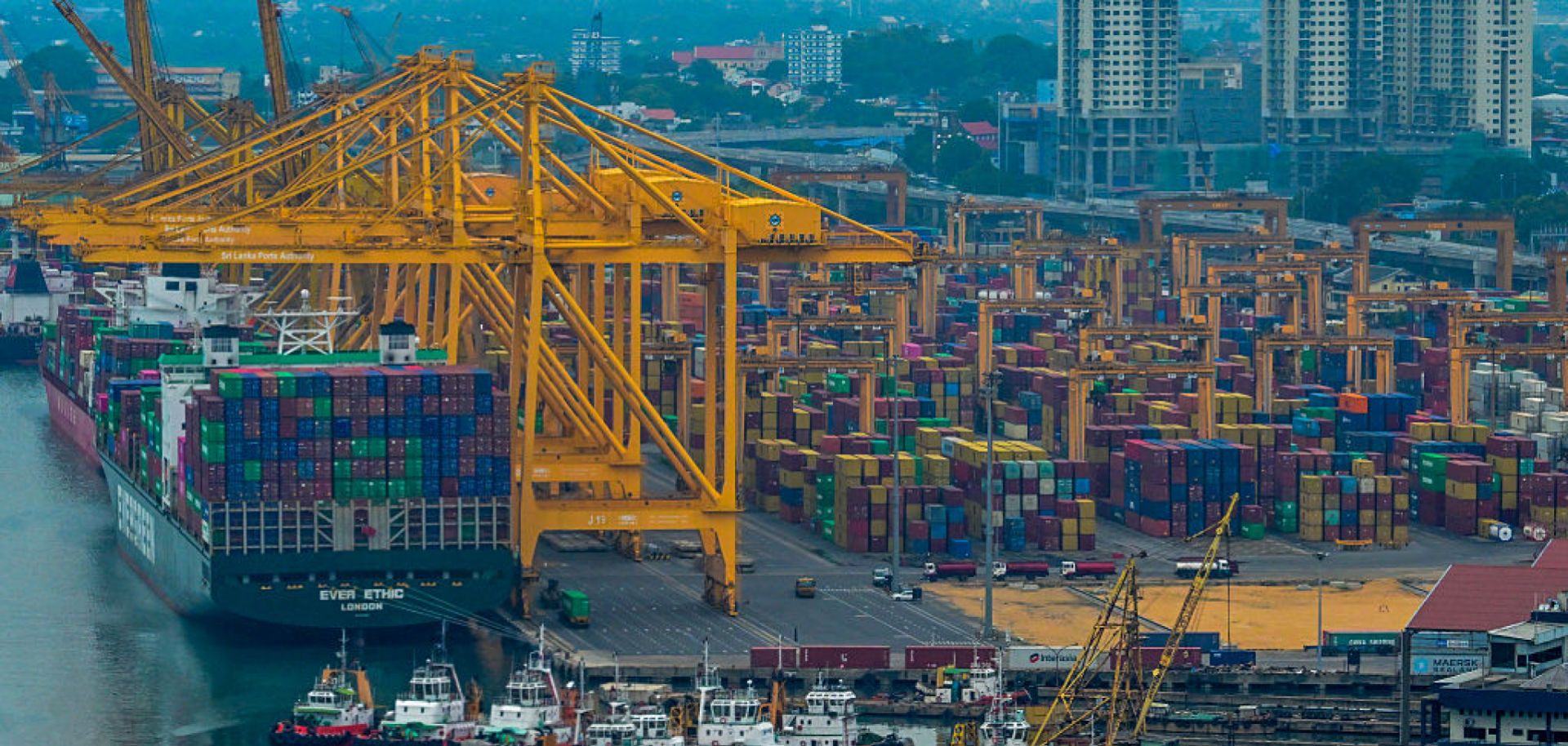
The new U.S. tariffs will particularly impact textile exports from Bangladesh, Sri Lanka and Pakistan, exacerbating political and economic challenges and risking derailing their IMF programs. On April 2, the United States announced a new set of tariffs impacting many trading partners, including a 37% tariff on Bangladesh, 30% on Pakistan and 44% on Sri Lanka. While the United States suspended these so-called reciprocal tariffs for 90 days on April 9, Bangladesh, Pakistan and Sri Lanka remain subject to the blanket 10% tariff that the United States imposed on most of its trading partners. These tariffs are part of a broader U.S. strategy to address trade imbalances. This announcement came as all three countries are engaged in International Monetary Fund programs and face economic challenges, including high debt burdens and dwindling foreign exchange reserves.
- According to the U.S. Trump administration, Bangladesh imposes a 74% tariff on U.S. goods, Pakistan 58% and Sri Lanka 88% — figures derived by converting bilateral trade deficits into tariff equivalents, a method widely considered economically inaccurate. Washington then used these numbers to justify imposing U.S. tariffs at roughly half those levels. While the Trump administration did not formally accuse Bangladesh, Pakistan or Sri Lanka of currency manipulation (as it did other countries), the White House raised broader concerns about nontariff barriers.
- The United States is a key export destination for these countries. Pakistan and Bangladesh each send approximately 18% of their total exports to the United States, while Sri Lanka sends 25% of its total exports there.
U.S. tariffs will likely hit Bangladesh hardest, as its export-dependent ready-made garment sector faces further strain amid political instability, which has already led buyers to diversify sourcing, increasing the risk of factory closures and massive layoffs. Bangladesh's ready-made garment sector accounts for 80% of its exports and employs over four million workers, primarily women. The United States is the largest market for Bangladeshi ready-made garments, accounting for 18% of total sectoral exports in the 2023-24 fiscal year. With the sector contributing around 10% to the country's GDP, the U.S. tariffs pose a serious risk of factory closures and massive layoffs. The timing of this crisis is particularly challenging amid political instability following the ousting of former Prime Minister Sheikh Hasina in August 2024 and the formation of an interim government led by Nobel Laureate Muhammad Yunus. Given that buyers from the United States and Europe have already begun diversifying their sourcing strategies amid the political instability in Bangladesh, the U.S. tariffs will only intensify these challenges, prompting more importers to shift their orders to countries with lower U.S. tariffs like India and Latin America, exacerbating Bangladesh's financial strain. In response to the U.S. tariffs, the Yunus government has initiated negotiations with the Office of the U.S. Trade Representative and is examining Bangladesh's own tariffs on American imports. The government also plans to reduce its trade surplus with the United States by increasing imports of essential goods, such as agricultural products and machinery, though Bangladesh's scarce foreign reserves will limit the effectiveness of this approach. Additionally, Bangladesh is focusing on removing nontariff barriers to further facilitate trade, although the effectiveness of these measures in securing U.S. trade concessions remains uncertain. Additionally, as a World Trade Organization member, Bangladesh faces limitations in unilaterally reducing tariffs on U.S. imports, with any such move likely to require broader cuts for all trade partners.
- In October 2024, Bangladesh's Labour and Employment Advisor Asif Mahmud Shojib Bhuiyan reported that amid worsening law and order following the political transition, rising worker unrest and protests led Western buyers to divert orders of ready-made garments to competing countries. As a result, around 15%-20% of garment orders were canceled due to the disruption in production.
- A survey by the United States Fashion Industry Association found that the top 30 U.S. apparel brands are increasingly favoring India over Bangladesh, citing the political instability in Dhaka last year as a key factor driving the shift.
Similarly, the U.S. tariffs will exacerbate economic challenges in Sri Lanka and Pakistan, which also rely on textile exports, leading to potential factory closures, decreased competitiveness and job losses. The United States accounts for the largest share of Sri Lanka's apparel exports at about 40%, valued at over $5.5 billion in 2023. Garments make up nearly half of Sri Lanka's total exports, and the sector employs around 350,000 people, making it one of the country's largest industries and a major driver of export earnings and employment. The tariffs could reduce demand for Sri Lankan goods in the United States, potentially forcing factories to scale back operations or even shut down. Sri Lanka's government has pledged to significantly lower both tariff and nontariff trade barriers with the United States to deepen bilateral trade ties. Agricultural trade has been a key focus of these discussions, with the United States pushing for expanded access for its products, including inputs like animal feed. However, Sri Lanka faces several constraints in delivering on these commitments, including domestic resistance from local producers, concerns over food security and regulatory hurdles that complicate the relaxation of import restrictions. Textiles are also a major contributor to Pakistan's economy, accounting for about 50% of Pakistan's total exports, with 77% of those textile exports going to the United States. Therefore, newly imposed U.S. tariffs could significantly impact Pakistan's textile sector by raising costs, reducing competitiveness in its largest export market, and threatening jobs and foreign exchange earnings. Although Pakistan faces lower tariffs than Bangladesh and Sri Lanka, it still risks being sidelined as buyers diversify their sourcing to countries like India, where U.S. reciprocal tariffs are even lower, further intensifying competition in the market. Pakistan's government has initiated a strategy to address the impact of the new U.S. tariffs, with Prime Minister Shahbaz Sharif forming a working group led by Finance Minister Muhammad Aurangzeb to explore potential solutions.
- U.S. tariffs could redirect trade away from Sri Lanka, Pakistan and Bangladesh, creating an opening for India to capture market share with its strong textile base, competitive labor and favorable trade ties. However, competition from countries like Mexico and Turkey will temper this potential due to their sizable garment exports and lower U.S. tariffs — an advantage that could widen if the Trump administration reimposes 27% reciprocal tariffs on Indian exports in the future.
- Pakistan and the United States are exploring ways to deepen trade cooperation under the Trump administration, with critical minerals emerging as a potential area of collaboration. On April 7, U.S. Secretary of State Marco Rubio spoke with Pakistani Foreign Minister Ishaq Dar to discuss newly imposed tariffs, broader trade relations and opportunities in the critical minerals sector. While this dialogue signals a willingness to strengthen economic ties, it remains unclear whether such cooperation will be enough to ease tensions or avert the threat of reciprocal tariffs.
- Both Sri Lanka and Pakistan have key export items beyond textiles sold to markets besides the United States. For instance, tea makes up 11% of Sri Lanka's total exports, and the primary markets are Turkey, Russia and Iraq. Meanwhile, Pakistan is a major global exporter of rice, which accounts for 9.95% of its total exports. The top destinations for Pakistan's rice exports include Afghanistan, Malaysia, Indonesia, the United Kingdom and Saudi Arabia. In contrast, Bangladesh's export profile remains heavily concentrated in ready-made garments, with limited diversification into other sectors.
The new U.S. tariffs risk exacerbating painful economic conditions in Bangladesh, Sri Lanka and Pakistan that could delay IMF reforms and funding, which would exacerbate inflation, worsen currency depreciation and prolong economic instability. For Sri Lanka, Pakistan and Bangladesh, reduced key export revenues — particularly from the apparel sectors — due to U.S. tariffs will threaten to delay progress in building foreign exchange reserves, which are critical for maintaining economic stability. Reduced export earnings could also impede fiscal consolidation efforts, making it harder to implement IMF-requested reforms like implementing revenue collection measures and strengthening the financial sector. By complicating each country's ability to meet IMF conditions, these financial pressures also jeopardize their continued access to crucial IMF funding. Without this support, the risk of further economic instability rises, with the potential for higher inflation, currency depreciation and delays in debt restructuring, all of which could prolong economic challenges and delay recovery. Pakistan and Sri Lanka are in relatively stronger positions than Bangladesh concerning their IMF programs. On March 25, Pakistan reached a staff-level agreement with the IMF on the first review of its Extended Fund Facility, signaling a measure of economic stability and continued access to IMF funding. Maintaining progress on this program will help bolster foreign exchange reserves and stabilize the currency. Similarly, Sri Lanka successfully completed the third review of its IMF bailout on March 3, with the IMF executive board expressing confidence in the country's economic reforms. Meanwhile, Bangladesh is already grappling with a political crisis, and Dhaka's slow progress in implementing key structural reforms recommended by the IMF — such as improving revenue collection, strengthening the financial sector and pursuing fiscal consolidation — suggests it will be more vulnerable to the economic fallout from U.S. tariffs. This, combined with Bangladesh's higher reliance on apparel exports, will likely complicate Dhaka's ability to stay on track with its IMF program and further strain its economic stability.
U.S. tariffs will risk fueling social unrest and instability in all three countries, especially in Bangladesh, where deeper economic hardship will risk triggering early elections or even military intervention, undermining investor confidence and prolonging regional instability. The U.S. tariffs heighten the risk of social unrest in Pakistan, Sri Lanka and Bangladesh, as the economic pressures of reduced export revenues will likely deepen existing hardships related to inflation, unemployment and fiscal consolidation. In Pakistan and Sri Lanka, ongoing economic struggles — combined with the continued IMF-mandated austerity measures — will likely fuel public dissatisfaction and raise the risk of protests, heightening instability. However, in both countries, authorities will likely respond with heavy crackdowns, potentially limiting unrest to short-lived demonstrations rather than sustained movements. In Bangladesh, the risk of social unrest is more serious and far-reaching. The country is still recovering from mass protests in July, and a fresh wave of unrest triggered by rising economic hardship could escalate quickly. Such unrest could pressure the interim government to call early elections in an attempt to restore political legitimacy and ease public anger. Alternatively, if protests intensify and the interim administration appears incapable of managing the crisis, the situation could heighten the risk of military intervention. Bangladesh's history offers precedent, particularly during the extended caretaker government of 2006-2008, when the military stepped in under similar conditions. Any new intervention could take the form of direct rule or behind-the-scenes control over the interim setup. Such a move could further delay Bangladesh's return to electoral democracy and trigger international backlash, including diplomatic pressure and potential sanctions. Even without military intervention, heightened political instability will likely erode investor confidence, delay foreign aid and disrupt the flow of IMF disbursements, compounding the region's economic and political challenges.
- In Bangladesh, the unelected interim government has been in power since August 2024 following deadly student-led protests in July against the formerly ruling Awami League party that eventually led former Prime Minister Sheikh Hasina to flee to New Delhi, India. While the government has suggested that elections could take place in the first half of 2026, no official date has been announced.
