
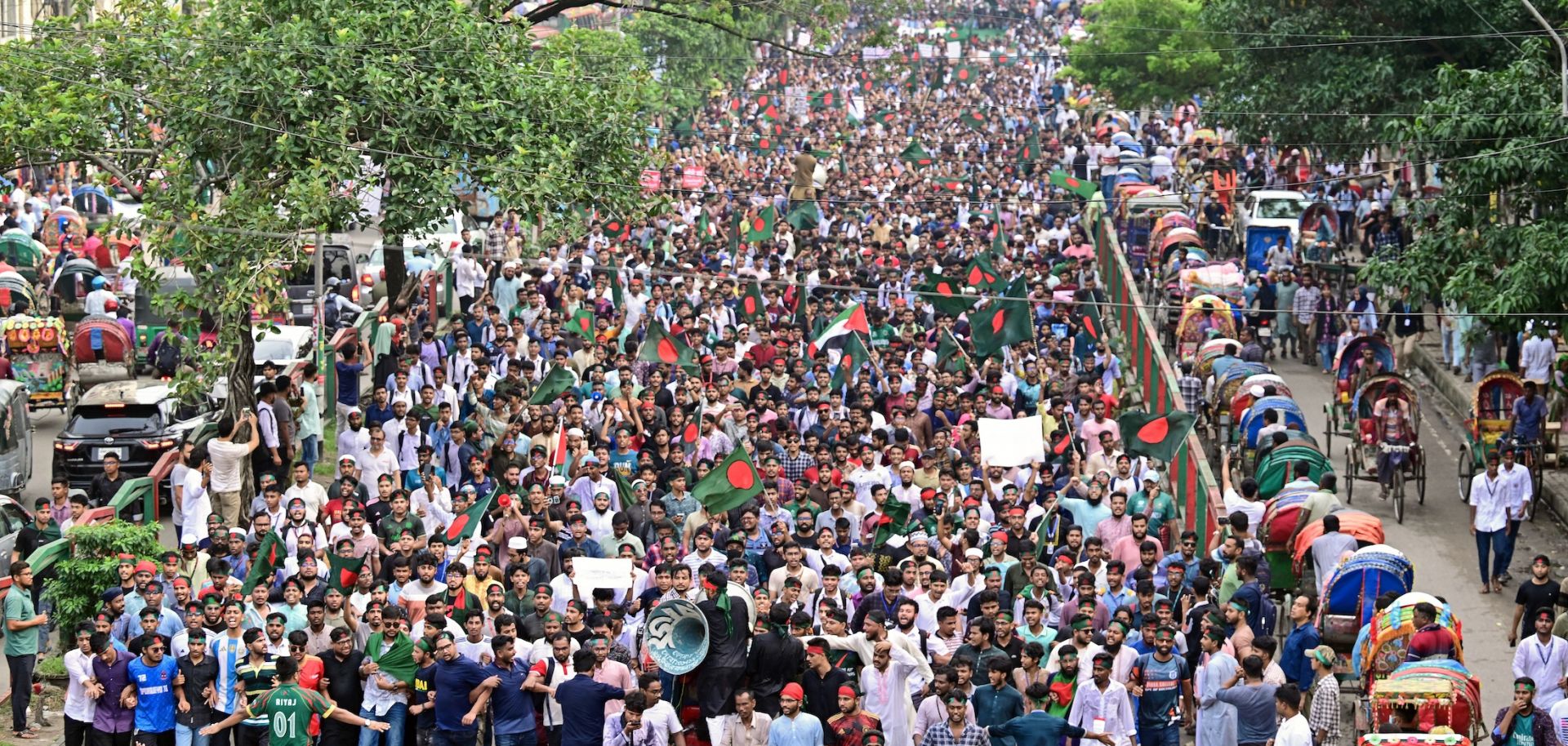
The emphasis on extensive reforms by the interim government of Bangladesh will likely delay elections, intensifying unrest and destabilizing the country even more. Muhammad Yunus, the leader of Bangladesh's interim government, said Dec. 16 that "election dates could be set by the end of 2025 or the first half of 2026" provided electoral reforms occur first. The interim government, which assumed power Aug. 9 after the ouster of Prime Minister Sheikh Hasina, has exceeded its constitutional deadline to hold elections. While the interim government argues that electoral, judicial and institutional reforms must happen before a vote, mainstream political parties including the Bangladesh Nationalist Party and Hasina's Awami League have called for elections as soon as possible.
- On Aug. 5, Hasina resigned following weeks of mass anti-government protests; more than 200 people died during a harsh government crackdown. The unrest against Hasina and the Awami League crescendoed with thousands of protesters defying a nationwide curfew and storming Hasina's official residence. She reportedly escaped just moments before the protesters entered the building, later fleeing to India aboard a military helicopter.
- The interim government's 17 Cabinet members, referred to as advisers, comprise a diverse group of prominent figures, including renowned human rights advocates, legal experts, founders of influential nongovernmental organizations, economists, academics, a retired military officer and two key coordinators from the student-led movement. Their selection was made in consultation with student leaders, the military, opposition parties and civil society representatives. No members of the Awami League were involved in the discussions that led to the formation of the interim government.
The interim government is prioritizing law and order and judicial, police, economic and electoral reforms, the last of which Yunus said must precede elections. Since the formation of the interim government, its members have said their priority is to restore law and order and ensure that the previous Awami League government be held accountable for its alleged misdeeds. Hasina's tenure had been marred by allegations of human rights abuses, including extrajudicial killings, mass detentions of political opponents, and widespread politicization of the judiciary and civil service. Critics argue that her administration manipulated the electoral system in her party's favor and undermined democratic checks on government power, necessitating the reforms called for by Yunus. These include new members of the country's election commission, and probably measures to expand its independence and responsibilities such as increasing voter registration and preventing voter fraud. Other reforms will include removing executive control over the promotion and transfer of judges and establishing a separate Supreme Court secretariat to enhance judicial independence. The government also plans a comprehensive police system overhaul, focusing on accountability and public service. This includes revising legal frameworks, improving officer welfare and strengthening institutional structures for recruitment, operations and support services. But the interim government will likely struggle to implement these reforms due to limited resources, making election delays even likelier. The interim government may also pursue these reforms to its advantage, something new regimes in Bangladesh have often done when replacing repressive governments.
- Yunus' Dec. 16 statement that electoral reforms were the minimum requirement for elections marked his first comments on the subject. He said that "if the political parties agree to hold the election on an earlier date with minimum reforms, such as having a flawless voter list, the election could be held."
The interim government's emphasis on reforms will likely delay elections beyond 2025, heightening the risk of social unrest. Widespread unrest could erode investor confidence, deter foreign investment, and deepen political polarization and instability. Despite the interim government's having missed the 90-day election window, protests have remained subdued. While consistently calling for timely elections, activists have been largely tolerant due to their support for reforms being implemented. While the announcement of elections in late 2025 or early 2026 may temporarily ease frustrations among activists who have intermittently protested over various issues in recent months, the absence of a specific date will remain a source of tension. The interim government's insistence on extensive reforms as a prerequisite for elections suggests that elections are unlikely to occur in 2025. This risks undermining support for the government, which had been seen as merely a caretaker. Prolonged delays would increase the risk of clashes between rival political factions, particularly between Awami League and BNP supporters. While both groups want elections, their competing agendas could fuel tensions. Additionally, social unrest coupled with frequent protests in Bangladesh's crucial ready-made garment sector could disrupt supply chains and harm the economy, as the industry accounts for approximately 80% of annual exports. Such unrest could disrupt manufacturing operations in the capital of Dhaka, delay shipments, and heighten concerns among global companies about Bangladesh's reliability as a manufacturing and investment destination.
Elections in 2025 or early 2026 would lead to improved political certainty, but even then, Bangladesh would still face heightened risks of unrest due to its history of disputed elections, factional tensions and protests from the Awami League, which will likely find itself barred from full participation in any vote. Elections within the two years would enhance political certainty by bringing a party with cohesive policy goals to power, replacing the current technocratic government marked by diverging views. The winning party would likely align with the interim government's reform-oriented agenda, reflecting widespread public support for change. But Bangladesh's long history of disputed elections could undermine voter perceptions of the fairness of the election, potentially sparking protests both before and after the vote. Efforts by the interim government to marginalize the Awami League will heighten this risk, increasing the likelihood of protests and clashes between league supporters and other political groups, particularly the Bangladesh National Party. These deep-seated factional tensions mean Bangladesh will likely face elevated risks of unrest through early 2026, and potentially beyond.
- On Oct. 23, the interim government banned the Awami League's student wing, the Bangladesh Chhatra League, citing allegations of involvement in violent activities. The Anti-Discrimination Student Movement, the student union that led the toppling of Hasina's government, has meanwhile demanded a complete ban on the Awami League. Rival political parties, including the BNP, have opposed this, viewing it as suspect since Hasina herself used such bans.
Failure to hold timely elections could push Bangladesh toward authoritarian rule with military backing, leading to social instability and setbacks in the vital ready-made garment sector. In such a scenario, the interim government could leverage its close ties to the military to consolidate power, sidelining democratic institutions and undermining constitutional processes. Suppressing opposition parties and curtailing civil liberties would lead widespread discontent among the public and intensifying protests; violence could ensue. Unrest would likely lead to slowdowns in the ready-made garment sector, prompting foreign investors and buyers — particularly from Western countries — to reconsider partnerships due to fears of instability and the sector's reliability in fulfilling orders, hampering the sector's growth and employment opportunities for millions. The interim government's diverse composition and lack of a unified party or cohesive strategy would meanwhile hamper its ability to implement policies. A shift toward authoritarianism could pressure some human rights lawyers and activist advisers from the interim government to resign, complicating the implementation of economic reforms and potentially deterring foreign investment in other sectors.
