
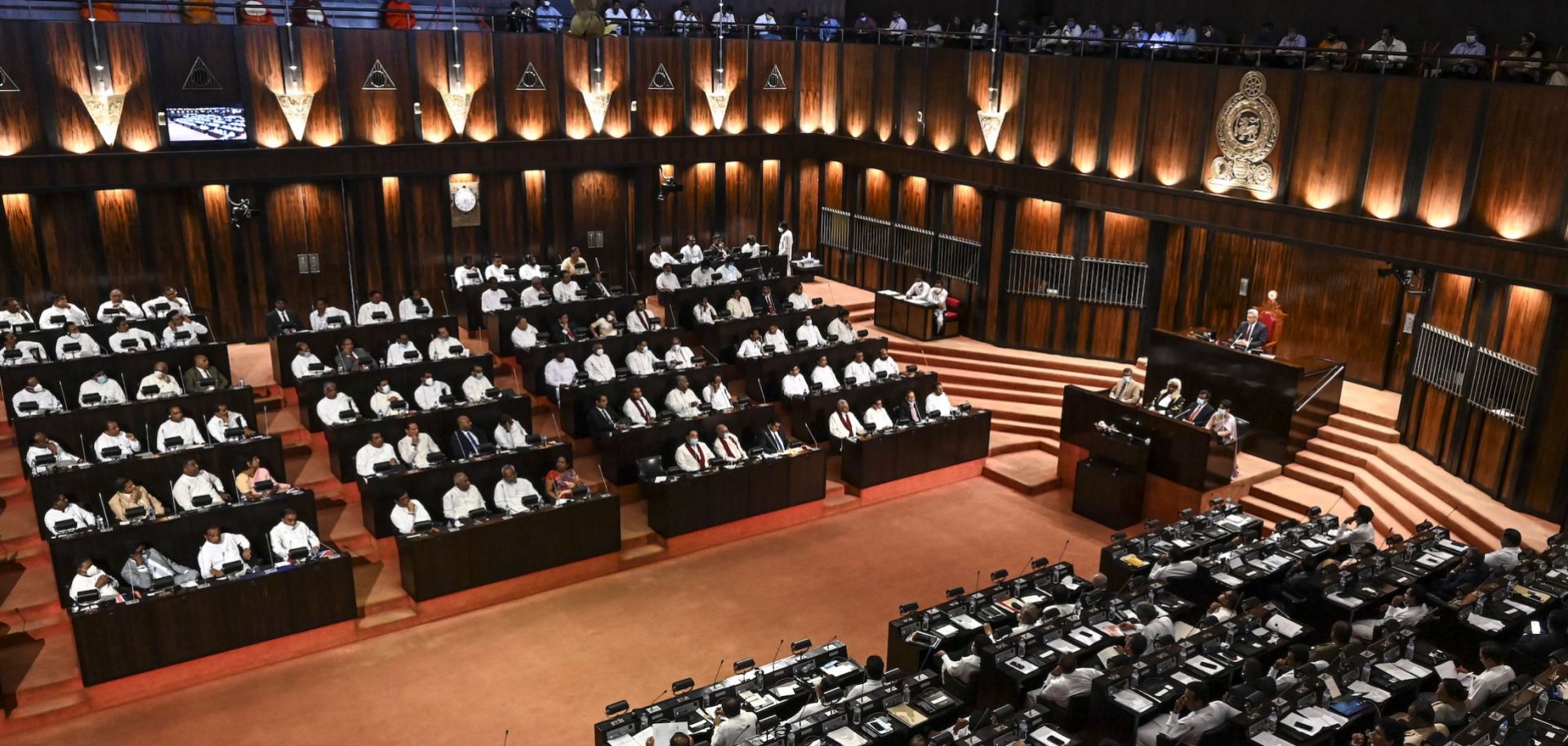
In Sri Lanka, early legislative elections could bolster the new socialist president's ability to expand social welfare spending and renegotiate the terms of the country's deal with the International Monetary Fund (IMF), though the vote could also yield a hung parliament that leads to more government infighting and political instability. On Nov. 14, Sri Lanka will hold elections for 196 seats in the country's 225-seat Parliament. The vote comes after the Sept. 23 inauguration of President Anura Kumara Dissanayake, who dissolved the legislature the day after he was sworn in, bringing forward the parliamentary elections that were originally scheduled for August 2025. In addition to Dissanayake's socialist National People's Power (NPP), other parties running include the right-wing Sri Lanka Podujana Peramuna, which held the majority in the last parliament, and the center-left Samagi Jana Balawegaya. The newly elected Parliament is expected to convene on Nov. 21.
- To hold a majority in Parliament, a party or coalition needs at least 113 seats of the 225 seats. 196 of those seats are elected from 22 electoral districts using an open-list proportional representation system. Voters select a party and can rank up to three candidates within that party. A party must secure at least 5% of the national vote to win any seats. The remaining 29 seats are national list seats, allocated to parties based on their total share of votes nationwide. Party leaders appoint members to these seats from their national lists, allowing them to include individuals who didn't run in constituency elections.
- Former President Ranil Wickremesinghe will notably not be running in the parliamentary elections after he failed to secure another term in the September presidential election, where he ran as an independent. As president, Wickremesinghe implemented IMF-recommended austerity measures that aided Sri Lanka's economic recovery after the country's default in 2022. But the measures also raised living costs and taxes for already struggling Sri Lankans. Against this backdrop, Wickremesinghe only received 17% of the vote in the first round of the 2024 presidential election, and did not qualify for the runoff that resulted in Dissanayake's victory.
By holding early elections, Dissanayake is hoping to expand his party's presence in Parliament and advance his policy agenda, which is focused on increasing welfare subsidies and scaling back his predecessor's austerity measures. But if it falls short of a majority, the NPP may have to reach agreements with other parties, posing risks of continued legislative gridlock. During his presidential campaign, Dissanayake pledged to negotiate fairer tax policies under Sri Lanka's IMF program by balancing tax increase requirements and increasing social welfare subsidies. He also promised to block the Wickremesinghe government's Economic Transformation Bill, which introduces IMF-aligned austerity measures that could limit government spending on the policies Dissanayake and his NPP support, including fuel and fertilizer subsidies for farmers and fishermen, pension increases, and the distribution of underutilized land to farmers. Moreover, the Economic Transformation Bill supports the continued privatization of state-owned enterprises, expanding the list of entities to be sold or restructured; this approach also conflicts with Dissanayake's economic vision, which favors greater state control of key sectors and prioritizes the welfare of Sri Lankan businesses and workers over that of foreign entities. However, before Dissanayake dissolved Parliament, the NPP only held three seats in the legislature, which would have made it difficult for him to fulfill these campaign pledges. Dissanayake is thus likely hoping the snap election will yield more seats for his party by building off the momentum from his recent victory in the presidential race, where he secured 42.3% of the vote. And this gamble will likely prove successful, as Dissanayake's election showcased how he and the NPP's anti-establishment platform and pledges for more economic support have resonated among many disillusioned Sri Lankans. However, even if the NPP receives a similar share of votes in the parliamentary election as Dissanayake did in the presidential election, it may still fall short of the 113 seats needed for a majority. This would require the NPP to engage in political horse-trading to form a coalition with other parties, potentially undermining Dissanayake's ability to implement his policies and maintain a stable government.
- In July, the Sri Lankan government, led by then-President Wickremesinghe and his right-wing party, passed the Economic Transformation Bill. The bill introduces strict debt limits, sustainable public spending and incentives for foreign investment, which are intended to apply to future Sri Lankan governments, reinforcing fiscal discipline and long-term economic stability. Its key targets include keeping Sri Lanka's debt-to-GDP ratio below 95% by 2032, reducing the government's annual gross financing needs to below 13% of GDP by 2032, and bringing the foreign currency debt service ratio to below 4.5% by 2027. In response to the bill's passage, Dissanayake's NPP filed a fundamental rights petition in Sri Lanka's Supreme Court, challenging the Economic Transformation Bill, which the NPP argues will limit the powers of future governments and transfer significant economic decision-making authority to non-elected bodies.
The center-left Samagi Jana Balawegaya (SJB) party, weakened by internal divisions, is unlikely to gain majority control of the legislature, though the party may consider forming a coalition with the NPP based on shared anti-corruption and IMF renegotiation goals. The SJB's position has weakened since the presidential race, where its leader Sajith Premadasa secured 32.76% of the vote. While the party remained united during the presidential election behind Premadasa, internal divisions have emerged following his defeat, which disillusioned many of its supporters. This is further underscored by the fact that Premadasa had significant backing from the Tamil National Alliance (TNA) party, which is running separately in the parliamentary election, further constraining the SJB's chance of victory. If the NPP falls short of a majority, it may seek to form a coalition with the SJB, as the two parties' short-term policy priorities — such as focusing on welfare, renegotiating the IMF deal and blocking the Economic Transformation Bill — align. Additionally, in parliament, the SJB will likely push to abolish Sri Lanka's Online Safety Act, which was passed under former President Wickremesinghe and has been criticized for restricting freedom of speech and limiting online expression under the guise of cybersecurity. Repealing the act aligns with the SJB's broader agenda to promote transparency, protect civil liberties and prevent government overreach. Additionally, the SJB plans to implement anti-corruption measures by strengthening legal frameworks, improving transparency, and enforcing stricter anti-corruption laws. These policy priorities, particularly the SJB's focus on civil liberties and transparency, will likely be key points of cooperation if the party forms a coalition with the NPP. However, in the medium to long term, the two parties may clash on issues related to economic liberalization, the pace and scope of privatization, and how to approach fiscal policy and social welfare spending, which would raise the risk of legislative deadlock.
- The SJB has shown signs of fracturing in recent weeks, with several key figures stepping down or facing internal disputes. In mid-October, the leader of the SJB women's wing resigned after a disagreement with Premadasa's wife. An SJB lawmaker also announced he would not be contesting the upcoming election. Earlier, actress Damitha Abeyratne, a key supporter in Premadasa's presidential campaign, was denied a nomination due to a dispute with SJB Ratnapura District leader Hesha Vithanage.
- The Tamil National Alliance (TNA), which represents the Tamil ethnic community in Sri Lanka, did not put forth a formal candidate in the presidential election. Some members supported Pakkiyaselvam Ariyanethiran, a Sri Lankan Tamil politician, while others supported Premadasa of the SJB, likely due to his pledges to address Tamil-related grievances, particularly those related to political autonomy and reconciliation.
Former President Wickremesinghe's Sri Lanka Podujana Peramuna (SLPP) party will likely lose control of Parliament due to its widespread unpopularity, though the once-dominant party's attempts to retain influence could lead to policy clashes with President Dissanayake and heighten the risk of unrest. The SLPP, led by the politically dominant Rajapaksa family, held the majority of seats in the previous Parliament, but it is widely expected to lose its majority in the upcoming elections due to the party's widespread unpopularity. Indeed, around 30 long-serving and once-popular SLPP lawmakers, including members of the Rajapaksa family, have opted out of the race, anticipating defeat. Furthermore, if the NPP falls short of a majority, a coalition with the SLPP is unlikely due to their differing agendas, which include the SLPP's commitment to IMF-led economic reforms focused on fiscal stabilization, tax reform, and structural adjustments to manage inflation while maintaining the Economic Transformation Bill. However, having previously held 145 seats and still potentially retaining some support among the elite, the SLPP is not expected to relinquish control without resistance. This could lead to political maneuvering, protests or other forms of resistance, as the SLPP may try to form alliances with smaller parties to maintain influence. Such actions could increase the risk of low-level unrest and complicate the new NPP's ability to govern effectively, potentially hindering the implementation of key policies, particularly fiscal stabilization measures and tax reforms.
Regardless, the new Sri Lankan government will continue to balance ties between China and India through debt management, infrastructure development and trade agreements. The elections will likely see Sri Lanka shift away from the SLPP's long-standing policies (such as adherence to IMF-led economic reforms for fiscal stabilization, tax reforms, structural adjustments, and privatization of state-owned assets) to the NPP's policy proposals, which focus on social welfare and renegotiating the IMF deal to secure more favorable policies that ease austerity measures. However, while this shift could transform the country's economic approach to emphasize transparency and inclusivity, it is unlikely to yield drastic foreign policy changes. Given Sri Lanka's economic dependence on China and India, the incoming government will probably aim to maintain strong relations with both countries, particularly in areas like debt management, infrastructure development and trade. Sri Lanka is also expected to continue negotiations for free trade agreements with China and India to broaden market access for its goods. However, these efforts may encounter obstacles, including opposition from domestic industries worried about heightened competition, sensitive discussions in sectors such as agriculture and textiles, and the complex task of balancing ties between China and India.
- China is a major trading partner for Sri Lanka, with Chinese exports to the island nation totaling $3.76 billion in 2023, mainly consisting of machinery, construction materials and equipment. Beyond trade, China has invested heavily in Sri Lankan infrastructure, including the Colombo Port City and various energy projects.
- India is a crucial trade partner for Sri Lanka as well, with Indian exports to the country totaling $3.58 billion in 2023. India's primary exports include petroleum products, vehicles and pharmaceuticals, while Sri Lanka mainly exports textiles and tea to India. Indian investments in Sri Lanka span sectors such as telecommunications, manufacturing and hospitality.
