
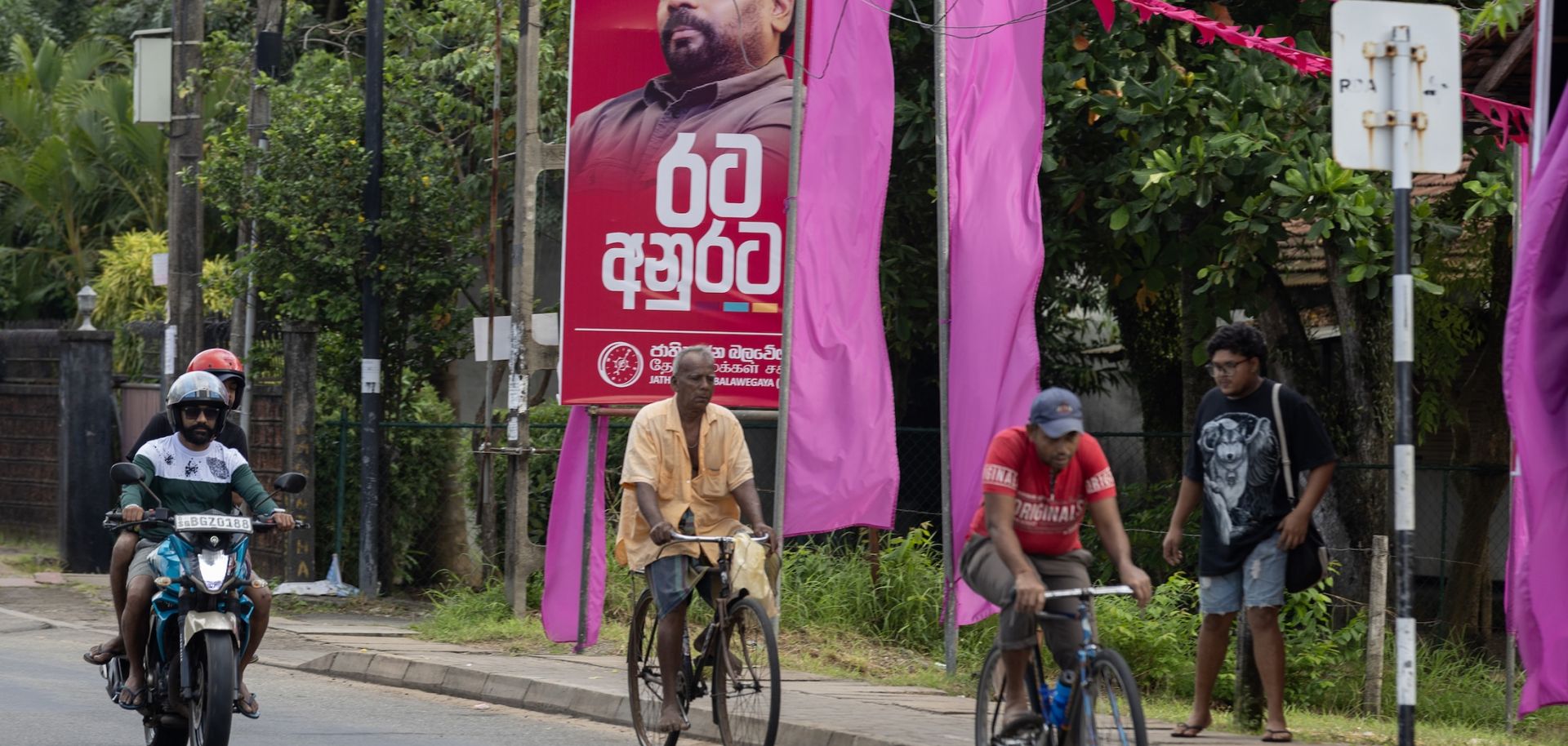
In Sri Lanka's presidential elections, differing views on the country's agreement with the International Monetary Fund and austerity measures, social issues involving Tamils and Muslims, and balancing relations with India and China heighten the risk of social unrest, delays in financial support, and uncertainty in economic planning and reforms, while the new president's insufficient support in Parliament may delay policy. Sri Lanka will hold its presidential election Sept. 21 with a record 39 candidates competing. Key contenders include incumbent center-right President Ranil Wickremesinghe; Namal Rajapaksa of the right-wing Sri Lanka Podujana Peramuna, or SLPP; Sajith Premadasa of the center-left Samagi Jana Balawegaya; and Anura Kumara Dissanayake, leader of the Janatha Vimukthi Peramuna running under the socialist National People's Power coalition. No reliable opinion polls indicate a clear front-runner, but several surveys suggest opposition candidates Premadasa and Dissanayake are gaining popularity. The election will use Sri Lanka's system of having voters rank candidates by preference. The president is directly elected for a five-year term using a version of Instant-Runoff Voting, where voters can select their first, second and third favorite candidates. If no candidate secures more than 50% of the vote outright, second-choice votes will be redistributed to the top two candidates to determine the winner.
- While Wickremesinghe belongs to the United National Party, he is running as an independent.
- The SLPP, which holds a majority in Parliament, initially supported Wickremesinghe, but later withdrew its backing in favor of Namal Rajapaksa, a member of parliament and the son of former President Mahinda Rajapaksa and nephew of former President Gotabaya Rajapaksa. A group of SLPP members of parliament and ministers has expressed support for Wickremesinghe, revealing residual support for him despite the party's official stance.
Wickremesinghe and Premadasa are broadly unpopular due to delayed local elections and the implementation of austerity measures under the IMF program, even though the economy is improving. These are the first presidential elections since Wickremesinghe took office in July 2022 following widespread protests triggered by a severe financial crisis that forced his predecessor, Gotabaya Rajapaksa, to flee the country and eventually resign. With significant support from lawmakers in Rajapaksa's SLPP party, Parliament elected Wickremesinghe to complete the remainder of Rajapaksa's term. The presidential elections are also taking place amid criticism from human rights activists and opposition parties arguing that Wickremesinghe violated voters' fundamental rights by postponing local elections scheduled for March 2023; those elections still have not been held. Under Wickremesinghe, the economy has shown signs of recovery, with year-on-year inflation dropping to 17.5% from a peak of 47.5% in 2022, Sri Lanka reached debt-restructuring agreements with lenders, and increased foreign reserves. But the benefits have not yet impacted most Sri Lankans, as according to the World Bank, poverty rates in Sri Lanka have risen for the fourth consecutive year. An estimated 25.9% of the population was below the poverty line in 2023, up from 14.3% in 2019. The population is also still struggling with a high cost of living and taxes amid the country's IMF program-related austerity measures, making Wickremesinghe and the SLPP widely unpopular.
- In 2022, Sri Lankans experienced power cuts and shortages of essentials such as fuel, with inflation rising to 50%. Protests erupted in the capital of Colombo in April and spread nationwide. The country struggled with a lack of foreign currency reserves, leading to shortages of fuel and surging gasoline and diesel prices. Economic mismanagement, including heavy borrowing and abrupt policy shifts, compounded the crisis, leading to widespread protests, political instability and the resignation of President Gotabaya Rajapaksa.
- In Sri Lanka, local elections are held every four years for members of municipal councils, divisional councils and urban councils. In 2023, however, Wickremesinghe postponed local government elections, citing insufficient funds. The controversial decision raised concerns about the government's commitment to democratic processes. The Supreme Court of Sri Lanka on Aug. 22 found Wickremesinghe guilty of arbitrary and unlawful conduct in postponing the local elections and ordered his administration to hold the polls as soon as possible, rejecting the government's argument that a lack of funds justified the delay.
A win for Wickremesinghe or Rajapaksa would likely ensure the continuation of current IMF-driven economic policies; Premadasa and Dissanayake, by contrast, would seek more favorable terms from the IMF, though not an exit from the program, suggesting continued adherence and stability in the short to medium term. A win for Wickremesinghe or Rajapaksa would likely result in the continuation of the government's current policies aimed at achieving economic stability. This would include adherence to IMF-driven reforms such as fiscal stabilization, debt restructuring, tax reform and structural adjustments to control inflation. This could reassure international investors and creditors, offering medium- to long-term stability. Along these lines, both candidates are likely to push for the passage of three key economic reform bills — the Economic Transformation bill, the Public Debt Management bill and the Public Financial Management bill — to prevent future crises by establishing consistent economic policies, regulating borrowing and enhancing fiscal discipline. Opposition candidates are likely to oppose the passage of the Economic Transformation bill, however, arguing that it undermines the powers of the Board of Investment, the body responsible for promoting and facilitating foreign direct investment. They contend that the bill grants the finance minister authority that effectively nullifies board functions and reduces accountability. Failure to pass the bill would create regulatory uncertainty, potentially deterring foreign and local investors. The SLPP's majority in Parliament will make it hard for Premadasa and Dissanayake to block the bill, however, especially because the president lacks the power to veto legislation approved by a parliamentary majority. This means that policies the SLPP opposes may need to be altered to gain approval in Parliament. Additionally, Premadasa and Dissanayake are unlikely to exit the IMF deal, though they would seek to negotiate with the institution for fairer tax policies and increased social welfare subsidies to reduce the risk of social unrest. While the IMF might allow some adjustments that do not undermine its overall goal of fiscal consolidation, the institution would likely reject any changes that lead to a higher fiscal deficit, potentially delaying IMF financial support and worsening fiscal challenges. Moreover, a new Sri Lankan president would be unlikely abruptly to abandon the IMF program in the early months of his term, making its continuation likely in the short to medium term and avoiding the risk of economic destabilization.
- The Economic Transformation bill aims to create a national policy for consistent economic growth, targeting 5% annual gross domestic product growth by 2027, unemployment below 5% by 2025 and female labor participation of 50% by 2040. The Public Debt Management Bill seeks to regulate borrowing and debt practices, introducing oversight through a new Public Debt Management Office to prevent excessive borrowing and improve fiscal responsibility. Meanwhile, the Public Financial Management bill aims to enhance budget discipline by capping primary spending at 13% of GDP and establishing a 2% budget reserve. These bills are designed to improve investor confidence, promote sustainable growth and ensure financial stability.
- If Wickremesinghe wins, the acceleration of state-owned enterprise privatization could attract domestic and foreign investment and ease the government's financial burden. This could, however, lead to public sector job losses, provoking resistance from labor unions and potential social unrest. Conversely, a win for Rajapaksa, Premadasa or Dissanayake would likely slow or halt privatization, preserving public sector jobs but potentially prolonging inefficiencies and straining government finances. While this might reduce immediate job-related social tensions, it could limit private capital inflows.
Failing to address ethnic and religious discord risks heightened regional tensions, increased political unrest and intensified grievances across the population. Failure by Sri Lanka's next president to implement the 13th Amendment, which provides greater autonomy to the Northern and Eastern provinces and addresses Tamil grievances, could heighten regional tensions and lead to increased political mobilization, unrest, and demands for greater autonomy or secession. But approving the amendment might provoke social unrest if other ethnic groups or political factions view this increased autonomy as a threat to national unity. Premadasa is the only candidate who explicitly supports the full implementation of the 13th Amendment. While not committed to fully implementing the amendment, Wickremesinghe and Dissanayake might instead address Tamil grievances through supplementary measures. These could include promoting targeted investment in infrastructure, education, health care and job creation in Tamil-majority regions to address economic disparities and improve living standards, and establishing a formal dialogue process with Tamil political leaders, civil society and diaspora groups to address specific concerns related to justice, reconciliation and development. By contrast, Rajapaksa is likely to adopt a security-focused approach in Tamil-majority areas, emphasizing law and order while possibly neglecting deeper political grievances and avoiding significant political concessions. Separately, if Wickremesinghe or Rajapaksa win, they would likely make limited progress on the investigation into the 2019 Easter Sunday attacks due to political sensitivities surrounding the involvement of various ethnic and religious groups, as well as competing government priorities such as economic recovery and debt management. Pursuing the investigation risks exacerbating grievances within the Muslim community, while not doing so risks amplifying general discontent throughout those more concerned by national security and justice for victims of the attack. Dissanayake and Premadasa, by contrast, would likely work to ensure justice for the victims, focusing on support, compensation and a thorough investigation. This will likely require substantial financial and administrative resources and face legal and political challenges, potentially limiting progress.
- The 2019 Easter Sunday attacks were a series of bombings carried out by local extremists reportedly inspired by the Islamic State. The attacks targeted churches and hotels, resulting in much loss of life and injury. The aftermath of these attacks led to heightened security measures and scrutiny of the Muslim community, causing severe hardship and contributing to broader societal tensions. Survivors and bereaved families have demanded a thorough investigation into allegations of links between the bombers and Sri Lankan intelligence officials. The United Nations has reinforced the call for accountability, urging Sri Lanka to address its "accountability deficit" and ensure justice.
- The 13th Amendment, passed in 1987 but still awaiting implementation, seeks to address Tamil grievances such as ethnic discrimination and issues related to governance and resource allocation by granting the Northern and Eastern provinces greater control over local governance and resources. Previous governments have shown varying levels of commitment to these provisions due to shifting political priorities, resistance from other ethnic and political groups, and challenges in effectively decentralizing authority while maintaining national cohesion.
Sri Lanka's economic reliance on China and India means that the next president will likely seek to preserve ties with both, especially on issues such as debt management, infrastructure investment and trade. All candidates have expressed a commitment to a balanced approach in international relations, with no proposals to pivot away from China or India. Their approach will focus on managing debt repayment, maintaining investments in infrastructure like ports and public transportation, and cooperating on regional and maritime security. They will also likely continue ongoing free trade agreement negotiations with both China and India to expand market access for Sri Lankan products. Whether these efforts would succeed remains unclear due to challenges such as domestic resistance from industries worried about increased competition, sensitive negotiations in sectors like agriculture and textiles, and the need to balance relationships between major international partners like India and China, which could delay progress in the short to medium term.
- Both India and China have extended substantial support to Sri Lanka, so a balanced foreign policy approach is crucial to the country's economic recovery. On June 26, Wickremesinghe announced an agreement to restructure bilateral debt with several countries, including India and China. The Official Creditor Committee, co-chaired by India plus Japan and France, includes representatives from 17 countries that together have lent Sri Lanka $5.8 billion. The Export-Import Bank of China meanwhile holds approximately $4 billion of Sri Lanka's external debt.
- India and China are among Sri Lanka's top import partners, supplying a range of essential products. Sri Lanka imports petroleum oils, fabrics, cane or beet sugar, rice, wheat, and other food products from India, along with various consumer goods. China meanwhile exports machinery and equipment, electronic goods, construction materials, and various industrial products.
