
Editor's Note: With many significant elections occurring in 2024, RANE is publishing a series of scenario analyses focused on different outcomes of major elections occurring this year, describing how an election outcome might unfold with implications for each potential outcome. The first installment covered India's general election, the second covered European parliamentary elections, the third covered South Africa's general election, the fourth covered Mexico's presidential election, the fifth covered Iran's presidential election, and the sixth covered the United Kingdom's general election. The following is a scenario analysis for Sri Lanka's Sept. 21 presidential election.
Sri Lanka will hold the first round of its presidential election on Sept. 21, with a record 39 candidates registering to run. The election will be conducted under Sri Lanka's preferential voting system, where voters rank candidates in order of preference. If a candidate secures more than 50% of first-choice votes, they win the election outright. If no candidate achieves this majority, the candidate with the fewest votes is eliminated, and their votes are redistributed based on the next preferences indicated. This process continues until a candidate obtains a majority. Of the 39 candidates, the most likely to win include Ranil Wickremesinghe, Namal Rajapaksa, Sajith Premadasa and Anura Kumara Dissanayake. However, while the president holds significant executive powers, including the ability to appoint key officials and influence national policy, the new president will still need to collaborate with the parliament, which is currently dominated by the Sri Lanka Podujana Peramuna (SLPP) party. The SLPP has substantial legislative authority and controls key committees and budgetary decisions, which could impact the next president's ability to implement policy changes if those changes face pushback from the SLPP.
If Ranil Wickremesinghe or Namal Rajapaksa wins, current policies will continue, including International Monetary Fund (IMF) reforms and infrastructure projects. Wickremesinghe will likely pursue asset sales, while Rajapaksa would likely halt them. Both would maintain a balanced foreign policy and promote an export-led economy. Both would also have close ties with the parliament, which would facilitate the passage of legislative priorities, particularly regarding agricultural modernization and the energy transition, as well as economic reforms-related bills focused on stabilizing the economy, tackling the fundamental issues behind past economic crises, and creating a solid base for long-term financial sustainability.
If Sajith Premadasa of the Samagi Jana Balawegaya (SJB) wins, he will focus on economic growth through tax breaks, subsidies and expanded free trade agreements, while implementing anti-corruption measures and renegotiating the IMF agreement for better terms. He aims to balance fiscal discipline with social welfare needs and will likely attempt to abolish the Online Safety Act to protect freedom of speech.
If Anura Kumara Dissanayake wins, his National People's Power (NPP) administration will focus on social justice and economic equality, including increasing subsidies and welfare benefits while likely ending state asset sales. He would also pursue negotiations with the IMF. While the IMF may show some flexibility with both Dissanayake and Premadasa in modifying parts of the program that do not significantly undermine its overall objectives, changes that lead to a financing shortfall may encounter resistance, potentially delaying financial support and exacerbating fiscal imbalances. Meanwhile, Dissanayake will try to implement strong anti-corruption measures and potentially shift foreign policy closer to India, seeking greater bilateral cooperation.
Incumbent President Wickremesinghe or Ruling Party Candidate Namal Rajapaksa Wins
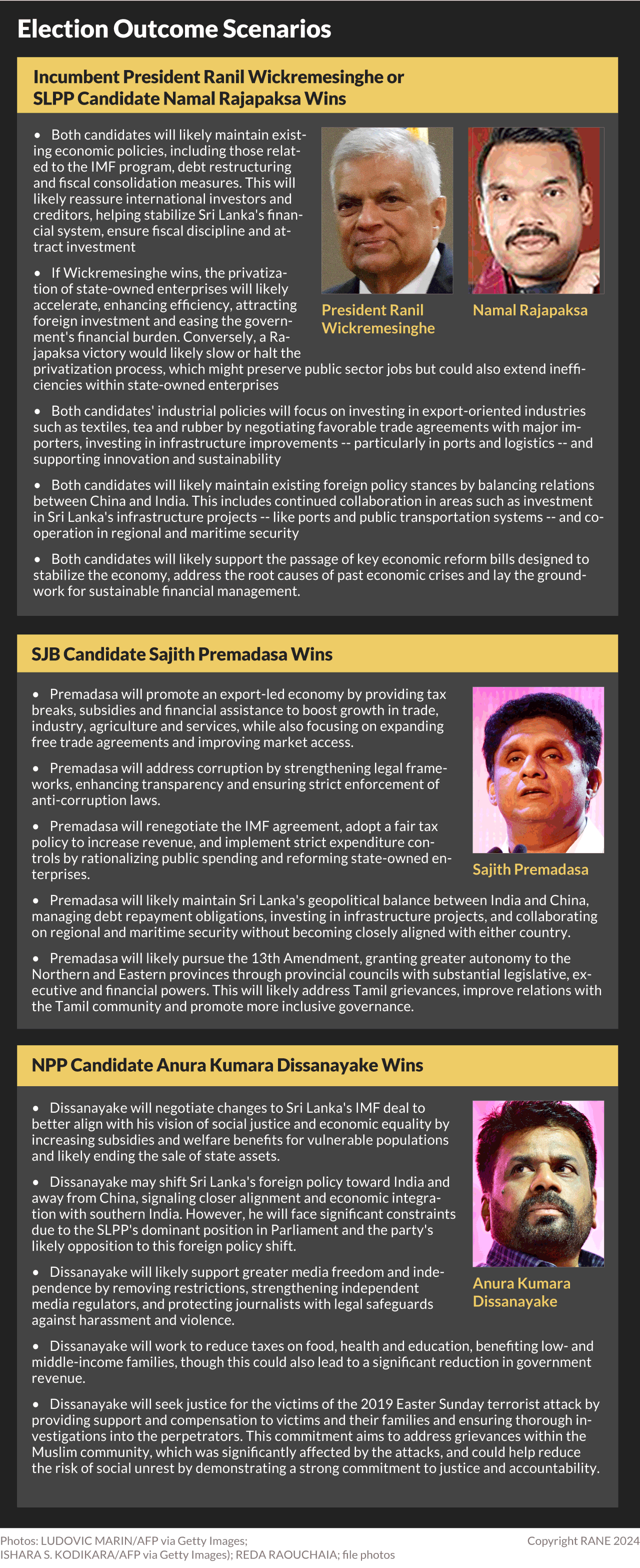
A victory by incumbent President Ranil Wickremesinghe, who is running as an independent, or Namal Rajapaksa of the ruling SLPP would result in the current ruling establishment retaining power and maintaining the government's current policies. This continuity would likely include adherence to IMF-led economic reforms aimed at fiscal stabilization, tax reform and structural adjustments to stabilize inflation. If Wickremesinghe wins, his administration would likely pursue a sale of state assets as part of broader economic restructuring efforts, though this may face pushback from the SLPP due to concerns about national sovereignty, potential job losses, and the unpopularity of privatization among the party's voter base. A Rajapaksa victory, by contrast, would freeze or slow the sale of assets. A Rajapaksa and Wickremesinghe administration would also likely pursue infrastructure development projects and anti-corruption measures, while maintaining existing foreign policy stances in balancing between China and India. Additionally, such a government would likely continue its role as a regulator, negotiate free trade agreements with China and India, and promote an export-led economy in textile, tea and rubber.
Implications
- If either Wickremesinghe or Rajapaksa wins, it would likely signal the continuation of existing economic policies, including those related to the IMF program, debt restructuring and fiscal consolidation measures. This would likely reassure international investors and creditors, providing stability in the short term. Additionally, sticking to the IMF program could help stabilize Sri Lanka's financial system by facilitating debt restructuring, ensuring fiscal discipline and attracting investment.
- A victory for Wickremesinghe or Rajapaksa would reassure international creditors and investors about Sri Lanka's commitment to economic reforms, potentially encouraging foreign investment or at least keeping the investment climate relatively positive.
- Sri Lanka maintains its current geopolitical stance, including its relationships with key international partners like India, Japan and China. This includes ongoing collaboration in areas like investment in Sri Lanka's infrastructure projects, including ports and public transportation systems, and collaboration in regional and maritime security.
- The continuation of austerity measures and high taxes will likely fuel public discontent, particularly among lower-income groups. This could potentially trigger protests and social unrest, heighten the risk of disruptions to business, and lower investment confidence amid outbreaks of social unrest.
- If Wickremesinghe wins, the privatization of state-owned enterprises will accelerate, improving efficiency, attracting foreign investment, and reducing the government's financial strain. However, this could also lead to job losses in the public sector, sparking resistance from labor unions and potentially contributing to social unrest.
- A Rajapaksa victory would likely slow or halt the privatization process, preserving jobs in the public sector but potentially prolonging inefficiencies within state-owned enterprises. While this might reduce immediate social tensions related to job losses, it could also strain the government's finances in the long run and limit the inflow of private capital necessary for modernizing these industries.
- Sri Lanka pursues free trade agreements with China and India, aiming to enhance trade relations, reduce tariffs and expand market access for Sri Lankan products. Still, the likelihood of success is low as challenges, including domestic resistance by local industries concerned about market competition, sensitive sector negotiations such as those involving agriculture and textiles, and geopolitical concerns such as balancing relationships with major international partners, particularly between India and China, will likely stall the finalization in the short to medium term.
- Sri Lanka's industrial policy focuses on investment into export-oriented industries, like textiles, tea and rubber, by attempting to negotiate favorable trade agreements with major importers, investing in infrastructure improvements, particularly in ports and logistics, and supporting innovation and sustainability. Nevertheless, infrastructure bottlenecks, regulatory and bureaucratic hurdles, skill gaps and labor shortages, sustainability challenges, intense global competition, political and economic instability, and limited access to capital will constrain these efforts.
- Both candidates will likely work to transition Sri Lanka to a green economy with a strong focus on achieving net-zero emissions by soliciting large-scale investments in renewable energy, such as solar, wind and hydroelectric power. However, despite the government's policy, the high cost of these technologies keeps the energy transition slow in Sri Lanka.
- If both candidates introduce new laws enforcing stricter environmental regulations and promoting carbon reduction, it could lead to significant industry changes by establishing a more rigorous compliance framework. This might initially increase operational costs but could also attract long-term green investments. The investment climate could become more appealing to ESG-focused investors, driving a shift in industry practices toward cleaner technologies and sustainable processes. However, it would also deter Chinese and other investors that do not put a premium on those initiatives.
- Wickremesinghe will likely continue to promote reconciliation efforts with the Tamil community, building on previous government initiatives aimed at addressing grievances related to the civil war. This could result in offering greater autonomy or devolution of power to Tamil-majority regions, leading to increased political stability and social cohesion and fostering greater regional development and economic opportunities in Tamil-majority areas.
- Rajapaksa will likely take a security-focused approach in Tamil-majority areas, prioritizing law and order and maintaining control and stability. His policies could emphasize these aspects at the expense of addressing deeper political grievances, as he may be less inclined to offer significant political concessions, such as greater autonomy or devolution of power. This approach could lead to continued discontent among Tamil political leaders and potentially fuel tensions between the government and the Tamil population.
- Sri Lanka's government will modernize the Agricultural Support System, which will include enhancing technical expertise through increased training and support, improving market linkages with better supply chains and access to global markets, and integrating advanced technologies and sustainable farming practices. This modernization effort will boost agricultural productivity, improve sustainability and economic growth in rural areas, and may contribute to higher incomes for farmers, better food security and overall rural development.
- Sri Lanka is likely to pass three significant economic reforms bills — the Economic Transformation Bill, the Public Debt Management Bill and the Public Financial Management Bill — aimed at stabilizing the economy, addressing the root causes of past economic crises and laying the foundation for sustainable financial management.
- The Economic Transformation Bill, which aims to establish a national policy on economic transformation to ensure stability regardless of changes in government, will likely be passed. When passed, the bill may improve investor confidence, help mitigate future economic shocks and guide sustainable growth. Key parts of the bill include components for long-term economic planning, including targets like achieving 5% annual GDP growth by 2027 and exceeding that rate in subsequent years, reducing unemployment to below 5% of the labor force by 2025, and boosting female labor force participation to at least 40% by 2030 and 50% by 2040.
- The Public Debt Management Bill will likely be passed and will seek to regulate borrowing and debt servicing practices. It introduces requirements for authorization to borrow, oversight of public debt through a newly established Public Debt Management Office and guidelines for issuing guarantees. Upon passage, this bill will likely lead to more controlled and transparent debt management, reducing the risk of excessive borrowing and future debt crises. It will enhance fiscal responsibility and accountability, potentially improving investor trust and contributing to a more stable financial environment.
- The Public Financial Management Bill will likely pass and aim to enhance fiscal discipline by replacing the Fiscal Management Responsibility Act, capping primary spending at 13% of GDP, and establishing a 2% budget reserve. This will result in increased fiscal responsibility, improved investor confidence and enhanced budget stability.
- If Wickremesinghe or Rajapaksa win, they will likely make limited progress on the stalled investigation into the 2019 Easter Sunday attacks by local extremists reportedly inspired by Islamic State, which could inflame Muslim grievances and spark unrest, given the significant hardships endured by the Muslim community in the aftermath, which may result in increased social tensions and potential instability if not addressed promptly and effectively.
Main Centrist Opposition Candidate Sajith Premadasa Wins
If Samagi Jana Balawegaya (SJB) candidate Sajith Premadasa wins, he and the SJB will focus on addressing Sri Lanka's economic challenges. Premadasa will promote an export-led economy by offering tax breaks, subsidies and financial assistance to stimulate growth in trade, industry, agriculture and services, as well as expanding free trade agreements and enhancing market access. The SJB will implement anti-corruption measures by strengthening legal frameworks, increasing transparency and ensuring strict enforcement of anti-corruption laws. Regarding fiscal policy, the SJB plans to renegotiate the IMF agreement on more favorable terms for Sri Lanka, adopt a fair tax policy to boost revenue and implement strict expenditure controls, including rationalizing public spending and reforming state-owned enterprises. Attempts to renegotiate the IMF deal that significantly differs from Sri Lanka's financing goals will likely face challenges due to the IMF's stringent conditions and potentially delay future tranches. Still, if successful, they could provide Sri Lanka more flexibility in managing its economic recovery while balancing fiscal discipline with social welfare needs. The SJB will likely implement a mix of interventionist and free-market economic policies, strategically intervening in critical sectors such as energy, utilities, infrastructure and healthcare to ensure stability and growth while promoting competition and private sector participation. Premadasa will also likely make efforts to abolish the Online Safety Act, passed under Wickremesinghe, which has been criticized for its potential to restrict freedom of speech and limit online expression under the guise of cybersecurity. This move would align with his broader agenda of promoting transparency, safeguarding civil liberties and ensuring that government policies do not infringe on individual rights. However, Premadasa will likely be constrained in implementing his policy promises due to the SLPP's dominance in parliament and diverging political views, meaning more of his policies will need to either be watered down to get through parliament or rely on executive authority.
Implications
- Premadasa will likely enter negotiations with the IMF for more favorable agreement terms, aiming to adopt a fair tax policy and show leniency in cutting back on social expenditure to make the cost of living more manageable, potentially lowering the risk of social unrest. While the IMF may show some flexibility in modifying and renegotiating parts of the program without compromising its viability, it will likely resist changes that impact previously agreed-upon conditions or targets if financing falls short, leading to prolonged negotiations, delays in accessing essential financial support and uncertainty in economic planning.
- Premadasa will likely continue Sri Lanka's geopolitical balancing act between India and China and refrain from becoming too close to either. This approach will involve managing debt repayment obligations, maintaining investments in infrastructure projects such as ports and public transportation systems, and collaborating on regional and maritime security.
- A relaxation of the austerity measures under Premadasa and the SJB will lead to higher debt levels and fiscal imbalances, increasing Sri Lanka's borrowing costs and the risks of another financial crisis.
- In an effort to tackle corruption and strengthen transparency, Premadasa is likely to bolster legal frameworks and enhance the implementation of anti-corruption laws by increasing the rigor of legal enforcement, promoting transparency in government dealings and establishing independent oversight bodies. These measures will work to improve governance, restore public trust and foster greater political stability. However, Sri Lanka may still face a high risk of corruption due to entrenched systemic issues, such as weak institutional capacities, historical patterns of corruption and political resistance to reform.
- Premadasa will work to implement both interventionist and free-market approaches by intervening in critical sectors like energy, utilities and infrastructure where necessary while also encouraging private sector participation and competition to drive growth. It will also involve increased regulation and oversight, subsidies and support, and public ownership and management.
- Premadasa will likely implement policies to support green technologies and sustainable practices, aligning with global climate commitments. Possible policy measures include offering renewable energy incentives, introducing stricter carbon emission regulations and promoting investments in sustainable infrastructure and green transportation.
- Increasing welfare spending could improve the cost of living for the population but may strain public finances if not supported by sustainable revenue sources, which could lead to higher deficits and potential long-term economic instability. The measures, however, could also reduce the frequency of protests.
- Premadasa will likely work to boost agricultural productivity through modernization and support programs. This could involve adopting the SJB's proposed National Agricultural Policy, which aims to reduce existing value-added taxes on fertilizers and other agricultural inputs and introduce a new price formula that is fair to both farmers and consumers. This would result in increased agricultural output and improved livelihoods for farmers, but it would also face challenges such as budget constraints, potential market distortions and resistance from stakeholders accustomed to the current system.
- The Economic Transformation Bill is unlikely to pass, with Premadasa arguing that it undermines the Board of Investment's (BOI) powers by providing the finance minister with authority that renders the BOI's functions void. The failure to pass the bill would create uncertainty around the regulatory environment, potentially deterring both foreign and local investors. This could also delay or alter the implementation of other key economic reforms.
- Premadasa will likely attempt to repeal or significantly amend the Sri Lanka Electricity Bill, which is a recent piece of legislation that repealed the 1969 Ceylon Electricity Board (CEB) Act and established 12 new companies to take over the CEB's functions, with an eventual goal of privatization or commercialization. This move could reverse the planned electricity sector restructuring, potentially delaying or disrupting efforts to modernize the electricity sector, attract private investment and improve service delivery. Additionally, such actions might create regulatory uncertainty, impact investor confidence and provoke backlash from stakeholders who support the new reforms.
- Premadasa will likely implement fiscal reforms like streamlining public spending and offering tax incentives for key industries, such as manufacturing, renewable energy and technology, that support the Central Bank's efforts to stabilize inflation and encourage investment. However, the adjustment to higher interest rates could dampen economic growth and increase the cost of borrowing for the private sector in Sri Lanka.
- Premadasa will likely enhance social safety nets by strengthening programs to support vulnerable populations and address inequality, such as expanding access to healthcare, increasing benefits for low-income families, and improving education and job training programs. This might require additional funding and careful implementation to ensure effectiveness and avoid misuse.
- Premadasa will likely enact policies to ensure stronger public sector management and digitalization by introducing reforms aimed at improving government efficiency and service delivery. These policies may include investing in digital infrastructure to streamline administrative processes, implementing e-governance systems to enhance transparency and access to services, and conducting training programs to build digital skills among public sector employees. While these initiatives might involve upfront costs and significant changes in administrative processes, they are expected to yield long-term benefits by increasing efficiency, reducing bureaucratic delays and improving the quality of public services.
- The abolition of the Online Safety Act, which aims to regulate online content and enhance cybersecurity but has faced criticism for restricting free speech, will restore broader digital freedoms and foster a more open online environment. This will likely reduce regulatory constraints and enhance digital engagement opportunities while also increasing the need for robust measures for organizations in Sri Lanka against cybersecurity risks and misinformation.
- Premadasa will likely try to enact the 13th Amendment, which involves granting greater autonomy to the Northern and Eastern Provinces by establishing provincial councils with significant legislative, executive and financial powers. This move aims to address Tamil grievances by enhancing regional governance and cultural rights. The implementation could lead to improved relations with the Tamil community and foster a more inclusive approach to governance. However, it could also trigger social unrest if other ethnic groups or political factions perceive the increased autonomy as a threat to national unity. Additionally, the administrative and financial challenges of integrating the new governance structures might exacerbate tensions and complicate the implementation process.
Left-Wing Opposition Leader Anura Kumara Dissanayake Wins
If National People's Power (NPP) candidate Anura Kumara Dissanayake wins the election, Dissanayake and the NPP will focus on welfare policies that emphasize social justice and economic equality. The NPP has promised to negotiate changes to Sri Lanka's deal with the IMF to better align it with their economic vision, increasing subsidies and welfare benefits to support vulnerable populations and likely ending the sale of state assets. If finance shortfalls out of these changes arise, such changes are likely to face challenges, as renegotiating the IMF deal will likely lead to pushback from the IMF, potentially leading to delays in IMF financial assistance and increasing economic uncertainty. Additionally, significantly increasing subsidies and welfare benefits might strain the national budget, worsening the fiscal deficit and causing financial imbalances if not managed carefully. These factors could introduce significant financial and administrative challenges. The NPP is also likely to announce strong anti-corruption measures. Dissanayake will potentially tilt Sri Lanka's foreign policy towards India and away from China. This shift could signal a closer alignment with Indian interests and a prioritization of partnerships that bolster Sri Lanka's economy through partnerships with Indian firms and economic integration with southern India. However, Dissanayake will face significant constraints in fulfilling his promises due to the SLPP's dominant position in parliament and their likely opposition to the foreign policy shift.
Implications
- Dissanayake will likely focus on negotiating changes to the IMF deal to better align with his vision of increased subsidies and welfare benefits. The IMF will likely adapt parts of the program as needed without undermining its overall viability. However, the IMF will hesitate to alter previously set conditions or targets if there is a financing shortfall. This could result in extended negotiations, delays in securing critical financial aid and greater uncertainty in economic planning.
- Under Dissanayake's leadership, the sale of state assets will likely be halted. This could mark a shift away from recent trends towards privatization, reflecting a return to stronger state intervention in key sectors and damaging investor confidence, as well as maintaining inefficient SOEs that risk creating new fiscal crises in the future.
- Dissanayake will likely prioritize implementing strong anti-corruption measures, focusing on transparency and accountability. These reforms may include strengthening anti-corruption laws with stricter penalties and clearer definitions, improving transparency through mandatory disclosures of government contracts and public officials' assets, and establishing independent anti-corruption bodies with the authority to investigate and prosecute cases.
- Dissanayake will potentially steer Sri Lanka towards a closer alignment with India. Such a shift would result in increased bilateral cooperation in trade, infrastructure development and regional security, offering Sri Lanka greater economic and strategic support.
- A pivot by Sri Lanka toward India will potentially strain Sri Lanka's relationship with China, which has been a significant partner in infrastructure projects and investment, possibly leading to a reduction in Chinese investment and support, thereby constraining new projects and limiting economic engagement.
- Dissanayake may attempt to repeal or significantly amend the Sri Lanka Electricity Bill, which recently repealed the 1969 Ceylon Electricity Board (CEB) Act and established 12 new companies to take over the CEB's functions, with an eventual goal of privatization or commercialization. This move could reverse the planned sector restructuring, potentially delaying or disrupting efforts to modernize the electricity sector, attract private investment and improve service delivery.
- Dissanayake will likely support greater media freedom and independence by reforming media laws to eliminate restrictive regulations, strengthening independent media regulators to ensure impartial oversight, and protecting journalists through legal safeguards against harassment and violence, aiming to foster a more open and transparent information environment that supports democratic processes and public accountability.
- Dissanayake will likely prioritize comprehensive educational reforms. This would include ensuring that education is accessible by improving infrastructure in underserved areas to expand access and reduce taxes on education-related expenses to further support educational access and quality across all levels. This focus could enhance educational outcomes and align the system with current and future workforce needs.
- Dissanayake will likely work towards protecting the rights and well-being of women, children, youths, elders, people with special needs and the LGBT community by enacting comprehensive legal protections, improving access to services and promoting social inclusion. This effort aims to create a more inclusive and equitable society, fostering greater social cohesion and ensuring equal opportunities for all.
- Dissanayake will work to reduce the price of fuel and electricity by implementing measures to lower these costs. This could help alleviate financial pressures on households and businesses, stimulate economic activity and reduce operational costs. However, subsidizing these reductions might strain government finances and lead to budget deficits.
- Dissanayake will work to reduce the tax on food, health and education, which could benefit low and middle-income families but may also significantly reduce in government revenue. However, to compensate for these losses, the government might need to find alternative revenue sources or make cuts in other areas, potentially impacting fiscal stability.
- Dissanayake will work to seek justice for the victims of the Easter Sunday terror attack by providing support and compensation to victims and their families and ensuring thorough investigations into the perpetrators. This commitment aims to address grievances within the Muslim community, which way significantly affected by the attacks and could help lower the risk of social unrest by showing a commitment to justice and accountability. However, it may require significant financial and administrative resources and could face legal and political challenges.
