
Editor's Note: With many significant elections occurring in 2024, RANE is publishing a series of scenario analyses focused on different outcomes of major elections occurring this year, describing how an election outcome might unfold with implications for each potential outcome. The first installment covered India's general elections, the second covered European parliamentary elections, the third covered South Africa's general elections, and the fourth covered Mexico's presidential election. The following is a scenario analysis for Iran's June 28 presidential election.
Iran's hastily organized June 28 presidential election in the wake of President Ebrahim Raisi's death in a May 19 helicopter crash will be tightly managed and orchestrated by Iran's Guardian Council, which is tasked with vetting and approving presidential candidates. In recent years, the Guardian Council has increasingly rejected reformist, moderate and even many traditional conservative candidates in an effort to steer Iran's elections in the favor of the country's hard-line conservatives, most recently to clear the path for Raisi to assume power by breaking down opposition to him as president. With Raisi dead, the Guardian Council's approval process, which will culminate with the announcement of the candidates for the election on June 11, will be under increased scrutiny, as there is no clear hard-line frontrunner to replace him.
In the most likely election outcome, the Guardian Council tightly manages Iran's elections, thus leading to the victory of another hard-line presidential candidate, likely after a tightly contested election where only hard-liners compete. The most likely candidates to win such a ballot are Parliament Speaker Mohammad Bagher Ghalibaf, former and Chief Nuclear Negotiator Saeed Jalili. The election of any of these figures would portend few, if any, changes to Iran's social, foreign and national security policies. Under another hard-line president, Iran's government may pursue negotiations with the United States and the West, but is unlikely to offer enough substantial concessions to reach a comprehensive deal, with the best-case scenario being a deal in which Iran agrees to freeze or slightly reduce its enrichment of uranium to 60% U-235, which only needs to limited further enrichment to reach 90% weapons grade.
In the alternative scenario, Iran's Guardian Council opens up the election to a wider field of candidates in an effort to increase voter turnout, leading to the election of a moderate or traditional conservative — but still a trusted product of the Iranian system — as the country's new president. One of the most likely candidates to win such a ballot is former Speaker of the Parliament Ali Larijani, a highly respected official who has served in many positions in Iran's government, including as advisor to Supreme Leader Ali Khamenei. Larijani hails from the traditional conservative faction in Iranian politics, which is more open to limited engagement with the West than the hard-line faction. Other potential candidates include former first Vice President Eshaq Jahangiri, reformist lawmaker Masoud Pezeshkian, and former central bank governor Abdolnasser Hemmati, though some of the reformists that run are more likely to be blocked by the Guardian Council. Most of Iran's regional strategy of exerting influence through proxy forces would initially remain unchanged under a moderate or traditionally conservative president. However, the decision to let a powerful figure like Larijani have a shot at the presidency would suggest a willingness by the Supreme Leader and the Guardian Council to entertain improved relations with the United States and especially Europe through renewed nuclear talks.
A Hard-Line Conservative Wins the Presidency
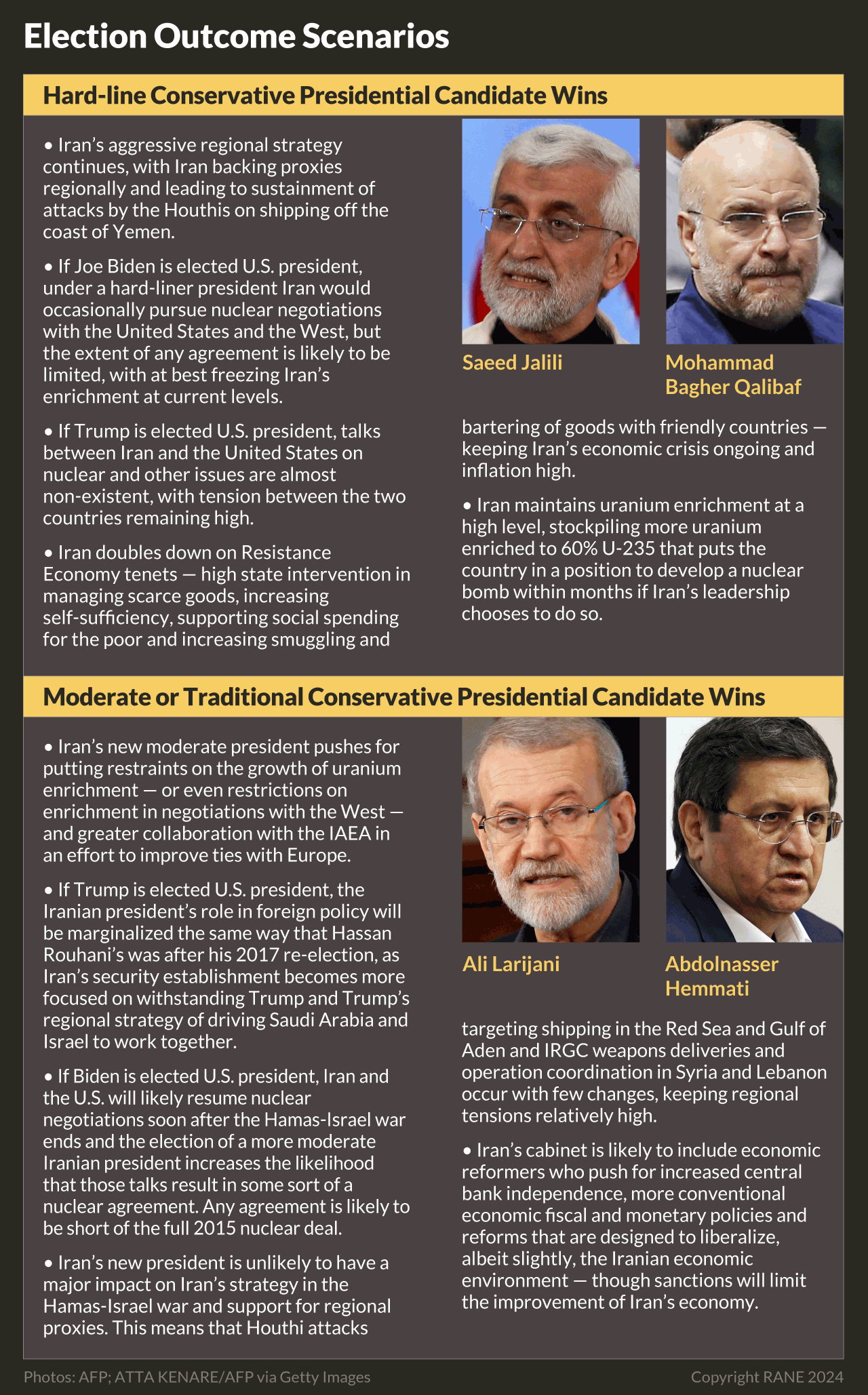
A hard-line conservative wins the presidential election, resulting in few changes in Iran's social, foreign and national security policies. Figures that could fill this role include former Chief Nuclear Negotiator Saeed Jalili and Parliament Speaker Mohammad Bagher Qalibaf. These figures would only play a minor role in formulating foreign and national security policies, letting Supreme Leader Ali Khamenei, the Supreme National Security Council and the Islamic Revolutionary Guard Corps drive policy, much as they did during Raisi's presidency. In practice, this would mean that Iran would aggressively support regional proxies, deepen ties with countries like China, Russia and Venezuela, and only engage with the United States when it is necessary to avoid direct conflict or to demand extreme concessions in nuclear negotiations that Washington cannot accept. The new hard-line conservative president would back the further curtailment of Iran's social freedoms and back the aggressive strategy that Iran has had against social unrest, including the 2022-23 crackdown on protests against compulsory hijab laws.
The largest difference between individual hard-line conservatives' policies will be over domestic economic policies. It is in this area that many will try to distance themselves from Raisi, whose policies have been widely criticized in Iran as continuing the country's economic crisis, which has seen high inflation and the Iranian rial drop to record lows. Of the likely hard-line presidential candidates, most would back a continuation of Raisi and Khamenei's efforts to build a ''resistance economy'' by reducing Iran's reliance on foreign trade, boosting domestic manufacturing and production, and offering subsidies to poorer Iranians. But different candidates will have different proposals on how to do this. Though he is not the most likely candidate to win, Fattah would likely implement an economic policy that differs the most, borrowing from the populist strategy employed by previous President Mahmoud Ahmadinejad, which would likely only worsen Iran's inflation crisis and downward pressure on the rial.
Implications
- Iran maintains uranium enrichment at a high level, stockpiling more uranium enriched to 60% U-235, which puts the country in a position to develop a nuclear bomb within months if Iran's leadership chooses to do so. Iran also limits cooperation with the International Atomic Energy Agency (IAEA) on inspecting its nuclear program, which is likely to eventually lead to a formal censure by the IAEA that results in Iran accelerating its program even more.
- The consolidation of power by Iran's hard-line conservatives and the marginalization of other factions increases the likelihood that Iran eventually develops a nuclear weapon, either by its own volition or in response to regional tensions with Israel. Although Iran will not necessarily develop a nuclear weapon, any progress toward doing so would result in Israel declaring itself to be a nuclear power and Saudi Arabia either pursuing its own nuclear weapons or being brought under the U.S. nuclear umbrella.
- Iran's support of Iraqi and Syrian militias remains high, with Iran and the IRGC trying to push Iraq to restrict its relationship with U.S. military forces and, potentially, push them out entirely, which is far more likely should former U.S. President Donald Trump be reelected. The reduced U.S. presence in Iraq drives Baghdad to more closely align its regional policies with Iran, as well as deepen its ties with Asian countries, including China.
- With virtually all of Iran's political leadership aligned on the need to deepen ties with China and Russia, Iran reaches more economic agreements and security agreements with Russia and China, which increasingly include more arms transfers to Iran (and from Iran to Russia). The lack of diversity within Iran's political elite blunts previous Iranian concerns about becoming too dependent on China or Russia.
- Initially, Iran's new hard-line president and foreign minister seeks to improve ties with Saudi Arabia, the United Arab Emirates and other Gulf Arab countries, but due to the IRGC and Iran's security establishment driving regional policy, the tangible impacts of this push are limited. The United Arab Emirates and Saudi Arabia entertain talks with Iran in hopes of ensuring that Iran and its proxies do not attack their countries, but their skepticism about Iran's regional strategy limits cooperation beyond largely superficial contacts and low-level hanging fruit, such as coordinating Iranian pilgrims performing the hajj.
- Iran's new hard-line president — and the Iranian establishment around him — seeks to use the Hamas-Israel war to consolidate popular support. This likely leads to increased rhetoric criticizing Israel and the United States, inspiring some attacks against Israeli and U.S. interests and/or demonstrations and boycotts of U.S. companies in the region where Iran has an influence, such as Lebanon and Iraq.
- Control of the presidency solidifies the high level of uncontested clout that Iran's hard-liners have in the country's political system, resulting in Iran's next Supreme Leader almost certainly being just as, if not more, hard-line than Khamenei, who is 85 and reportedly in ill health. If a strong hard-line conservative succeeds Khamenei, the new leader could break with Khamenei's policy of trying to arbitrate disputes between a diverse set of Iranian voices when setting policy, leading to a more narrow set of hard-line voices being heard, which only reinforces Iran's long-term aggressive regional strategy and opposition to the West.
- Iran's new president struggles to unite Iran's ultra-conservative factions behind him the same way that Raisi did. This results in more tensions between the president and the parliament, potentially leading to more policy disagreements and scandals that slow policymaking, as the parliament tries to impeach cabinet members and rivals frequently accuse each other of corruption and other scandals. Such legislative gridlock would most significantly affect economic policies and issues like passing the annual budget, ultimately exacerbating Iran's economic crisis.
- The new president likely maintains Iran's policy of supporting the Houthi Movement in Yemen, and its attacks in the Red Sea and Gulf of Aden targeting Israeli-, U.S.- and U.K.-linked shipping. Any increased rhetoric by the new president shortly after his election could inspire Houthi factions to carry out fresh attacks against ships, as well as long-range missile and drone strikes against Israel, though this would likely be only a short-term bump in attacks.
- Israel and Iran's shadow war will continue, with the IRGC eventually returning more of its weapons deliveries to Iraq, Syria and Lebanon, and Israel occasionally launching military strikes against these weapons deliveries, as well as IRGC personnel, with both sides continuously carrying out cyberattacks against each other.
- Iran doubles down on its resistance economy tenets — namely, high state intervention in managing scarce goods, increasing self-sufficiency, supporting social spending for the poor, and increasing smuggling and bartering of goods with friendly countries while reducing trade with the West. These policies keep inflation in Iran high and lead to the Iranian rial continuously setting new record lows against the dollar, exacerbating economic challenges in the country, driving economically motivated protests, and squeezing Iran's lower and middle-income class.
- Iran's social freedoms become progressively more limited as the new president backs the clerical establishment's efforts to enforce mandatory hijab-wearing, re-empower Iran's morality police force, and restrict internet freedoms. This further drives a wedge between Iran's leadership and younger Iranians, many of whom demand increased social and political freedoms. The continued curtailment of social freedoms, combined with Iran's high inflation and overall poor economic conditions, keep the likelihood of more rounds of major protests extremely high, with demonstrations initially focusing on specific issues (like economic issues or women's rights) often turning into anti-government protests that can last for weeks at a time and force large-scale crackdowns.
- If Trump is elected U.S. president, U.S.-Iran talks on nuclear and other issues would be almost non-existent, with tensions between the two countries remaining high. With hard-liners dominating Iran's decision-making, this would increase the likelihood of periodic regional military crises between the United States and Iran, similar to the 2020 U.S. assassination of Quds Force Commander Qassem Soleimani in Baghdad and the 2019 Iranian shootdown of a U.S. drone over the Strait of Hormuz.
- If Trump is elected U.S. president, his close ties to Saudi Arabia and Israel and aggressive policy against Iran would increase the likelihood of Iran and its proxies targeting regional oil and gas infrastructure, potentially even in Saudi Arabia, risking sizable amounts of oil production being taken offline, similar to the 2019 bombing of Saudi Arabia's Abqaiq oil processing facility, which Iran is widely suspected of orchestrating.
- If U.S. President Joe Biden is reelected, Iran, under a hard-liner president, would occasionally pursue nuclear negotiations with the United States and the West, but the extent of any agreement is likely to be limited. At best, a deal would see Iran freeze its enrichment at current levels but not substantially roll back any enrichment activities, as neither Iran nor the United States would be in a position to offer concessions to each other.
- If Biden is elected U.S. president, tensions between Iran and the United States would remain high, but deconfliction talks through Omani, Qatari, Iraqi, Kuwaiti and/or Swiss intermediaries would be held to keep tensions from boiling over to direct conflict. That said, the ongoing Gaza conflict would still sustain the risk of an intense and sudden escalation due to Iran's support of regional proxies, similar to the January 2024 incident in which an Iranian-backed militia killed three American troops in a drone strike in Jordan.
A Moderate or Traditional Conservative Wins the Presidency
A moderate or traditional conservative wins Iran's presidential election, opening the door to potential future negotiations with the United States and the West. Figures who could fulfill this role include former Parliament Speaker Ali Larijani and former Central Bank Governor Abdonnaser Hemmati. Of these potential candidates, Larijani is the most likely figure to be elected president due to his close relationship with Supreme Leader Ali Khamenei and deep experience working throughout the Iranian government. The new president would initially have little to no impact on Iran's foreign or national security policies. But the Guardian Council's mere approval of allowing any of these figures to run — and Iran's tightly managed political system allowing them to win in this scenario — indicates an intent by Khamenei to broaden Iran's leadership to include voices that can counterbalance the influence of Iran's ultra-hard-liners and IRGC, which have driven Iran's national security and foreign policy in recent years. Over time, this results in Iran more seriously entertaining talks with the United States and the West over its nuclear program and offering legitimate concessions in an effort to seal a new agreement. However, the success of these talks would depend largely on the outcome of the 2024 U.S. presidential election, as a return of former U.S. President Donald Trump to the White House would eliminate any possibility of negotiations due to his hawkish stance on Iran, though the new Iranian president would still push for improved relations with Europe.
On economic policy, a moderate or traditional conservative president would likely push for a more liberalized approach to the resistance economy, as well as some economic reforms designed to boost the private sector and reduce the dominance of state-owned enterprises. In terms of domestic social policies, a traditional conservative president like Larijani – whose brother headed Iran's judiciary and pushed back on social freedoms while in power – would likely sustain the status quo of progressively fewer social freedoms in Iran with harsh crackdowns. Conversely, a moderate or even reformist president more closely aligned with Rouhani and former President Akbar Hashemi Rafsanjani would push back against Iran's clerical establishment and try to introduce some liberalizing social reforms, though their success to this end would be limited.
Implications
- Initially, Iran maintains its high enrichment and stockpiling of uranium, but in an effort to improve ties with Europe, its new moderate president pushes for putting restraints on the growth enrichment (or even restrictions on enrichment in negotiations with the West) and greater collaboration with the IAEA. This reduces the likelihood of Europe triggering a formal IAEA censure of Iran's nuclear activities that would likely result in Iran ratcheting up nuclear activities even further.
- Iran retains the technological ability to develop nuclear weapons, but its new president's push to improve relations with Europe and even entertain talks with the United States reduces the likelihood of Iran developing such weapons in the short term and triggering a regional nuclear proliferation crisis — particularly if Joe Biden is re-elected U.S. president and does not pursue an aggressive anti-Iran policy.
- Iran's support of Iraqi and Syrian militias will remains high. However, to display its displeasure with the election of a more moderate or traditional conservative president, the IRGC will likely try to embarrass the president by more aggressively supporting proxies in the region and undermining the president's relationship with Iraq's prime minister. A surge in IRGC resources to support Iraqi militias would further entrench them in Iraq's political system and increase the likelihood of a resumption of Iranian attacks on U.S. forces.
- If Trump is elected U.S. president, the Iranian president's role in foreign policy will be marginalized the same way that Hassan Rouhani's was after his 2017 re-election, as Iran's security establishment becomes more focused on withstanding Trump and his regional strategy of driving Saudi Arabia and Israel to work together. This will not completely nullify the Iranian president's voice when trying to influence policy, but will reduce his influence.
- If Biden is elected U.S. president, Iran and the United States would likely resume nuclear negotiations soon after the Hamas-Israel war in Gaza ends. The election of a more moderate Iranian president would increase the likelihood of those talks yielding some sort of an agreement, which is unlikely to be as comprehensive as the 2015 nuclear deal, but it would probably still include Iran stopping enrichment at 60%, and reducing or eliminating its uranium stockpiles enriched beyond 20%. This initial agreement could serve as a building block to a broader agreement, but such talks are unlikely to conclude during Biden's next term in office, meaning they could be scrapped if a Republican wins the U.S. presidency in 2028.
- Despite efforts to improve ties with Europe, Iran's security relationships with China and Russia continue to expand, leading to more defense sales and collaboration between Iran and the two, such as drone and advanced jet deals with Russia. But under a new more moderate president, Iran also pursues stronger economic ties with India and other Asian countries, in an effort to keep Iran from becoming overly dependent on Russia and China. Similarly, Iran also works to increase economic connectivity with Europe and re-establish a banking mechanism with Europe that gets around U.S. sanctions to enable limited trade, mainly humanitarian, between the European Union and Iran — particularly if Trump is elected U.S. president and negotiations with the United States become impossible.
- Iran's new president tries to improve ties with Saudi Arabia and other Gulf countries, likely leading to some success in realizing the goals of the 2023 Iran-Saudi Arabia normalization agreement, with more diplomatic meetings and visits between Saudi Arabia and Iran. Saudi Arabia is also more likely to invest in Iran's economy under a more moderate president in an effort to limit the risk of any Iranian security threats targeting Saudi Arabia.
- Iran's strategy in the Hamas-Israel war and support for regional proxies remain largely unchanged, as these efforts are overseen by the Supreme National Security Council, which includes the IRGC leadership as well as many appointments of hard-line figures made by the Supreme Leader. Houthi attacks targeting shipping in the Red Sea and Gulf of Aden, along with IRGC weapons deliveries and operation coordination in Syria and Lebanon, thus continue to occur, keeping regional tensions relatively high.
- Iran's more diverse political leadership under a more moderate or traditional conservative president increases the likelihood that a figure similar to Supreme Leader Khamenei is tapped to eventually succeed him. Such a Supreme Leader would largely play an arbitrative role in settling disputes between different Iranian factions, instead of solely supporting one over another, acting as a bulwark against Iran's ultra-conservatives dominating the country for years to come.
- IRGC and other security leaders back policies that actively undermine the president and his ability to drive a foreign policy that they reject, driving tensions between the Iranian government and Iran's IRGC-led security establishment. The IRGC is highly unlikely to carry out attacks without the Supreme Leader's support, though it will probably pursue an aggressive regional strategy (which is where it has the most freedom) aimed at impeding the new president's attempts to negotiate with the European Union and the United States, keeping the risk of regional tensions high.
- Iranian attacks in the Strait of Hormuz targeting U.S. and other ships likely become less frequent under a moderate president, particularly if Biden is re-elected in the United States. Fewer attacks in the Strait of Hormuz keep shipping costs and threats to the energy sector in the region low, as the risk of Iranian attacks against Saudi or other key regional oil infrastructure also declines.
- Iran's improved relations with Saudi Arabia increase the likelihood of a future settlement in Yemen's civil war between the war-torn country's government and Iran-backed Houthi rebels. This would somewhat decrease the threat of Houthi attacks on commercial shipping in the region, though any such settlement would likely be fragile and may not last the Iranian president's entire term.
- Tensions between Iran's president and the conservative-dominated parliament likely remain high, with ambitious Parliament Speaker Mohammad Bagher Qalibaf likely using his opposition to the president as a way to further his own political career, which includes the goal of eventually becoming president. Such tensions will probably play out over economic and social policy initiatives, but the most significant impact would be on U.S.-Iran nuclear negotiations if they occur. If a nuclear deal appears imminent, Iran's combative parliament would likely pass new laws that grant it a greater say in the deal's approval and establish specific demands to be met in any deal. This would make negotiations more difficult and time-consuming, though Iran's legislature would ultimately be unlikely to scuttle a U.S.-Iran nuclear deal because such an agreement would only be reached with the backing of the Supreme Leader.
- Iran-Israel tensions remain high, as Iran's president has little influence over the country's approach to its ongoing shadow war with Israel. This sustains the risk of frequent cyberattacks, proxy attacks and other areas of conflict between the two countries.
- If a moderate Iranian president is elected, such as a protege of former presidents Rafsanjani and Rouhani, the government will likely try to expand social freedoms in the country, including increased women's rights and more internet and media freedoms. This push would be curtailed by the conservative-led judiciary and parliaments, though some modest victories on specific issues, such as potentially women's rights, could occur as Iran's political elite tries to reduce triggers for protests against them.
- If a traditional conservative Iranian president is elected, such as former Speaker Ali Larijani, the government is less likely to focus on pushing through social liberalization policies, though it is likely that some moderate or even reformist figures are placed in the cabinet and try to push for those policies. Nevertheless, progress will be largely stunted by Iran's unelected institutions and a president that is not willing to spend political capital pushing for social reforms he is not in favor of.
- The new president's cabinet likely includes economic reformers who push for increased central bank independence, more conventional economic fiscal and monetary policies, and reforms that are designed to liberalize, albeit slightly, the Iranian economic environment and open the country up to more foreign investment. This slightly improves Iran's economy and better positions it to withstand the stress of sanctions, though inflation and a weakening rial remain a challenge and continue to undermine the lower and middle class.
- Although some of the enabling conditions driving protests will be lower in intensity, anti-government protests in Iran, including large ones, are still likely to occur during the next Iranian president's term in office as economic conditions and social freedoms are likely to remain poor, even if slightly improved. Such protests are unlikely to threaten the government, but will be weaponized by Iran's conservative-led parliament to undermine the president's policies and attempt to impeach various cabinet members.
