
Editor's Note: With many significant elections occurring in 2024, RANE is publishing a series of scenario analyses focused on different outcomes of major elections occurring this year, describing how an election outcome might unfold with implications for each potential outcome. The first installment covered India's general elections, the second covered European parliamentary elections, the third covered South Africa's general elections, the fourth covered Mexico's presidential election, and the fifth covered Iran's presidential election. The following is a scenario analysis for the United Kingdom's July 4 general election.
The United Kingdom will hold a general election on July 4, which opinion polls predict the opposition Labour Party will comfortably win, ending 14 consecutive years of Conservative Party rule. Local elections in England and Wales on May 2 also confirmed the Conservative Party's poor prospects going into the general election, with the party suffering heavy defeats at the hand of Labour, including in contested constituencies widely seen as key electoral battlegrounds.
In the most likely scenario, Labour wins a majority of seats in parliament, which enables it to implement its policy agenda with minimal opposition or internal resistance. A large majority would enable the party to overcome potential internal dissent and pass legislation despite sporadic intra-party rebellions. By contrast, a narrower majority would make the government more susceptible to potential defections, thus increasing the influence of the party's left-wing factions and labor unions on policy. A Labour government would result in a greater state presence in the economy, higher spending on social policies and public services, and a more ambitious energy transition agenda. But the new government would still be subject to fiscal and economic constraints, meaning that spending increases would be limited and largely offset by tax hikes. U.K. foreign policy would not see major changes under a Labour government, and while Labour would seek closer relations and regulatory alignment with the European Union, a reversal of Brexit would likely not be on the agenda, at least initially.
Two alternative scenarios explore the potential implications of a hung parliament, with no party securing the 326 seats necessary for an outright majority. Whether the largest party is Labour or the Conservatives, either would be forced to negotiate a coalition agreement with smaller parties or attempt to form a minority government in a confidence-and-supply agreement with one or more other parties. In the most likely of such scenarios, Labour could form a majority with the Liberal Democrats, the Scottish National Party or the Greens, each of which would demand different policy concessions in exchange for their support. An alternative, unlikely scenario would see the Conservatives form a minority government supported in Parliament by Northern Ireland's Democratic Unionist Party and lawmakers elected under the right-wing Reform UK party or, in an even less likely scenario, with the center-left Liberal Democrats. Both under a Labour or Conservative minority government, the necessity to negotiate with coalition partners would lead to compromises on key policies, while a potential legislative gridlock due to the diverse interests of coalition partners and the constant horse trading would increase policy uncertainty, slow decision-making and increase the chances of a premature government collapse.
Labour Wins a Majority
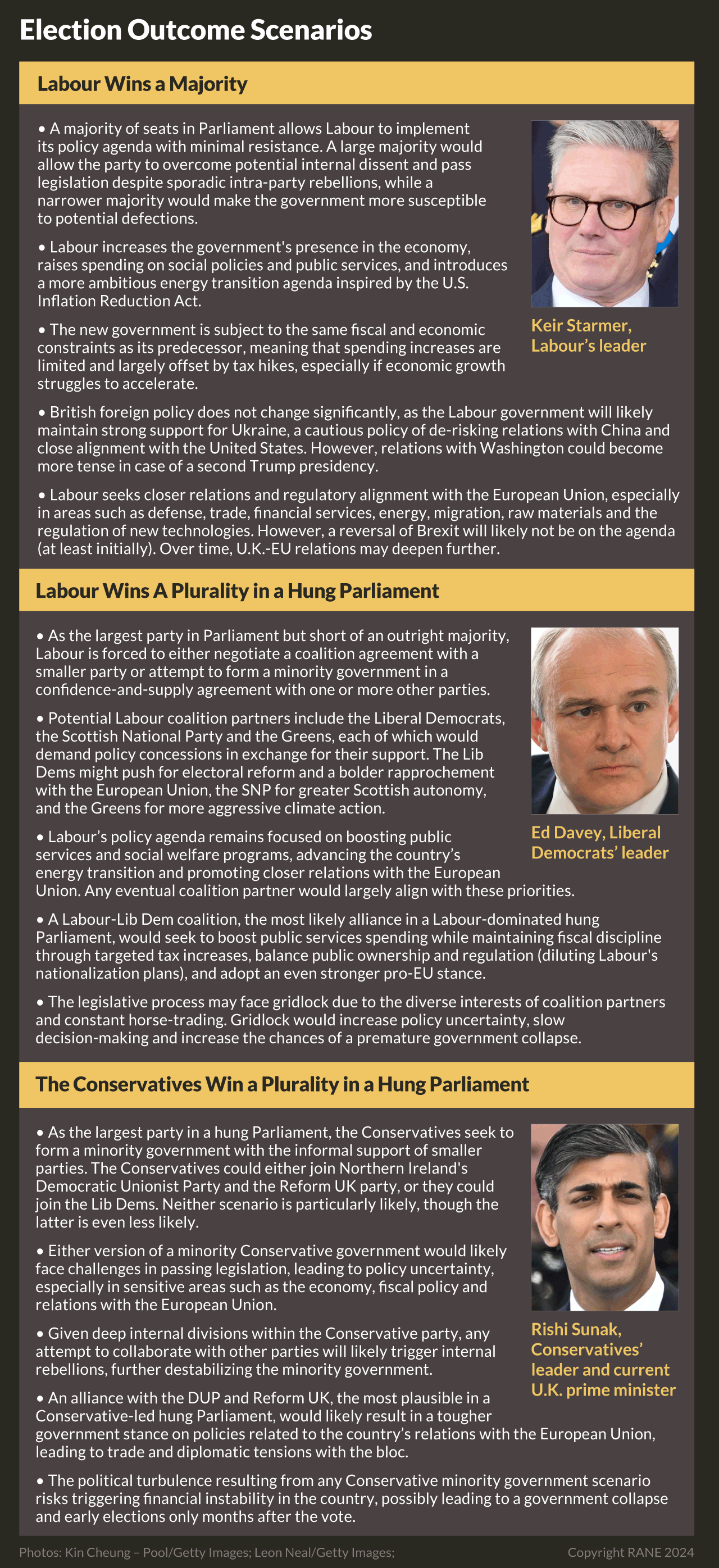
In this outcome, the Labour Party wins a majority of seats in parliament, enabling it to govern alone and install its leader Keir Starmer as prime minister. A large majority would enable the government to overcome potential internal dissent and pass legislation despite sporadic intra-party rebellions, while a narrower majority would make the government more susceptible to potential defections, thus increasing the influence of the party's left-wing factions and labor unions on policy, including related to the Gaza conflict, as well as various socio-economic measures. A Labour government would increase the state's presence in the economy and spend more on social policies and public services, such as healthcare and education. A Labour government would also have a more ambitious energy transition agenda, including measures inspired by U.S. President Joe Biden's Inflation Reduction Act, with increased spending on new green energy infrastructure and industrial subsidies for the production of green technologies. Nevertheless, a Labour government would be subject to the same fiscal and economic constraints as its predecessor, meaning that spending increases would be limited and largely offset by tax hikes, most likely on wealthy individuals and large companies, especially if the country's economic growth struggles to pick up pace. In terms of foreign policy, there would be a high degree of continuity, with a Labour government maintaining strong support for Ukraine and alignment with NATO, although relations with the United States could become more tense if former U.S. President Donald Trump is reelected in November. A Labour government would also maintain its predecessor's policy of de-risking from China without severing economic and trade relations with Beijing. Finally, a Labour government would seek closer relations and regulatory alignment with the European Union, particularly in areas such as defense, trade oversight, financial services, energy and the regulation of new technologies, though a reversal of Brexit would likely not be on the agenda.
Implications
- The government's commitment to reducing public debt as a share of GDP to ensure economic and financial stability, coupled with an initial reluctance to significantly hike taxes, reduces its ability to considerably increase public spending in the first months/years of its term. But the Labour government only partially complies with its predecessor's pledge to keep borrowing below 3% of GDP (applying the target only for ''day-to-day spending'' — namely, regular recurring expenses on things such as public sector wages, healthcare, education, defense and public services), leaving more space for public investment.
- Until growth accelerates and borrowing costs decrease, the new Labour government likely prioritizes implementing lower-cost policies (such as on workers' rights and cutting red tape). The government also likely seeks to raise tax revenues by fighting tax evasion, ending tax credits for private schools, extending the windfall tax on energy companies and completing plans to phase out of the so-called 'non-dom' tax regime, which allows residents to be taxed only on U.K. income, with foreign income taxed only if it is brought into the United Kingdom.
- If the economic environment improves, the new government's fiscal and economic agenda will grow increasingly ambitious to deliver on promised spending increases in public services such as healthcare, education and affordable housing.
- Should growth continue to stagnate, the government will look to increase tax revenues through measures such as an increase in the top rate of income taxes, corporate tax rates and on financial transactions. The introduction of a wealth tax and increases in the inheritance tax are also possible.
- The government seeks to spur growth and productivity through more state-driven, interventionist supply-side policies, such as increasing public investment in digital infrastructure, education and vocational training. To this end, the government also pursues reforms to reduce red tape, simplify planning processes and streamline applications for high-value projects (such as those in high- and green-tech manufacturing) to favor business expansion and innovation.
- The government simplifies the planning system for the construction of new housing projects and public-funded infrastructure like railways, roads and energy infrastructure (plants and grid) — fast-tracking regulatory permits, environmental assessments, compensations for local communities and eventual litigations, while granting local authorities greater oversight powers to accelerate projects completion.
- The government enacts new protections for workers and other labor reforms to increase job security and wages (including reducing so-called zero-hours contracts, strengthening workers' protections against dismissal, increasing sick pay, repelling laws restricting trade union activities, and promoting flexible working arrangements), which somewhat increases operational costs for businesses.
- The government expands regulation of the private sector in areas such as ESG, tax evasion, data and AI protection, mergers and acquisitions, procurements, financial services and supply chains, increasing regulatory risks and compliance costs for businesses.
- If Labour secures a large parliamentary majority, the government will prove more stable than its predecessor, which would improve the United Kingdom's investment outlook after years of successive scandals and leadership changes affecting the Conservative Party and post-Brexit policy uncertainty.
- The government's spending plans and other economic initiatives are more state-driven, but also rely on increased private financing, including through the issuance of so-called ''green gilts'' to fund new green energy infrastructure. This reduces the overall impact of large infrastructure projects on public finances and creates opportunities for the private sector.
- The Labour government pursues more ambitious climate and energy transition targets, aiming to decarbonize the country's power sector by 2030 — five years earlier than the target set by its predecessor.
- The government sets up a state-owned green energy company (Great British Energy) and creates a national wealth fund to drive investment in renewable energy projects, industrial projects, infrastructure, green hydrogen production and the decarbonization of the steel industry, as well as investments in upgrading and extending the country's power grid and upgrading homes insulation.
- Green investment increases, with the government seeking to increase the United Kingdom's onshore wind capacity to 35 gigawatts, solar power capacity to 50 gigawatts, offshore wind capacity to 55 gigawatts by 2030, and green hydrogen production capacity to 10 gigawatts. The government also seeks to fast-track five gigawatts of floating offshore wind capacity.
- The Labour government likely bans new oil and gas licenses for the North Sea, leading to a slow and steady decline in the United Kingdom's domestic hydrocarbon production. The ban would not affect existing projects or projects already under development, with the likely exception of the large-scale Rosebank and Cambo oil fields, meaning the United Kingdom would continue to produce oil and gas domestically through at least the late 2040s (though at ever-declining rates).
- The government maintains support to the nuclear power sector by promoting new projects, extending existing plants' lifetimes and investing in new nuclear technologies, such as Small Modular Reactors.
- Higher investments by utilities potentially increase energy bills for U.K. consumers in the short-to-medium term, before eventually reducing prices by increasing the country's renewable power production and expanding the electricity grid.
- The Labour government tries to rebuild dialogue and increase regulatory alignment with the European Union, seeking incremental advances — such as a veterinary regulations agreement, mutual recognition of qualifications, and potentially rejoining the Erasmus student exchange scheme — without seeking to revamp major elements of the post-Brexit deal. Labour likely does not seek to rejoin the EU single market or customs union, but pushes for deeper cooperation in areas like trade, security and environmental standards.
- The U.K. government seeks regulatory alignment with the European Union in specific sectors, such as food standards, data protection, raw materials and pharmaceutical supply chains, to reduce trade barriers and facilitate closer economic ties while showcasing to the British public it has maintained U.K. sovereignty.
- Labour works toward establishing a more structured, formalized U.K.-EU framework for cooperation, with regular meetings and official-level contacts, potentially negotiating access to EU forums like the Foreign Affairs Council to enhance diplomatic and policy coordination. Against this backdrop, the signing of a U.K.-EU defense and security pact is likely, while bilateral agreements in areas such as migration, emissions trading and critical raw materials are also possible.
- Political and structural constraints limit the extent to which the Labour government is able to seek closer alignment with the European Union, but bilateral relations may still deepen over time, particularly if public opinion shifts toward closer ties with the European Union and if Labour looks set to secure a second term in power. In the medium term, this potentially leads to more structurally close U.K.-EU cooperation through higher levels of regulatory alignment and a de-facto customs union.
- The Labour government largely maintains its predecessor's foreign policy, including strong support for Ukraine and alignment with NATO. But relations with the United States could become strained if Trump is reelected.
- The Labour government also maintains its predecessor's policy of de-risking from China while preserving economic and trade relations. This likely sees the United Kingdom implement export and outbound investment restrictions vis-a-vis China for sensitive technologies such as AI, facial recognition and advanced semiconductors.
- In regards to the Israel-Hamas war, the Labour government maintains an overall cautious approach — supporting the idea of a potential formal recognition of Palestine as part of an eventual peace process with Israel, while also sustaining a large degree of coordination with the United States on the conflict. If, however, Labour secures only a narrow majority in the House of Commons, it will face more internal pressure from its left-wing flank to take a tougher approach toward Israel.
- Outgoing Prime Minister Rishi Sunak is likely replaced as Conservative leader, with the former ruling party possibly pivoting further to the right under successive leaders through the next couple of election cycles.
Labour Wins A Plurality in a Hung Parliament
In this outcome, Labour becomes the largest party in Parliament but falls short of securing the 326 seats needed for an outright majority, which forces it to either negotiate a coalition agreement with a smaller party or attempt to form a minority government in a confidence-and-supply agreement with one or more other parties. Potential coalition partners for Labour include the centrist Liberal Democrats, the center-left Scottish National Party (SNP) and the Greens, each of which would demand policy concessions in exchange for their support (either formally as members of a coalition government or indirectly as backers in Parliament of a Labour minority government). In this scenario, Labour's policy agenda focuses on boosting public services and social welfare programs, advancing the country's energy transition and promoting closer relations with the European Union — all elements any eventual coalition partner would also largely align with. Given economic and fiscal constraints, increased public spending would be financed through higher taxes on the top earners and corporations. The need to negotiate with coalition partners would still lead to compromises on key policies. For instance, the Liberal Democrats may push for electoral reforms and bolder rapprochement with the European Union, while the SNP and the Greens may push for greater Scottish autonomy and more aggressive climate action, respectively. The legislative process may face gridlock due to the diverse interests of coalition partners and the constant horse trading, in turn increasing policy uncertainty, impeding decision-making and increasing the chances of a premature government collapse.
Implications
- A hung parliament forces Labour to negotiate with potential coalition partners, leading to policy compromises and a more fragmented legislative process. Delays in decision-making and greater policy uncertainty introduce the risk of a premature government collapse.
- Coalition negotiations potentially result in more substantial spending increases to accommodate eventual partner demands, thus limiting the fiscal space for Labour's plans to boost public services and social welfare programs. This increases the likelihood that the government raises taxes on top earners and corporations to finance increased public spending.
- Perceptions of increased political instability under a coalition or a minority government could somewhat hurt investor confidence in the United Kingdom, with investment likely to remain at relatively low levels in the country compared to its European peers.
- The U.K. government focuses on simplifying the planning system for new housing projects and public infrastructure, aiming to reduce bureaucratic delays and fast-track key projects. However, coalition negotiations potentially impact the scale and scope of these initiatives.
- A coalition between Labour and the Liberal Democrats would seek to implement stronger trade union rights, higher minimum wages and better protections for gig economy workers, increasing the operating costs for companies in the service sector, as well as ridesharing and delivery companies.
- While the Liberal Democrats support greater regulation and some level of public ownership, the party is less inclined toward large-scale nationalization compared with Labour, which advocates for more public ownership of utilities and key industries. Thus, in any coalition government with the Liberal Democrats, Labour may be forced to significantly water down its plans to increase public investment in industries and infrastructure, as well as its push to nationalize the United Kingdom's train network. A coalition government between Labour and the Liberal Democrats would likely agree on significant increases in public spending to boost public services such as the NHS, education and infrastructure, while largely maintaining a commitment to long-term fiscal sustainability — reflecting Labour's commitment to maintaining fiscal discipline and the Liberal Democrats' focus on budget balance. This means eventual spending increases would largely be offset by cuts elsewhere, as well as targeted tax increases.
- Should economic growth stagnate and the U.K. government find itself in need of more revenue, a coalition between Labour and the Liberal Democrats would likely agree to increase taxes on the wealthy and large corporations, including higher income tax rates for top earners and reform capital gains tax, along with a mansion tax. A specific tax increase to fund the NHS might also be adopted.
- A coalition between Labour and the Liberal Democrats would have a stronger pro-EU stance than a Labour-only government. While Labour would seek incremental advances in trade and regulatory cooperation, the Liberal Democrats might push for even closer regulatory alignment with the European Union and further integration on trade, cross-border movement and other areas.
- If the party starts losing support as the junior partner in the coalition with Labour, the Liberal Democrats might even push for a second Brexit referendum or a vote to seek the public's mandate on significantly closer EU ties, depending on the evolution of the U.K. public's attitudes toward the European Union.
- In a coalition with Labour, the Liberal Democrats would push for electoral reform to move away from the United Kingdom's traditional first past the post system and toward proportional representation, something that could significantly transform the country's political landscape and governance structure in the future. Labour would be unlikely to agree to such a reform, given that it benefits from the current electoral system. But the party could be forced to agree to hold another referendum on the electoral reform, even though U.K. voters rejected the Liberal Democrats' 2011 referendum on the issue.
- A coalition between Labour and the Liberal Democrats could lead to more extended timelines to achieve key climate targets, such as a complete decarbonization of the United Kingdom's power sector. This is because the Liberal Democrats support a more gradual approach to transitioning away from fossil fuel than Labour.
- A government coalition between Labour and the Greens, by contrast, would increase the likelihood of aggressive climate action, potentially leading to stricter environmental regulations and accelerated renewable energy targets. The government would also stop issuing new oil and gas licenses for the North Sea, favor renewable energy investment over nuclear energy projects and seek to link the country's emissions trading system with the European Union's system to create a single carbon price.
- In exchange for agreeing to form a coalition with Labour, the SNP would likely demand greater Scottish autonomy, leading to increased devolution of powers to Scotland and greater economic opportunities for the region.
- A potential pact with the SNP might also include a Labour concession to hold a new Scottish independence referendum, particularly if polls indicate it would likely result in a vote for Scotland to remain part of the United Kingdom.
The Conservatives Win a Plurality in a Hung Parliament
In this outcome, the Conservative Party loses its majority but remains the largest party in the House of Commons. To govern, the party would have two options. The first would be to form a minority government, most likely supported in Parliament by Northern Ireland's right-wing Democratic Unionist Party (DUP) and eventual members of parliament elected under the right-wing Reform UK party. The viability of this option will largely depend on how short the Tories are of a majority, as well as the number of seats that the DUP and Reform UK obtain (and how many of these would come at the expense of the Conservative Party itself), which would determine whether a pact with them is mathematically viable. The second option would be to seek informal support in Parliament by the Liberal Democrats. While this outcome is possible if incumbent Prime Minister Rishi Sunak retains the Conservative Party's leadership and keeps the party in its current centrist trajectory, the Conservatives' low popularity means that the Liberal Democrats would be very skeptical of cooperating with the party. Either version of a minority Conservative government would likely seek to build majorities on an ad-hoc basis amid the lack of formal support, accepting the fact that proposed legislation would end up heavily amended or even defeated in Parliament. Against this backdrop, the new government would face challenges in passing bills, leading to policy uncertainty, especially in particularly sensitive areas such as the economy, fiscal policy and relations with the European Union. Moreover, given deep internal divisions within the Conservative Party itself, any attempt at collaborating with other parties on either the left or the right end of the political spectrum would likely trigger internal rebellions, further destabilizing the minority government. Eventually, the political turbulence resulting from any scenario in which the Conservatives form a minority government would also risk triggering some financial instability in the United Kingdom, and would ultimately lead to a government collapse and early elections only months after the vote.
Implications
- The government faces challenges in passing legislation, leading to policy uncertainty. Frequent negotiations and compromises to build ad-hoc majorities slow decision-making processes and potentially result in watered-down policies.
- Political instability likely triggers financial market turbulence, potentially undermining investor confidence and leading to a sell-off in British financial assets, along with fluctuations in currency and the stock market.
- The minority government struggles to implement a coherent fiscal policy, likely creating budgetary challenges, such as delays or compromises. This, in turn, leads to inconsistent or fragmented fiscal policies that are less effective as a result, while also complicating deficit reduction efforts.
- The Conservative Party potentially enacts its promised tax cuts, such as a cut to the inheritance tax or further cuts to National Insurance contributions. This would likely cause a budget shortfall, thus necessitating spending cuts and austerity measures to maintain some fiscal discipline and reduce likely market turbulence.
- Potential financial instability under a minority Conservative government could lead to further delays or reductions in funding for public services, impacting areas such as healthcare, education and social welfare. The ongoing uncertainty might also hinder long-term planning and investment in critical infrastructure projects.
- Public spending cuts likely trigger protests and strikes from labor unions, leading to disruptions to transport, business activity and public services.
- The need to collaborate with other parties likely exacerbates internal divisions within the Conservative Party, triggering internal rebellions and potential leadership challenges, further destabilizing the government and the U.K. economy.
- The minority government struggles to maintain a consistent foreign policy, particularly in sensitive areas such as relations with the European Union. Any Conservative attempts to negotiate new agreements or align with EU standards likely face significant opposition from within the coalition, complicating efforts to maintain positive relations with the bloc.
- In the case of a Conservative coalition with the DUP and Reform UK, the government would be under pressure to take a tougher stance on anything related to the country's relations with the European Union. The DUP would likely demand a repeal or renegotiation of the post-Brexit Agreement's Northern Ireland Protocol, which would significantly escalate tensions with the European Union and potentially trigger a trade war.
- In the case of a Conservative coalition with the DUP and Reform UK, the reopening (or questioning) of post-Brexit negotiations on arrangements regulating trade likely reignites tensions in Northern Ireland, potentially leading to unrest and clashes between unionists and Irish republicans.
- Reform UK would likely demand tougher anti-immigration policies, pushing for much stricter controls and a cap on the number of immigrants, as well as controversial measures such as leaving the European Convention on Human Rights or pushing back migrant boats across the English Channel. This would, in turn, significantly strain the United Kingdom's ties with the European Union, as well as with key European allies like France.
- The Liberal Democrats would push for more moderate migration policies, closer relations with the European Union and potentially electoral reforms, creating additional points of contention within the government and possibly triggering a rebellion from pro-Brexit lawmakers from the Conservative Party's right-wing flank, which would likely result in a government collapse and fresh elections.
- Economic and fiscal hurdles caused by renewed political instability force the Conservative government to further water down its climate and energy transition plans, especially if it forms a coalition with Reform UK, which is more skeptical about the urgency of climate change.
- The Conservative Party likely maintains its previous pledge to raise military spending to 2.5% of GDP by 2030, though rising financial and economic constraints probably force the government to delay the necessary actions to achieve that target.
- Strained relations with the European Union and some of the United Kingdom's key European allies push the country closer to the United States, especially if Trump is reelected. This sees London more closely align with Washington's China policy, likely leading to more U.K. export and investment restrictions targeting Beijing.
- The inherent instability of a minority government creates a lingering risk of early elections and the constant threat of a government collapse, leading to further political and economic uncertainty.
