
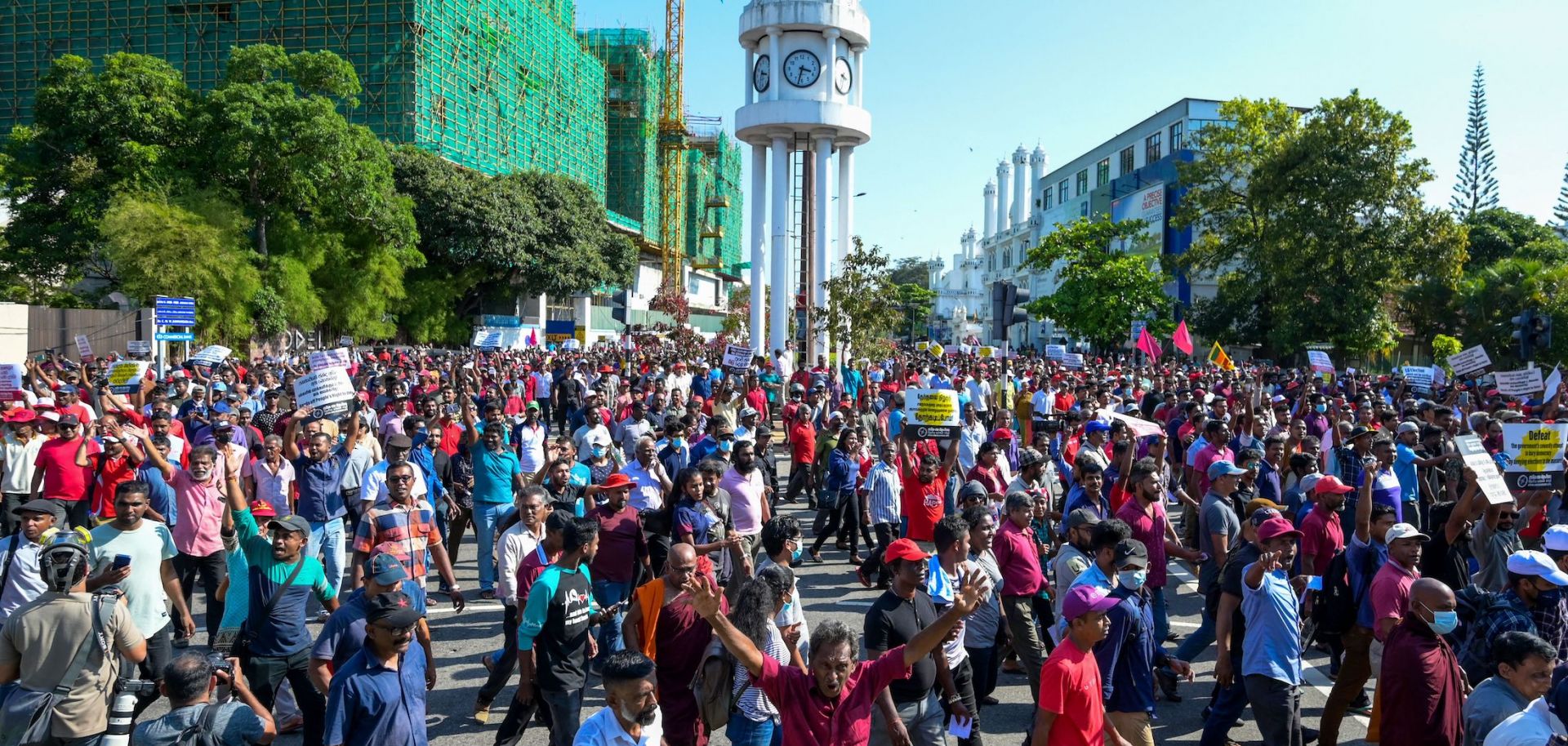
Supporters of the opposition National Peoples Power (NPP) take part in a protest in Colombo, Sri Lanka, to urge the government to hold local elections as scheduled on Feb. 26, 2023.
Delayed local elections will offer a key glimpse into Sri Lanka's political climate since disruptive protests swept across the country last year, and could weaken the cash-strapped government's ability to implement IMF-mandated reforms. On March 7, Sri Lanka's election commission proposed April 25 as the tentative date for local government elections. The elections were originally scheduled for March 9, but were delayed in late February after the Treasury was instructed to prioritize funds for only essential government services (which doesn't include elections) due to the country's increasingly dire cash shortage. Without funding, the election commission was unable to print ballot papers, secure voting stations and conduct other election-related tasks, forcing it to delay the ballot. This triggered an uproar among opposition parties and civil society groups, which accused the government of deliberately trying to postpone the local elections for fear of losing the vote. But Sri Lankan President Ranil Wickremesinghe has defended his government's controversial decision, arguing that his government had no choice but to cut spending on anything that wasn't truly critical amid the country's ongoing economic crisis. Against this backdrop, the Sri Lankan government has issued executive orders preventing protests and allowing the use of the military to maintain law and order.
- In Sri Lanka, local elections are scheduled every four years to elect the members of municipal councils, divisional councils and urban councils. These members are elected through a mixed electoral system of first past the post and proportional representation.
- On Feb. 26, thousands of people protested in Colombo calling for local elections. The demonstrations turned violent, with police using tear gas and water cannons to block and disperse the protesters.
- The Supreme Court, acting on a petition submitted by the opposition Samagi Jana Balawegaya (SJB) party, ordered the finance secretary not to withhold funds for this year's local elections.
- On Feb. 28, Wickremesinghe effectively banned transportation workers from striking by issuing an executive order that declared the transportation of people, fuel and food items as essential services.
The local elections will be the first test of popular support for Sri Lanka's new government after the mass social unrest forced former President Gotabaya Rajapaksa to resign in mid-2022. Wickremesinghe became president in July 2022 following weeks of violent protests that resulted in Rajapaksa's resignation. However, many in Sri Lanka see him as illegitimate because he was appointed with support from Rajapaksa's Sri Lanka Podujana Peramuna party. In fact, Wickremesinghe's United Nationalist Party (UNP) only has one seat in the Sri Lankan parliament. More recently, the implementation of unpopular austerity measures to secure a bailout package from the International Monetary Fund (IMF) has further weakened the new government's popularity. This explains why, even if the local government polls do not have a direct impact on the parliament or the composition of the government, Wickremesinghe fears that a defeat would further undermine his authority.
- Since early 2022, Sri Lanka has been in the grips of the worst-ever economic crisis in its history, which has left the country's 22 million people with widespread shortages of electricity, food, fuel, medicines and other basic necessities.
- Since January, the Sri Lankan government has raised personal income tax rates, which has angered most Sri Lankans, including even those in the upper-middle class. Colombo has also increased tariffs on fuel and electricity, along with other goods and services. But while key to increasing government revenue and cutting expenditures, these IMF-mandated austerity measures have further strained household budgets at a time when the country is already facing rampant inflation, which hit 50% earlier this year and has remained above 30% since June.
- The IMF is currently assessing Sri Lanka's request for a $2.9 billion loan spread over four years. A decision is expected in late March, and Colombo may receive the first tranche of money shortly thereafter.
A weak electoral performance by the ruling party would threaten the implementation of unpopular reforms needed for Sri Lanka's economic recovery. A crushing electoral defeat by the government and its allies in the local elections would confirm strong anti-establishment sentiments in the country. Such a painful loss at the polls would also send the message to Sri Lankans that Wickremesinghe's administration does not have enough legitimacy to implement austerity measures to secure a loan from the IMF. For the opposition, significant gains in local elections would likely set the stage for a victory in the 2024 presidential election. But the opposition remains unlikely to try to unseat the Wickremesinghe administration before then, as it does not want to be responsible for the painful austerity measures that Colombo will have to implement in the coming months to mitigate the country's ongoing economic crisis. A poor performance in the upcoming elections would thus unlikely pose an immediate threat to Wickremesinghe's place in power. It could, however, jeopardize his deal with the IMF by highlighting the political threat of supporting his government's unpopular austerity measures, which could see some of his allies in parliament refuse to implement IMF-mandated economic reforms. Given these risks, there's a chance the Wickremesinghe administration could try to delay the local elections once again, which would raise the risk of significant social unrest and violent crackdowns on protesters.
- A massive strike among state workers forced hospitals, ports and banks to shut down across Sri Lanka on March 15. Labor union leaders said new strikes will take place in the coming days unless the government reverts controversial tax hikes.
The rise of new political parties could threaten decades of the supremacy of Sri Lanka's mainstream parties, though the emergence of inexperienced leaders could also produce fragile governments. The most likely winner of the local elections is expected to be the National People's Power (NPP), a coalition of socialist parties that have garnered much public support in the past year. If it performs strongly in the upcoming ballot as projected, it's possible the NPP could carry that momentum into next year's presidential elections. But most of these parties also have no governing experience, which raises questions about the NPP's ability to implement reforms to strengthen Sri Lanka's democracy and curb corruption and cronyism. Moreover, a government made up of relatively inexperienced political parties would also be vulnerable to the power politics of traditional elites, whose electoral prospects could improve if Sri Lanka's economy starts to recover in 2023 and the negative impacts of austerity measures begin to fade.
