
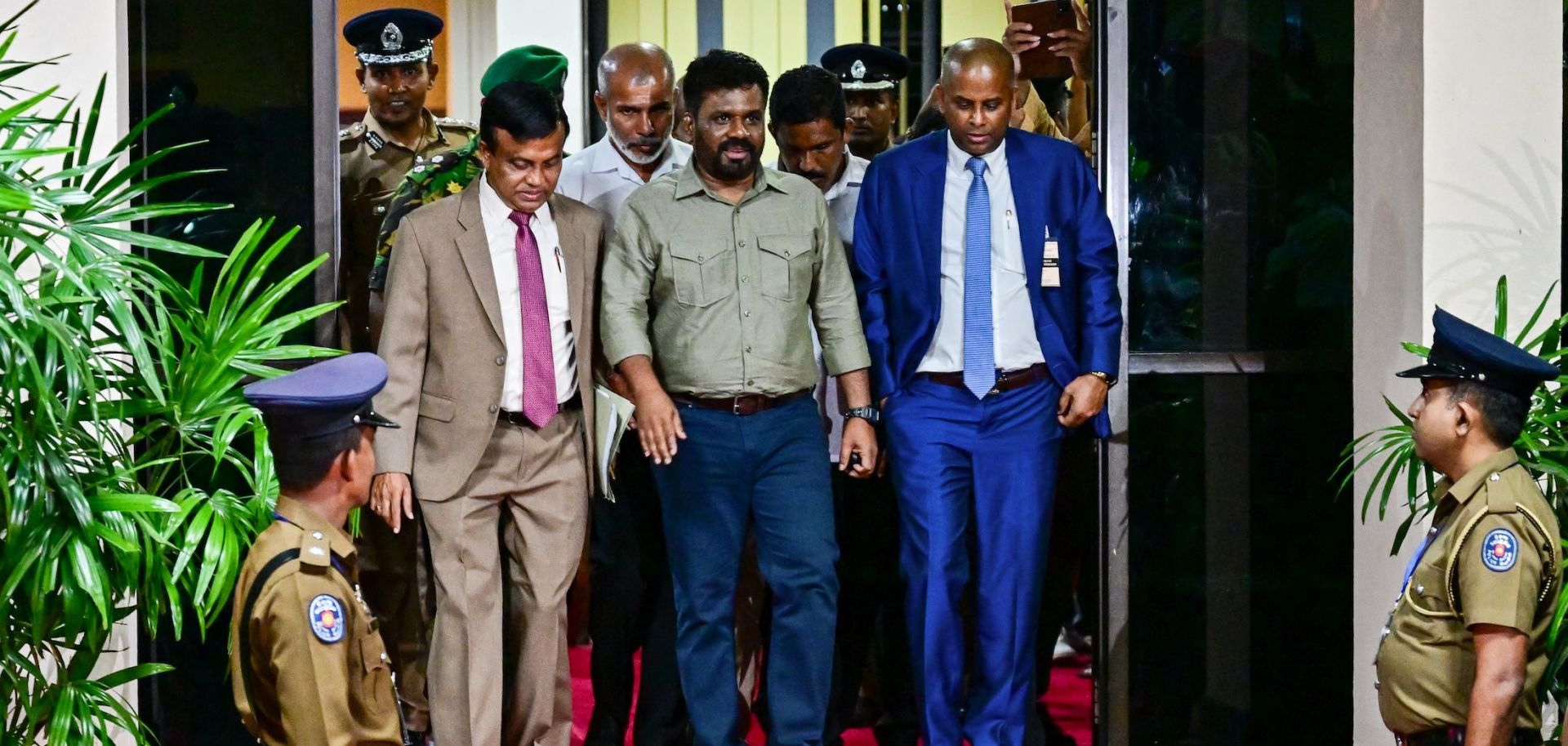
Sri Lanka's new president will struggle to find a balance between his left-wing agenda and the country's IMF commitments against the backdrop of an opposition-controlled parliament, which increases the probability of an early legislative election that could reshape Sri Lanka's political landscape but also result in continued policy uncertainty. On Sept. 23, Anura Kumara Dissanayake was sworn in as Sri Lanka's new president after winning the country's Sept. 21 presidential election. Dissanayake leads the leftist National People's Power (NPP) alliance, which includes his Marxist party, the Janatha Vimukthi Peramuna (JVP). Dissanayake secured 42.31% of the vote in the second round of the presidential race, while his closest rival, opposition leader Sajith Premadasa, garnered 32.76%. Incumbent president Ranil Wickremesinghe came in third with 17%.
- Sri Lanka's presidential elections use a ranked voting mechanism, according to which voters rank the candidates in order of preference. If no candidate receives more than 50% of the vote in the first count, all candidates except the top two are eliminated, and a second count takes place. The 2024 election was the first held since the system was introduced in 1982 where a candidate did not obtain enough votes in the first count to automatically become president. Dissanayake won the election in the second count, highlighting Sri Lanka's fragmented political landscape.
Sri Lanka's election served as a referendum on the economy, reflecting a strong desire for change and a move away from the influential Rajapaksa family. This presidential election was the first since Wickremesinghe assumed office in July 2022, following mass protests sparked by a severe financial crisis that led to the ousting and resignation of his predecessor, former President Gotabaya Rajapaksa. With strong backing from lawmakers from Rajapaksa's Sri Lanka Podujana Peramuna party (SLPP), the parliament elected Wickremesinghe to finish Rajapaksa's term. Under Wickremesinghe, Sri Lanka's economy has shown signs of improvement, with year-on-year inflation dropping to 0.50% in August 2024 from 64.30% in August 2022. Wickremesinghe's government has also reached debt-restructuring agreements, while the central bank's foreign reserves have increased. However, most Sri Lankans have not felt the benefits of these improving economic indicators, as living costs and taxes remain high due to austerity measures tied to the country's IMF program, leaving Wickremesinghe and the SLPP widely unpopular. Growing anti-establishment sentiment across the population further fueled this discontent, benefiting Dissanayake's pro-working class and anti-elite presidential campaign, which — combined with his promises of tougher anti-corruption measures and expanded welfare programs — struck a chord among Sri Lankan voters and ultimately ushered him to victory on Sept. 21.
- Many Sri Lankans see the Rajapaksa family as a symbol of corruption, with allegations of state resource misuse and a lack of transparency in governance, all exacerbated by dynastic politics. They blame the family for the country's economic turmoil, citing financial mismanagement and corruption. This has resulted in widespread public disillusionment, fueling protests and demands for accountability, as many citizens seek a government free from the Rajapaksa legacy.
- Dissanayake began his political career as a student leader in the Janatha Vimukthi Peramuna, a party known for its violent Marxist uprisings in the 1970s and 1980s but that has since renounced violence. He was elected to parliament in 2000 and briefly served as the agriculture and irrigation minister under then-President Chandrika Kumaratunga. Dissanayake became the JVP leader in 2014 and the NPP leader in 2019. He ran for president for the first time in 2019, losing to Rajapaksa. In the 2024 presidential election, Dissanayake was notably the only major contestant who did not hail from one of Sri Lanka's prominent political families.
Dissanayake's main challenge will be balancing competing economic priorities by relaxing austerity measures while still maintaining the confidence of the IMF and international creditors, which is essential for securing further international financial assistance. During the electoral campaign, Dissanayake promised to expand Sri Lanka's welfare programs, increase tax exemptions, and improve oversight of government spending, all while maintaining economic stability and securing continued IMF bailout support. Although he hasn't provided detailed plans for the IMF deal negotiations, Dissanayake will advocate for reduced taxes within the framework of the austerity measures and expanded social welfare subsidies to appeal to the working class and lower-income groups, aiming to minimize the risk of social unrest. While the IMF may permit some adjustments that don't undermine its fiscal consolidation goals, the fund will likely reject changes that increase Sri Lanka's fiscal deficit, potentially delaying financial support and exacerbating fiscal challenges. Nonetheless, Dissanayake is unlikely to exit the IMF deal due to the need for financial stability and support, as well as the requirements of international lenders, which means some austerity measures will probably remain in place.
- Dissanayake has also pledged to develop Sri Lanka's manufacturing, agriculture, and IT sectors by fostering investment, enhancing infrastructure, providing skills training, and promoting export-oriented policies to drive growth and innovation.
- Sri Lanka found it increasingly difficult to meet its debt obligations following its economic crisis in 2022, which was characterized by declining foreign reserves, rising inflation, and a significant fiscal deficit. The government's debt restructuring efforts thus aim to alleviate the financial burden, restore fiscal stability and facilitate economic recovery by negotiating more manageable repayment terms with creditors. Additionally, restructuring is a key condition for accessing Sri Lanka's IMF bailout program, signed in March 2023, which is crucial for stabilizing the economy and promoting sustainable growth.
- On Sept. 19, Sri Lanka's government announced an agreement in principle on debt restructuring terms with the Ad Hoc Group of Bondholders, the Local Consortium of Sri Lanka, and the China Development Bank. Earlier, on June 26, then-President Wickremesinghe announced an agreement to restructure bilateral debt with several countries, including India and China. The Official Creditor Committee, co-chaired by India, Japan and France, represents 17 countries that have collectively lent Sri Lanka $5.8 billion. Meanwhile, the Export-Import Bank of China holds approximately $4 billion of Sri Lanka's external debt.
- The Sri Lankan government is aiming for a budget deficit of 9.1% of GDP in 2024, which is wider than the revised estimate of 8.5% for 2023. Additionally, the government aims to significantly lower the fiscal deficit, with a target of approximately 2.3% of GDP by 2025. Furthermore, the IMF program seeks to increase revenue to 15% of GDP by 2025, up from 11% in 2023.
Dissanayake will likely balance relations with both India and China while prioritizing Sri Lanka's economic stability by managing debt repayments, securing infrastructure investments and avoiding future debt traps. Because of Dissanayake's Marxist leanings, many in Sri Lanka perceive the new president as ideologically close to China, and his JVP party has historically criticized India's policy toward Sri Lanka as expansionist. However, in February 2024, Dissanayake met with Indian External Affairs Minister S. Jaishankar and National Security Adviser Ajit Doval to discuss enhancing bilateral relations and deepening ties, while also addressing Sri Lanka's economic challenges. Additionally, in April, Dissanayake met with a top delegation of the Chinese Communist Party to discuss Sri Lanka's political situation and elections. This indicates that as Sri Lanka's president, Dissanayake will seek to balance his government's relationships with both India and China, recognizing the importance of not jeopardizing support from either country, especially in economic matters. Dissanayake's approach will thus likely focus on managing debt repayment, maintaining infrastructure investments (such as ports and public transportation), and cooperating on regional and maritime security. Dissanayake has also advocated for greater scrutiny of investment deals with China and other countries to prevent future debt traps, which will likely see his administration take a more cautious approach to negotiations with both Beijing and New Delhi. Nonetheless, Dissanayake will likely continue trade talks with both countries in the hopes of expanding market access for Sri Lankan products. However, the success of these efforts remains uncertain due to domestic resistance from industries concerned about increased competition and sensitive negotiations in sectors like agriculture and textiles, which could delay progress in the short to medium term.
- Sri Lanka and China have been negotiating a comprehensive free trade agreement (FTA) since 2014. Despite multiple rounds of discussions, progress has been sluggish, with significant issues like tariff reductions and non-tariff barriers still being addressed. In contrast, Sri Lanka and India are working to upgrade their existing FTA, known as the India-Sri Lanka Free Trade Agreement, which has been in effect since 2000. Talks between Sri Lanka and India resumed in October 2023.
- China is one of Sri Lanka's largest trading partners. Chinese exports to Sri Lanka amounted to $3.76 billion in 2023, consisting primarily of machinery, equipment and construction materials. China has also heavily invested in Sri Lankan infrastructure projects, including the Colombo Port City and various energy initiatives. Similarly, India is another key trading partner for Sri Lanka, with Indian exports to the country totaling $3.58 billion in 2023. Major exports from India include petroleum products, vehicles and pharmaceuticals, while Sri Lanka primarily exports textiles and tea to India. Additionally, Indian investments in Sri Lanka are considerable, focusing on sectors such as telecommunications, manufacturing and hospitality.
When it comes to addressing the grievances of Sri Lanka's ethnic Tamil minority, Dissanayake will likely pursue less controversial measures aimed at improving Tamils' living standards, such as targeted investments and formal discussions with Tamil leaders, rather than pursuing devolution of powers and reconciliation. Another challenge for Dissanayake will be addressing the grievances of the Tamil people, who comprise 12% of Sri Lanka's population. The Tamils have been advocating for the devolution of powers to the Tamil-majority Northern and Eastern Provinces, along with greater political reconciliation efforts (like stronger representation of the Tamil language in government administration and public life, increased political representation, and accountability for war crimes), since the end of Sri Lanka's civil war in 2009, in which the country's Sinhalese-dominated national government battled the Tamil Tiger insurgency for 26 years. If Dissanayake fails to implement the 13th Amendment of Sri Lanka's 1987 constitution during his presidency, which grants greater autonomy to the Northern and Eastern provinces and addresses other Tamil grievances, regional ethnic tensions could escalate, as could the Tamil peoples' demands for greater autonomy or even secession. However, implementing the amendment could also trigger social unrest if other ethnic groups perceive this increased Tamil autonomy as a threat to national unity. Dissanayake has not committed to implementing the amendment, which suggests he may instead choose to address Tamil grievances through alternative measures, such as targeted investments in infrastructure, education, healthcare and job creation in Tamil-majority areas to reduce economic disparities and enhance living standards. Such measures could also include establishing a formal dialogue process with Tamil political leaders, civil society and diaspora groups to address concerns specifically related to justice, reconciliation and development.
- The conflict between the Tamil Tiger rebels and the Sri Lankan state, which began in 1983, saw the Tigers establish control over significant territories in their quest for independence in the island's north and east, but they were ultimately defeated in a military offensive in 2009. 15 years later, the Sri Lankan government has largely failed to deliver on its promises to share power and devolve authority in Tamil-majority regions.
- Despite calling for unity with the Tamils in his inauguration speech, Dissanayake's JVP party has historically been a firmly Sinhala Buddhist party, often perceived as opposing the rights of Tamils living in the north and east, where they experience economic and military repression. Additionally, although support for the leftist NPP alliance (of which JVP is a member) has grown in the north and east, Tamils did not overwhelmingly back Dissanayake in the presidential election, reflecting skepticism about the NPP's stance on their political aspirations.
As Dissanayake navigates the complexities of governing without a legislative majority, he will likely dissolve parliament to trigger new elections — a move that could significantly reshape Sri Lanka's political landscape and strengthen his ability to govern by rallying support from disillusioned anti-establishment supporters. Former President Rajapaksa's SLPP party currently holds a majority in Sri Lanka's 225-seat parliament. Dissanayake's NPP alliance, meanwhile, only holds three seats in the legislature, which means the new president will struggle to implement his policy agenda. To effectively govern, Dissanayake will likely initially embrace consensus-driven politics, which will involve collaborating with various political parties and seeking compromises on key issues. But in the likely case that this approach fails and results in legislative deadlock, Dissanayake will probably dissolve parliament and call for an early legislative election, a strategy he has hinted at. In this early election, Dissanayake would likely rally support from disillusioned anti-establishment factions, positioning himself as a reformist leader. This could prompt a realignment of political alliances, with various parties and alliances potentially re-evaluating their positions in response to Dissanayake's appeal to anti-establishment sentiments. However, the SLPP, having held power for a considerable period, may not relinquish their control easily. Indeed, the party would likely perceive the dissolution of parliament, where it currently controls a majority, as a direct threat to its political survival, prompting the SLPP to mobilize its base in opposition to Dissanayake's reformist agenda. This scenario would elevate risks of political instability and dissent, particularly from the SLPP and other opposition groups, which could impede Dissanayake's ability to implement his policies and maintain a stable administration by diverting attention away from needed economic and governance reforms. The resulting political instability may also deter foreign investment and aid, which are crucial to Sri Lanka's economic recovery. Additionally, the fact that Dissanayake received 42% of the vote in the presidential election suggests that while a snap ballot may yield more seats for the NPP, his leftist alliance may still fall short of securing a majority. Therefore, while new legislative elections could improve Dissanayake's position, they may not resolve the deadlock in parliament.
- Article 70 of Sri Lanka's constitution allows the president to dissolve parliament after four and a half years from the date of the first meeting following a general election, which occurred on Aug. 5, 2020. Following the dissolution, elections must be held within three months. The next parliamentary election is not due until August 2025.
