
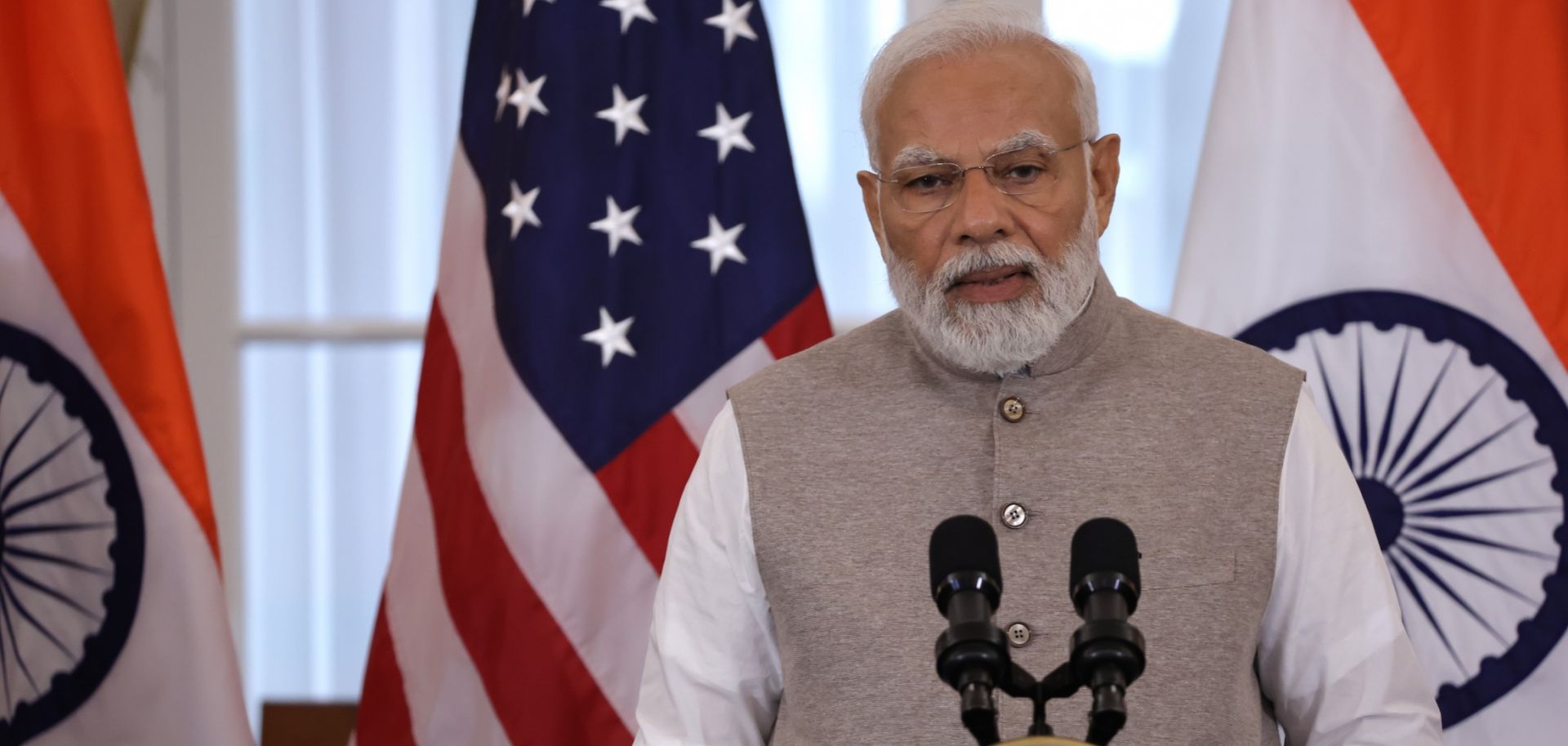
Indian Prime Minister Narendra Modi's upcoming visit to the United States will likely focus on addressing trade concerns, exploring ways to mitigate potential tariffs on key sectors like pharmaceuticals, enhancing defense collaboration, and potentially expanding India's role in the Quad grouping (which also includes Australia and Japan). Modi will travel to the United States on Feb. 12 for a two-day visit where he will meet with President Donald Trump for the first time since Trump retook office on Jan. 20. The visit follows Indian Foreign Minister Subrahmanyam Jaishankar's trip to Washington on Jan. 21 to meet with top diplomats from fellow Quad countries (the United States, Australia and Japan), which marked the first high-level engagement between India and the United States under the new Trump administration. It also follows a Jan. 27 phone call between Modi and Trump in which the two leaders discussed defense cooperation, tackling illegal immigration and working toward a balanced trade relationship.
- After their Jan. 21 meeting, the four Quad members (India, the United States, Australia and Japan) issued a joint statement highlighting efforts to strengthen regional security, counter coercive actions, and enhance cooperation on critical minerals to build self-sufficient supply chains and economic resilience. India will host the next Quad meeting later this year.
- During his trip to Washington on Jan. 21, Jaishankar also met with U.S. Secretary of State Marco Rubio, where they discussed cracking down on illegal immigration to the United States, among other issues. Following the meeting, Jaishankar said New Delhi would accept the return of approximately 18,000 undocumented Indian migrants that the Trump administration had reportedly identified for deportation. On Feb. 5, a U.S. military plane carrying over a hundred deported Indian immigrants landed in Punjab. The move has sparked a political controversy in India, with the opposition Congress Party criticizing the Modi government for remaining silent on what it calls the ''humiliation'' of Indian nationals.
While trade tensions between India and the United States have increased in recent years, the two countries retain significant economic and security ties. On the campaign trail, Trump labeled India a ''major trade abuser'' and pledged to impose reciprocal tariffs if he was re-elected, citing India's $32 billion trade surplus with the United States. The United States is India's largest trading partner, with bilateral trade exceeding $118 billion in the fiscal year 2023/24. In his first term, Trump imposed tariffs on Indian steel and aluminum in 2018 and revoked India's preferential trade status under the Generalized System of Preferences in 2019, prompting India to retaliate by raising tariffs on U.S. goods like almonds, apples and walnuts. But despite this recent uptick in trade tensions, the United States and India retain strong military cooperation, driven by their mutual interest in creating a free and open Indo-Pacific to counter China's growing military and economic assertiveness in the region. The U.S. and Indian militaries also collaborate on efforts to combat terrorism and extremism in South Asia (particularly in Pakistan), and are interested in reducing India's defense dependence on Russian arms and expanding U.S.-India defense collaboration. Indeed, the United States remains India's third-largest defense supplier after Russia and France, accounting for 10% of the South Asian country's arms purchases. India also conducts more military exercises and exchanges with the United States than any other country.
- The United States exports a range of goods to India, including crude oil and petroleum products, liquified natural gas, coal, medical devices, scientific instruments, scrap metals, turbojets, computers and almonds. Meanwhile, India's exports to the United States range from textiles, pharmaceuticals and engineering goods, to petroleum oils, machinery and cut diamonds. India also exports smartphones, auto parts, shrimp, gold jewelry, footwear, and iron and steel to the United States.
- The United States and India have signed several agreements to enhance military cooperation in recent years. These include the 2016 Logistics Exchange Memorandum of Agreement (which grants mutual access to each other's military facilities for refueling and replenishment), the 2018 Communications Compatibility and Security Agreement (which enables secure military communications and intelligence sharing), the 2019 Industrial Security Agreement (which allows U.S. defense firms to share sensitive technologies with Indian counterparts), and the 2022 Basic Exchange and Cooperation Agreement in 2022 (which facilitates the sharing of geospatial intelligence and satellite data for defense purposes). The fact that these agreements were signed under three different U.S. presidents (Barack Obama, Donald Trump and Joe Biden) shows the United States' continued interest in security ties with India.
- Since 2008, India has contracted over $20 billion in U.S.-origin defense equipment.
During his trip to Washington, Modi will likely seek to address Trump's concerns with India's trade surplus to avoid potential U.S. tariffs on Indian pharmaceutical goods. Discussions between Modi and Trump will likely focus on trade, including strengthening economic ties, addressing India's trade surplus, and enhancing India's attractiveness to foreign manufacturers shifting from China. While India has so far avoided Trump's recent tariff measures, Trump in late January said he was considering imposing tariffs on Indian pharmaceutical exports to the United States, which accounted for 31% of India's total drug exports in 2023-24, amounting to $8.73 billion. These tariffs could heavily impact India, as the pharmaceutical sector is an important part of its economy, contributing around 1.72% to the country's GDP. To avoid the duties and mitigate potential trade tensions, Modi's government has already taken proactive steps to appease the new White House, including by deciding to uphold the U.S. dollar as India's trading currency and committing to accepting thousands of deported Indian migrants from the United States. On Feb. 1, New Delhi also announced broad tariff cuts on imports of U.S. goods Trump has often claimed face unfair treatment. Against this backdrop, Modi's upcoming meeting with Trump will likely involve discussions on concessions for Indian pharmaceutical exports, particularly given India's role as a key supplier of affordable generic medicines to the United States. Modi may, for example, promise to continue recent efforts to address U.S. concerns over India's reliance on China for active pharmaceutical ingredients (APIs) and regulatory compliance in Indian pharmaceuticals, particularly amid drug recalls. Modi may also offer to increase India's purchases of U.S. energy products and defense equipment, which would not only support India's energy and defense needs but align with Trump's ''America First'' policy — particularly given that Trump specifically emphasized the importance of India increasing its purchases of American-made security equipment during his Jan. 27 call with Modi.
- According to India's Department of Commerce, Indian pharmaceutical companies are projected to achieve a 9-11% revenue growth in FY25, driven by strong demand in key markets like the United States.
- In its Union Budget for 2025-26, presented on Feb. 1, the Indian government significantly reduced customs duties on imports of high-end motorcycles, cars and smartphone parts, which is expected to benefit major U.S. companies like Harley-Davidson, Tesla and Apple. With Trump emphasizing boosting domestic industry under his ''America First'' trade policy, these tariff cuts are being seen as a strategic gesture aimed at securing assurances the United States will refrain from raising taxes or imposing new trade barriers on Indian exports.
- India has several pending defense agreements with the United States aimed at acquiring advanced military technology and strengthening defense ties through joint modernization efforts. One key initiative involves ongoing discussions between U.S.-based GE Aerospace and India's state-owned Hindustan Aeronautics Ltd. for the co-production of jet engines in India.
- The Indian government is working to improve quality standards in its pharmaceutical sector by enhancing regulatory frameworks and increasing inspections through agencies like the Central Drugs Standard Control Organization. Additionally, India is trying to reduce its reliance on China for APIs by encouraging domestic production and diversifying supply chains.
- Technology-sharing will also be a key topic during the upcoming Modi-Trump meeting — either within the existing critical and emerging technologies framework that governs cooperation on cutting-edge sectors like artificial intelligence, semiconductors and biotechnology, or through a revised initiative aimed at further strengthening India-U.S. collaboration in these key areas.
Modi and Trump will also discuss U.S.-India defense collaboration, including advanced military technology and joint exercises, as well as the potential to expand India's role in the Quad to enhance regional security and counter China. India remains unlikely to abandon its multi-alignment policy by fully positioning itself as a U.S. security partner, particularly as India's relations with China are now showing signs of improvement. However, India's concerns over China's assertive actions in the Indo-Pacific and Indian Ocean will nonetheless compel it to keep deepening its defense cooperation with the United States. Such cooperation will thus likely also be on the agenda of the Modi-Trump meeting. The two leaders may discuss increasing India's access to advanced U.S. military technology and expanding joint exercises between the two militaries. They may also agree to strengthen bilateral efforts to monitor Chinese submarine activity in the region, a move that would benefit India given past tensions along the Himalayan border. Additionally, Modi and Trump will likely discuss security cooperation within the Quad and Trump's potential commitment to attending the grouping's leadership summit in India later this year. Such discussions could revolve around India's role in the alliance and whether the United States wants a greater strategic contribution from New Delhi, particularly as a counterweight to China. This could involve enhancing India's coordination with Quad countries on emerging security challenges, such as cyber threats, supply chain resilience and defense-industrial collaboration. Additionally, discussions could touch on expanding Quad-led infrastructure and development initiatives in the Indo-Pacific, positioning India as a key player in countering China's Belt and Road influence, which would also advance New Delhi's own regional connectivity goals.
- Trump's appointment of Mike Waltz as National Security Advisor, a staunch China critic who previously served on the Congressional Caucus on India, further increases the outlook for deeper U.S.-India defense cooperation in the coming years.
- According to a report by the U.S. Congressional Research Service published on Dec. 5, the United States and India have steadily expanded the scope, complexity, and frequency of their joint military exercises since 2002, with a strong focus on maritime security and interoperability.
Finally, India's decreasing reliance on Russian arms and oil could ease U.S. concerns and strengthen defense and energy ties under the Trump administration. India's defense and energy ties with Russia were a major point of contention with the administration of former U.S. President Joe Biden, especially India's military purchases and reliance on discounted Russian oil. However, India has been steadily reducing its dependence on Russian arms, which comprised only 36% of its total arms imports in 2023, compared with 76% in 2009. This shift aligns with India's broader push to diversify its defense procurement by inking deals with Western suppliers, including France and the United States. Additionally, the U.S. Treasury's move to sanction Russian energy firms and tankers on Jan. 10 has further pressured India to reduce its reliance on Russian crude. In response to the sanctions, Indian refiners are already negotiating alternative supply agreements with Middle Eastern and U.S. producers for 2025-2026. While India is unlikely to sever its ties with Russia entirely, these steps will likely address some of the United States' primary concerns and help ease tensions in their strategic partnership.
