
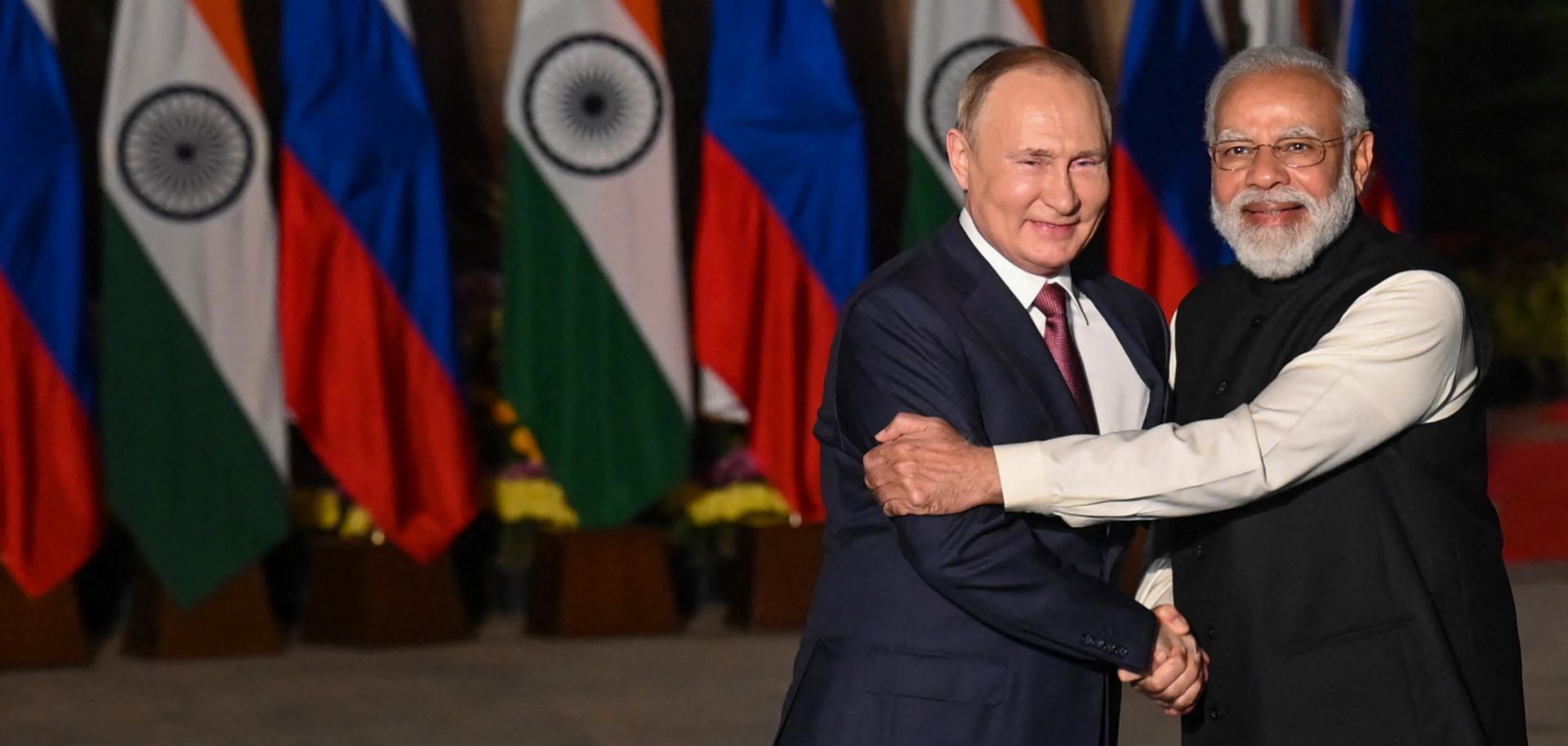
An upcoming meeting between India's Prime Minister Narendra Modi and Russia's President Vladimir Putin underscores New Delhi's efforts to maintain balanced relations with Moscow, paving the way for renewed India-Russia summits and the finalization of a major defense deal. Modi is scheduled to visit Moscow, Russia, on July 8-9 for discussions with Putin. This visit marks Modi's first trip to the Russian capital since 2015 and his first to Russia since the invasion of Ukraine (he visited Vladivostok in September 2019 for the Eastern Economic Forum). Additionally, this visit follows Putin's fifth consecutive swearing-in as president of Russia in May, as well as confirmation of Modi's third straight term as India's prime minister in June.
- Russia and India have held annual summits since 2000 when they signed the Declaration on the India-Russia Strategic Partnership, which established their highest institutionalized dialogue mechanism. The two countries usually alternate hosting these meetings, which aim to strengthen their strategic partnership through high-level discussions. However, apart from Putin's visit to India in 2021, no annual summits have taken place since 2020 because of the COVID-19 pandemic and Russia's invasion of Ukraine.
The visit signifies India's efforts to maintain a multi-aligned foreign policy and may portend a revival of the long-standing annual India-Russia summit format, especially given the two countries' economic and defense ties. Despite sanctions imposed by the United States and other Western governments on Russia following the 2022 invasion of Ukraine, India's ties with Moscow have remained robust. As the world's third-largest crude consumer, India is a significant purchaser of discounted Russian oil, and Moscow continues to be India's largest supplier of military hardware, responsible for 36% of India's arms imports from 2019 to 2023. New Delhi has notably refrained from criticizing Russia's actions in Ukraine, advocating instead for diplomatic solutions to the conflict. This stance underscores India's "multi-aligned" stance on international affairs. Modi's trip to Moscow highlights the continuation of robust India-Russia relations, particularly since this was Modi's first trip abroad during his third term; at the beginning of Modi's previous terms, he focused on visiting neighboring countries. This diplomatic engagement also signals India's commitment to maintaining a balanced approach in its bilateral relations with Russia, Ukraine and other countries amid the ongoing Russia-Ukraine conflict. Following the easing of constraints from COVID-19, Russia's war and both countries' elections, India and Russia appear primed to resume their annual forums.
- In June, Indian refiners imported 2.13 million barrels per day, or bpd, of Russian crude oil, an increase from 2.1 million bpd in May and the highest since May 2023, when imports peaked at a record 2.15 million bpd, solidifying Russia's position as India's top supplier.
- Meanwhile, Modi's decision to skip the Shanghai Cooperation Organization summit in Astana, Kazakhstan, on July 3-4 aligns with the ongoing parliamentary session in India and his scheduled state visit to Russia.
- On June 14, Modi and Ukrainian President Volodymyr Zelensky met on the sidelines of the Group of Seven summit in Italy. During their meeting, Modi emphasized India's ongoing support for a peaceful resolution of the Russia-Ukraine war through dialogue and diplomacy. Additionally, "India did not associate itself with any communique/document emerging from [the June 15-16 summit on peace in Ukraine]," as "a resolution requires a sincere and practical engagement between the two parties to the conflict," according to an official statement from India's Ministry of External Affairs.
During Modi's visit, he and Putin will likely address trade issues and prioritize finalizing the Reciprocal Exchange of Logistics Agreement, enabling mutual access to military facilities and exchanges. The Modi-Putin talks are expected to cover several key areas, including enhancing oil trade through the development of alternative payment mechanisms that avoid the use of Western currencies and addressing payment challenges due to Western sanctions. The talks will also likely advance discussions on the Chennai-Vladivostok maritime route, a strategic shipping corridor proposed between Chennai on India's central eastern coast and Vladivostok, Russia's main port city on the Pacific Ocean in its Far East. Finalizing this route could unlock increased trade opportunities for India and Russia and streamline operations. However, the primary focus of the discussions is likely to be on finalizing the Reciprocal Exchange of Logistics Agreement, which facilitates mutual access to military facilities for logistical support like refueling and maintenance. This agreement is crucial for expanding defense cooperation, particularly in accessing Arctic shipping routes and Russia's Far East, where India has been increasing investments. While the exact timeline for finalizing the agreement remains unclear, reports indicate Russian Prime Minister Mikhail Mishustin has directed Russia's Defense Ministry to collaborate with India on this effort. Once finalized, as part of India's broader geopolitical balance strategy, the agreement will underscore India's commitment to maintaining robust bilateral trade, military cooperation and political ties with Russia.
- In February, reports indicated that India's shipping ministry, Indian businesses and Russian stakeholders were collaborating to enhance traffic and ensure the commercial viability of the Chennai-Vladivostok route. The proposed route would significantly reduce the travel distance between the two countries from 8,675 nautical miles to 5,600 nautical miles.
- After several years of delays, the Reciprocal Exchange of Logistics Agreement is expected to conclude. This agreement will enable military exchanges for exercises, training, port calls and disaster relief, as well as give India access to Russian military facilities, including those in the Arctic.
- Modi and Putin may also discuss the repatriation of Indian citizens who joined the Russian army through an alleged human trafficking network promising high salaries, creating potential areas of contention as Modi calls for their early discharge.
