
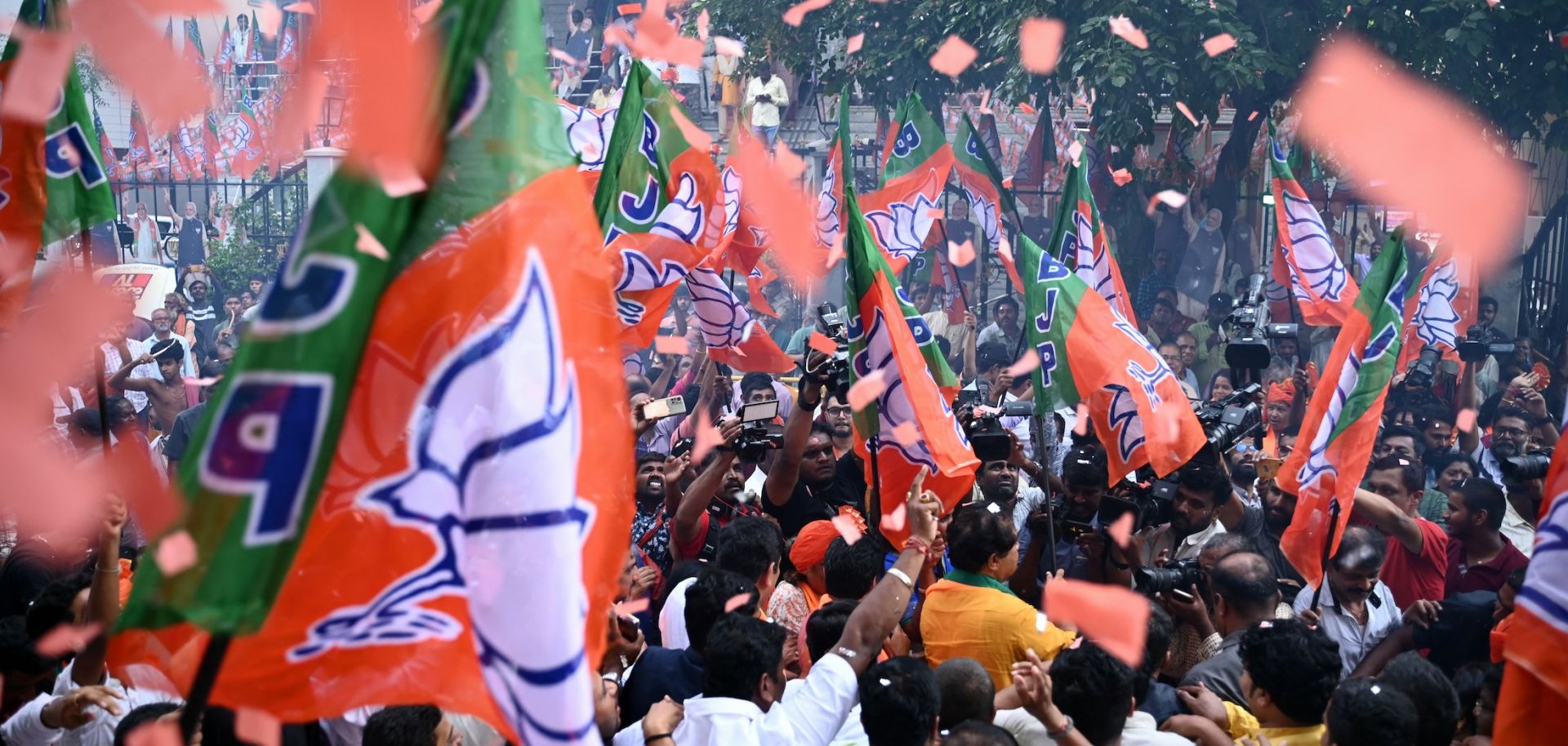
Results from India's general election indicate that the ruling party will return to office but will need to work with coalition partners, which will likely still result in broad domestic economic policy continuity, but will probably also introduce intra-coalition splits on major reforms and controversial social measures that generate some policymaking slowdowns and potential uncertainty. As of June 4, early results from India's general election indicate that Indian Prime Minister Narendra Modi and his Bharatiya Janata Party (BJP)-led government are poised to secure a historic third consecutive term in office, but will fall short of a majority needed to form a government, thus forcing it to rely on its coalition partners within the National Democratic Alliance (NDA) to remain in power. But the NDA has already reached the 272-seat threshold needed to secure a majority in the Lok Sabha, the 543-seat lower house of India's Parliament, thereby clinching Modi and his party's reelection. However, the BJP itself only won around 240 seats, leaving it without an outright majority for the first time since it took power in 2014. The BJP's rivals, meanwhile, have performed better than expected in the polls, with the opposition INDIA alliance led by the Indian National Congress (Congress) now projected to come away with around 220 seats in the lower house of Parliament.
- India operates under a first-past-the-post multiparty electoral system, where the candidate with the highest number of votes wins. To achieve a majority, a party or coalition must secure at least 272 seats in the Lok Sabha.
- Voting for the 543 seats in the lower house of India's Parliament, which serves a five-year term, took place over six weeks. The election commenced on April 19 and concluded on June 1, spanning 28 states and eight Union Territories.
- A number of key states have yet to report full results, including West Bengal, Kerala and Maharashtra. Tallies from key states, including West Bengal, Kerala and Maharashtra.— which are seen as crucial electoral battlegrounds due to their size, demographics and political landscapes — all show opposition parties in the lead.
- Some controversies have emerged during the weeks-long election, with the opposition coalition criticizing and submitting complaints to India's election commission, including regarding the allegedly ''slow'' counting of votes in certain constituencies. In addition, some politicians and parties have claimed issues with how the elections were held in certain areas, or that localized violence had influenced results, prompting authorities to conduct re-votes.
While the BJP will remain at the helm of India's government, opposition parties' surprising electoral performance in key states suggests voters prioritized economic issues over the Hindu nationalist issues that were the core focus of the BJP's campaign. Results come in contrast to earlier surveys and exit polls that consistently indicated the BJP and its allies would secure a large majority, between 350-380 of the 543 seats in India's lower house of Parliament. Modi himself had set a goal of winning 400 seats and thus the opposition alliance's stronger-than-expected showing illustrates a personal setback for the prime minister. Results so far indicate that the opposition INDIA alliance's unexpectedly strong showing was fueled by its success in key states — particularly Uttar Pradesh, India's most populous state, which alone accounts for 80 parliamentary seats. Notably, the BJP conceded defeat in Uttar Pradesh's Faizabad constituency of Uttar Pradesh, where Modi inaugurated a grand Hindu temple months ago to fulfill a key campaign pledge in an attempt to mobilize voters and increase the BJP's chances of electoral victory. Initial media reports suggest the BJP's unexpectedly weaker electoral showing has been fueled by voters resonating less with the party's prominent Hindu nationalist agenda and being more concerned with issues surrounding welfare, unemployment, inflation and economic challenges under the BJP's leadership. In recent weeks and in response to initial concerns over low voter turnout, Modi shifted his campaign from emphasizing economic progress and improving welfare and employment to making divisive comments aimed at energizing his Hindu base by inflaming religious tensions.
- In the 2019 general election, the NDA secured 64 seats of Uttar Pradesh's 80 parliamentary seats (with the BJP alone securing 62), while the opposition Congress party secured just one seat. But initial 2024 election results from Uttar Pradesh show the Congress-led INDIA alliance closely competing with the BJP.
Should the final tally align with early vote counting, the BJP-led government will likely maintain broad domestic economic policy continuity by prioritizing manufacturing, infrastructure projects and job creation in the coming years. Broad agreement between the BJP and its key coalition partners Janata Dal (United) and Shiv Sena will likely enable Modi to focus the government's domestic policies on long-standing priorities like enhancing manufacturing, infrastructure development and job creation. The BJP may support manufacturing specifically by expanding infrastructure and broadening financial incentives for foreign firms to set up local production in industries such as textiles, leather and engineering goods. Modi will also likely implement a variety of protectionist measures like tariffs and export restrictions, as his administration has done in the past. He will also prioritize reducing India's reliance on imports from China and on positioning India as an attractive destination for tech companies shifting their operations from China, which will drive further production-linked incentives, especially in the tech sector. NDA coalition partners' alignment with the BJP on how to resolve major economic challenges like unemployment and food inflation suggests broad policy continuity on key economic policies as well.
- Following the election, Modi will release his 100-day agenda, which will encompass 50-70 objectives and proposals outlining the trajectory of the incoming government. Given Modi's existing ''Make in India'' initiative, the government will likely commit to bolstering manufacturing, potentially by expanding its production-linked incentives, which offer financial incentives for manufacturers to move operations to India.
- The BJP will likely significantly emphasize building out India's physical infrastructure capacities. These will include the development of railway lines, roads, highways, renewable energy sources and transmission lines. The focus will likely be on key manufacturing hubs and rural areas in southern states like Telangana and Tamil Nadu, as well as eastern states like Odisha and Bihar, to enhance connectivity and streamline supply chains.
However, the BJP's coalition partners will drag their heels on certain economic and electoral reforms, as well as disagree over some social issues, which may slow policymaking and dampen investor sentiment. The BJP's weaker majority will likely constrain its ability to pass more structural economic reforms proposed in recent months, such as privatization, land and labor reforms, partially due to pushback from NDA partners over fear of mass protests from trade unions and farmer groups. For this reason, the BJP in the short term will likely refrain from pushing for significant policy changes, such as the vigorously campaigned ''one nation, one election'' reform. Additionally, minor disagreements between the BJP and NDA partners may arise, particularly around legislation that seeks to regulate social issues, like the Citizenship Amendment Act and the Uniform Civil Code; disagreements are particularly common among regional and state-level party members. Differing ideological perspectives on secularism, Hindu nationalism and other policy priorities could push key NDA partners like Shiv Sena and Janta Dal (United) to pressure the BJP by severing and reviving ties, as they have done previously. Coalition partners may also use these tactics to push the BJP to address local concerns or other policy agendas, potentially disrupting the BJP's national agenda. This disunity could occasionally lead to some short-lived policymaking roadblocks that risk constraining the BJP's efforts to implement social reforms, like the Citizenship Amendment Act and the National Register of Citizens. The opposition INDIA alliance's greater strength in the lower house will likely also pose political barriers for the BJP in passing policies that require a supermajority, including the ''one nation, one election'' reform. These obstacles for the BJP risk somewhat constraining investment amid political uncertainty and a higher risk perception, particularly since the BJP will likely refrain from immediately pushing for pro-business and agriculture policies like land and labor reforms. Investment levels could sink further if policymaking gridlock worsens.
- The ''one nation, one election'' reform proposes simultaneous general and state elections. Implementing this reform would warrant constitutional amendments, requiring approval from two-thirds of both the upper and lower houses. However, the BJP might delay its pursuit of this reform due to its lack of a supermajority.
- In the near term, the BJP's projected narrower victory will likely also fuel risks of at least localized protests and unrest by supporters of varying parties. For example, some ruling party supporters may dispute election results given the wide discrepancy between exit polling and reported results, while some opposition supporters may claim electoral irregularities limited the opposition's success. Other post-election grievances also risk fueling near-term disruptive activity, with Congress' general secretary already calling for Modi's resignation due to the BJP's unexpectedly weak performance.
- On June 4, Indian stocks experienced their most significant decline since March 2020. This dip was attributed to the emerging vote-counting trends indicating that Modi's alliance might not secure the supermajority anticipated by exit polls.
