
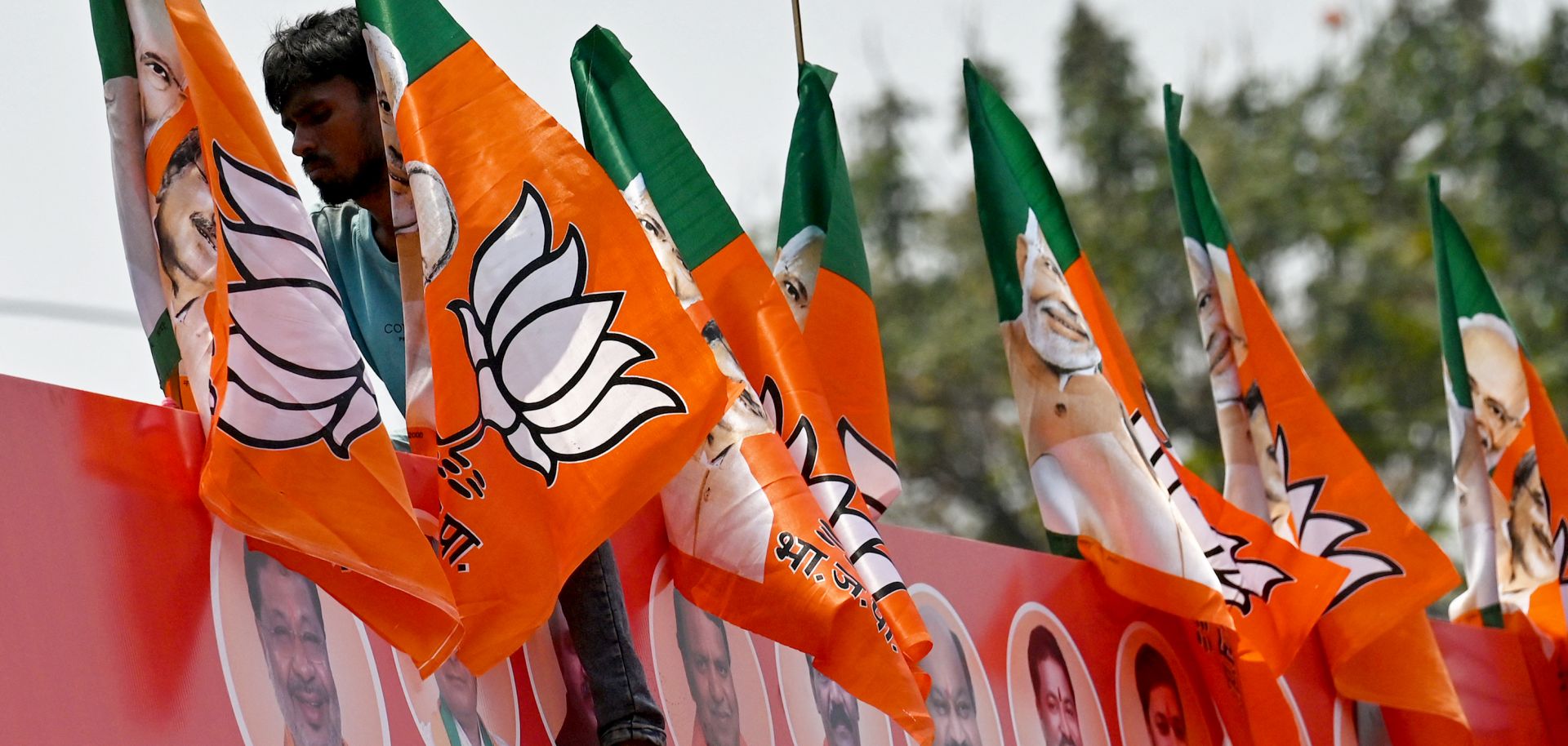
If India's ruling BJP party remains in power after the country's April 19-June 1 general election, policy continuity regarding efforts to increase employment, build infrastructure and implement controversial social policies nationally that trigger social unrest can be expected. Voting for India's general elections will start April 19, with results announced June 4. The elections will determine the composition of the 543-seat Lok Sabha, India's lower house of parliament, with an additional two members nominated by the president. India follows a first-past-the-post multiparty electoral system, where the candidate with the highest number of votes in each constituency wins. To secure a majority, a party or coalition must attain at least 272 seats. The main contenders are the Bharatiya Janata Party, led by Prime Minister Narendra Modi, and the Indian National Congress, led by Rahul Gandhi. Congress is running under a coalition called the Indian National Developmental Inclusive Alliance, or INDIA.
- An estimated 969 million people are eligible to vote, and 5.5 million electronic voting machines will be set up at 1.05 million polling stations.
- Voting will unfold in seven phases starting April 19 and continuing April 26, May 7, May 13, May 20, May 25 and June 1, with results announced June 4. The multiphased election approach is primarily aimed at ensuring enough federal security forces to safeguard the integrity of the electoral process.
- Additionally, in four states — Andhra Pradesh, Arunachal Pradesh, Odisha and Sikkim — parliamentary and legislative assembly elections will be conducted concurrently, with results announced June 4.
- Following its win in 2019, the BJP secured an absolute majority by winning 303 seats plus 52 for the National Democratic Alliance, a coalition led by the BJP, totaling 352 seats. Congress, by contrast, won just 52 seats.
The BJP has focused its manifesto on job creation for the young, welfare policies and infrastructure development, while Congress emphasizes representation for all castes and safeguarding farmers from market fluctuations. The BJP's manifesto focuses on welfare, women's economic empowerment and youth employment. This emphasis would likely result in efforts by a new BJP government to enhance manufacturing in India, potentially generating more jobs and reducing youth unemployment. Modi's manifesto also highlights initiatives to boost infrastructure by improving highways, roads, railway lines and energy supplies in various states, underscoring efforts to enhance connectivity, streamline supply chain operations, improve working conditions and attract investment. Congress's platform has meanwhile focused on job creation and youth employment, removing the cap on affirmative action for marginalized castes, and guaranteeing farmers a minimum support price ensuring the government would buy crops to protect farmers from market fluctuations.
- A recent survey by the Centre for Study of Developing Societies highlighted unemployment and rising prices as key concerns among Indian voters. Many young people struggle with unemployment in a labor market that favors highly skilled workers. In agrarian states like Punjab and Uttar Pradesh, farmers' rising debt and protests have meanwhile been persistent issues, while farmers groups have also demanded a doubling of their income.
While the elections will take place against the backdrop of farmers' protests, the demonstrations are unlikely to significantly affect the BJP's electoral prospects, as some farmers approve of the BJP's welfare schemes. Modi's government promised in 2016 to increase investment in rural development to double farmers' incomes by 2022, issue loan waivers and dismiss legal actions filed against farmers stemming from the 2020-21 farmers' protests. The government, however, appears unlikely to concede to demands for a minimum support price, which government ministers have said would consume a significant portion of the budget and leave little funds for other development efforts, though discussions between farmers unions and the government are ongoing. Agriculture is a vital sector in the Indian economy, and the bulk of protesting farmers hail from Punjab, Haryana and Uttar Pradesh, three politically significant states in the Hindi heartland. In recent years, Modi's government has introduced support schemes, including housing subsidies, and made campaign promises for infrastructure development and welfare initiatives that have resonated with some farmers. In its current manifesto, the BJP government offers similar schemes and subsidies, and promised a minimum support price for major crops. Farmers unions have not responded to this manifesto, but earlier statements that they would continue rallying suggests protests will likely persist for at least several more weeks, and potentially for longer.
- In 2020-21, farmers protested three Farm Bills aiming to reform agriculture. While the government repealed the measures in late 2021, other demands (including for a minimum support price) remain ongoing issues. Farmers have since conducted small protests in northern states.
The elections will also take place against the backdrop of controversial government policies such as the Uniform Civil Code, which could stoke political divisions and intercommunal tensions. In its manifesto, the BJP promises further implementation of the Uniform Civil Code, which seeks to replace religious personal laws with unified common laws governing marriage, relationships and inheritance. The code includes provisions to advance gender equality by prohibiting polygamy and child marriage; establishing a minimum marriage age for girls; standardizing divorce procedures; and outlining guidelines on inheritance and property rights. Many conservative Muslim groups perceive the Uniform Civil Code as a so-called Hindu code being imposed universally, potentially infringing upon existing Islamic laws and traditions. Implementation of this policy is likely to exacerbate political divisions and intercommunal tensions in India, with critics accusing Modi's government of promoting a Hindu nationalist agenda and discriminating against Muslim citizens. Some states like West Bengal and Tamil Nadu have opposed the implementation of the code.
- In March, the government called for the nationwide implementation of the Citizenship Amendment Act. The legislation establishes an expedited route to Indian citizenship for persecuted religious minorities, namely, Hindus, Sikhs, Buddhists, Jains, Parsis and Christians who fled Afghanistan, Bangladesh and Pakistan and entered India before 2015. Notably, the legislation excludes Muslims, marking the first instance of religion explicitly being employed as a criterion for citizenship in Indian law.
- The government has said it will expand the National Register of Citizens to document all lawful citizens of India with the aim of aiding in the identification of illegal immigrants. Critics argue that expanding the register coupled with the Citizenship Amendment Act could make Indian Muslims vulnerable to losing their rights. The government has yet to expand the register, which was initially introduced in the state of Assam, or mention plans to do so in its manifesto.
While the BJP could secure enough seats to form a majority independently, it might need support from its National Democratic Alliance partners to meet the majority threshold and govern effectively. Opinion polls suggest that the BJP is poised to win the upcoming elections, though projections differ on exactly how many seats it will get. The BJP could win a simple majority by securing at least 272 seats out of 543, allowing Modi to continue as prime minister. This would permit the BJP to pass legislation on its own. If the BJP fails to meet the 272 threshold, it will look to its partners in the National Democratic Alliance, a BJP-led coalition. Given the BJP has successfully maintained alliances with National Democratic Alliance member parties, notably Shiv Sena and Janata Dal-United, it would likely meet the 272 seat requirement via a coaltion with the National Democratic Alliance. Whether working through the alliance or alone, a BJP-led government would likely pursue similar policies. That said, the National Democratic Alliance could fragment, a risk increased given potential disagreements with Shiv Sena and Janata Dal-United over power sharing and policy differences. Both parties have a history of severing and reestablishing ties with the BJP due to differing ideological perspectives on secularism, perceptions of Hindutva — a political ideology that embraces Hindu nationalism — and other policy priorities. This could delay the passage of legislation in the lower house should the BJP lack a majority without the alliance. In the event the BJP and its National Democratic Alliance partners fail to control 272 seats, they could still team up with regional parties such as the National People's Party and Biju Janata Dal, among others, to form a coalition government. In this scenario, however, the BJP would find itself juggling different party priorities, slowing its ability to pass laws.
- According to a recent India TV-CNX opinion poll, the National Democratic Alliance coalition is projected to win 399 of the 543 seats in the lower house of parliament. Meanwhile, the BJP alone is expected to secure 342 seats.
In the unlikely scenario the opposition wins the elections, it would work to bolster secularism and potentially roll back Hindu-nationalist policies, but would face constraints on its ability to govern due to intracoalition divisions. A victory by INDIA is unlikely because of internal divisions, financial limitations and the absence of a strong alternative leader to Modi. An INDIA victory could, however, materialize if the coalition successfully implements a strategic seat-sharing agreement, which would comprise political parties contesting elections together and dividing constituencies among themselves with the aim of collectively maximizing their chances of winning seats. As elections approach, some seat-sharing arrangements are still being finalized. This scenario would also require INDIA to reach multiple political alliances after the elections. Parties that belong to INDIA are like to accuse the BJP of neglecting guarantees of representation for traditionally marginalized castes; emphasize their promise to reinforce the Indian Constitution's secular provisions and advocating the reversal of the BJP's Hindu-nationalist policies like the Citizenship Amendment Act; and advocate minimum support prices. This could resonate with voters and pave the way for an INDIA alliance victory. If INDIA were to win the elections, its new prime minister would likely be Rahul Gandhi of Congress. Following a win, the INDIA alliance would likely prioritize minimum support prices for farmers, job creation, uninterrupted power supply, free electricity for the poor and infrastructure development. But internal discord already in evidence within the INDIA alliance regarding power-sharing and ideology could persist, potentially weakening the government and increasing the risk of political instability.
