
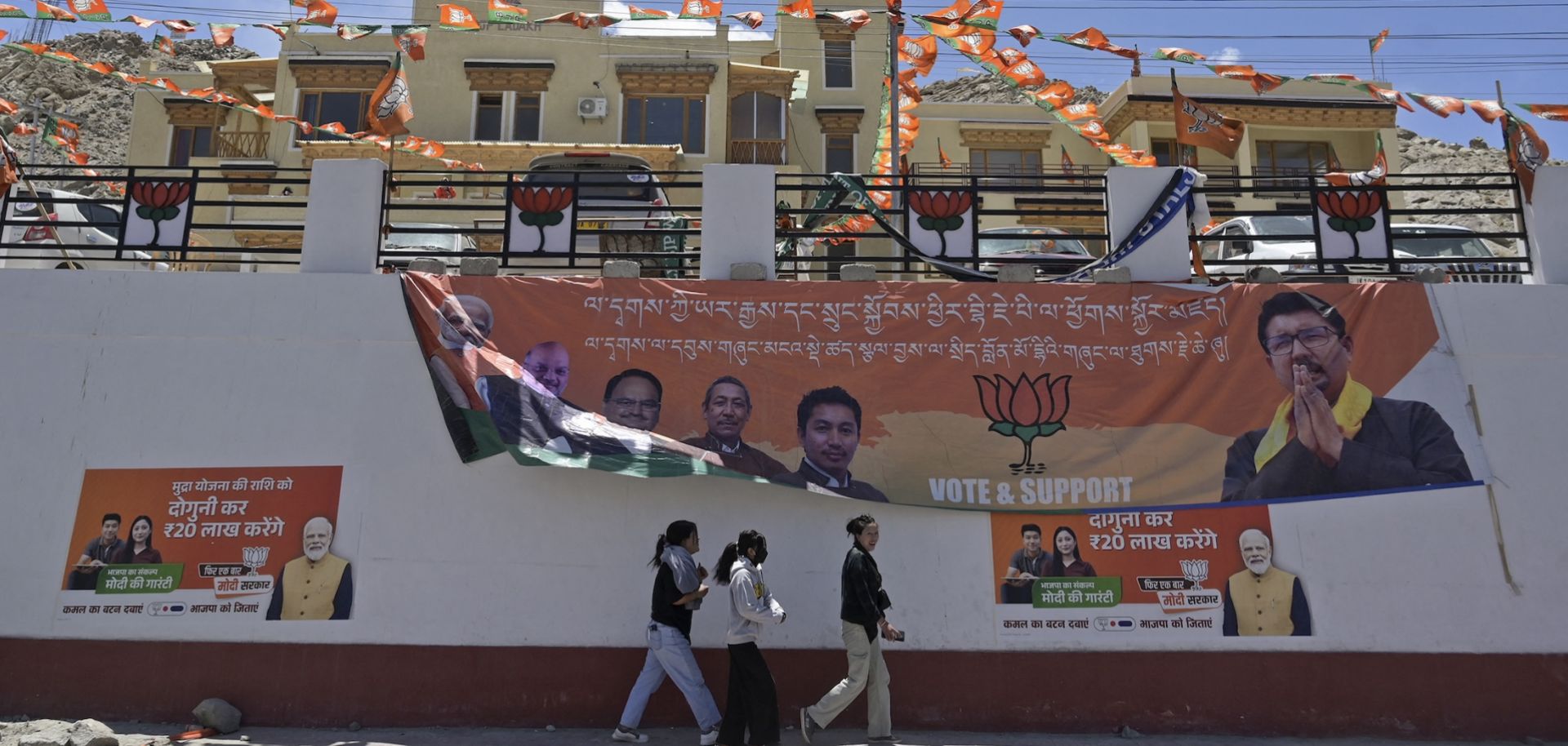
In India's ongoing general election, low voter turnout and controversies surrounding inflammatory remarks will likely persist, potentially impeding the ruling Bharatiya Janata Party (BJP)'s ability to secure a supermajority, but the party is still likely to win another term. Five out of the seven phases of India's general election have been completed. The remaining phases are scheduled to conclude by June 1, with the results announced on June 4. So far, voting has been conducted in 24 out of the 28 states and 8 union territories, covering 428 seats of the total 543 constituencies. The main contenders for power include the BJP, led by Prime Minister Narendra Modi, and the Indian National Developmental Inclusive Alliance (INDIA), a coalition of parties led by India's main opposition party, the Indian National Congress (Congress).
- The voting for the elections, which started on April 19, follows a multiphased approach primarily aimed at ensuring the presence of sufficient federal security forces to safeguard the integrity of the electoral process.
- The fifth phase of voting started on May 20, covering 49 constituencies in six states and two Union Territories, including India's Gangetic plains (like Bihar, Maharashtra, Odisha, Uttar Pradesh and West Bengal), after concluding in south and central India. These states collectively account for a large number of seats in the lower house of India's parliament, the Lok Sabha, and therefore hold significance for any political party aspiring to form a government. In Uttar Pradesh and Bihar, the BJP appears popular, signaling a potential win for the party in these two states. However, in states like West Bengal, regional parties have historically dominated the political landscape, presenting challenges for the BJP in contesting for power.
Amid slightly lower voter turnout in the polls so far, Prime Minister Modi and the BJP will likely continue to propagate inflammatory remarks to energize their Hindu voter base in the hopes of securing a supermajority in the lower house of India's parliament, likely heightening the risk of localized election violence. One of the most notable features of the election process so far has been the voter turnout, which has been slightly lower compared with the previous general election in 2019 — a trend partly attributable to the extreme heatwaves in several regions. Lower-than-expected turnout could threaten the BJP's ability to secure a supermajority in the lower house of India's parliament, the Lok Sabha. In response to this potential threat, Modi appears to have recently shifted the focus of his 2024 campaign from economic progress and improving welfare and employment, to divisive comments aimed at energizing his Hindu base by inflaming religious tensions. During a campaign rally on April 21, the Indian prime minister directly told his supporters that the opposition Congress party wanted to redistribute India's wealth to Muslims, whom he called ''infiltrators.'' On the campaign trail, Modi has also begun referring to Muslim votes as ''Vote Jihad'' to encourage Hindus to vote for the BJP. While Modi often indirectly references pro-Hindu and anti-Muslim sentiments, this marks some of his most overt and inflammatory rhetoric yet. The shift in tone appears to be part of a larger strategy to rally India's massive Hindu population, who comprise 80% of the country's roughly 1.417 billion people, to head to the polls for the remainder of the election. With the recent phases of voting still showing lower turnout, Modi and the BJP politicians may thus continue to fuel such divisive rhetoric until the election concludes on June 1, as they seek to maintain support among their Hindu voter base in the hopes of sidelining the opposition and securing a supermajority in the Lok Sabha. While this strategy may face backlash from Muslim groups and leaders, it is unlikely to result in significant social unrest because such inflammatory remarks are not novel in Indian politics and have historically not incited large protests. Furthermore, would-be protesters may be apprehensive about demonstrating against the government, as Indian authorities are skilled at managing dissent and promptly cracking down on perceived threats through stringent police measures. Additionally, while previous Indian elections have witnessed bouts of violence (particularly in the states of Arunachal Pradesh, Manipur and West Bengal), such violence has remained fairly localized.
- 65.68% of registered Indian voters cast ballots in the third phase of India's 2024 general election, slightly lower than the 68.4% who did so in the third phase of the 2019 general election. During the first and second phases of the current election, the turnout was 66.71% and 66.14%, respectively, compared with the 69.64% and 69.43% recorded in the first and second phases of the 2019 polls.
- During an April 21 rally in the western state of Rajasthan, Modi said that when the opposition Congress party was in power, ''they said Muslims have the first right over the country's resources.'' He warned his supporters that if Congress returned to power, it would ''gather all your wealth and distribute it among those who have more children.'' He then added that a Congress-led government would ''distribute [Indians' wealth] among infiltrators. Do you think your hard-earned money should be given to infiltrators?''
- Hindu nationalists in India often add the word ''jihad,'' which means ''struggle'' in Arabic, to various terms, using it as shorthand for alleged Muslim plots to dominate the country.
Although low voter turnout may reduce the BJP's chances of securing a supermajority in the Lok Sobha, potentially constraining its ability to reform the constitution, Modi and his party are still likely to win the election and return to power for a third term. To secure a simple majority in the lower house of India's parliament, a party or coalition must control at least 272 of the body's 543 seats. Given its widespread popularity, the BJP is almost guaranteed to meet this threshold and thus secure another term, either by winning the 272 seats by itself or through the National Democratic Alliance (NDA), of which the BJP is a member. The larger question, however, is whether the BJP will be able to achieve its stated goal of securing a 400-seat supermajority in the Lok Sobha, which is needed to push through the controversial constitutional amendments that the party has proposed. In particular, the Modi government has suggested changing India's constitution to ensure that elections to the parliament and state assemblies are held simultaneously. While the BJP argues this will save time and money, critics have said such reforms are primarily aimed at increasing the party's control of the country, as holding the state and national elections at the same time would help the BJP at the state level (because of its national popularity), marginalize regional issues in favor of national issues, and weaken smaller, state parties. From the opposition's perspective, this situation could lead to a lack of political diversity and weaker checks and balances in India, which is home to the world's largest democracy. The opposition has also argued that changing the constitution to synchronize the dates for national and state elections could open the floodgates to other constitutional reforms that further weaken India's secularist principles and sideline ethnic and religious minorities. Critics have claimed that the BJP's push for a supermajority in the 2024 election is driven by a desire to facilitate such reforms, as initiating major changes to India's constitution requires a two-thirds majority in the lower house of parliament, or 362 seats — just below the 400-seat threshold for a supermajority. But while Modi has refuted these claims, the policies and reforms proposed by his party suggest otherwise.
- If the BJP does not win enough seats to form a simple majority and is forced to form a governing coalition with other members of the National Democratic Alliance, it could pose challenges to policymaking due to internal divisions, as parties within the alliance have a track record of breaking and remaking alliances with the BJP due to contrasting ideological stances on secularism and varying interpretations of Hindu nationalism. However, such challenges would be unlikely to significantly hinder the passage of laws or constrain the BJP's popularity.
- When Modi took power in 2014, the Lok Sabha had 30 Muslim lawmakers, with only one belonging to the BJP. Currently, Muslims hold 25 out of 543 seats in the Lok Sabha, with none belonging to the BJP.
