
Although China appears to be expediting the approval process of rare earth shipments, Beijing will likely continue to wield restrictions on such exports in the face of growing U.S. technology and trade restrictions, sustaining a high risk of future supply chain disruptions, particularly for automakers. U.S.-China trade talks in London focusing on export controls began on June 9 amid a growing supply chain crisis for U.S. and other Western automakers following China's April 4 introduction of a new export licensing regime covering seven rare earth elements. China introduced those measures in response to sweeping new U.S. tariffs on Chinese goods that the United States announced on April 2. Since then, China has approved far fewer exports of these rare earth magnets, which have aerospace and defense applications due to their high heat tolerance, but are also widely used in vehicles. This has led to global shortages due to China's market dominance, with the country producing about 69% of the world's rare earth elements and about 90% of rare earth magnets. In recent weeks, several global automakers and auto parts suppliers have warned that the new Chinese licensing requirements are starting to affect their operations, with several being forced to pause production, including Ford and Suzuki. Ahead of the June 9 meeting, China appeared to finally be taking steps to expedite approvals. On June 6, Reuters reported that China approved temporary six-month export licenses for sales to three U.S. automakers. On June 7, China said it was willing to put into place an expedited approval process for EU firms. U.S. and Chinese officials will meet again on June 10 to further discuss export controls.
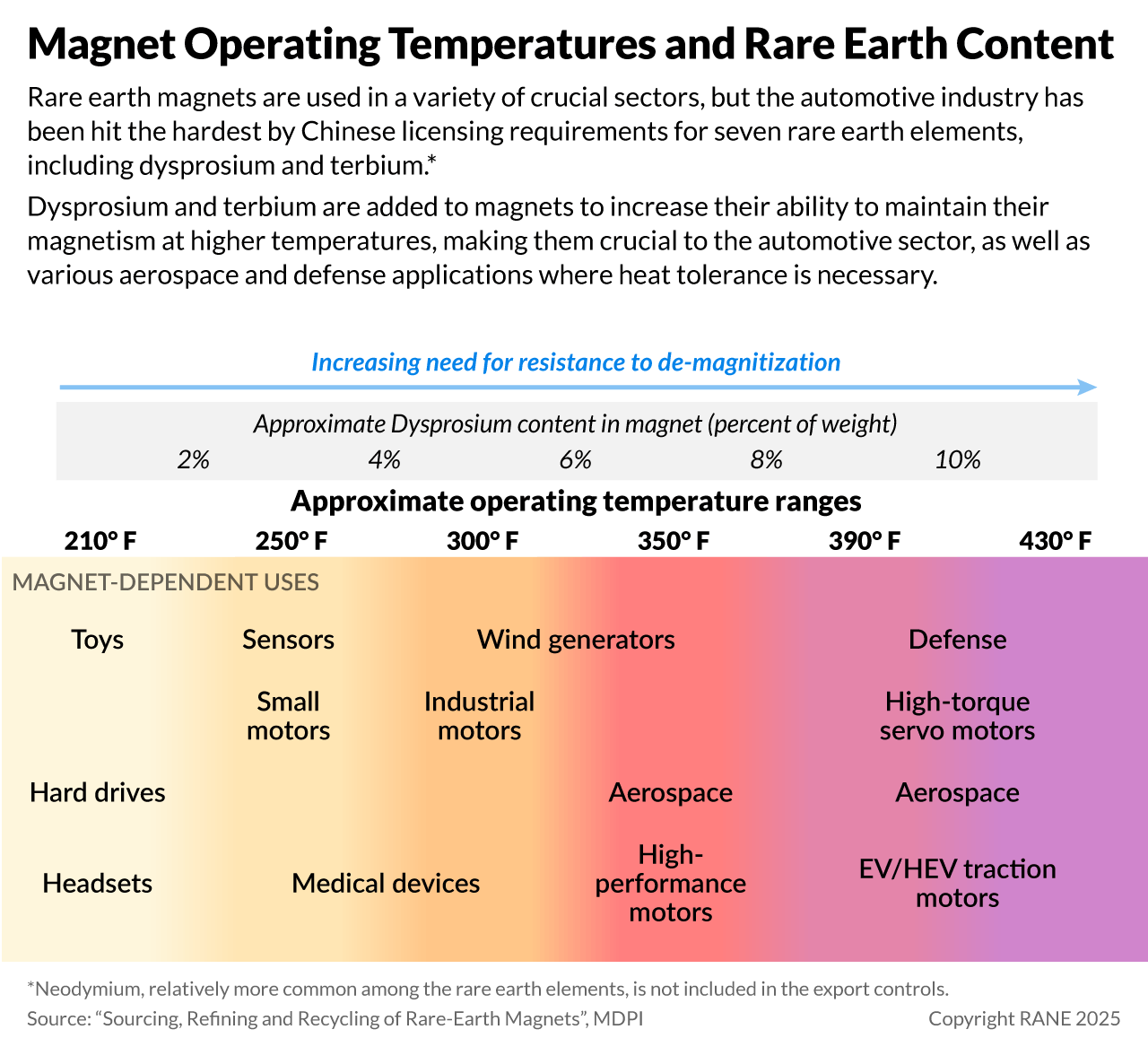
- The seven rare earth elements affected by the export licensing restrictions — scandium, terbium, dysprosium, gadolinium, lutetium, samarium and yttrium — are particularly important for aerospace and defense. China declined to restrict exports of the two most important light rare earth minerals, neodymium and praseodymium, which are commonly used in magnets and applications like hard drive disks, wind power and other civilian industries. Unlike neodymium and praseodymium magnets, however, samarium-cobalt magnets retain their magnetism under high heat conditions, meaning that they are often used in the aerospace and defense industries, where heat tolerance is a design necessity. Dysprosium and terbium are also added to magnets to increase their heat tolerance. Unfortunately for automakers, they also need magnets that can withstand higher temperatures, making the automotive industry far more susceptible to China's restrictions.
- The rare earth magnet shortage forced U.S. automaker Ford to shut down production of its Explorer SUV in Chicago for a week in May. Japanese automaker Suzuki also shut down production of its Swift subcompact in Japan on May 26. Additionally, European auto parts supplier association CLEPA said on June 4 that several parts suppliers had shut down their operations; CLEPA also said that only about 25% of licenses submitted by auto suppliers since early April have been approved, with some cuts rejected.
- China is by far the world's largest producer of rare earth minerals. Many other global rare earth producers, including the main U.S. producer MP Materials, also export their rare earths to China for some level of processing. For example, the country of Myanmar — which accounted for 8% of all rare earth mining production in 2024 — exports virtually all of its ore to China for processing.
China's slow approval of rare earth exports comes amid misunderstandings and accusations regarding the commitments Washington and Beijing made under their May 12 trade deal, which the June 9-10 meetings aim to clarify. In the May 12 deal, China agreed to "adopt all necessary administrative measures to suspend or remove the non-tariff countermeasures taken against the United States since April 2, 2025" for 90 days. The White House clearly believes this means China should have removed the licensing requirements on the seven rare earth elements, and that all exports of those elements and related magnets to the United States and elsewhere should be unaffected. But the Chinese government's interpretation appears to hinge on the specific wording that it must suspend actions "taken against the United States," which, from Beijing's perspective, should not encompass the licensing requirements on rare earth elements, since they impact all importers and do not directly target those in the United States. Additionally, China has accused the United States of violating the May 12 agreement by imposing various new restrictions targeting Chinese technology in recent weeks, thereby giving Beijing little incentive to permanently resolve the slow process of approving rare earth export licenses. While the United States has viewed the June 9-10 meetings as a way to ease restrictions on rare earth exports, China is likely using the meetings as a way to limit or reverse U.S. export controls on China's technology sectors.
- On May 14, just two days after the U.S.-China deal was reached, the U.S. Commerce Department issued guidance saying that Ascend processors made by the Chinese tech giant Huawei were subject to U.S. export controls because they contained U.S. technology, in what was an apparent effort to limit Huawei's ability to sell its advanced AI chip abroad. Later that month, the Commerce Department then sent letters to U.S. producers of machine tools, electronic design automation software and aviation equipment notifying them of new restrictions on exports of such technologies to China without a license, and also notified several companies that it was revoking an existing license that had allowed them to do so. On June 9, The Wall Street Journal reported that U.S. President Donald Trump had authorized U.S. negotiators to offer potential concessions around those restrictions in a deal that would lead to more rare earths being approved for export.
- On May 28, U.S. Secretary of State Marco Rubio also announced that the State Department would work with the Department of Homeland Security to "aggressively revoke" visas for Chinese students.
While China likely partially intentionally slowed down the approval process for rare earth exports in an effort to gain leverage against the United States, the slowdown is also the result of a maturation of China's export control strategy for national security purposes and the subsequent increase in bureaucratic hurdles. Over the last two years, China has sought to implement export licensing regimes for critical raw materials, critical technologies and dual-use technologies, similar to the United States' own export control lists. At times, China has used these restrictions to retaliate against U.S. actions it deems unfair, such as the numerous export controls and other restrictions that Washington has imposed against China's semiconductor industry over the past five years. But while China's April 4 decision to place export licensing requirements on seven rare earth elements and related magnets was clearly in response to the April 2 announcement of new U.S. tariffs, Beijing would have likely eventually imposed such requirements regardless amid its broader efforts to increase such controls on its exports. Bureaucratic hurdles are also slowing down the approval process for Chinese rare earth exports. Indeed, there have been signs that China's administrative capacity responsible for approving the export licenses is struggling to keep pace with requests, as it has to approve each shipment individually (unlike authorities in the United States, which often grant export licenses on a term basis, although China appears to have done so with the shipments recently approved for U.S. automakers). Additionally, China has sought to secure more information from companies about their rare earth shipments, including what they plan to use them for and who they plan to sell them to. For example, in late May, China began implementing a new tracking system that requires companies to submit pictures of the location of their end buyers. For China, this is significant as the country has lagged far behind the United States in its ability to enforce end-user licensing requirements for export controls, raising the risk that sensitive products with potential national security implications (including rare earth elements) end up in the hands of U.S. defense contractors.
- China's licensing restrictions on rare earth minerals and magnets have led to shortages globally — not just in the United States — as some Japanese, European and Indian automakers and auto-parts suppliers have also experienced supply disruptions. This suggests that the slowdown is at least partially due to Chinese authorities being overwhelmed by export applications.
Although the June 9-10 meetings will likely result in Chinese shipments of rare earths and related magnets increasing in the coming weeks, the risk of another shortage remains high if U.S.-China trade tensions worsen. China's approvals prior to the June 9 meeting and the United States' willingness to offer concessions on some technology restrictions suggest the talks will conclude with some sort of an understanding that will result in more rare earths being exported from China. Already, the U.S. appears to have already conceded on other issues as well. During a June 5 phone call with Chinese President Xi Jinping, Trump reportedly agreed to let more Chinese students study in the United States. However, exports may not return to the same volume, as the Chinese government has found that its control of the rare earth market has given powerful leverage over the Trump administration via significant disruptions to the auto sector, an industry key to Trump's support base. Should trade talks between the United States and China break down and U.S. tariffs on China increase, China will likely suspend its commitment to the May 12 deal and begin blocking more shipments of rare earths to the United States. Moreover, if any country signs a deal with the United States that clearly targets China, such as by including explicit language for both sides to put large tariffs on China, the Chinese government will likely slow down or halt some rare earth exports to that country. Even if Washington and Beijing reach an understanding around U.S. export controls during the talks in London, the Trump administration and China hawk-dominated U.S. Congress will likely eventually resume placing more restrictions on China's technology sector for national security reasons. If that occurs, China will be all the more incentivized to place restrictions on the rare earth sector. Nevertheless, China has little incentive to cut off all rare earth exports to its European and Asian trading partners, in part to ensure they do not closely align with the United States in their own trade talks with the White House.
- China's readout of the Xi-Trump call said that the United States would welcome Chinese students to study in the United States. Afterwards, Trump said on June 5 that, "Chinese students are coming no problem. It's our honor to have them, frankly."
Even though shipments may resume, in response to supply chain risks, automakers will seek to stockpile raw materials when possible; if another major disruption occurs, or if the ongoing U.S.-China talks leave some issues unresolved, automakers may also increase some manufacturing in China, as well as roll back certain car features that rely on rare earth magnets. In the short term, spare capacity for processing rare earths outside of China will remain limited, particularly for heavy rare earths. If automakers and parts suppliers are able to procure normal volumes of rare earth metals in the coming weeks, they may try to stockpile as many of those metals as possible to protect against such supply chain disruptions. However, increasing orders now to cover both stockpiling needs, as well as normal demand, means placing much larger orders, which, if done by many different automakers at once, would only exacerbate any administrative constraints bottlenecks that are already slowing down the licensing approval process in China; Chinese regulators might also be suspicious that such larger-than-usual purchases may also be designed to obfuscate end users and procure rare earths for defense contractors. Additionally, automakers will likely consider reducing rare earth mineral- and metals-intensive features in their vehicles when possible, such as automatic seats, if they anticipate supplies to be tight for an extended period of time. They may also further curtail production of electric vehicles, which rely more on rare earth elements compared with their gasoline- and diesel-powered counterparts, and which the Trump administration is already taking steps to make less attractive for U.S. consumers (e.g., by removing Biden-era tax breaks). Additionally, in the event of a prolonged disruption, Western automakers will likely consider shipping some parts to China for rare earth magnet installation, as finished electric motors containing rare earth magnets do not currently trigger export controls, making it an attractive option. However, for U.S. automakers, this would carry the risk of drawing Trump's ire by undermining his goal of bringing more of the auto supply chain to the United States. It is also unclear whether sending such parts to China for installation of a magnet would trigger U.S. tariffs on China upon re-entering the United States, though the Trump administration would likely lean on the U.S. Customs and Border Protection to consider reimported items Chinese for tariff purposes.
- Lynas Rare Earths, one of the main rare earth miners outside of China, announced in May that it had begun producing separated dysprosium at a rare earth processing facility in Malaysia, making it the first company outside of China to separate heavy rare earths. However, it declined to comment on the volume that it was processing. Lynas Rare Earths has been building processing circuits at its plant to separate up to 1,500 tonnes of heavy rare earths per year. The company is expected to begin separating terbium in June, but it will not produce separated samarium. For comparison, about 200,000 tonnes of high-performance rare earth magnets are produced per year.
- Many Japanese automakers began stockpiling rare earth elements after China cut off their access to such exports in 2010, and are thus better positioned to withstand shortages compared with other automakers.
