
Editor's Note: This article is the sixth installment in an ongoing RANE series on the shifting patterns of global trade. The first installment provided a broad overview of the geopolitical and economic implications of these shifts. The second examined how recent changes to U.S. trade and tariff policies will affect nearshoring trends in Canada, Latin America and the Caribbean. The third assessed how rising tensions between Israel, the United States and Iran could impact shipping in the Strait of Hormuz. The fourth installment assessed how U.S. reciprocal tariffs will have major economic and political impacts on Japan and South Korea, particularly as both East Asian countries prepare for summer elections. The fifth discussed India's evolving trade strategy of boosting key exports while protecting sensitive sectors.
Turkey's trade diversification strategy will continue to lean toward Europe and the United States even as Ankara uses its middle power, neutral position to build out trade ties with growing non-aligned powers. In recent years, Turkey's trade strategy has hinged on sourcing affordable imports for its manufacturing sector and finding appropriate markets for its exports, while also leveraging its geography to become a trade hub between Asia, Europe, the Middle East and Africa, and growing into a more advanced manufacturing center. But Turkey has deeper ambitions as part of its economic development program, such as its Distant Countries Strategy, a plan to expand its exports to 18 more geographically distant trade partners like the United States, Mexico, Brazil, South Africa, India and China. Against the backdrop of U.S. tariffs that are restructuring ties between the United States and the rest of the world, Turkey's role as a manufacturing hub makes it both vulnerable to U.S. tariffs and potentially able to benefit from them, depending on the level of tariffs imposed on countries that are Turkish trade competitors. But Turkey's trade strategy also requires it to navigate between the great powers that are increasingly at risk of cutting ties with one another.
- Turkey relied on an unsuccessful import substitution strategy after World War II before pivoting to an export-led liberalization program in the 1980s. This program aimed to modernize the Turkish economy and integrate it with its advanced NATO partners. Over the years, this strategy stabilized Turkey's economy and reduced the prominence of state-owned enterprises and agriculture.
- The 2008-09 global financial crisis harmed the European Union significantly, leading to a slowdown in Turkish exports and a decline in Turkish GDP, given that the bloc is Turkey's top trading partner. However, with successful stabilization efforts strengthening its financial sector in the 2000s, Turkey managed a quick recovery and was one of the best-performing countries in the Organization for Economic Cooperation and Development in the following years. The crisis demonstrated to the ruling Justice and Development Party, or AKP, the need to diversify export markets beyond the European Union.
- On April 2, U.S. President Donald Trump imposed 10% tariffs on Turkey as part of his broader "Liberation Day" package, which affected all countries globally.
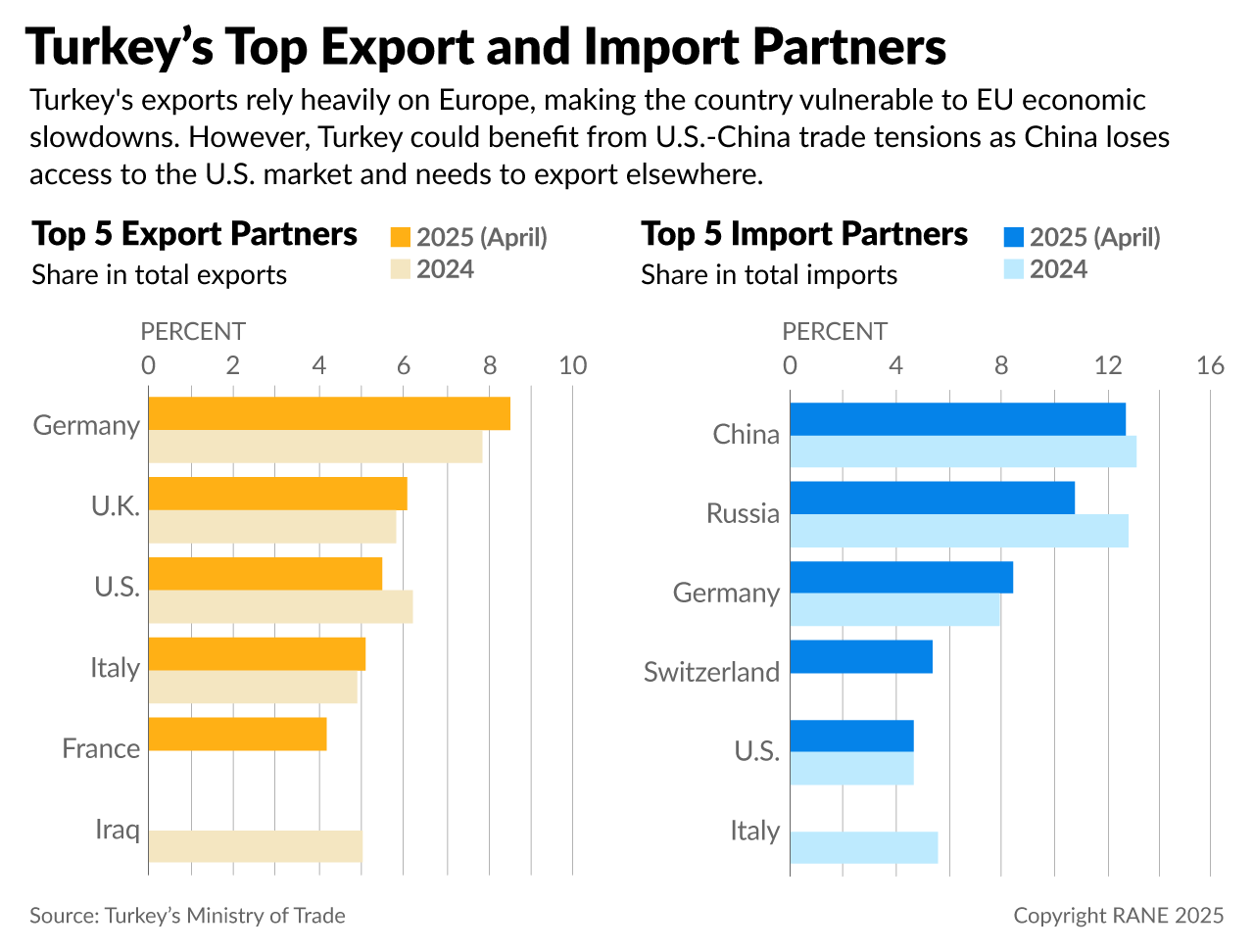
Turkey's export strategy hinges on access to the European Union, where the bulk of its goods go, but relies heavily on imports of commodities and energy from some of Europe's rivals, like Russia. Turkey sent some 41% of its total exports to the European Union in 2024, where the cheaper Turkish lira against the euro and Turkey's comparatively lower manufacturing costs make its goods competitive, particularly in automotives and appliances. While the European Union, led by Germany and Italy, accounted for a similarly significant 32% of total Turkish merchandise imports in 2024, many Turkish imports also come from EU rivals, with China making up 13.1% and Russia making up 12.8% the same year. Additionally, these figures do not account for Turkey's 2024 energy imports from Russia, which would have skewed the data further away from the European Union. Turkey's inputs from Russia in particular came under pressure in the wake of the Russian invasion of Ukraine in 2022, when Turkish importers had to adjust to an expansive Western sanctions campaign designed to weaken Russia's ability to fight. Imports nevertheless surged in 2022, as Western sanctions did not directly block Russian exports to Turkey (though financial ties did come under pressure), and Turkey became a hub for Russian exports to evade Western sanctions. Meanwhile, China supplies a significant portion of Turkey's capital goods used in its manufacturing sector, making up 45% of Turkey's total imports in 2022; in 2023, China was Turkey's top source of imports outside the European Union, bringing in $43 billion worth of imports that year.
- Manufacturing made up 19% of Turkey's GDP in 2023, according to the World Bank. Manufacturing is Turkey's leading sector and a major driver of employment.
- The European Union and the United States did not apply direct sanctions pressure on Turkey over Russia due to fears about damaging a key NATO ally's economy as global energy and food shocks rippled around the world in 2022. However, they did push for Turkey to tighten restrictions on Russian financial transactions, such as the usage of its Mir payment system, which is popular with Russian tourists. Later that year, Turkey's state banks blocked Mir usage.
As part of its overall push to expand its share of global manufacturing, Turkey seeks to gain greater market share for its exports in both advanced countries like the United States and developing ones across sub-Saharan Africa. Turkey's Distant Countries Strategy aims to make Turkish goods account for 1% of total imports for 18 countries by 2028 and generate export revenues of $50 billion, up from $20 billion today. These countries include industrialized economies like the United States but also developing ones like Nigeria and South Africa, where Ankara sees growing economies as an opportunity for Turkish businesses. This strategy also leans into Turkey's diplomatic positioning as a neutral middle power in an increasingly multipolar global environment in which it aims to deepen trade connections with "far abroad" export partners on opposite sides of growing spheres of influence, as well as partner with countries outside these power dynamics. Within this strategy, Ankara seeks diversified trade connections to withstand downturns in the global economy, as well as potentially the emergence of new patterns of tariffs, sanctions and embargoes that become more likely in the course of the multipolar great power competition. Turkey's strategy also bets on demographic trends, with growing populations in sub-Saharan Africa remaining the most youthful region globally (particularly Nigeria, one of the few countries slated to keep growing throughout the 21st century). As part of this bet on sub-Saharan Africa, Turkish companies have participated in numerous infrastructure and port projects, and its military has forces or basing rights in Somalia and Sudan, as Turkey aims to gain long-term influence along key trade routes like the Red Sea and gain political influence over countries that lie on this route.
- Trade between African countries and Turkey has increased notably in the 21st century, from $1.35 billion in 2003 to $12.4 billion in 2023. Turkey has also signed free trade agreements with Morocco, Tunisia, Egypt and Mauritius.
The effects of U.S. tariffs will offer Turkey's export strategy both opportunities and dangers, the latter of which would grow in the case of suddenly higher U.S. tariffs. Turkey is currently subject to the across-the-board 10% U.S. tariff announced on April 2, but this percentage is notably less than that faced by some of Turkey's competitors, like Bangladesh, which is subject to a 37% tariff and is a rival textile exporter to the United States. (It remains unclear if this baseline tariff will be implemented given uncertainties about America’s overall trade strategy). This dynamic creates some opportunities for Turkish exports to expand in the U.S. market. Turkey may also benefit should a U.S. tariff-induced economic slowdown in China reduce the costs of Turkish imports as Beijing seeks to divert exports away from the heavily tariffed United States. However, the broader pattern of higher tariffs slowing global trade creates deeper risks for Turkey, especially if expansive U.S. tariffs produce economic slowdowns in Turkey's export partners, particularly the European Union. In such a case, Ankara's exporters would have to sacrifice profit margins in the European Union or elsewhere to maintain their export volume and/or reduce supply to drive up demand. Finally, there remains a chance that the United States, either because of tariff policy or an unrelated issue, decides to issue stronger tariffs on Turkey, like it did in 2018, particularly on sensitive sectors like steel and aluminum.
- During his first term in 2018, President Trump sanctioned the Turkish government and imposed high steel and aluminium tariffs over the detention of U.S. pastor Andrew Brunson, whose arrest was unpopular with Trump's domestic political base. The crisis was resolved after Turkey released Brunson, but not without significant damage to the lira and a slowdown in the Turkish economy.
- Turkey is also under American investigation for what the United States claims are unfair fines and penalties on U.S. companies. Announced in February, this investigation might trigger new, higher tariffs. Additionally, the United States may impose higher tariffs on Turkey to pressure Ankara into reducing its high agricultural tariffs, which range from 15% to 145%, depending on the product.
- Turkey may impose new tariffs to prevent Chinese dumping, although an influx of certain Chinese products would benefit Turkey's economy, such as construction materials, as Turkey rebuilds from the damage of the 2023 earthquake. Meanwhile, other, cheaper Chinese inputs would boost Turkey's manufacturing as long as they do not have direct domestic competitors.
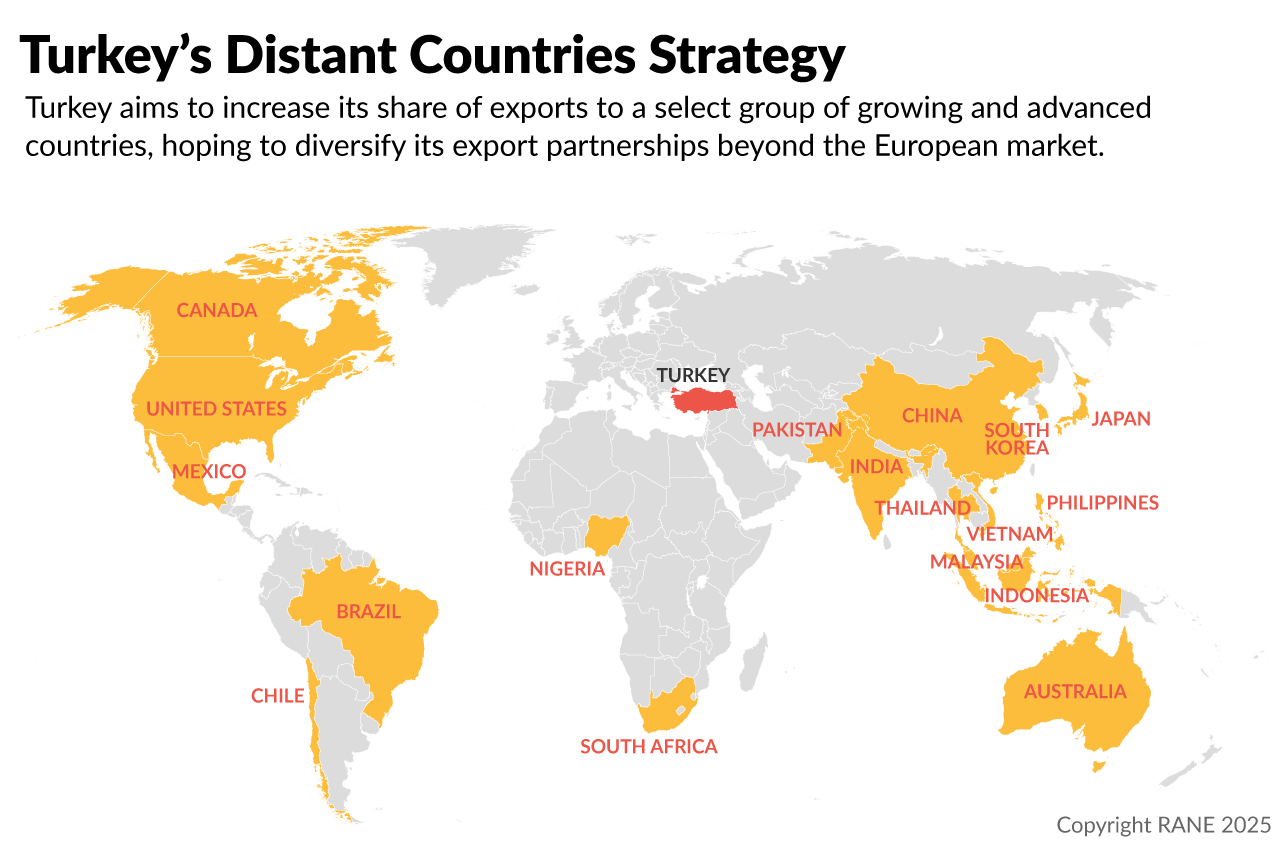
To maintain its overall trade strategy, Turkey will attempt to retain its neutral position in the global system and build ties with fellow middle powers, but conflicts between trade partners will make neutrality increasingly elusive. Turkey will likely try to forestall more sustained U.S. economic pressure by lowering tariffs and tax rates, as well as limiting ties to Russia and China that could run afoul of U.S. or EU sanctions. However, Ankara's trade diversification strategy still views Russia and China as key trade partners. As a result, Turkey will pursue a balanced approach to relations with great powers on all sides, attempting to take advantage of opportunities in various markets to develop its manufacturing sector. Turkey will also continue to pursue ties with middle powers like Brazil, Chile, South Africa, India and Pakistan, as part of its Distant Countries Strategy. However, Turkey will increasingly struggle to maintain neutrality in the face of expected future frictions between trade partners. In particular, as U.S.-Chinese competition deepens or even moves toward war, Turkey will be more likely to retain trade ties with the United States over China to maintain access to the American market and stay ahead of secondary sanctions that might block access to the European Union, depending on the scale of U.S. pressure to isolate China. Conflicts between middle powers will also present difficulties for Turkey. In the case of rivals like India and Pakistan, two key growing foreign markets for Turkish exports, Turkey will likely try to insert itself as a mediator as it attempts to retain working relations with both sides. However, such a strategy may be ineffectual given Turkey's lack of leverage over the two countries and overall pro-Pakistan tilt.
- Turkey's efforts to develop a more advanced manufacturing center will remain slow, in part because of domestic governance and monetary issues, which weaken investment interest needed to advance manufacturing.
- Turkey backed Pakistan during the latter's May military confrontation with India, drawing condemnation from New Delhi and calls for economic boycotts of Turkish companies and products.
